

The 11-Cent Error: A Lincoln Shield Cent Double Denomination Struck Over a Struck Dime
A 2013-D Lincoln Shield cent struck over a 2013-D Roosevelt dime creates one of the most dramatic modern Lincoln cent errors known.
Major mint errors rarely appear in the Lincoln Shield cent series. However, this 2013-D Lincoln cent stands far outside normal production. The Denver Mint struck it over an already-struck 2013-D Roosevelt dime.
Collectors call this type of error a double denomination. In simple terms, two different coin designs appear on one coin. Here, the piece carries the design of a one-cent coin over the remains of a 10-cent coin. As a result, specialists often describe this kind of cent-on-dime error as an “11-cent” error.
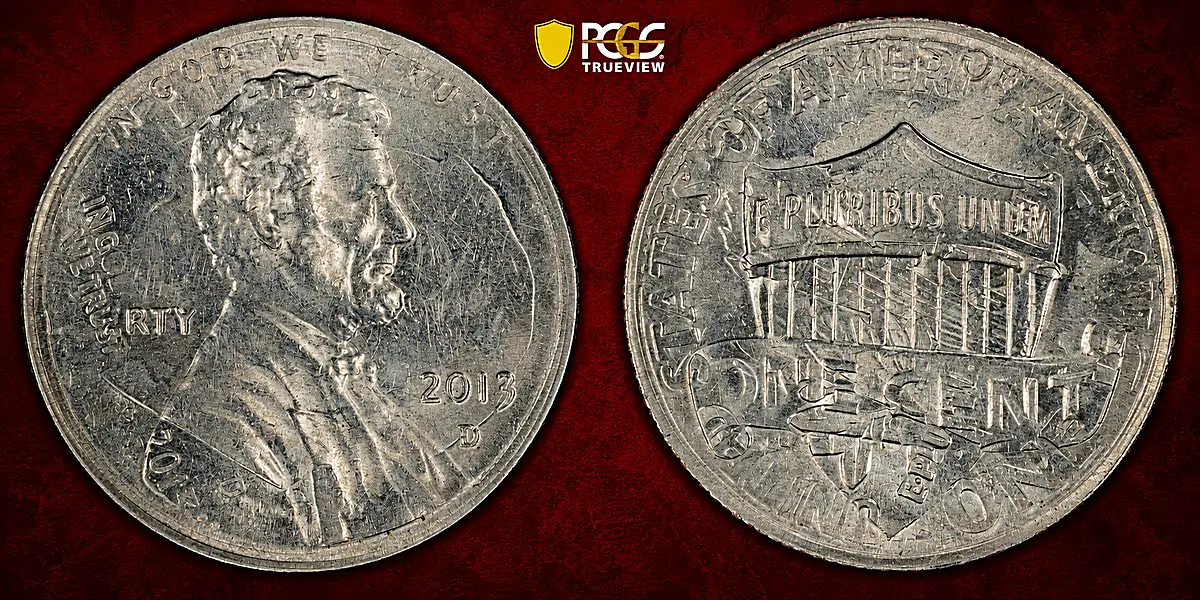
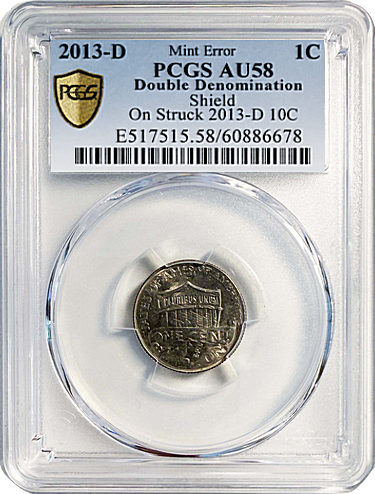
PCGS authenticated this example and certified it AU-58. More importantly, the coin stands as unique for the date. No other 2013-D Lincoln Shield cent struck over a struck 2013-D dime has been reported in the published source for this discovery.
Why This Coin Stands Out
The 2013-D Lincoln Shield cent is common as a normal coin. The U.S. Mint struck more than three billion examples for circulation. Yet this error turned a routine coin into a major numismatic prize.
That contrast creates the wow factor. Billions of ordinary cents entered commerce. However, this one coin escaped the Mint with two denominations and two designs.
Modern Mint technology should catch mistakes like this. Automated feeding systems, quality control checks, and high-speed production lines leave little room for a struck dime to enter a cent press. Still, this piece shows that even a modern coining system can produce a spectacular accident.
What Is a Double Denomination Error?
A double denomination error starts with a finished coin. Then, by mistake, that coin enters the coining press for another denomination. The second pair of dies strikes a new design over the first coin.
That process separates a true double denomination from a wrong-planchet error.
A wrong-planchet cent struck on a dime planchet would show only the cent design. It would not show Roosevelt, the dime date, or the dime reverse. By contrast, a double denomination keeps evidence of the first strike. Therefore, the earlier dime design becomes the key diagnostic feature.
This 2013-D error shows exactly that. The coin began as a Roosevelt dime. Then the Mint struck it again with Lincoln Shield cent dies.
The Visible Dime Understrike
The obverse tells the story first. Roosevelt’s portrait remains visible beneath the Lincoln cent design. In addition, the full date from the original dime strike still appears. These details matter because they confirm that the host coin was not a blank dime planchet. It was a fully struck dime before the cent dies hit it.
The reverse also carries strong evidence. Part of the torch from the Roosevelt dime reverse remains visible. So do portions of the inscriptions UNITED STATES OF AMERICA and ONE DIME.
Why Cent-on-Dime Errors Look Different
The modern Roosevelt dime is smaller than the Lincoln cent. It also has a reeded edge, while the cent has a plain edge. Because of the difference in diameter size, the struck dime does not fully expand to the size of a Cent.
As a result, cent-on-dime errors often show missing design near the outer areas. However, that same small size can help preserve the first strike. The second strike may not erase every trace of the dime.
That is why this example has so much collector appeal. The coin shows enough of the Lincoln cent design to identify the second strike. Yet it also retains enough of the dime to prove the first strike.
Known Shield Cent Double Denominations
The published discovery report describes this 2013-D example as unique for the date. It also reports two known 2014-P examples and two known 2015-P examples.
That small population places this coin in an elite group. Lincoln Shield cent double denominations do not appear with the frequency of common off-center strikes or minor clips. They represent a much more advanced minting accident. They also appeal to two strong markets at once: Lincoln cent collectors and major mint error specialists.
Market Significance
Unique and rare Lincoln cent mint errors have drawn increasing attention in recent years. Mules, transitional errors, off-metal strikes, and double denominations all bring strong collector demand. They also create headlines because they combine familiar designs with highly unusual production failures.
This 2013-D Lincoln Shield cent double denomination fits that pattern. It offers a modern date, a major error type, and strong visual evidence. It also carries PCGS authentication, which gives the piece added market confidence.
The original discovery report notes no auction records for this specific class of Shield cent double denomination at Heritage Auctions, Stack’s Bowers, or GreatCollections. That does not mean the market lacks interest. Instead, it suggests that collectors have had few public chances to compete for one.
A Major Error for Lincoln Cent Specialists
This coin belongs in an advanced Lincoln cent collection. It also belongs in a major mint error cabinet. Few modern errors tell their story as clearly.
A normal 2013-D Lincoln Shield cent may pass unnoticed in change. This one cannot. It began life as a dime. Then the Mint struck it again as a cent. The result gives collectors a rare view into the minting process, where speed, precision, and chance sometimes collide.
For collectors who value dramatic modern errors, this 2013-D Lincoln Shield cent double denomination offers exactly what they seek: rarity, certification, visual impact, and a story that begins inside the pressroom.
Where are each of the auction sites which coin err sales can be seen throughout each year? J . A. KIRBY 425 505 3690 txt preferred thank you
I have a 2021 silver penny
Can you take a picture and show it plz. I’m curious to see it
That is a cool all around coin I have a huge collection of Penny’s only like that one and different years from Indian heads to the days errors I have some a great bunch of error coins that I have not saw on any coin sites I have been colleting coins for a long time I’m 57 I’m a very private collector.i enjoy the penny sites only
I am hear in San Antonio till tomorrow but I have some coins quarters pennies on the nipples that are collectible that would love for someone to look at while I’m here because I’m from Clovis New Mexico I don’t know when I’ll be back this way but you can reach me at 575-425-8820 by tomorrow and then you can get together you can open my phone you might be interested and there’s some very good coins it’s worth something it’s worth pretty little Tammy but I would like for someone to look at him and help me while I’m here so I never know when I’ll be back
Nice to see another collector from my neck of the woods. I am just across from the Texas border a small town called Mu-Les-hoe (French pronunciation).
I have a 2013 D I would like to show you
You are very helpful