


The President Who Turned American Coins Into Art
By GOVMINT
The Civil War changed America forever. Then, in the decades that followed, the nation changed again.
Industry grew. Railroads expanded. Immigration reshaped cities. New technology changed work, travel, and communication. At the same time, the United States began to play a larger role in world affairs.
As a result, Americans started to see their country in a new way. They saw strength, purpose and also an uncertain, yet optimistic, future.
How a President and a Sculptor Changed U.S. Coins Forever
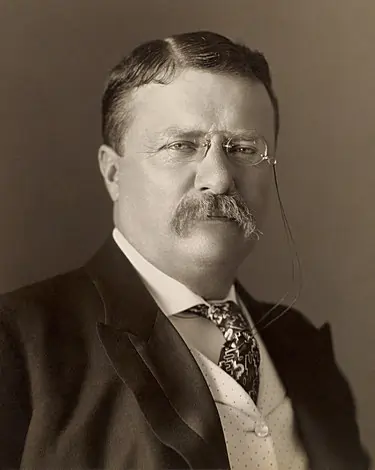
Then Theodore Roosevelt entered the White House with force.
Roosevelt had a bold public style. He spoke plainly, moved quickly, believed the United States needed a stronger national image.
That image, he thought, should reach beyond politics. It should appear in public buildings, monuments, art, and even pocket change.
To Roosevelt, American coins looked tired. They lacked beauty. They lacked energy. Even worse, he believed they failed to express the power of a rising nation.
So, Roosevelt turned to one of America’s greatest sculptors: Augustus Saint-Gaudens.
Roosevelt Wanted More Than New Coins
Roosevelt did not view coinage as a small matter. He understood symbolism. He also understood that millions of people handled coins every day.
Therefore, a coin could carry a message.
By the early 1900s, Roosevelt wanted that message to feel American. He wanted designs with dignity, force, and permanence. In his view, the nation’s coins should compare with the great coinage of ancient Greece. They also needed a distinctly American spirit.
Augustus Saint-Gaudens fit that vision.
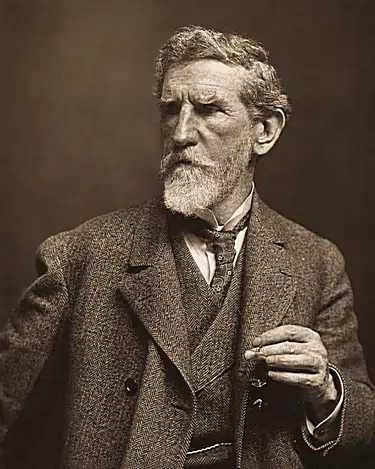
By then, Saint-Gaudens ranked among the most respected American sculptors. He also had federal connections. After the turn of the 20th century, he joined the Senate Park Commission, better known as the McMillan Commission. That group helped shape the future of Washington, D.C. It expanded the vision for the National Mall and proposed the Lincoln Memorial’s location at the Mall’s western end.
This work placed Saint-Gaudens near the center of national art, architecture, and public memory. Soon, Roosevelt asked him to design a medal for the president’s 1905 inauguration.
That medal started a numismatic revolution.
The Medal That Opened the Door
Roosevelt loved the inaugural medal.
Saint-Gaudens created a direct, powerful obverse. It showed Roosevelt in profile. Around the portrait appeared the Latin phrase “Aequum cuique.” The phrase translated the heart of Roosevelt’s campaign slogan: “A square deal for every man.”
The reverse showed a standing eagle. It looked proud, firm, and alert. Its feathers carried the kind of sculptural detail that later helped define Saint-Gaudens’ coinage.
Tiffany & Co. produced the medal. The firm cast 125 examples in bronze. It also struck just three in gold.
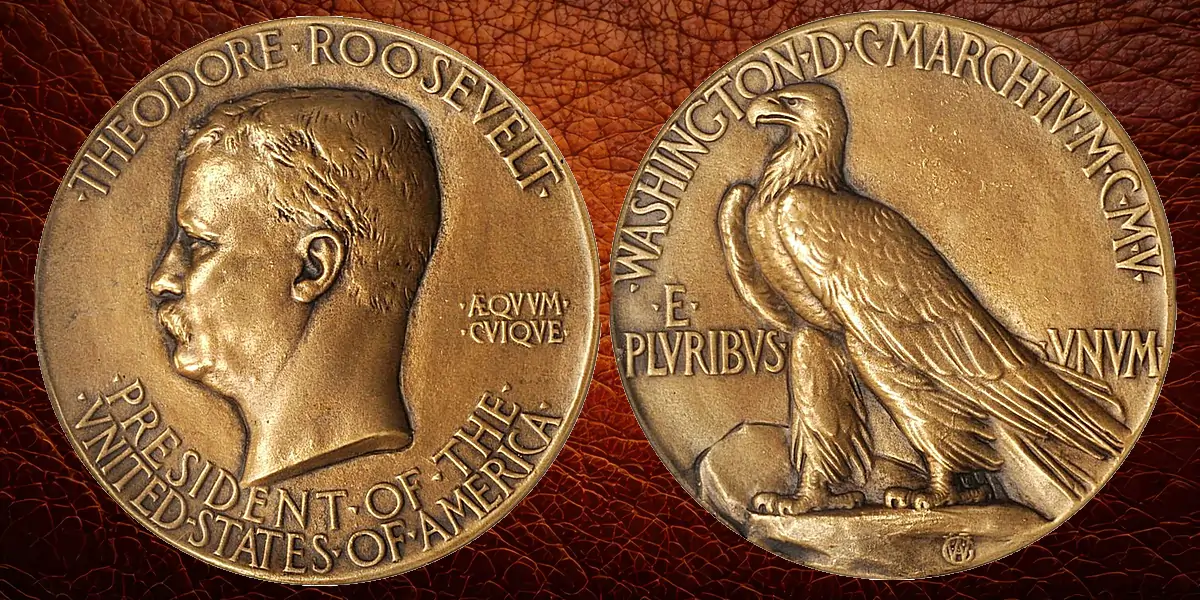
When Roosevelt received his gold medal, he wrote to Saint-Gaudens with delight.
“Thank Heaven,” Roosevelt wrote, “we have at last some artistic work of permanent worth done for the government.”
Those words mattered. They also foreshadowed a much larger project.
Roosevelt did not want one great medal. He wanted a new era for American coinage.
Saint-Gaudens Felt the Weight of the Job
After the 1905 medal, momentum grew. Roosevelt wanted Saint-Gaudens to bring the same sculptural power to circulating United States coins.
Even so, the assignment intimidated the artist.
Saint-Gaudens knew the challenge. A medal could serve as art. A circulating coin had to work as money. The Mint had to strike it. Banks had to count it. The public had to use it.
So, the sculptor wrote candidly to the president.
“You may not recall that I told you I was ‘scared blue’ at the thought of doing that,” Saint-Gaudens wrote. “Now that I have the opportunity, the responsibility looms up like a spectre.”
Still, Roosevelt pushed forward.
The two men discussed the look and meaning of the new coins. Both admired ancient Greek coinage. However, neither wanted to copy the ancient world. Instead, they wanted American coins with classical strength and New World identity.
That combination changed U.S. coin design.
Classical Beauty Meets American Identity
Roosevelt and Saint-Gaudens focused on gold coinage.
Their collaboration produced two designs that still dominate American numismatic history: the $10 gold eagle and the $20 gold double eagle.
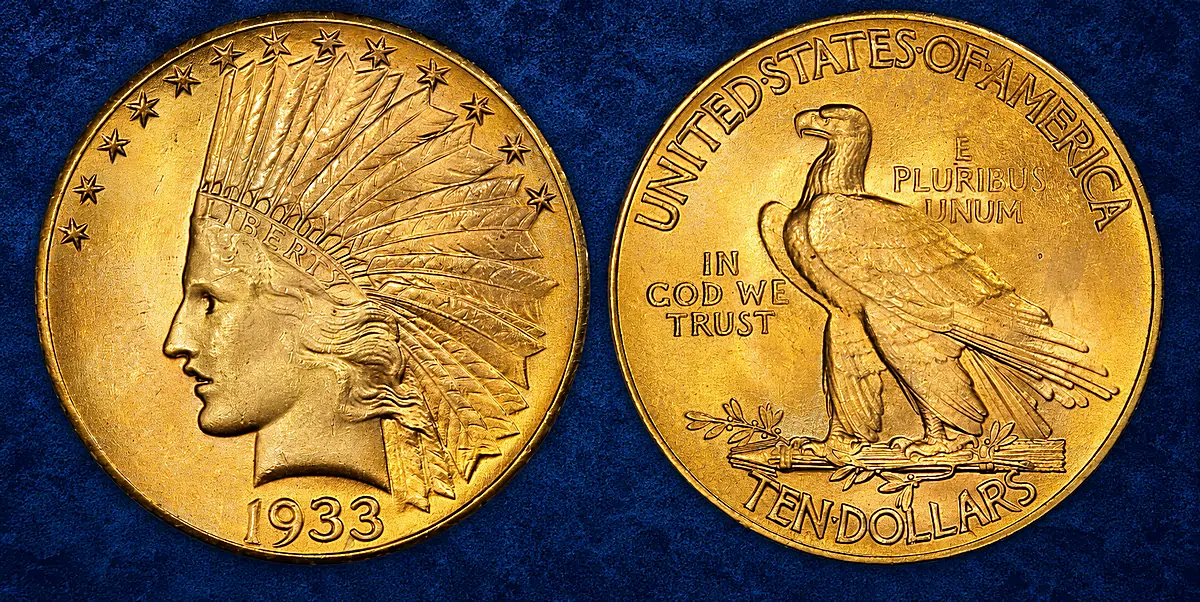
The $10 eagle carried one of Roosevelt’s boldest ideas. The obverse showed Liberty wearing a Native American feather headdress. Roosevelt supported the choice because he wanted American symbols, not recycled European ones. He believed Liberty could wear a “typically American” headdress just as naturally as the ancient Phrygian cap.
This idea created a striking image. It also created one of the most debated depictions of Liberty in U.S. coinage.
On the reverse, Saint-Gaudens used a standing eagle. The design echoed the powerful bird from Roosevelt’s inaugural medal.
Then came the $20 double eagle.
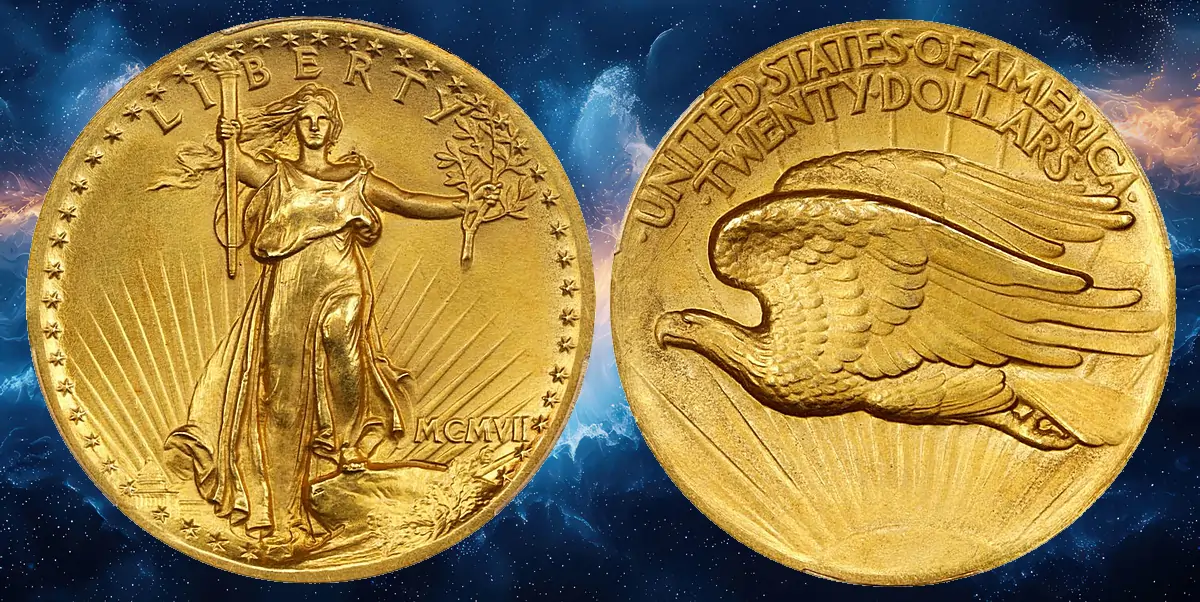
For this coin, Saint-Gaudens created a full-length Liberty. She strides forward with a torch in one hand and an olive branch in the other. Behind her, the sun rises. On the reverse, an eagle flies through rays of light.
Together, the two gold coins gave American coinage a new language. They used motion, strength, and national confidence. They also placed the eagle at the center of a modern American visual identity.
Roosevelt Got the Coinage He Wanted
Roosevelt loved the $20 double eagle.
“The $20 piece is far better than any modern coin,” he wrote, “and ranks alongside the best and most beautiful of the old Greek coins.”
Many American art critics agreed. They saw the Saint-Gaudens coins as a major achievement. They also recognized that Roosevelt had forced the United States Mint into a new artistic age.
However, not everyone praised the results.
Some critics argued that the Mint had not translated Saint-Gaudens’ models with enough skill. Others blamed the public. They felt Americans did not understand the quality of the new designs. Meanwhile, Roosevelt faced political criticism for driving the project with such force.
Then another controversy exploded.
The “In God We Trust” Controversy
The first Saint-Gaudens gold coins omitted the motto “In God We Trust.”
Roosevelt had a reason. He believed that placing God’s name on coins showed poor judgment because people could use coins for immoral or criminal purposes. In his mind, that cheapened the sacred phrase.
However, many Americans disagreed. Newspapers took up the issue. Critics attacked Roosevelt. Congress soon entered the fight.
The controversy forced change. In 1908, Congress required the motto to return to coins on which it had previously appeared.
As a result, the Saint-Gaudens double eagle exists in two major forms for 1908: No Motto and With Motto. The debate also secured the motto’s long-term place on American coinage.
Still, the controversy did not erase the artistic achievement. If anything, it showed how deeply Americans cared about the symbols on their money.
A Coinage Renaissance Begins
Roosevelt’s coinage program did not stop with Saint-Gaudens.
Instead, it sparked a wider American coinage renaissance. The new spirit reached other artists and later designs.
James Earle Fraser, who worked with Saint-Gaudens, designed the Buffalo nickel. Adolph A. Weinman, who helped model Roosevelt’s 1905 inaugural medal, later designed the Winged Liberty Head dime and the Walking Liberty half dollar.
Those coins carried the same ambition. They did not treat coinage as routine metalwork. They treated it as national art.
Roosevelt’s vision also changed expectations. After Saint-Gaudens, collectors and critics judged U.S. coins by a higher standard. They looked for beauty, meaning, and national character.
Roosevelt’s Legacy in American Coins
Theodore Roosevelt wanted American coins to say something powerful about the nation.

He succeeded.
His collaboration with Augustus Saint-Gaudens produced two gold coins that collectors still rank among the greatest U.S. designs. The $10 Indian Head eagle brought American symbolism into a new form. The $20 double eagle became one of the most celebrated coins ever struck by the United States Mint.
More importantly, Roosevelt proved that coinage could shape national identity.
A coin could honor the past. It could serve commerce. It could also announce a country’s ambitions.
That was Roosevelt’s “Square Deal” for American coinage. It began with a medal. It reached its peak in gold. Then it inspired a generation of American coin designs that still command admiration today.


Great article featuring Theodore Roosevelt and Augustus Saint-Gaudens.
History and coinage doesnt get better than that.
The Standing Liberty quarter & Peace Dollar were later iterations of this same design revolution, focusing on neo Classical symbolism, with the Washington quarter in 1932 being the crux point between allegory & representative art on US coins.