


The mystery surrounding the Continental Dollar – the “coin” that may not be a coin.
A famous “1776” Continental Dollar will headline the opening stretch of Stack’s Bowers Galleries’ June 16, 2026 Rarities Night session. The piece appears as Lot 2001 in the firm’s June 2026 Showcase Auction, Session 2, which features Rarities Night and the Young-Dakota Collection.
The coin carries one of the most compelling descriptions in early American numismatics:
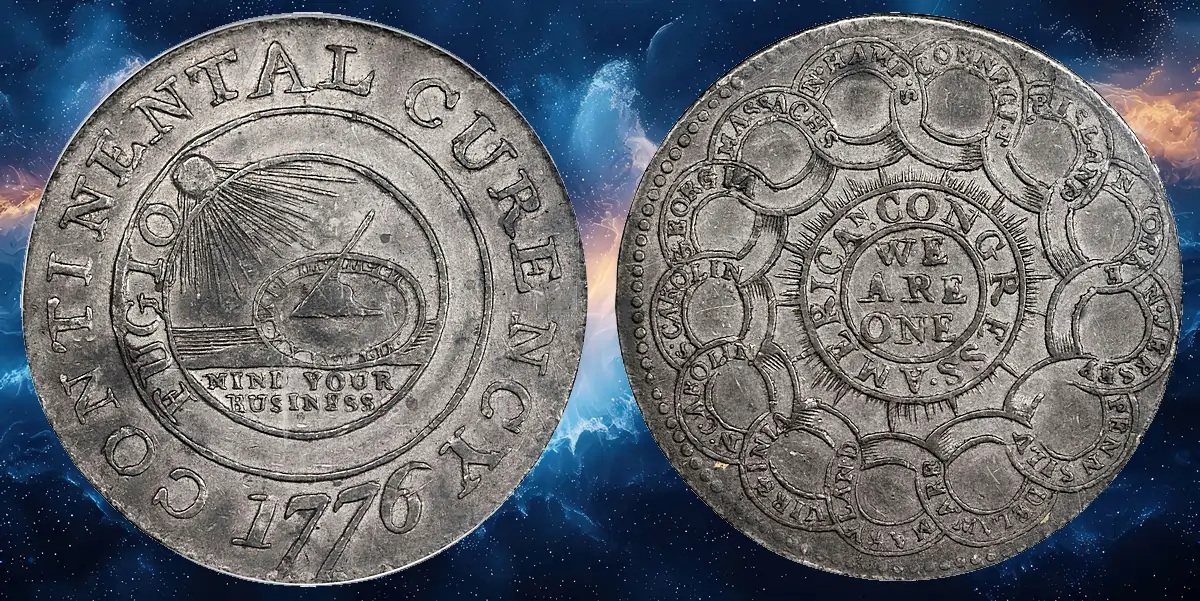
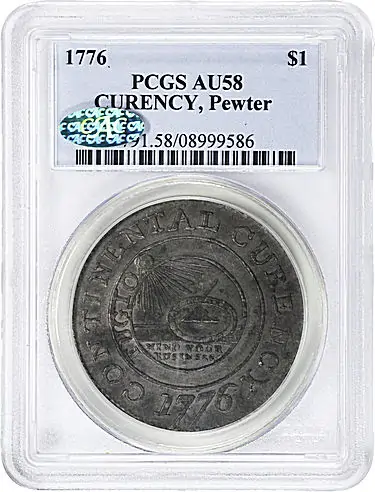
“1776” (1783) Continental Dollar. Newman 1-C, W-8445. Rarity-3. CURENCY. Pewter. AU-58 (PCGS). CAC.
That short catalog line opens a much larger story. It points to the American Revolution. It touches Benjamin Franklin’s iconography. It leads to Paul Revere. Then it crosses the Atlantic and lands in a debate that has reshaped how many scholars view this legendary issue.
A Choice AU Continental Dollar With Exceptional Eye Appeal
The offered Continental Dollar displays rich pewter-gray surfaces. The obverse also shows subtle swirls of warmer steel-gray tone. The devices remain boldly defined across both sides. In addition, the surfaces show unusual smoothness for the type.
That matters. Many pewter examples show problems. Corrosion, roughness, or handling often limit their eye appeal. However, this example combines sharp detail, attractive color, and a Choice AU grade. CAC approval adds another layer of market confidence.
The variety also carries the famous CURENCY misspelling. Numismatists know this as Newman 1-C and W-8445. PCGS Auction Prices also records the Newman 1-C, W-8445 pewter CURENCY variety as a recognized Continental Dollar entry.
The Traditional Story: A Coin for a Missing Dollar Note
For generations, many collectors believed the Continental Dollar had a direct Revolutionary War purpose.
The traditional theory starts with the Continental Congress. Resolutions dated February 17, 1776, and May 9, 1776, authorized paper currency that included a $1 note. Later 1776 emissions, including those tied to July 22 and November 2, omitted that denomination. Therefore, scholars once argued that Congress may have planned these pewter pieces as substitutes for the missing $1 note.
This theory also made economic sense on the surface. Most surviving examples are pewter. A few silver and brass pieces also exist. Since Continental paper money had no hard-money backing, a pewter dollar could have served as fiat money. The new American government also lacked a deep treasury reserve.
Eric P. Newman later pointed to Elisha Gallaudet as a possible maker. Gallaudet worked as a New York City engraver. He also had ties to New York paper money production in the 1770s. That made him a plausible candidate for earlier generations of researchers.
Yet the story had a problem. No known Continental Congress document authorizes the issue.
The Design Still Speaks the Language of 1776
Even if the issue’s origin remains debated, its design speaks with Revolutionary power.
The obverse shows a sundial beneath a radiant sun. The motto FUGIO appears nearby. The phrase means “I fly” or “I flee.” Collectors often read it as a warning that time flies. Below the dial appears the famous Franklin-linked motto MIND YOUR BUSINESS.
The reverse carries 13 linked rings. Each ring names one of the colonies. At the center sits the message WE ARE ONE. Around it appears AMERICAN CONGRESS.
These motifs strongly echo Continental Currency designs. APMEX notes that the CURENCY pewter variety carries the sundial, FUGIO, Mind Your Business, 13 linked rings, and We Are One design elements. It also notes that the precise authorship and status of the issue remain debated.
That is part of the charm. The Continental Dollar looks like an object born from the Revolution, even as its paper trail points somewhere more complicated.
The First Printed Clues Appeared in Europe
The earliest known published image of the Continental Dollar did not appear in Philadelphia, Boston, or New York. Instead, it appeared in a German book.
Matthias Christian Sprengel’s Historical and Genealogical Almanac, or Yearbook of the Most Remarkable New World Events for 1784 was published in 1783. The book included two major images tied to the new American nation. One showed the Libertas Americana medal. The other showed the Continental Dollar. Its German caption, AMERICANISCHE LANDES MUNTZE, roughly means “American Country Money.”
The publisher had written to Benjamin Franklin to request illustrations. Franklin was then in Europe. However, no known reply from Franklin survives. As a result, the exact source of Sprengel’s Continental Dollar illustration remains uncertain.
A few years later, Bishop Richard Watson described the piece in Chemical Essays, Volume IV, published in 1786. Watson described a pewter-like piece about an inch and a half in diameter and 240 grains in weight. He also recorded the sundial, FUGIO, Mind Your Business, linked rings, American Congress, and We Are One design elements.
Watson believed Congress had made it. That belief would not go unchallenged.
Paul Revere Pushes Back
Modern research changed the conversation.
Erik Goldstein and David McCarthy challenged the long-accepted American coinage theory in “The Myth of the Continental Dollar,” published in the January and July 2018 issues of The Numismatist. Their work emphasized contemporary testimony and the silence of official records.
Josiah Meigs pushed back against Watson in 1788. Meigs owned and published The New Haven Gazette. He argued that Watson had likely mistaken a privately made pewter impression for an official American coin.
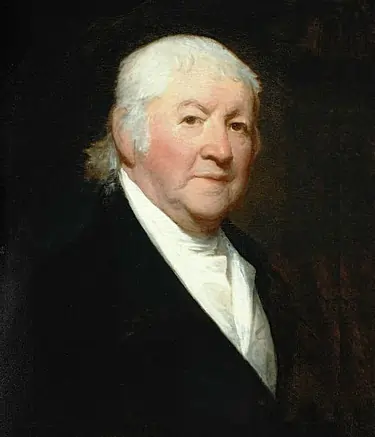
Then Paul Revere weighed in. In a February 21, 1790 letter to Watson, Revere said he had made careful inquiry.
He wrote that he had never seen pewter money struck in America. He also believed Watson had received bad information.
That is the “wow” moment. One of the Revolution’s best-known patriots personally tried to correct the record on this piece.
Du Simitière Knew the Scene Better Than Almost Anyone
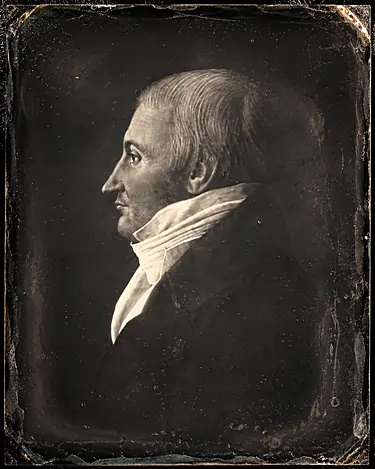
Pierre Eugene Du Simitière also complicates the old story.
Du Simitière lived in Philadelphia. He collected coins, paper money, documents, and historical material during the Revolution. Congress even considered appointing him “Historiographer to the Congress of the United States” in 1779.
He owned and documented major early American items. His memorandum included Massachusetts silver and seven Higley coppers. Yet he did not list a Continental Dollar in his own collection.
Even more importantly, he described the piece as crown-sized, based on Continental money designs, dated 1776, and struck in London on type-metal.
That note matters. Few people stood closer to Congress, early American collecting, and Revolutionary material culture than Du Simitière.
Later Collectors Also Raised Doubts
Other early numismatists reinforced the uncertainty.
Matthew A. Stickney began collecting in 1823. He later traded his Immune Columbia piece to the United States Mint in 1843 for a newly made 1804 dollar. Yet he did not acquire his first Continental Dollar until roughly a decade later, during a trip to England.
Joseph B. Felt also questioned the American coinage claim in 1839. In his Historical Account of Massachusetts Currency, he noted Watson’s 1786 description. He then pointed out that the Continental Congress journals made no reference to such a coin.
Jeremiah Colburn likewise reported that he had not seen or heard of one until Stickney showed him an example. In 1857, Colburn wrote that no such pieces circulated as currency, although white-metal medal copies existed.
Sarah Sophia Banks Preserved the Key
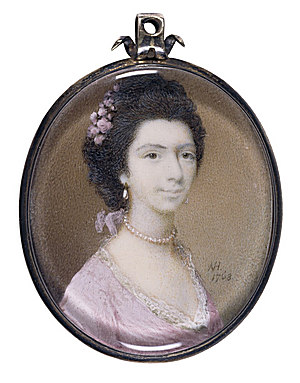
The strongest clue may come from London collector Sarah Sophia Banks.
Banks was a major numismatist. Her father, Sir Joseph Banks, ranked among the most famous scientists of his time. She acquired a Continental Dollar early. In her pre-1790 records, she described it as a “Congress Dollar,” but she also recorded it as never current and struck in Europe for sale in America.
Banks also preserved an explanatory handbill. The flyer advertised “American Medals” at sixpence each. It explained the linked colonies, the American Congress legend, the We Are One motto, the FUGIO sundial, and the 1776 date as a reference to independence.
That handbill changes the frame. It presents the Continental Dollar as a medal sold to the public, not as emergency money issued by Congress.
A German Engraver Enters the Story
More recent research adds another twist.
David McCarthy has argued that the “E.G.” signature may point not to Elisha Gallaudet, but to Elias Gervais. Gervais worked as a German engraver and served at the Cologne mint in the 18th century. Heritage’s 2026 FUN fact sheet summarizes that newer line of research and notes that Gervais signed work with EG or EGF. It also cautions that some researchers still disagree.
PCGS Auction Prices also summarizes McCarthy’s argument. It links the handbill’s “E.G. Fecit” language to Gervais and notes stylistic and circumstantial evidence for the attribution.
Therefore, many current descriptions now date these pieces as “1776” (1783). That style recognizes the famous date on the piece while reflecting the research that points toward European medal production around 1783.
Why the Mystery Makes the Continental Dollar Stronger
This debate does not weaken the Continental Dollar. Instead, it deepens its appeal.
The piece still carries the imagery of Revolutionary America. It still uses designs tied to Continental Currency. It still links the 13 colonies with the message WE ARE ONE. Also, it still belongs beside the Libertas Americana medal as one of the most evocative American-related medals of the era.
The difference is the backstory. Collectors once saw it mainly as a mysterious American coin. Now they can see it as something even stranger: a 1776-dated object, likely made in Europe in 1783, that used Revolutionary symbols to package the birth of the United States for a transatlantic audience.
That story includes Franklin, Watson, Revere, Du Simitière, Banks, Newman, Goldstein, McCarthy, and perhaps Gervais. Few early American-related pieces carry that many layers.
Provenance
Stack’s Bowers lists the offered piece with earlier appearances in the firm’s Baltimore Auction of June 2011, lot 232, and its Rarities Sale of February 2016, lot 73.
Auction Details
Stack’s Bowers Galleries will offer this “1776” (1783) Continental Dollar, Newman 1-C, W-8445, Rarity-3, CURENCY, Pewter, AU-58 (PCGS), CAC in its June 16, 2026 Rarities Night auction as Lot 2001.



…and that’s how American Numismatics got started…
Got to love the history (and the mystery)!
Thanks for another great article!
Interesting history! Thanks for posting!
Apropos for 250th birthday.
Truly a beautiful coin with history.
I’ve always wanted one of these and I always believed them to be coins. A Libertas Americana would be quite nice to have, as well. I’ve only recently begun collecting medals and I find the new history of this piece quite exciting! Perhaps, I’ll be lucky one day and manage to pick up a copy of it. Not genuine, just a copy.
Fascinating article!
Great article. thank you
WOW!!
Very interesting article.
Great article, I always love all the details given in these stories.
Fascinating story!
The coin carries one of the most compelling descriptions in early American numismatics: Compelling opening shot of an article..Never heard of this one to date..Thank you
What a story behind this coin, and I never new that pewter revolutionary period coins existed
Interesting history…. Thanks for posting!
Proud to be an American. My great grandfather x5 gave his life in 1776 for the american cause. Coin reminds me of that.