


Counterfeit Banknotes by Paper Money Guaranty (PMG) ……
Czeslaw Bojarski and the Counterfeit Banknotes That Fooled France
Czeslaw Bojarski ranks among the most remarkable counterfeit banknote makers of the 20th century. Yet he did not run a vast criminal network. He worked alone.
That detail made him dangerous. It also made him difficult to catch.
A Counterfeiter Who Rejected the Hollywood Script
Most people picture counterfeit banknote operations in dramatic terms. They imagine mafia presses in dark cellars. They picture rogue governments. Sometimes, they picture criminal corporations.
However, real counterfeiting often looks different.
Bojarski proved that point. He built one of Europe’s most famous counterfeit banknote operations from a hidden workshop beneath his suburban Paris home. The Banque de France later described the case as extraordinary. Its experts first thought they faced an international gang with expensive equipment. Instead, one man used homemade machines under a house near Paris.
Who Was Czeslaw Bojarski?
Czeslaw Bojarski was a Polish-born engineer. He arrived in France during World War II and later became a French citizen. According to numismatic sources, he brought strong technical skill to every part of his work.
That skill mattered.
Bojarski did not simply copy notes. He made the tools. He made the paper. He prepared the ink. He also engraved the plates and built much of his own equipment.
As a result, he controlled every step. Moreover, he avoided suppliers who might expose him.
The Counterfeit Banknotes That Started the Case
The Banque de France detected a counterfeit 1,000-franc note on January 6, 1951. That discovery marked the beginning of the Bojarski affair.
Soon, more counterfeits appeared.
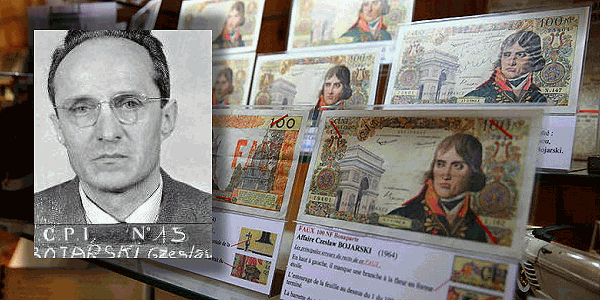
Bojarski produced several types of French counterfeit banknotes over the years. These included 1,000-franc notes, 5,000-franc notes, and later the famous 100 Nouveaux Francs Bonaparte note.
His output moved slowly and carefully. He spent notes in small amounts. Then he came home with genuine money. The Banque de France later said he offloaded about 25,000 banknotes.
Why Bojarski’s Counterfeit Banknotes Were So Convincing
Bojarski’s success came from patience and precision.
His notes looked exceptional. In fact, specialists struggled to separate some of his counterfeits from genuine Banque de France issues. The Banque de France later reimbursed holders of certain counterfeit notes because the public could not reasonably tell the difference.
That decision shows the quality of his work.
Bojarski’s most famous counterfeit banknote was the 100 Nouveaux Francs Bonaparte.

The 100 Nouveaux Francs Bonaparte Note
Bojarski’s most famous counterfeit banknote was the 100 Nouveaux Francs Bonaparte.
Collectors still study it today. PMG notes that the counterfeit came very close to the legitimate bank issue. It also identifies a small flower-petal difference in the upper corner.
Other specialists have listed additional tiny differences. These include details in a green leaf, Bonaparte’s hair, the “100 NF” placement, an orange star, the top frieze, and the watermark.
However, these flaws did not help ordinary people. Most users never noticed them.
The Secret Behind His Success
Bojarski stayed hidden because he stayed small.
He did not depend on a large team. He did not use a visible supply chain. Also, he avoided careless distribution for many years.
Instead, he passed notes one by one. He traveled to different regions. Then he used counterfeit banknotes for ordinary purchases.
This method reduced attention. It also kept police from seeing the full pattern.
The Mistake That Ended the Operation
Eventually, Bojarski needed help. He could not make counterfeit banknotes and pass them fast enough.
So, he recruited two associates.
That decision destroyed the operation. The Banque de France traced a roll of fake 100 Nouveaux Francs Bonaparte notes to a Paris post office transaction. Investigators then identified Alexis Chouvaloff and Antoine Dowgierd. The trail led to Bojarski.
Police searched his home. They found Treasury bonds in a safe. Then they discovered the hidden trapdoor to his workshop.
Arrest, Trial, and Prison
Police arrested Bojarski in 1964.
After a 13-year investigation, a court sentenced him to 20 years in prison. He served 13 years.
The arrest drew heavy press attention in France. Yet the public reaction proved unusual. Many people saw Bojarski not only as a criminal, but also as a strange kind of artist.
That reputation has lasted.
Why Collectors Still Want Bojarski Counterfeit Banknotes
Today, Bojarski counterfeit banknotes hold a special place in paper money collecting.
They do not trade like ordinary counterfeits. Instead, collectors prize them as historical artifacts. Thomas Numismatics notes that Bojarski’s 100 Nouveaux Francs Bonaparte counterfeits now attract strong collector demand. The firm also listed one example at €6,500, marked sold.
That market interest reflects more than rarity. It reflects the story.
Bojarski challenged a national bank with handmade tools. He fooled experts for years. Then he left behind counterfeit banknotes that now sit at the intersection of crime, art, and numismatic history.
Czeslaw Bojarski’s Lasting Legacy
Czeslaw Bojarski did not fit the usual image of a counterfeiter.
He did not command a syndicate. He did not build a flashy operation. Instead, he worked alone in secret.
Therefore, his story still matters.
For investigators, it shows how one skilled person can threaten public trust in money. For collectors, it shows how counterfeit banknotes can become important historical objects. And for numismatists, it proves that the smallest details can carry the biggest stories.




Thanks for such a fascinating story! I was aware of Bojarski’s efforts but not in detail.
To explain the word CONTREFAÇON that appears on the specimen 100 NF note, it’s French for “counterfeit”, obviously added to indicate its provenance.
Are his counterfeit bills worth more than the real ones in collector value? It’s always having to bring in others that is the undoing of people like him. Fascinating read though.