


The Dime-Sized 1837 Token That Almost Replaced America’s Copper Cent
In 1837, Americans needed small change. They also needed confidence.
The Panic of 1837 shook banks, businesses, merchants, and households. As fear spread, many people hoarded gold and silver. Soon, even small coins became harder to find. That shortage created an opening for private tokens. It also gave Dr. Lewis Feuchtwanger a chance to prove a bold idea.
Feuchtwanger believed the United States could replace its bulky copper large cent with a smaller, cheaper, and more practical coin. Congress rejected his proposal. However, the public embraced his token.
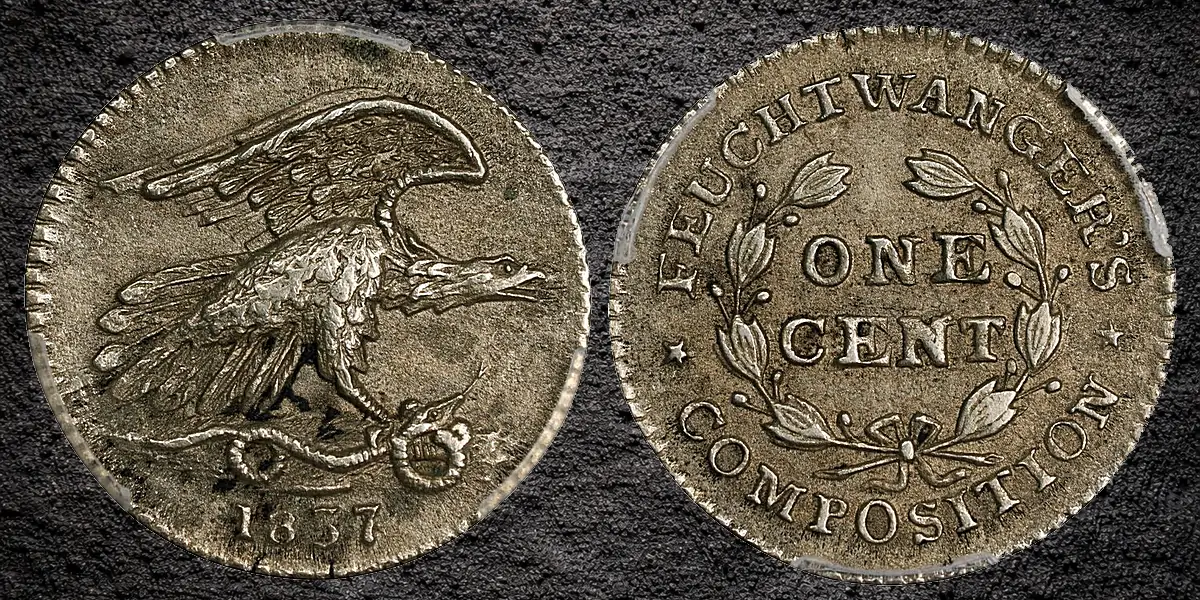
Today, the 1837 Feuchtwanger Cent stands as one of the most important American private issues of the 19th century. It belongs to the Hard Times token series. Yet it also points forward. In many ways, this dime-sized experiment helped anticipate the small-cent revolution that followed decades later.
A German Chemist With an American Coinage Plan
Dr. Lewis Feuchtwanger was born in Fürth, Bavaria, near Nuremberg, in 1805. He immigrated to the United States in 1829 and settled in New York City. There, he opened what numismatic sources identify as the city’s first German pharmacy.
Feuchtwanger did far more than sell medicine. He imported medicines from Germany. He also built collections of rare minerals, gemstones, fossils, coals, ores, and Native American artifacts. In addition, his shop displayed curiosities such as preserved reptiles.
Those interests shaped his career. Feuchtwanger published A Treatise on Gems in 1838 and Elements of Mineralogy in 1839. Later editions of his gem studies appeared during his lifetime, including a noted 1872 publication.
However, collectors remember him best for metal.
Why the Large Cent Needed a Rival
In the 1830s, the United States still struck large copper cents. These coins measured about 27.5 mm. They felt heavy in the hand. They also cost the Mint more to make than their face value justified.
Feuchtwanger saw the problem clearly. Therefore, he promoted a smaller one-cent piece made from his own alloy. His cent measured about 18.5 mm, close to the size of a modern dime. That made it far easier to carry than the official large cent.
His proposal came at the right moment. The Mint already worried about the cost of producing copper cents. Meanwhile, the public needed convenient small change.
So, Feuchtwanger made his pitch to Congress.
Feuchtwanger’s Composition
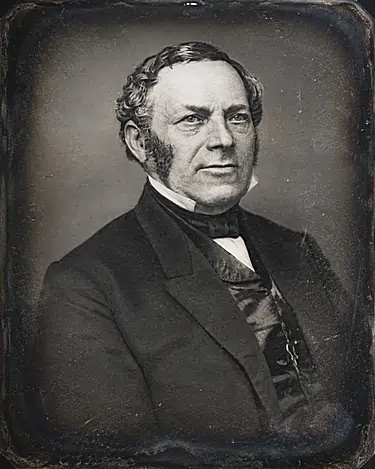
Feuchtwanger called his metal “Feuchtwanger’s Composition.” Numismatists also know it as German silver. Despite the name, German silver contains no silver.
Instead, it uses a copper, nickel, and zinc base. Some descriptions also cite tin and trace metals. The alloy resembles silver in color. It also resisted the green corrosion often seen on copper coins.
Feuchtwanger argued that his alloy offered a better answer for the cent. It cost less than pure copper. It also gave the coin a brighter appearance and better durability.
To strengthen his case, he provided examples to members of Congress. His design showed a dramatic eagle battling a snake. That image gave the piece instant visual power.
A Design That Looked Ahead
The obverse of the 1837 Feuchtwanger Cent features an eagle clutching a snake in its talons. The date appears below. It remains one of the most memorable images in American exonumia.
The reverse carries the denomination “ONE CENT” inside a wreath. Around the border appears the inscription “FEUCHTWANGER’S COMPOSITION.”
The design had lasting influence. Nearly 20 years later, the United States introduced the Flying Eagle cent. That official small cent did not copy Feuchtwanger’s token. Yet the connection remains clear enough that many collectors view Feuchtwanger as an early advocate for small-size cent coinage.
Congress Said No, but the Public Said Yes
Feuchtwanger’s plan gained support from Senator Thomas Hart Benton of Missouri. Still, Mint Director Robert Maskell Patterson rejected the proposal in 1838.
That decision ended Feuchtwanger’s hope for an official federal coinage contract. However, it did not end the story.
During the economic crisis, private tokens filled a real need. Between 1837 and 1844, more than a million Feuchtwanger cents reportedly entered circulation from his New York business. The public accepted them widely, especially as small change remained scarce.
As a result, the Feuchtwanger Cent became more than a pattern-style proposal. It became working money.
A Hard Times Token With Staying Power
Collectors classify the 1837 Feuchtwanger Cent as HT-268. Older references list it as Low-120. It belongs to the Hard Times token series, the unofficial copper, brass, and composition pieces that circulated during the banking and coinage strains of the 1830s and early 1840s.
Feuchtwanger also issued a small number of three-cent pieces in the same alloy. Later, in 1864, he made additional three-cent tokens. Those later pieces never entered public circulation.
The one-cent tokens did circulate. In fact, many stayed in use for decades. Some examples continued to appear in commerce up to and during the Civil War.
That long life explains why high-grade examples can prove difficult to locate today.
Varieties and Collector Demand
The 1837 Feuchtwanger Cent offers collectors more than one type. Specialists recognize 14 known die varieties. James Theodore Koutsoures’ work remains a key reference for attributing them.
The series includes six obverse dies and nine reverse dies. Some combinations appear with regularity. Others rank as major rarities. NGC notes that certain Rarity-8 combinations are unique or nearly unique.
Collectors also study the strike. The eagle’s body feathers often lack full detail because of the token’s high relief. Therefore, a weak central strike does not always mean heavy wear.
That point matters. Feuchtwanger cents can fool the eye. A token may look worn in the center while still showing strong overall preservation.
Robert Lindesmith also suggested that varieties 5-G, 5-H, 6-G, and 6-I may date to the Civil War period. He based that view on their absence from 1858 and 1859 lists by Bushnell and Cogan.
Market Notes
Many circulated Feuchtwanger cents remain accessible. Lower-grade examples may trade below major rarity levels. However, higher-grade tokens command stronger prices, especially when they show pleasing surfaces and clear detail.
Mint State examples often bring $500 or more. Circulated pieces can sometimes sell for under $200, depending on grade, surface quality, and variety. Rare die pairings can sell for much more. For example, Heritage Auctions sold an 1837 Feuchtwanger One Cent, Dies 3-C, Low R.8, AU58 NGC, for $21,000 in October 2024. PCGS lists a $14,400 auction record for the broader HT-268 listing.
Condition remains crucial. Planchet flaws also matter, since improper metal mixing sometimes created dramatic defects. Even so, those flaws can add interest when they reflect the crude reality of private production.
Why This Token Still Matters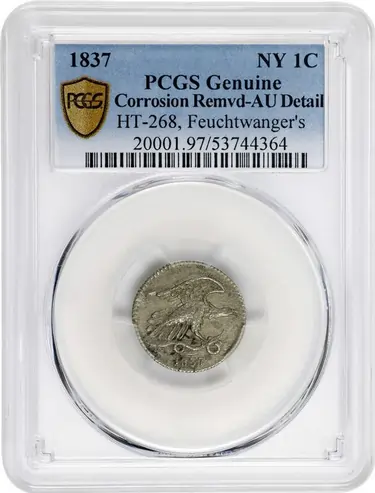
The 1837 Feuchtwanger Cent carries a powerful backstory.
It came from a chemist, not the Mint. It circulated because Americans needed money they could trust and use. It challenged the official copper cent. Then, long before the Flying Eagle cent, it showed that a smaller cent could work.
That makes the Feuchtwanger Cent more than a Hard Times token. It is a surviving piece of American monetary experimentation.
Congress rejected Feuchtwanger’s alloy. Yet history did not reject his idea. The United States eventually moved away from the large copper cent. It also embraced nickel-bearing small coinage. Feuchtwanger saw that future early.
Collectors still recognize that vision today. Jaeger and Bowers ranked Feuchtwanger’s coinage at number four in 100 Greatest American Medals and Tokens. That ranking reflects its importance, its historical timing, and its enduring collector appeal.
Auction Note
Stack’s Bowers Galleries offered a collectible 1837 Feuchtwanger Cent in its June 3, 2026 Collectors Choice Auction – U.S. Coins. The piece appears as Lot 90002.
For collectors who want a direct link to the Hard Times era, this token offers unusual historical depth. It represents panic-era commerce, private coinage, and one man’s attempt to reshape the American cent.



Beautiful coin and the history is fascinating. Great article!
It would have been exciting to see these coins become a part of regular U.S. circulatory issues. The photographed example submitted with this article is superb.
I’ve got one
Quite interesting. Had never heard of it.
I have quite a few hard times tokens in my collection. An example of this token would be the icing on the cake!
Great read. History lesson! Thank you for sharing!
A very interesting article.
A historic “coin” glad I got mine before the prices mentioned here.
i wish i could own one. these are neat. learn something new everyday.
Great story!
Innovators are always ahead of their time.
Learn something new everyday! I’m so glad I got into collecting coins and precious metals! I love learning the history behind all the pieces. Great article!
Too bad it wasn’t used.
I’ve never heard of these before. Cool piece of history!
A very good article.
Very interesting and a very attractive token.
Was most interesting to learn about the Feuchtwanger cent and its’ effect on US coinage,
Tokens have a unique spot in our need for coinage during a difficult time in our country’s history. I have a “DIX” token. It’s great to read the history of this particular token. Well done!
I thought that “German silver” was also called “pot metal” and that it’s not durable. So, unsurprising that there aren’t so many of these cents in really good condition.