


The $15 Silver Coin That Turned Out to Be a Four-Known U.S. Rarity
The 1853-O Seated Liberty Half Dollar No Arrows ranks among the most mysterious U.S. silver coins. Only four examples have earned broad acceptance as genuine. Yet the coin began as ordinary money.
That contradiction gives the issue its power.
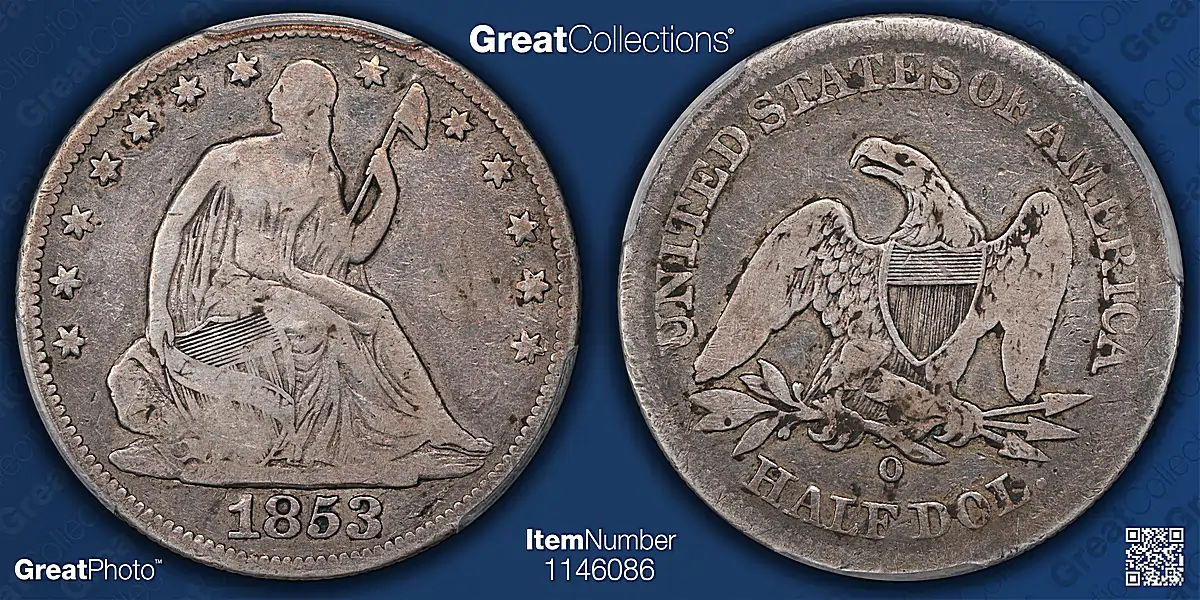
In early 1853, the New Orleans Mint struck half dollars at the old silver standard. Soon afterward, Congress changed the weight of U.S. subsidiary silver coins. The new half dollars carried arrows at the date and rays around the eagle. Those design changes told the public that the coins contained less silver.
The 1853-O No Arrows half dollar carried no such warning. It looked like the older, heavier coins. Therefore, most examples likely vanished into melting pots after the Mint Act of February 21, 1853. Today, the issue survives as a four-coin relic of one of America’s most important monetary turning points. Stack’s Bowers lists the mintage as unknown, with no more than 4,000 struck, and estimates only four survivors.
A New Orleans Coin Born at the Wrong Moment
The Philadelphia Mint shipped dies to New Orleans in late 1852. That allowed the branch mint to begin coinage early in the new year. This mattered because transportation took time. Dies often traveled by sea from the East Coast to the Port of New Orleans.
A January 2, 1853 report in The Daily Picayune described a new issue of American coinage from the New Orleans Mint on January 1. It mentioned a $20 gold piece and a silver half dollar. Since Congress had not yet authorized the Arrows and Rays design, that half dollar almost certainly belonged to the No Arrows type.
That timing makes the coin extraordinary. It emerged during the final weeks of America’s old silver standard.
The Silver Crisis of 1853
The California Gold Rush changed American money. Gold poured into the market. As a result, gold became cheaper relative to silver. Silver coins then carried more bullion value than face value.
By early 1853, a half dollar could contain more than 50 cents’ worth of silver. Therefore, people had little reason to spend them. Instead, silver coins moved into hoards, export channels, and melting pots.
Congress responded with the Mint Act of February 21, 1853. The law reduced the weight of half dimes, dimes, quarters, and half dollars. It did not reduce the silver dollar. For the half dollar, the correct statutory change reduced the old 206.25-grain standard to 192 grains, or from about 13.36 grams to about 12.44 grams. That represents a reduction of about 6.9%.
Then the Mint added visual markers. Half dollars and quarters gained arrows at the date and rays around the eagle. These devices told the public that the coins no longer offered a melting profit.
Why the 1853-O No Arrows Half Dollar Vanished
The 1853-O No Arrows half dollar carried the old design. It also belonged to the old silver-weight system. Therefore, it became obsolete almost as soon as it appeared.
No federal mintage figure survives for the issue. Stack’s Bowers notes that this lack of a recorded mintage has precedent in U.S. coinage history. The firm estimates that several hundred to several thousand pieces may have been struck, but no more than 3,000 to 4,000. Nearly all disappeared after Congress replaced the old-weight coins with lighter Arrows and Rays pieces.
Die research adds another clue. Liberty Seated half dollar specialists Bill Bugert and Randy Wiley linked the reverse die to the 1852-O WB-2 die marriage. A faint die line from the eagle’s right leg toward the underside of the right wing helps identify it. Walter Breen also noted that New Orleans still had reverse dies on hand during this period. That detail supports the idea that the mint paired a new 1853 obverse die with an older reverse die.
One of the Great New Orleans Mint Rarities
The 1853-O No Arrows half dollar did not enter numismatic fame quickly. John W. Haseltine announced the first known example around 1881. Since then, only four examples have gained broad acceptance.
PCGS CoinFacts states that all four known pieces share the same die pair. It also notes that each weighs below the old standard but above the 192-grain standard, which makes sense because all known examples show circulation wear.
The issue also holds a prominent place in modern rarity rankings. Jeff Garrett and Ron Guth ranked it No. 58 in 100 Greatest U.S. Coins. GreatCollections also highlights that ranking in its current auction listing.
The Four Known Examples
The finest known example traces to John W. Haseltine, J. Colvin Randall, Harold P. Newlin, the Garrett family, David Queller, and George Byers. PCGS grades it VF-35. Stack’s Bowers sold it in the August 2017 ANA Auction for $517,000.
A second example carries the Howell Family Estate provenance. PCGS graded it VG-08. Stack’s Bowers offered it in August 2012, after its discovery earlier that year. Heritage later offered it in August 2015, where it realized $199,750.
A third example traces to a Chicago trolley car conductor around 1909. It later passed through H.O. Granberg, William H. Woodin, Waldo Newcomer, B. Max Mehl, Col. E.H.R. Green, Charles M. Williams, the Adolphe Menjou sale, and Louis E. Eliasberg, Sr. PCGS CoinFacts lists that coin with an estimated VG grade and a recorded weight of 202.3 grains.
The fourth example traces to Colin E. King, the Chapman Brothers, Col. E.H.R. Green, Stack’s Anderson-Dupont sale, Stack’s Empire sale, R.E. Cox Jr., Jules Reiver, and other later owners. PCGS grades that piece Good-06.
The WOW Factor: A Coin Almost Lost for Melt
The 2012 discovery adds the human drama.
Coin World reported that the newly found 1853-O No Arrows and Rays half dollar had sat for decades in a suitcase in a Washington state home. The group included about $150 to $165 in face value of silver coins. The owner’s father had accumulated the coins during his travels as a truck driver.
Then came the near miss. A local coin shop initially viewed the half dollar as worth about $15 in silver. However, the owner’s husband had checked the Red Book and noticed the absence of arrows and rays. He pushed for another look.
That persistence saved the coin. The family contacted Stack’s Bowers, then hand-delivered the coin to Southern California for expert review and PCGS authentication. PCGS confirmed it as genuine and graded it VG-08. Coin World called it the first newly reported example of the subtype since 1911.
That is the backstory collectors remember. A four-known U.S. rarity almost became melt silver.
Current GreatCollections Auction
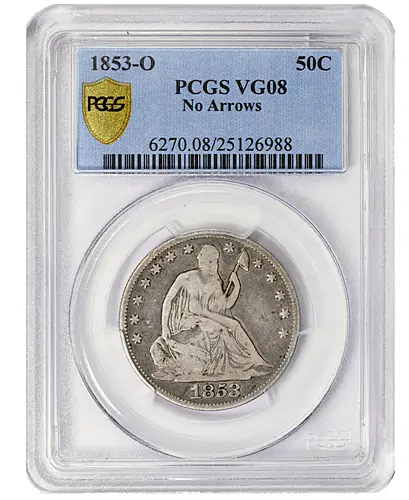
GreatCollections is currently offering an 1853-O Seated Liberty Half Dollar No Arrows graded PCGS VG-08. The listing identifies it as GC Item ID 1146086, PCGS certification number 25126988, and states that the present example was discovered in 2012. As of the page capture reviewed on May 21, 2026, the current bid stood at $95,500. The auction closes Sunday, June 21, 2026, at 4:46:04 PM Pacific Time.
The GreatCollections listing describes the issue as one of the key coins in the Seated Liberty half dollar series. It also notes that only four examples are known and that the issue appears in Garrett’s 100 Greatest U.S. Coins.
Because published rosters identify the PCGS VG-08 2012 discovery as the Howell Family Estate specimen, this listing deserves close attention from advanced Liberty Seated specialists. Heritage’s prior roster lists that VG-08 coin as the Howell Family Estate piece, sold by Stack’s Bowers in August 2012 and later by Heritage in August 2015.
Why Collectors Should Care
The 1853-O No Arrows half dollar is not just rare. It captures a turning point in American monetary policy.
The coin links the California Gold Rush to the disappearance of silver coinage in addition to linking the New Orleans Mint practice to emergency federal legislation. Also, it turns an ordinary-looking circulated half dollar into one of the most important design changes of 19th-century U.S. coinage.
Most great rarities look important. This one does not. That makes it even more compelling.
A collector could have spent it in 1853. A dealer nearly bought one for melt in 2012. Yet today, the 1853-O No Arrows half dollar stands as one of the great survivors of the Liberty Seated series.




Would like to have that in my collection along with a confederate fifty cent o minted coin
Very intereting articles about coins
fascinating
I wonder how many others are still out there biding their time to appear and astonish the coin-collecting world!
I’m going to look and see if I have one!
Neat!
Amazing! Great article. I never knew these 4 coins existed.l
Interesting article. I was actually unaware of the significance of the arrows in rhe seated liberty designs. I had actually just pulled out my type set because I had acquired a half di.w with arrows, simply saw it as a change in the design for artistic reasons, not realizing the true meaning.