Only 46 Were Struck. Now One of the Finest Survivors Has a $2 Million Estimate and a Legendary Pedigree.
The date says 1849. The mint records tell a different story.
On December 12, 1848, workers in the Great Salt Lake Valley struck 25 Mormon $10 gold coins. One week later, they produced another 21. Then a shortage of usable equipment brought production to a halt.
That left just 46 coins, all bearing the date 1849.
Today, only about 10 to 11 examples survive. Some belong to museums or institutional collections. Others show substantial wear, repairs, or damage.
Among the survivors, one coin stands apart for its extraordinary ownership history and preservation.
The Green-Kern-Carter-Miller specimen realized $840,000 at Stack’s Bowers Galleries in December 2020, establishing an auction record for the issue.
Five years later, the same coin resurfaced in publicity for Witter Coin’s November 2025 eBay Live debut. This time, its estimated value approached $2 million.
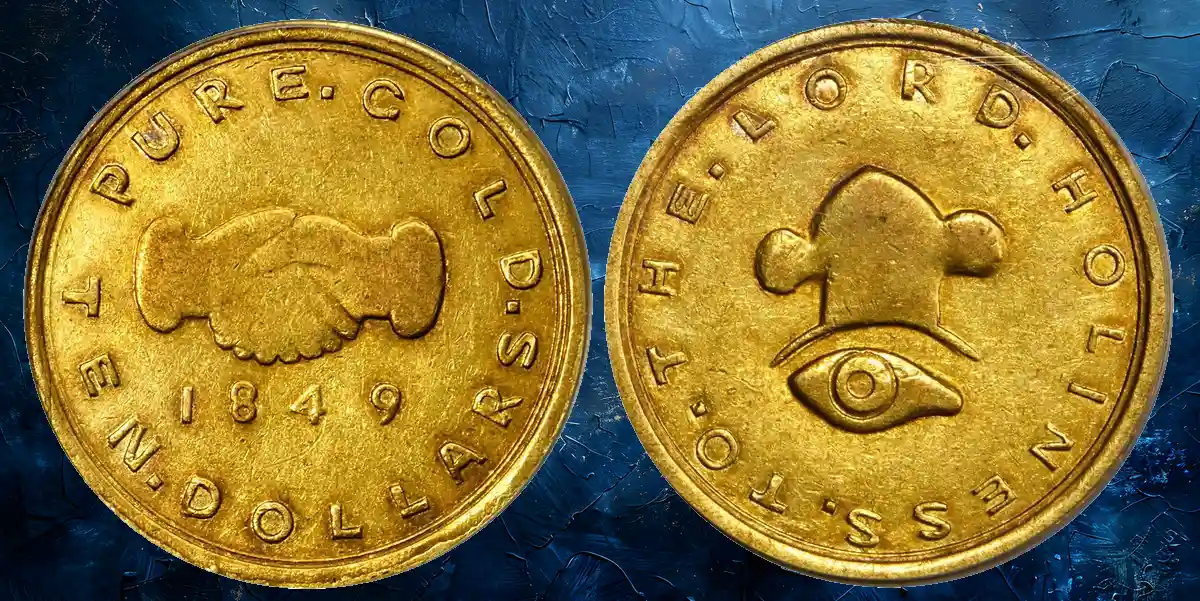
The coin subsequently appeared in PCGS records as AU55, an upgrade from its previous AU53 grade. PCGS currently identifies it under certification #47850549, while its Set Registry entry preserves the historic pedigree.
The 1849 Mormon $10 gold coin has traveled an extraordinary distance from its original $10 denomination. Yet its real significance extends beyond price.
It connects the California Gold Rush, the Mormon migration, the proposed State of Deseret, and the struggle to establish a functioning monetary system on the American frontier.
A $10 Gold Coin That Actually Came From 1848
Few American coins have such a precisely documented beginning.
According to records cited by numismatic researcher P. Scott Rubin, the small Mormon mint produced its first 25 gold $10 pieces on December 12, 1848. Five from that initial production entered circulation that day.
On December 19, workers struck another 21.
Then the mint’s crucibles broke, interrupting production until replacement equipment arrived in 1849.
Although the mint later resumed operations and introduced additional denominations, it never produced another $10 gold coin.
As a result, the entire 1849 Mormon $10 population began with fewer pieces than many famous American rarities have surviving examples today.
PCGS classifies the issue as Rarity-7, a designation that generally indicates four to 12 known examples. Heritage Auctions documented 11 specimens in its detailed 2014 census.
Therefore, approximately 10 to 11 surviving examples remains a reasonable estimate. Researchers must also account for possible duplicate appearances and incomplete historical records.
How California Gold Reached the Great Salt Lake Valley
The story begins with an army unit, a California sawmill, and a discovery that transformed the American West.
Members of the Mormon Battalion served during the Mexican-American War. After completing their military service, some remained in California and found employment near John Sutter’s operations.
Several helped construct the sawmill where James W. Marshall discovered gold on January 24, 1848.
Some of those workers soon carried California gold east to the Mormon settlements in the Great Salt Lake Valley.
For the settlers, gold presented both an opportunity and a problem.
The growing community needed reliable money. However, much of its wealth arrived as irregular gold dust rather than standardized coins.
Merchants had to weigh the dust during transactions. Moreover, differences in purity complicated valuations and created opportunities for fraud.
Community leaders initially used measured packets of gold dust to facilitate commerce. Nevertheless, the settlement needed a more practical solution.
Brigham Young and his associates decided to transform the gold into coins.
In November 1848, Young worked with John Taylor and John M. Kay on designs for the proposed coinage. Kay played a central role in preparing the dies and producing the coins. Other craftsmen also helped create the necessary tools and equipment.
Within weeks, the settlement had its first locally produced gold coins.
The Design That Declared “PURE GOLD”
The 1849 Mormon $10 gold coin looks unlike anything the United States Mint produced during the same period.
Its obverse features an all-seeing eye beneath a three-pointed Phrygian crown, an emblem associated with the Mormon priesthood.
Around the design appears the religious inscription:
HOLINESS TO THE LORD
The reverse displays two clasped hands above the date 1849. Around the border runs the inscription:
PURE GOLD TEN DOLLARS
The design carries a direct message. The obverse expresses religious identity, while the reverse emphasizes trust, friendship, and monetary value.
Later 1849-dated Mormon gold denominations used the initials G.S.L.C.P.G., generally interpreted as Great Salt Lake City Pure Gold.
Only the $10 issue spells out PURE GOLD in full.
However, the inscription also reveals one of the great ironies of the series.
The gold was not chemically pure.
California native gold naturally contained silver and other metals. Although the Mormon mint initially struck its coins without adding an intentional alloy, that process did not remove the metals already present.
Furthermore, the mint lacked the sophisticated refining and assaying equipment available at established federal mints.
That limitation eventually created a serious problem.
When the Philadelphia Mint Exposed the Shortfall
In 1850, Philadelphia Mint assayers Jacob R. Eckfeldt and William E. Du Bois examined Mormon gold coins.
They published their findings in New Varieties of Gold and Silver Coins.
The results raised troubling questions about the coins’ intrinsic value.
The assayers reported gold fineness of approximately .899, along with significant variations in weight.
For the $10 denomination, their samples weighed between 219 and 224 grains. They calculated intrinsic gold values of approximately $8.50 to $8.70.
In other words, a coin labeled TEN DOLLARS contained substantially less than $10 worth of gold at contemporary bullion valuations.
Other denominations experienced similar problems.
The $5 piece contained approximately $4.30 in gold, while the $2.50 piece contained about $2.25.
Those differences undermined confidence in Mormon gold outside the settlement.
Merchants increasingly discounted the pieces. Negative publicity further damaged their acceptance in commerce.
The mint had produced the coins to solve a monetary shortage. Instead, inconsistent weights and insufficient intrinsic value limited their usefulness beyond the Great Salt Lake Valley.
Early Mormon gold production ultimately totaled approximately $70,000 in face value. The mint operated intermittently through the early 1850s, before a final coinage effort introduced a new $5 design in 1860.
By then, the original $10 coins had become increasingly vulnerable to another fate.
The Melting Pot Nearly Erased the Entire Issue
The 1849 Mormon $10 faced two threats to its survival.
First, the mint produced only 46 examples.
Second, the coins eventually lost much of their usefulness in commerce outside the Mormon community.
Many examples entered melting pots. Others disappeared through wear, loss, and changing economic conditions.
The coins that survived became extraordinary reminders of the earliest California Gold Rush economy.
Heritage’s 2014 census identified two examples in the Smithsonian Institution and two in collections associated with The Church of Jesus Christ of Latter-day Saints.
Other survivors included coins with repairs, plugs, heavy wear, or other impairments.
Consequently, an attractive About Uncirculated specimen ranks among the most desirable pieces in American pioneer gold.
The Green-Kern-Carter-Miller coin offers an even more remarkable combination of condition, rarity, and history.
From Colonel Green to Jerome Kern: A Remarkable Pedigree
The Green-Kern-Carter-Miller specimen has passed through some of the most famous collections in American numismatics.
Its documented history includes Waldo Newcomer, Edward Howland Robinson “Colonel” Green, composer Jerome David Kern, Amon G. Carter, Sr., and Amon G. Carter, Jr.
Later chapters included Dwight Berger, Robert L. Hughes, Don Kagin, and Larry H. Miller.
Few coins can claim such a distinguished succession of owners.
Following Kern’s death in 1945, legendary dealer B. Max Mehl offered the coin in his May 1950 Golden Jubilee Sale of the Jerome David Kern Collection.
The coin appeared as lot 728 and realized $2,600.
Mehl regarded it as the finest example of the issue he had encountered.
The specimen later entered the Carter family holdings. Stack’s offered it in January 1984 as lot 1163 of the Amon G. Carter, Jr. Family Collection.
It realized $132,000.
The catalogers praised its luster, delicate orange toning, and outstanding preservation. They even suggested that its slight surface friction might not represent ordinary commercial circulation.
Heritage subsequently handled the coin in its July 1988 and August 1992 ANA auctions.
Eventually, the specimen joined the celebrated Larry H. Miller Collection of Mormon gold.
Miller, whose business interests included ownership of the Utah Jazz, assembled an exceptional collection reflecting the history of the Mormon pioneers.
His 1849 $10 became one of its greatest treasures.
The $840,000 Auction Record in December 2020
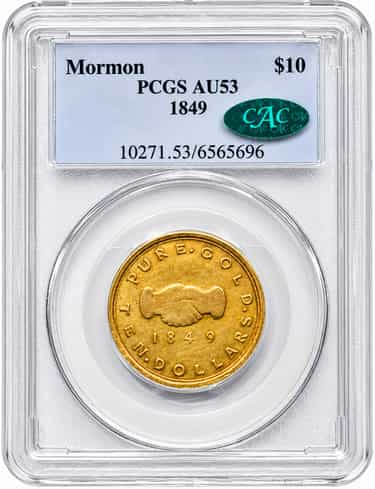
At the time, PCGS graded the coin AU53, and CAC approved it.
The coin displayed attractive original color, strong remaining detail, and the distinguished pedigree that collectors had followed for generations.
When bidding ended, the realized price reached $840,000, including the buyer’s premium.
That result established a new public auction record for the 1849 Mormon $10.
Moreover, it confirmed the exceptional demand for high-quality early territorial gold with documented provenance.
Yet the coin’s market story did not end there.
Witter Coin’s 2025 Appearance: The Same Legendary Specimen
On November 14, 2025, San Francisco dealer Witter Coin launched its eBay Live presence with a major numismatic event.
The 10-hour livestream featured more than $5 million worth of coins, currency, gold nuggets, bullion, and other collectibles.
Among the advertised highlights were an 1851 Augustus Humbert $50 gold piece, a 1652 New England shilling, and rare large-denomination United States currency.
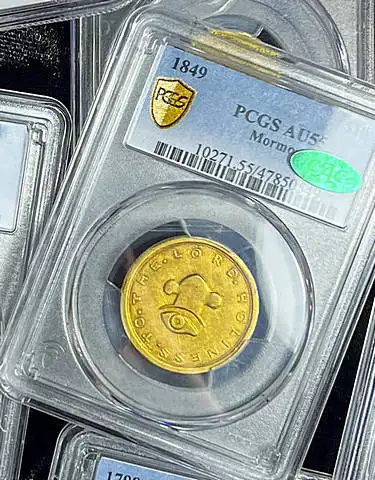
However, the headline attraction was an 1849 Mormon $10 gold coin.
Witter described the rarity as one of approximately 10 known examples and promoted its exceptional quality.
Contemporary reporting placed its estimated value between $1.9 million and $2 million.
Photographs circulated in connection with the Witter presentation identify the featured coin as the Green-Kern-Carter-Miller specimen.
Therefore, this was not the emergence of another previously unknown Mormon $10.
It represented a new market appearance for the same historic coin that had established the $840,000 auction record in 2020.
The distinction matters.
Witter’s $1.9 million to $2 million estimate reflected an assessment of the coin’s market potential. It did not establish a completed sale at that price.
Nevertheless, the 2025 presentation demonstrated how dramatically the market’s expectations had evolved for an extraordinary survivor of the early Gold Rush era.
From PCGS AU53 to AU55: Where the Coin Stands Today
Another development adds to the specimen’s modern history.
CoinWeek reported in a May 5, 2026, editorial update that Lone Mountain Coin had acquired the specimen and that PCGS had upgraded it from AU53 to AU55. The coin also retained CAC approval.
PCGS currently identifies the specimen as:
1849 Mormon $10 Gold, K-3, PCGS AU55, certification #47850549.
The PCGS Set Registry also displays the coin in a collector inventory and includes historical comments tracing its ownership through Green, Kern, Carter, and Miller.
That listing provides an important public record of the specimen’s current certification. However, registry participation alone does not prove a recent sale or disclose the present owner’s identity.
The AU55 grade also raises an important distinction between certification populations and historical condition-census rankings.
The specimen’s PCGS Set Registry page shows no higher population in its current summary. Yet its condition-census section continues to identify the separate Riverboat Collection example as AU58.
The two records do not fully reconcile.
Until PCGS clarifies the discrepancy, the most accurate description remains that the Green-Kern-Carter-Miller coin ranks among the finest known examples of the issue.
Its historic pedigree, excellent preservation, CAC approval, and $840,000 auction record already place it among the premier pieces of early American territorial gold.
The Riverboat Specimen: Another Exceptional Survivor
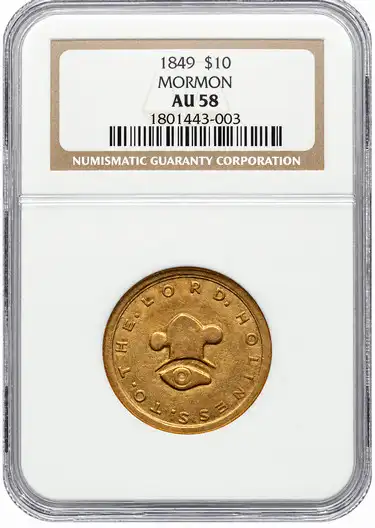
The principal comparison comes from the Riverboat Collection.
Heritage Auctions offered that 1849 Mormon $10 in April 2014 as lot 5455. NGC graded the piece AU58, and the coin realized $705,000.
Its ownership history reaches back to the 19th century and includes Captain Andrew C. Zabriskie, H.O. Granberg, Virgil Brand, Waldo Newcomer, Charles M. Williams, Henry Clifford, Donald Kagin, Robert Rhue, Paul Padget, and Stuart Levine.
Heritage identified distinguishing surface features that helped trace the coin through earlier collections.
The auction house also published an extensive census of surviving Mormon $10 gold coins.
Although the Riverboat piece held a higher numerical grade at its 2014 offering, the Green-Kern-Carter-Miller specimen eventually surpassed it in public auction price.
Together, these two coins demonstrate the extraordinary importance of provenance, preservation, and individual collector preferences in the market for pioneer gold.
Forty-Six Coins, More Than 175 Years of History
The 1849 Mormon $10 occupies an unusual place in American monetary history.
Its creators dated it 1849 but struck all 46 examples in December 1848.
They proclaimed PURE GOLD, although the native California metal contained natural alloy.
They introduced the coins to solve a shortage of practical money. Yet unfavorable assays helped undermine confidence in their value.
Finally, most disappeared into melting pots.
The Green-Kern-Carter-Miller specimen survived all those challenges.
It passed from the frontier economy into the great numismatic cabinets of the 20th century. It established a record price of $840,000 in 2020. Then, in 2025, Witter Coin placed it before a new generation of collectors with an estimate approaching $2 million.
Today, PCGS identifies the coin as AU55 under certification #47850549.
Yet the numbers tell only part of the story.
This coin represents a moment when religious migration, California gold, frontier industry, and the expansion of the American West converged.
For collectors of territorial gold, the 1849 Mormon $10 offers something that even extraordinary rarity cannot guarantee.
It preserves a tangible connection to one of the earliest efforts to transform California Gold Rush wealth into circulating American money.
Coin Specifications: 1849 Mormon $10 Gold
- Denomination: $10
- Date: 1849
- Actual Production: December 12 and 19, 1848
- Minting Location: Great Salt Lake Valley, present-day Salt Lake City, Utah
- Kagin Variety: K-3
- Rarity: Rarity-7
- Recorded Mintage: 46
- Estimated Survivors: Approximately 10–11
- Obverse: Three-pointed Phrygian crown above all-seeing eye; HOLINESS TO THE LORD
- Reverse: Clasped hands, date 1849; PURE GOLD TEN DOLLARS
- Metal: Native California gold containing natural alloy
- Reported Fineness: Approximately .899 in contemporary Philadelphia Mint assays
- Reported Weight Range: 219–224 grains for assayed $10 examples
- Approximate Diameter: 27 mm
- Green-Kern-Carter-Miller Specimen: PCGS AU55, cert. #47850549; previously PCGS AU53 CAC
- Public Auction Record: $840,000, Stack’s Bowers Galleries, December 17, 2020
- Notable Later Appearance: Witter Coin, November 14, 2025; estimated value of $1.9 million–$2 million, with no verified realized price