By Steve Benner for CoinWeek
Ancient Caria: Where Empires Collided and Greek Cities Minted Their Own Identity
From tiny silver fractions to magnificent tetradrachms, the coins of ancient Caria reveal a remarkable story of commerce, conquest, mythology, and artistic independence.
Ancient Caria: A Crossroads of Empires, Trade, and Culture
On the southwestern coast of Asia Minor, between the Aegean Sea and the rugged mountains of Anatolia, an extraordinary collection of ancient cities developed one of the most fascinating coinages of the Greek world. This was Caria, a land where native traditions met Greek culture and where the ambitions of great empires shaped everyday life.
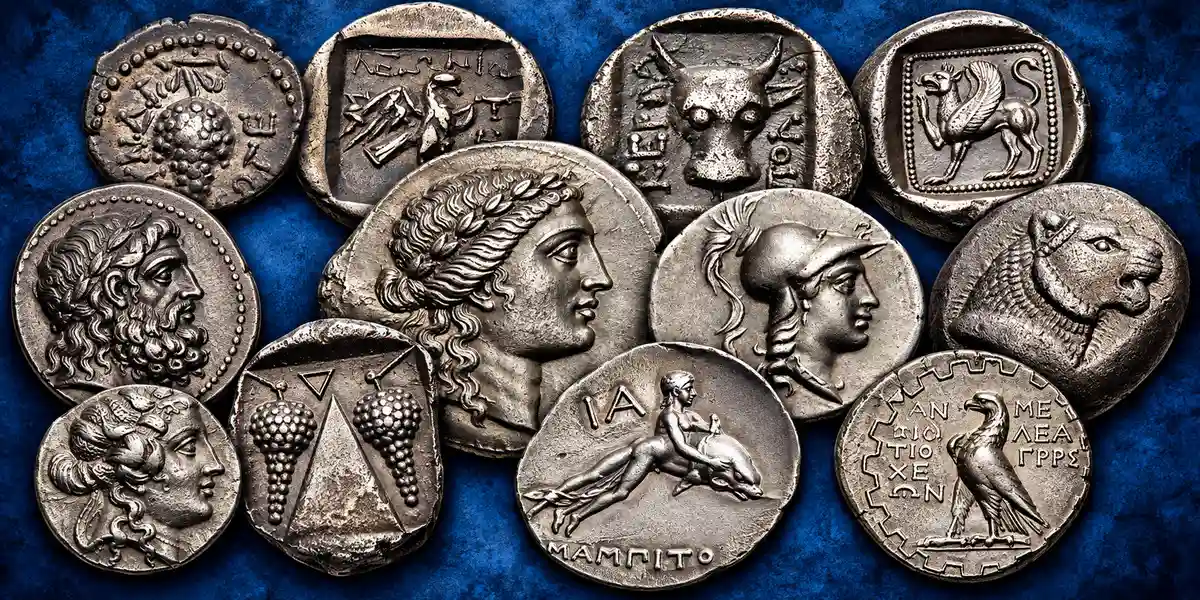
For centuries, the Carians lived at the crossroads of competing civilizations. Lydian kings, Persian satraps, Greek city-states, Macedonian conquerors, and eventually Roman officials all sought influence over this strategically important region. Yet Caria’s cities retained distinctive local traditions, and nowhere does that individuality appear more clearly than on their coins.
A winged goddess, a sacred stone, a lion, a scorpion, or a boy clinging to a dolphin might seem like an unusual collection of images. However, each had meaning to the people who struck and used these coins. Some celebrated local gods and legends. Others reflected economic activity, political alliances, or the authority of the officials who supervised their production.
Today, these small works of art offer collectors a remarkable opportunity to explore the history of a region that helped connect the Greek and Near Eastern worlds.
This article continues my series on the ancient history and coinage of Asia Minor. My goal remains the same: to examine interesting examples of ancient coinage while giving readers an appreciation for the artistry of both Greek and native engravers.
I will concentrate primarily on silver coinage from Caria’s mainland cities. I previously covered Halicarnassus and Cnidus in my article on Doris, so I will leave those cities aside. Likewise, the offshore islands deserve their own treatment because of their extensive coinages.
The Land That Made Caria Important
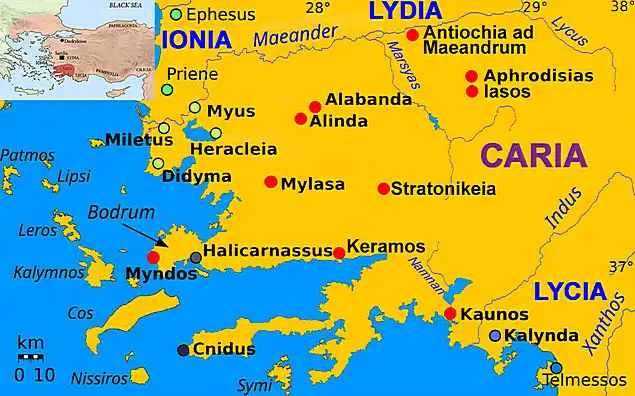
Ancient Caria occupied a valuable position along the southwestern coast of modern Turkey. Ionia lay to the northwest, Lydia to the north, and Lycia and Pisidia bordered its eastern and southeastern approaches. The Maeander River formed a major northern landmark, while the Indus, also known as the Calbys or Dalyan River, marked an important part of the southeastern frontier.
The terrain helped define Caria’s history. Mountain ranges divided its interior, while river valleys created routes for travel and commerce. Coastal cities enjoyed access to the Aegean and eastern Mediterranean trading networks. Fishing, maritime commerce, and regional exchange supported their prosperity.
However, Caria had much more to offer than good harbors. Its position between the Anatolian interior and the sea made the region valuable to rulers who wanted control of trade routes, ports, and military movements. Carian soldiers also earned a reputation as mercenaries, serving far beyond their homeland.
The Carians spoke their own Anatolian language, which belonged to the same broad linguistic family as Luwian. Meanwhile, Greek settlers and traders introduced additional cultural influences. Over time, this combination produced cities with both Greek and distinctly Carian characteristics.
During the Bronze Age, Caria’s wider region interacted with the Hittite world. Later, Greek settlement and cultural influence expanded along the coast. By the sixth century BCE, Lydia had extended its authority into Caria. Then, following Cyrus the Great’s conquest of Lydia around 547–546 BCE, the Persian Empire brought the region under Achaemenid control.
Persian power did not eliminate local ambitions. In the early fourth century BCE, the native Hecatomnid dynasty established a powerful regional administration while retaining its formal position within the Persian Empire. Mausolus, who ruled from approximately 377 to 353 BCE, became the dynasty’s most famous member.
His monumental tomb at Halicarnassus, the Mausoleum, eventually earned a place among the Seven Wonders of the Ancient World. Indeed, the English word mausoleum derives from his name.
Alexander the Great invaded Caria in 334 BCE. During his campaign, Ada, a displaced member of the Hecatomnid family, allied herself with Alexander. He subsequently entrusted her with authority over the region. In the centuries that followed, Caria became a contested prize among Hellenistic kingdoms before Rome emerged as the dominant power.
Through these political changes, Carian cities continued to use coins to communicate local identity and authority. Their designs provide a visual record of the region’s changing history.
Alabanda: The City That Celebrated Victory
Alabanda stood inland along the Marsyas River, where routes through the Carian countryside connected communities with the Maeander Valley. Its name traditionally combines two Carian words: ala, meaning horse, and banda, meaning victory.
The city had a long history before the Hellenistic period. Persian officials held authority there during the fifth century BCE. Later, Alabanda became part of the Chrysaorian League, a regional confederation that linked several Carian communities.
Alabanda faced repeated political upheavals during the wars among the Hellenistic kingdoms. Philip V of Macedon campaigned in Caria around 201 BCE. Subsequently, Antiochus III of the Seleucid Empire brought Alabanda under his influence, and the city adopted the name Antiochia of the Chrysaorians.
However, Antiochus suffered defeat at Magnesia in 190 BCE. The Treaty of Apamea followed in 188 BCE and placed much of Caria under Rhodian control. In the 160s BCE, political changes restored greater freedom to Carian communities, including Alabanda.
The city’s coinage reflects this turbulent period. Alabanda produced silver and bronze issues, including remarkable tetradrachms that combined artistic quality with civic symbolism.
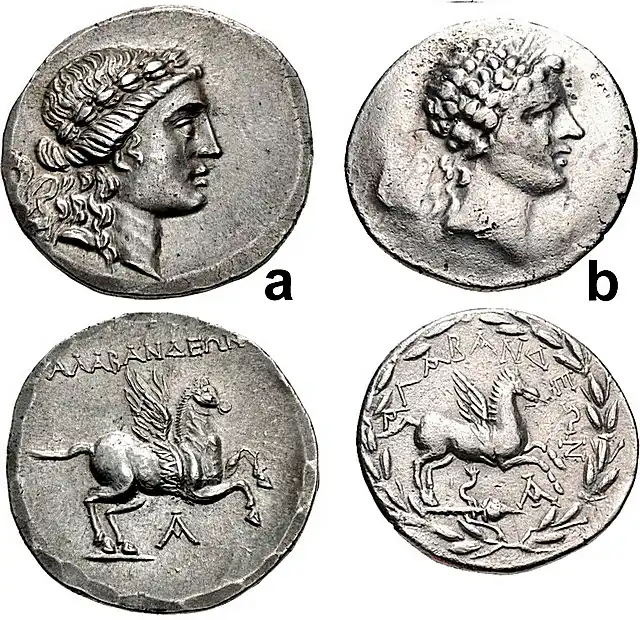
Figure 2a shows a silver tetradrachm dating to approximately 167–166 BCE. Apollo appears on the obverse, while Pegasos, the winged horse of Greek mythology, occupies the reverse. The inscription ΑΛΑΒΑΝΔΕΩΝ identifies the issuing city.
Figure 2b presents a tridrachm from the same period. Again, Apollo and Pegasos dominate the designs. However, the reverse also contains a laurel wreath, a filleted thyrsus, and a control mark. These details distinguish the issue from its larger companion.
Alabanda also struck tetradrachms in the name and types of Alexander the Great. The obverse portrays Herakles wearing the skin of the Nemean lion. Meanwhile, Zeus Aetophoros sits on the reverse, holding an eagle and scepter. A small Pegasos helps identify the mint.
Collectors should note that these coins appeared generations after Alexander’s death. Their familiar designs helped connect local currency with an established monetary tradition.
The city’s bronze coinage offers even greater variety. Apollo often appears on the obverse, while reverses feature lyres, bulls, Demeter, Pegasos, and other figures, including Capricorn-like creatures.
Alabanda therefore provides an excellent example of how a city could combine regional identity with designs familiar throughout the Greek world.
Alinda: A Fortress, a Queen, and an Ancient Coinage
Alinda occupied a commanding position in the Carian interior. Its elevated site overlooked the surrounding countryside and gave the city considerable defensive value.
Although evidence points to a settlement with much older roots, historians know relatively little about Alinda’s earliest political history. The city became especially important during the final years of Persian rule.
Here, Queen Ada maintained her position after a family struggle deprived her of authority over much of Caria. When Alexander the Great advanced into the region in 334 BCE, Ada surrendered Alinda and allied herself with the Macedonian conqueror.
According to the ancient accounts, Ada offered to adopt Alexander as her son. He accepted her support and later restored her authority over Caria. This unusual political arrangement helped Alexander secure a local ally while campaigning against Persian resistance.
Alinda’s surviving civic coinage consists chiefly of bronze issues. Its earliest generally recognized series dates to the second century BCE.
Herakles appears on many obverses. Other types feature Apollo or Dionysos. Meanwhile, the reverses display a club, bow case, thunderbolt, double-headed axe, Pegasos, or other religious and military symbols.
The double-headed axe, or labrys, deserves particular attention because of its strong associations with Carian religious traditions.
These modest bronzes lack the imposing size of Alabanda’s silver tetradrachms. Nevertheless, they preserve the visual language of a city that once played an important role in Alexander’s conquest.
Antiochia ad Maeandrum: Rare Silver From the River Valley
Antiochia ad Maeandrum occupied a strategic location near the meeting of the Maeander and Morsynos rivers. The surrounding valleys provided natural routes through the interior of Asia Minor.
A Seleucid ruler, traditionally Antiochus I, expanded or reorganized the settlement and gave it the name Antiochia. Unfortunately, relatively little of the city’s early history survives.
Its silver coinage, however, offers collectors several fascinating designs.
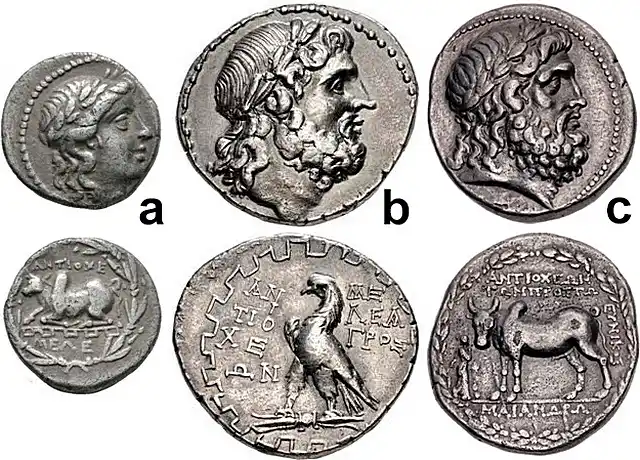
Figure 3a illustrates a second-century BCE drachm with Apollo on the obverse. On the reverse, a humped bull rests beneath the city name, ΑΝΤΙΟΧΕΩΝ. An abbreviated magistrate’s name identifies the official associated with the issue.
The bull, or zebu, appears on several of the city’s coins. Its prominent place suggests that the animal carried special local significance.
The city’s tetradrachms present an even more interesting story.
One type, represented by Figure 3b, portrays Zeus on the obverse. The reverse shows a standing zebu bull with a small female figure nearby. A laurel wreath surrounds the composition. The inscriptions identify Antiochia on the Maeander and name the magistrate Eunikos.
The small female figure may represent Nemesis, although the identification remains uncertain. The coin belongs to the stephanophoric tradition, in which a wreath encloses the reverse design. Known examples remain exceptionally rare.
Figure 3c offers another tetradrachm design. Zeus again appears on the obverse, but the reverse carries an eagle standing on a thunderbolt, with its wings folded. A decorative Maeander pattern surrounds the scene.
The accompanying inscriptions include the name of the magistrate Meleagros. Moreover, the Maeander border forms a particularly appropriate design for a city whose identity depended so closely on the river.
For collectors, the appeal extends beyond rarity. These coins reveal a city using its own river, religious imagery, and civic identity to distinguish its currency from the silver issues of neighboring communities.
Iasos: The Boy, the Dolphin, and a Tragic Ancient Legend
Few ancient Carian coins tell a story as memorable as those of Iasos.
The city occupied a sheltered gulf on the western Carian coast. Originally, its principal settlement stood on an island, which later became connected to the mainland.
Greek tradition associated Iasos with settlers from Argos. However, archaeological evidence reveals a much older settlement, reaching back into the Bronze Age.
The sea provided much of the city’s wealth. Iasos developed a thriving fishing industry and traded fish throughout the region. In addition, nearby quarries supplied distinctive marble with red and pale veins.
Nevertheless, prosperity could not protect Iasos from the political struggles of the Greek world.
The city joined the Delian League and became involved in the Peloponnesian War. Spartan forces and their allies captured and plundered Iasos in 412 BCE. Later, the city entered the Hecatomnid sphere of influence, passed under Alexander’s control, and faced further conflict during the campaigns of Philip V of Macedon.
A Silver Coin Smaller Than a Fingernail
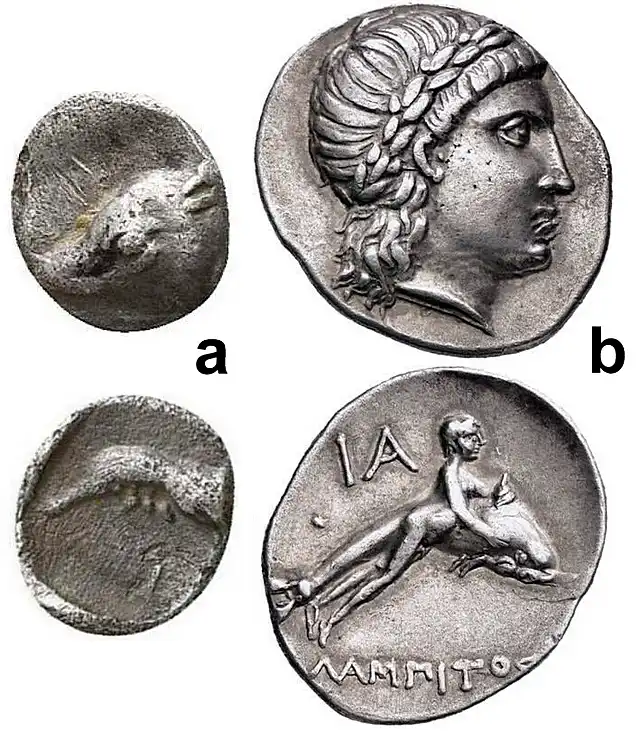
Iasos produced a limited range of early silver coinage. Figure 4a illustrates a tiny tetartemorion from approximately 450–400 BCE.
The obverse carries a boar’s head, while the reverse features a shrimp. At just 5mm in diameter and 0.16 grams, the coin demonstrates the astonishingly small scale of some ancient Greek silver denominations.
The shrimp also provides a fitting reminder of the city’s dependence on the sea. Other small silver fractions may belong to Iasos, although specialists debate certain attributions.
After a lengthy interruption in its silver coinage, Iasos resumed production during the third century BCE.
Its new drachms featured Apollo on the obverse and one of the most poignant scenes in ancient numismatics on the reverse.
The Friendship That Became a City’s Legend
According to local tradition, a boy named Hermias regularly swam in the waters near Iasos. There, he befriended a dolphin.
Each day, the animal returned to meet him. The boy would hold the dolphin’s fin as the two moved through the water together.
However, the story ended tragically.
Hermias drowned during one of their encounters. In some versions, an accidental wound from the dolphin’s fin caused his death. The dolphin carried the boy’s body to shore but could not save him. Overcome by grief, the animal remained beside Hermias and eventually died.
The people of Iasos preserved the story on their coinage. Instead of choosing another familiar god or heroic warrior, they portrayed a local boy holding onto his dolphin companion.
Figure 4b shows the design on a silver drachm from approximately 250–190 BCE. The city’s bronze coins also carried versions of the scene.
I find this coin particularly appealing. Its design combines attractive Greek engraving with an unusually personal story. More importantly, it reminds us that ancient coinage did more than support commerce or celebrate powerful rulers.
Sometimes, a city used its money to preserve a story that its people never wanted to forget.
Kaunos: Winged Goddesses and the Coinage of a Trading Port
Kaunos occupied a strategic position near the southeastern boundary of Caria, close to the river known in antiquity as the Calbys or Indus.
The city traced its origins deep into antiquity, with evidence of settlement reaching back to at least the early first millennium BCE. Ancient tradition connected the Kaunians with Crete, although their exact origins remain a subject of historical debate.
Persia gained control of the region during the sixth century BCE. However, Kaunos later joined the Ionian Revolt against Persian authority between 499 and 494 BCE.
Following the Persian Wars, Kaunos entered the Delian League and benefited from growing maritime commerce. Its harbor supported trade in salt, preserved fish, pine resin, figs, and other products. Ancient accounts also identify slaves among the region’s exports.
Black mastic and resin held particular value because shipbuilders needed waterproofing materials to maintain their vessels.
Consequently, Kaunos occupied a valuable position in the maritime economy of the eastern Mediterranean.
The city returned to Persian control following the King’s Peace of 387–386 BCE. During the fourth century, new public buildings, including an agora and temples, reflected its development.
Alexander’s campaign brought another change in 334 BCE. After his death, Kaunos passed between Hellenistic rulers and Rhodes. Eventually, Rome incorporated the region into the province of Asia during the late second century BCE.
The city’s political troubles continued during the First Mithridatic War. Kaunos supported Mithridates VI in 88 BCE and subsequently suffered Roman punishment after his defeat and the peace settlement of 85 BCE.
The Mysterious Winged Figures of Kaunos
Kaunos issued some of the most distinctive silver coins in Caria. Its early staters combine Greek artistic conventions with imagery that reflects local Anatolian traditions.
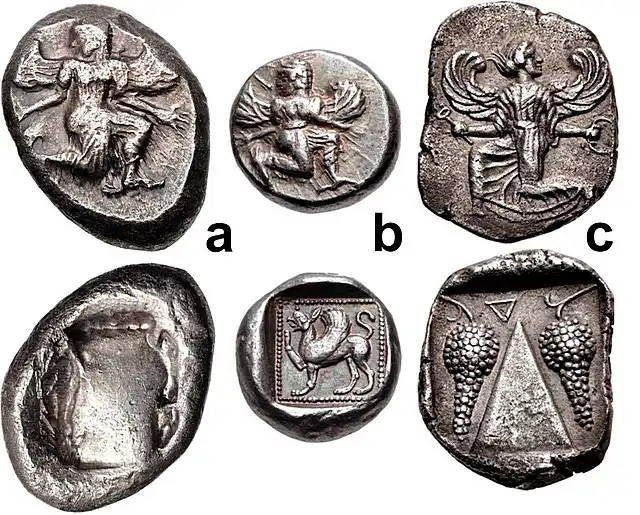
Figure 5a shows a silver stater dating to approximately 490–470 BCE. The obverse features a winged female figure in the familiar running or kneeling pose of early Greek art.
Scholars generally identify the figure as Iris, the messenger of the gods, although Nike, the goddess of victory, remains another possible interpretation.
The reverse contains a rectangular object within an incuse square. It may represent a baetyl, or sacred stone. However, the precise identification remains uncertain.
Figure 5b offers a variation on the same theme. The obverse again portrays a winged female, while the reverse features a griffin, a mythical creature combining the features of an eagle and lion.
A later stater, shown in Figure 5c, retains the winged figure but places a sacred stone between grape-like forms on the reverse.
The combination is striking. These coins bring together Greek mythological imagery, possible local religious objects, and symbols that may reflect the region’s economic or ceremonial traditions.
From Barley Grains to Thunderbolts
The city’s later coinage demonstrates how much variety ancient engravers could achieve, even on very small pieces.
Figure 6d illustrates a one-thirty-second stater from approximately 400–350 BCE. At only 6mm and 0.35 grams, it features a barley grain on the obverse and a large inverted character associated with the Carian script on the reverse.
The design could hardly be simpler. Nevertheless, it offers an intriguing glimpse of the region’s native language and writing traditions.
Figure 6e shows a silver obol with a seated sphinx on both sides. The engraver placed the reverse sphinx inside an incuse square, continuing an earlier method of organizing the coin’s design.
By the second century BCE, Kaunos had adopted more conventional Hellenistic imagery.
Figure 6f, a silver drachm, displays Zeus on the obverse and a winged thunderbolt on the reverse. The magistrate Ktetos appears in the accompanying inscription, while the city monogram and a small torch help identify the issue.
Figure 6g shows a hemidrachm featuring Athena on the obverse. The reverse depicts a sword in its sheath, complete with a strap, together with a decorated palm frond.
The city marks on these later coins provide another important connection between their imagery and the community that issued them.
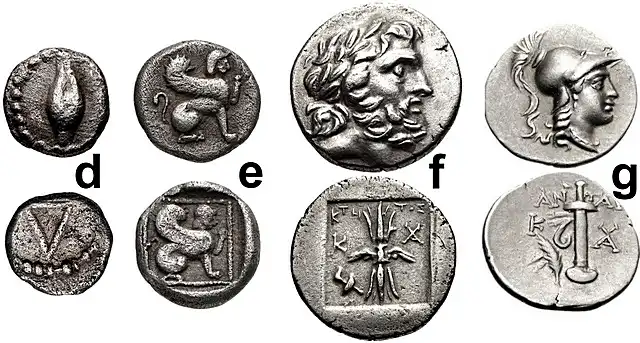
The larger silver staters of Kaunos are particularly desirable because of their unusual imagery. However, the smaller denominations provide an equally compelling opportunity to examine the city’s changing artistic traditions.
Keramos: A Small City With a Distinctive Coinage
Keramos stood on the northern coast of the Ceramic Gulf, a broad inlet along the southern Carian shoreline.
Ancient records reveal relatively little about the city’s political history. However, Keramos appears among the communities associated with the Athenian maritime sphere during the fifth century BCE.
In later centuries, the city experienced the influence of Rhodes and nearby Stratonikeia. Its religious connections may also have included the worship of Zeus Chrysaoreus, an important deity in the Carian countryside.
Although Keramos lacked the prominence of Mylasa or Halicarnassus, it issued silver and bronze coins that reflected its civic independence.
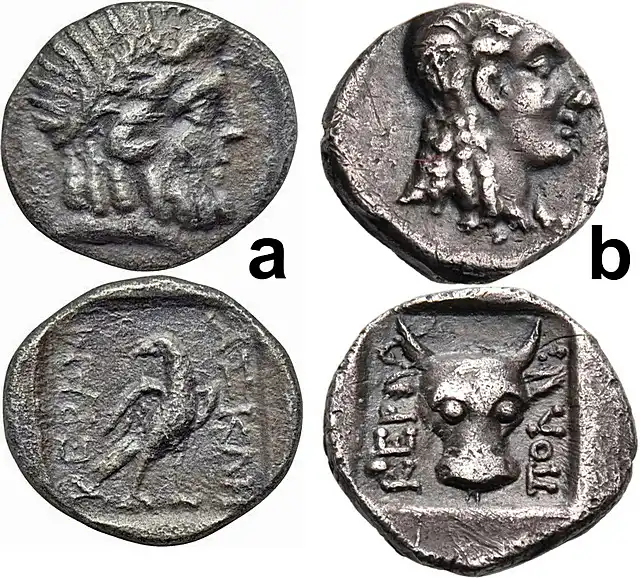
The silver coinage includes two attractive types of hemidrachm from the later Hellenistic period.
Figure 7a shows Zeus on the obverse, while an eagle spreads its wings on the reverse. The city name appears beside the eagle, along with an abbreviated magistrate’s name.
Figure 7b presents a different design. Apollo appears on the obverse, while a bull’s head faces directly outward on the reverse. Again, the inscription identifies Keramos and its issuing official.
The frontal bull’s head creates a particularly bold image on such a small coin. Its compact design demonstrates how effectively Greek engravers could use a limited surface.
Keramos also produced bronze issues with related designs, including additional representations of Apollo, Zeus, bulls, and eagles.
Mylasa: The First Capital of Caria and Its Changing Coinage
Mylasa occupies a special place in Carian history.
Long before Halicarnassus became the seat of Mausolus, Mylasa served as the political center of the Hecatomnid dynasty. Its importance also extended into an earlier period of Carian and Lydian history.
Ancient accounts mention Mylasa during the seventh century BCE, when Carian leaders participated in the struggles for the Lydian throne.
Following the Persian conquest, Mylasa became a major administrative center. During the fifth century, it briefly entered the Athenian alliance system before Persian influence returned.
However, the city’s greatest political prominence came with the rise of the Hecatomnids.
Hecatomnus established the dynasty’s authority under Persian sponsorship around the beginning of the fourth century BCE. His son Mausolus succeeded him in 377 BCE and expanded the family’s influence throughout southwestern Anatolia.
Mylasa served as the dynasty’s original capital, although Mausolus later transferred the principal seat of government to Halicarnassus.
Tiny Electrum Coins With Lions and Scorpions
Mylasa’s early coinage presents several unusual designs.
Figure 8a shows a tiny electrum fraction traditionally attributed to Mylasa, although specialists continue to question the mint attribution of some early types.
The obverse features a facing lion’s head, while the reverse shows a scorpion inside an incuse square.
This one-forty-eighth stater belongs to the early tradition of electrum coinage in western Asia Minor. Electrum, a gold-silver alloy, played an important role in the development of coinage across the region.
At approximately 5mm and 0.29 grams, the piece is exceptionally small. Yet its engraver managed to distinguish both the lion and scorpion.
By around 500 BCE, Mylasa also produced larger silver staters with a lion’s forepart on the obverse and two rectangular incuse impressions on the reverse.
Figure 8b illustrates an example measuring 20mm and weighing 10.65 grams.
Additional early silver denominations included tiny fractions with lions, birds, and other symbols. These ranged from pieces traditionally described as one-forty-eighth staters or tetartemoria to hemiobols and related fractional denominations.
Some fifth-century issues paired a lion’s head with a facing head of Apollo.
When Mylasa Borrowed the Coinage of Rhodes
Mylasa’s later coinage followed a very different artistic direction.
The city’s production of silver appears to have diminished significantly after its early issues. However, by the second century BCE, Mylasa had begun striking substantial quantities of drachms modeled on the coinage of Rhodes.
This development illustrates the enduring economic influence of the island.
Rhodian silver circulated widely because merchants and traders recognized its familiar designs and monetary standard. Consequently, a Carian city could benefit by producing currency that closely resembled Rhodian issues.
Figure 8c shows one of these imitative drachms.
The obverse portrays the facing head of Helios, the sun god. A small bird, generally identified as an eagle, appears against his cheek.
The reverse displays a rose with a bud. This floral symbol closely resembles the famous rose design of Rhodes.
Mylasa produced numerous varieties with different letters, monograms, and magistrate marks. The series continued into the late second and early first centuries BCE, with issues extending toward the period of the First Mithridatic War in 88 BCE
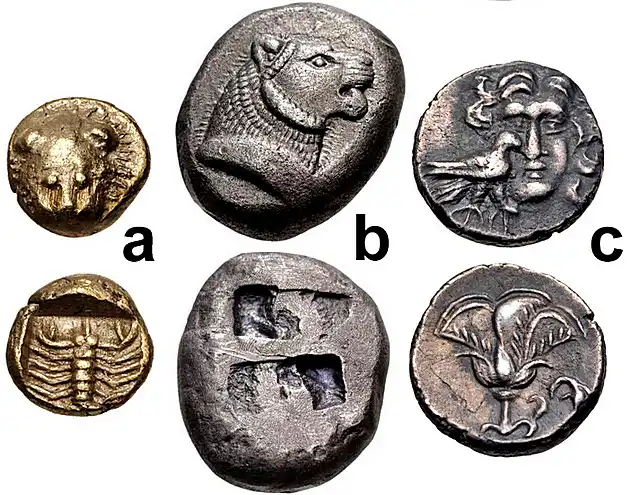
The contrast between these coins is extraordinary. Mylasa’s earliest issues display the bold animals and incuse punches of archaic western Anatolia. Its later drachms imitate the refined Hellenistic coinage of Rhodes.
Together, they illustrate centuries of political and economic change through a handful of small silver coins.
Myndos: The Harbor That Resisted Alexander
Myndos occupied a harbor on the western side of the Bodrum Peninsula. Greek tradition connected its foundation with settlers from Troezen in the Peloponnese.
Its coastal position gave Myndos strategic importance. The city possessed substantial defensive walls and a harbor capable of supporting maritime trade and military operations.
Indeed, Myndos appears in the history of Alexander the Great’s campaign against Halicarnassus in 334 BCE.
During the siege, Alexander attempted to capture Myndos. However, the city’s defenders resisted his attack. Alexander ultimately withdrew rather than continue an operation that threatened to divert resources from the principal siege.
For a relatively small Carian city, resisting the Macedonian conqueror represented a notable achievement.
Myndos later produced a distinctive series of silver coins, especially during the second century BCE.
Egyptian Gods and the Influence of the Mediterranean World
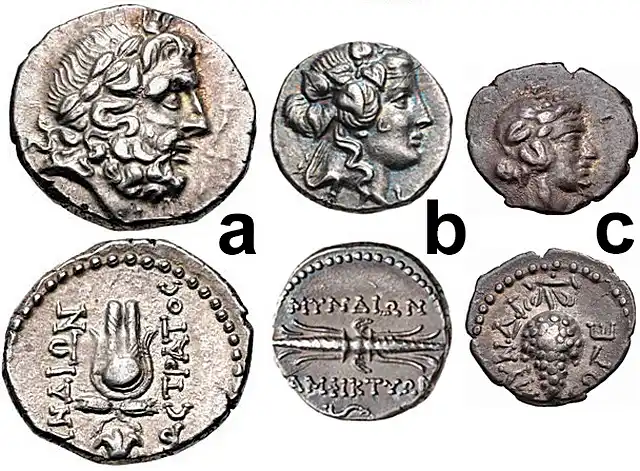
Figure 9a shows a silver drachm featuring the head of Sarapis, the Greco-Egyptian deity, on the obverse. The reverse carries the elaborate headdress of Isis, resting upon two ears of grain.
The inscription ΜΥΝΔΙΩΝ identifies the city, while the name Sostratos records the magistrate.
This coin deserves attention because of its religious imagery. Sarapis and Isis reflect the spread of Egyptian religious influences through the Hellenistic Mediterranean. Their appearance at Myndos reveals how readily coastal communities adopted religious symbols from beyond their traditional borders.
The grain ears beneath the headdress add another layer of meaning, connecting the imagery with fertility and abundance
Myndos also produced smaller silver denominations.
Figure 9b shows a hemidrachm portraying Dionysos, the god of wine, on the obverse. A thunderbolt appears on the reverse, together with the name of the magistrate Amphyktion.
Finally, Figure 9c presents a trihemiobol with a wreathed head of Dionysos and a bunch of grapes on the reverse.
The connection between Dionysos and grapes is obvious. However, it also illustrates the city’s use of instantly recognizable religious symbolism on even its smallest coins.
The city also issued bronze coinage in several designs.
Together, its silver denominations offer collectors an interesting combination of Greek religious tradition, Egyptian influence, and civic identity. They also provide a reminder that the cultural boundaries of the ancient Mediterranean were far more fluid than modern maps might suggest.
Stratonikeia: Sacred Temples, Roman Politics, and Coins of War
Stratonikeia stood inland, east-southeast of Mylasa, on a site with roots reaching back to the Bronze Age.
The surrounding region maintained connections with Anatolian and Aegean civilizations long before the Hellenistic period. Eventually, the Seleucid kings established a major city there.
Ancient tradition credits Antiochus I Soter, who ruled from 281 to 261 BCE, with the foundation or reorganization of Stratonikeia. He reportedly named the city in honor of his wife Stratonice.
However, scholars have also proposed Antiochus II or Antiochus III as possible founders of the Hellenistic settlement. The precise chronology remains open to debate.
Stratonikeia became an important member of the Chrysaorian League, which linked communities across Caria.
The city also controlled two major rural sanctuaries: the temple of Hekate at Lagina and the sanctuary of Zeus at Panamara.
These religious centers helped define the city’s territory and civic identity. They also connected the urban population with the countryside and its traditional cults.
During the third century BCE, Rhodes gained influence over Stratonikeia. However, the political settlement of 167 BCE brought the city greater freedom and encouraged the development of independent civic coinage.
The Silver Hemidrachms of Stratonikeia
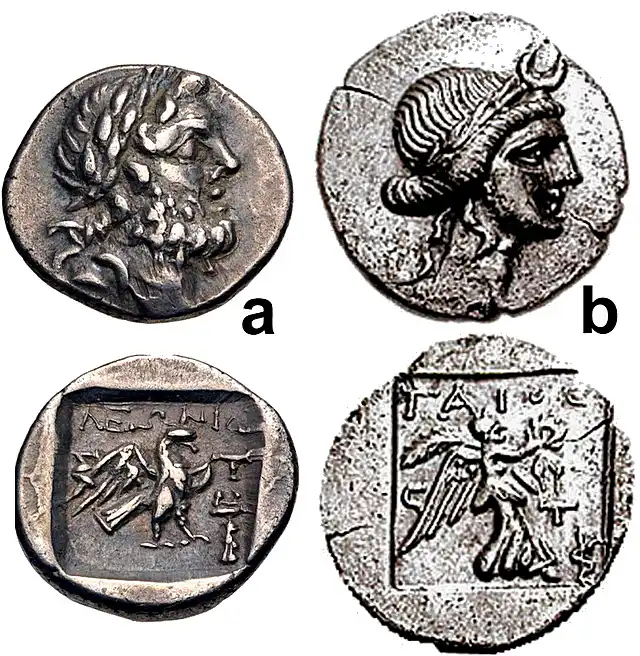
Figure 10a illustrates a silver hemidrachm from approximately 133–125 BCE.
The obverse features Zeus, while the reverse shows an eagle with outstretched wings inside an incuse square.
The city ethnic appears as abbreviated letters beside the eagle. Meanwhile, the magistrate’s name appears above.
These coins follow the widespread tradition of using Zeus and his eagle as symbols of divine authority. However, the inscriptions distinguish Stratonikeia’s issues from those of other Carian communities.
Hekate and the First Mithridatic War
The city’s later silver coinage takes on greater historical significance.
During the First Mithridatic War, beginning in 89–88 BCE, the eastern Mediterranean became a battleground between Rome and Mithridates VI of Pontus.
The conflict disrupted trade, shifted political allegiances, and placed enormous financial pressure on cities throughout Asia Minor.
Stratonikeia issued silver drachms during this turbulent period. Figure 10b illustrates an example dating to approximately 88–85 BCE.
The obverse carries the head of Hekate, identified by the crescent associated with the goddess. On the reverse, Nike advances while carrying a wreath and palm branch.
The magistrate Gaios appears in the inscription.
The choice of Hekate seems especially appropriate. Her great sanctuary at Lagina formed an important part of the city’s religious identity. Meanwhile, Nike supplied a fitting symbol of victory during a period of armed conflict.
These coins may have helped meet the financial demands of the war, including military expenditure. However, surviving evidence does not establish the specific purpose of each issue.
Stratonikeia’s silver coins demonstrate how a city’s religious traditions could become inseparable from its political identity.
Even while Caria’s rulers changed, local sanctuaries and familiar gods continued to provide enduring symbols of civic pride.
Collecting the Coins of Ancient Caria
The cities discussed here produced an extraordinary variety of silver coinage. Some issues are relatively common within their respective series. Others survive in only a handful of known examples.
Not surprisingly, the larger denominations often command substantial premiums. Collectors prize the staters of Kaunos for their unusual winged figures and mysterious reverse designs. Likewise, Alabanda’s large silver tetradrachms attract attention for their size and artistry.
Fortunately, collecting ancient Caria does not necessarily require pursuing the rarest and most expensive pieces.
Smaller silver denominations from Mylasa, Kaunos, Myndos, and several other cities appear in numismatic auctions. Their availability varies considerably by type, magistrate, condition, and attribution.
In my view, these smaller coins often offer some of the most interesting opportunities. A collector can assemble examples that illustrate different religious traditions, political influences, and stages in the development of Greek coinage.
Of course, identifying these coins requires care. Small differences in legends, symbols, and magistrate names can distinguish a relatively available variety from a major rarity. In addition, some early Carian issues retain uncertain mint attributions.
Collectors should therefore compare prospective purchases with established references and carefully documented auction examples.
Remarkable Numismatic Legacy
Caria never possessed the lasting imperial power of Persia, Macedon, or Rome. Nevertheless, its cities occupied an important place in the economic and cultural history of the ancient Mediterranean.
Their coins reveal the region’s extraordinary diversity.
The tiny electrum fractions of Mylasa recall the earliest experiments in western Anatolian coinage. The winged goddesses and sacred stones of Kaunos preserve unusual religious traditions. The silver drachms of Myndos reveal Egyptian influences, while the coinage of Stratonikeia reflects the continuing importance of local sanctuaries during an age of political upheaval.
Then there is the remarkable dolphin coinage of Iasos, which preserves a story of friendship and loss rather than the victories of kings.
That, perhaps, is what makes the coinage of ancient Caria so rewarding to study.
These coins are more than evidence of ancient trade. They are miniature historical documents, preserving the beliefs, traditions, ambitions, and artistic achievements of people who lived more than 2,000 years ago.
For collectors willing to look beyond the most famous Greek mints, Caria offers an exceptionally rich field of study.
And as I continue this exploration of the coinage of Asia Minor, I am repeatedly struck by how much history these small pieces of metal can still reveal.
References
1. ACSearch.info. Ancient coin auction records and historical sale catalogs.
2. Classical Numismatic Group (CNG). Auction archives and ancient Greek coin descriptions.
3. Grant, Michael. A Guide to the Ancient World: A Dictionary of Classical Place Names. Barnes & Noble edition, 1986.
4. Head, Barclay V. Historia Numorum: A Manual of Greek Numismatics. Oxford, 1887.
5. Hoover, Oliver D. Handbook of Coins of Italy and Magna Graecia, Sixth to First Centuries BC. Classical Numismatic Group, Lancaster/London, 2018.
6. Hornblower, Simon, and Antony Spawforth, editors. The Oxford Classical Dictionary, third edition. Oxford University Press, 1996.
7. Sear, David R. Greek Coins and Their Values, Volume II: Asia and North Africa. B. A. Seaby, 1979.
Additional research consulted for this revision includes historical scholarship on the Hecatomnid dynasty, specialized coin catalogs, and documented examples from CNG, Leu Numismatik, and other auction firms.