Why Did the U.S. Mint Cover Liberty’s Breast on the 1917 Quarter?
The 1917 Standing Liberty Quarter Type 1 holds one of the most intriguing stories in American coinage. Its designer challenged the United States Mint over changes to his artwork. The country stood on the brink of war. Meanwhile, a controversy about Liberty’s appearance would follow the coin for more than a century.
Yet the familiar story about why the Mint changed this beautiful quarter may not be entirely true.
The evidence points to something more interesting: an artist fighting for his vision, a government struggling to produce a new coin, and a changing nation searching for symbols of its identity.
The Sculptor Who Challenged the U.S. Mint
On January 10, 1917, sculptor Hermon Atkins MacNeil received 20 Standing Liberty quarters. The new coins represented the culmination of his work on America’s quarter dollar.
However, MacNeil quickly discovered something troubling. Mint engravers had modified elements of his design without his approval.

The following day, he wrote to Mint Director Friedrich Johannes Hugo von Engelken. His letter identified several changes that he wanted the Mint to make.
MacNeil wanted a lower position for Liberty’s head. He also sought improvements to her legs and the drapery surrounding her shield. In addition, he requested changes to the lettering.
Interestingly, his complaints did not address the exposed breast that would later dominate stories about the coin.
The disagreement eventually reached Treasury Secretary William Gibbs McAdoo. On January 22, MacNeil met with government officials in Washington to discuss improvements.
The sculptor then returned to New York and resumed his work.
This episode reveals something important about the Standing Liberty quarter. Its redesign did not simply emerge from a public controversy. It also grew from a dispute over artistic control and the practical challenges of coin production.
A Coin Born Between Peace and War
MacNeil’s Liberty captured an extraordinary moment in American history.
When the United States introduced the new quarter, Europe had already endured more than two years of devastating warfare. President Woodrow Wilson continued to pursue American neutrality, but international tensions kept growing.
Against that backdrop, MacNeil created a powerful national symbol.
Liberty stands in the opening of a stone gateway. Her right hand extends an olive branch, the traditional emblem of peace. Meanwhile, her left arm supports a shield, signaling America’s readiness to defend itself.
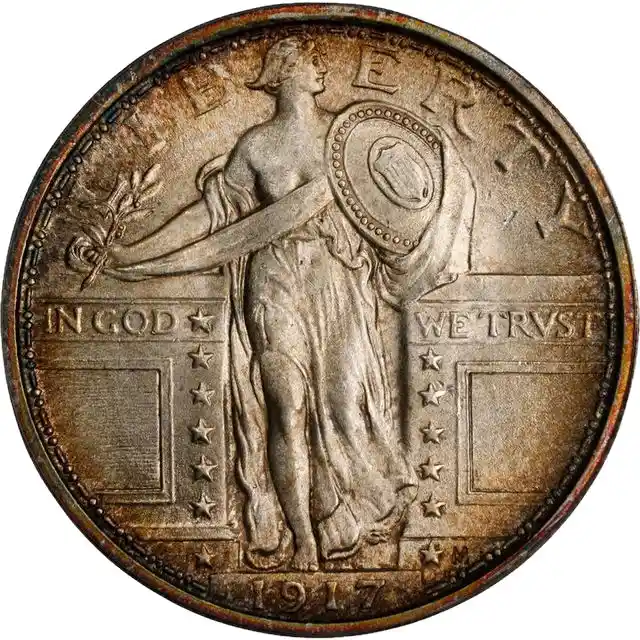
The design conveys two messages at once. America desires peace, but it will not surrender its security.
Even the figure’s movement adds meaning. Rather than standing motionless, Liberty appears ready to step forward.
MacNeil brought the sensibilities of a sculptor to a small silver coin. His earlier work included major public monuments and depictions of Native American subjects, but his artistic training also reflected the classical traditions popular during the American Renaissance.
His earliest concepts were more elaborate than the circulating quarter. One version even featured dolphins, commonly interpreted as symbols of the Atlantic and Pacific oceans. Those dolphins disappeared before the Mint adopted the final design.
The finished quarter retained the essential message: peace, vigilance, and national confidence.
However, the first version would survive for only a brief period.
Did Americans Really Demand That Liberty Cover Up?
The original Standing Liberty quarter depicted Liberty with her right breast exposed. MacNeil drew on classical artistic traditions, where partially draped allegorical figures had long represented national ideals.
Nevertheless, collectors have repeated a dramatic explanation for the 1917 redesign.
According to the familiar account, the public objected to Liberty’s exposed breast. Moral reformers supposedly demanded a more modest design, forcing the Mint to cover the figure.
But where is the documentary evidence?
Numismatic researcher Roger W. Burdette examined the Mint records surrounding the design. In his Renaissance of American Coinage, 1916–1921, he found no convincing support for the popular story of widespread public outrage.
Instead, surviving correspondence documents the difficulties between MacNeil and Mint officials. The records also establish the artist’s desire to improve his work.
That does not prove that nobody objected to Liberty’s appearance. It does mean that historians should not present an organized public campaign as an established reason for the redesign.
Meanwhile, the figure’s identity presents another mystery.
Accounts have associated MacNeil’s Liberty with actress and model Dora Doscher, also known as Doris Doree, and actress Irene MacDowell. Both women had connections to the sculptor. However, researchers have not established either woman as the definitive model. Burdette considered a composite figure a plausible explanation.
More than a century later, the woman on the coin still keeps some of her secrets.
How World War I Changed the Meaning of Liberty
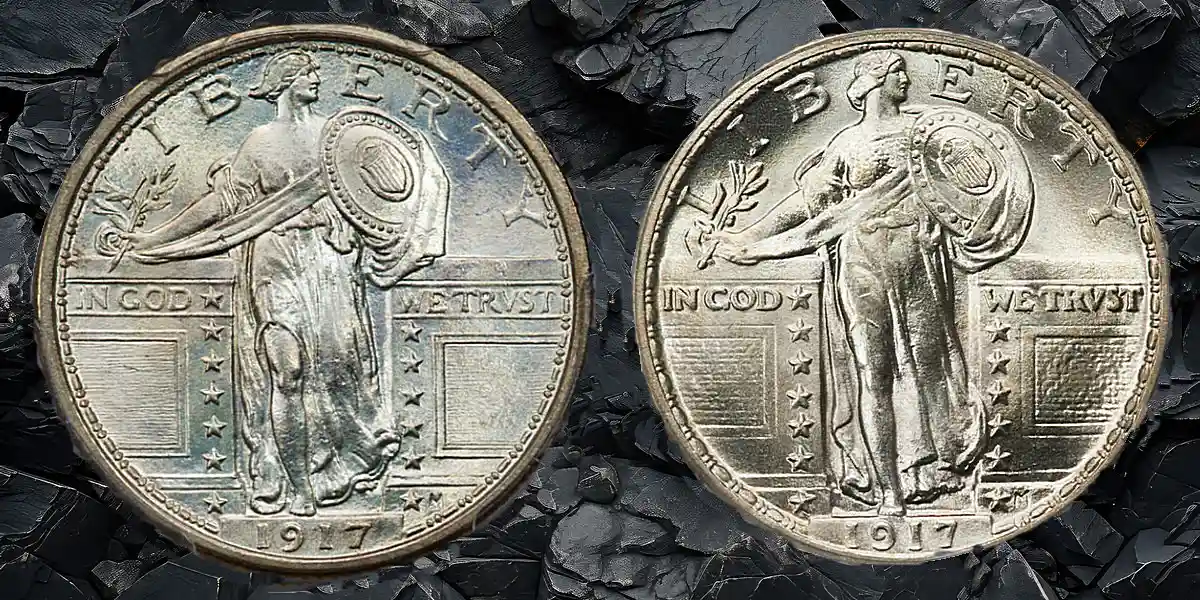
By mid-February 1917, MacNeil had completed a revised obverse design. Liberty now wore a covering of chain mail across her torso.
The modification gave the figure a noticeably different appearance.
Moreover, the timing mattered.
On April 6, 1917, the United States declared war on Germany and formally entered World War I. The nation had moved from guarded neutrality into direct military conflict.
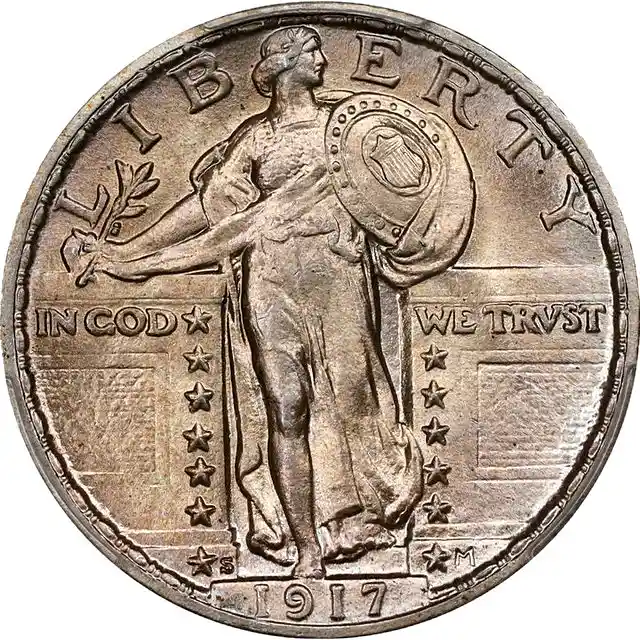
MacNeil’s armored Liberty suited this new political reality. She still carried the olive branch, but her protective equipment emphasized readiness and defense.
However, the revised artwork preceded America’s formal declaration of war. Therefore, the war alone cannot explain the entire redesign.
Practical considerations also influenced the changes. The Mint needed a coin that would strike reliably and function properly in commerce.
The resulting Type 2 quarter featured reduced relief and changes to Liberty’s clothing, shield, and other design elements.
The Mint also modified the reverse. It moved the eagle higher and relocated three stars beneath the bird.
By the middle of 1917, production had shifted to the new design.
Consequently, collectors received something unusual: two distinctly different Standing Liberty quarters bearing the same date.
Two 1917 Quarters, Two Different Designs
The differences between the Type 1 and Type 2 Standing Liberty quarters extend beyond Liberty’s clothing.
On the Type 1 obverse, Liberty wears a flowing gown that leaves her right breast exposed. On the Type 2, a chain-mail covering protects her upper torso.
The reverse provides an especially useful identification feature.
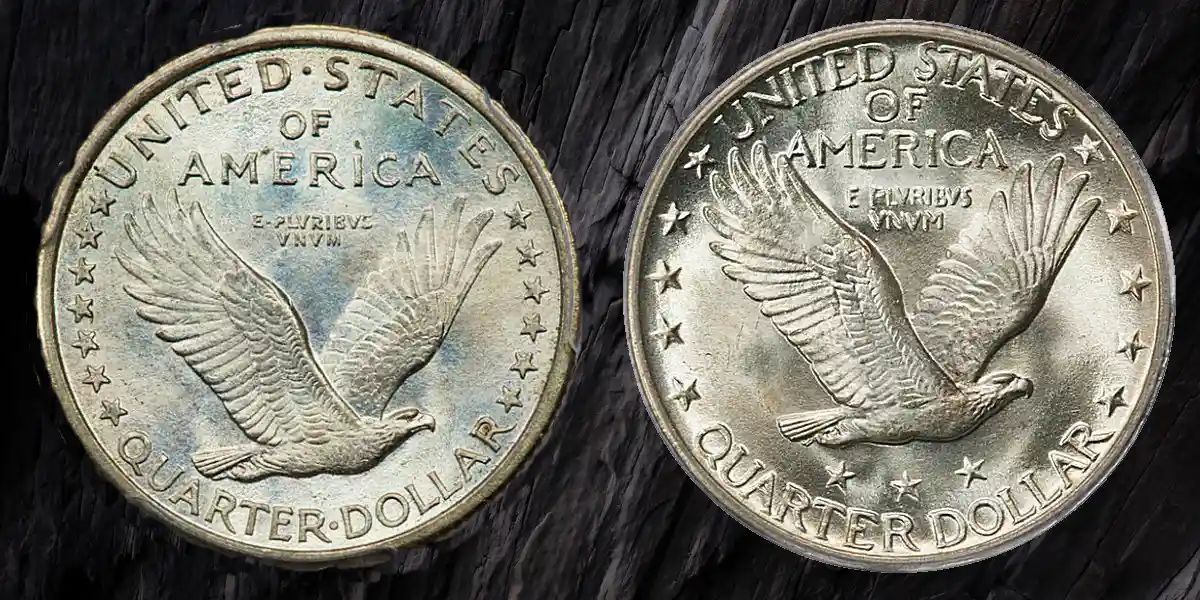
On Type 1 coins, thirteen stars flank the eagle, with seven on the left and six on the right. None appear beneath the bird.
By contrast, Type 2 quarters place three stars below the eagle. The remaining ten stars flank it.
This distinction allows collectors to identify the design even when wear obscures some obverse details.
The Philadelphia Mint produced 8,740,000 Type 1 quarters dated 1917. Denver struck another 1,509,200, while San Francisco produced 1,952,000.
Altogether, the three facilities struck 12,201,200 Type 1 quarters bearing the 1917 date.
These numbers also explain the coin’s appeal to type collectors.
The 1916 Standing Liberty quarter had a mintage of just 52,000. In contrast, the much larger 1917 output gives collectors a more accessible opportunity to acquire MacNeil’s original design.
However, finding an attractive example with exceptional surfaces and a sharp strike presents a different challenge.
Why Collectors Prize the Full Head
Standing Liberty quarters have long attracted collectors who study the smallest details of a coin’s strike.
One designation carries particular importance: Full Head, or FH.
On the 1917 Type 1 quarter, PCGS looks for sharp, distinct separation between Liberty’s hair cords and her cap. The 1917 Type 1 features stronger head details than its 1916 predecessor.
As a result, Full Head examples occur more frequently than on many later issues.
Still, the designation tells only part of the story.
Collectors also examine the rivets on Liberty’s shield, the definition of her gown, the eagle’s feathers, surface preservation, and original mint luster.
A coin can earn the Full Head designation without displaying an equally complete strike across every other design feature.
Furthermore, exceptional toning and strong eye appeal can influence demand well beyond the numerical grade.
For serious collectors, the best examples combine sharpness, originality, and visual character.
From 25 Cents to $26,840: The 1917 Quarter at Auction in 2026
More than a century after the redesign, the original Standing Liberty quarter continues to attract attention in major auctions.
A Philadelphia Type 1 example graded PCGS Type One MS67+ Full Head, with CAC approval, realized $26,840 at Heritage Auctions on March 28, 2026. and a Type 2 example graded 1917 25C Type Two MS67 Full Head PCGS. CAC. realized $29,280 at Heritage on May2.
The price demonstrated the strength of collector demand for a high-end example of the original design and changed design.
However, not every Superb Gem commands a five-figure price.
On May 2, Heritage sold another Philadelphia Type 1, graded PCGS MS67 Full Head with CAC approval, for $10,370. The difference illustrates how strongly the market can respond to individual grade levels and other quality characteristics.
An especially interesting example appeared during Heritage’s August 31, 2026, ANA auction session.
The NGC MS67 Full Head quarter came from the Costa Family Collection, Part III. Earlier owners included noted Standing Liberty quarter specialist Jay Cline, whose work helped generations of collectors understand the series.
Despite that distinguished pedigree, the coin realized $4,148.
The sale shows why buyers must evaluate individual specimens rather than assume that every Full Head coin will command a similar price.
Meanwhile, more accessible examples continue to trade at much lower levels. On September 22, 2026, Heritage sold an NGC MS63 Full Head example for $585.60.
The Denver and San Francisco issues also remain important. During Heritage’s October 8, 2026, auction session, a PCGS MS67 Full Head 1917-D Type 1 brought $10,980. An NGC MS67 Full Head 1917-S Type 1 realized $5,612.
These results represent individual auction transactions, including buyers’ premiums. They do not establish fixed values for other coins.
For perspective, the PCGS auction record for the Philadelphia 1917 Type 1 Full Head issue remains $32,900, set at Heritage in January 2016.
A Small Piece of Silver With a Remarkable History
The 1917 Standing Liberty Quarter Type 1 contains 90% silver and 10% copper. It weighs 6.25 grams, measures 24.3 millimeters in diameter, and has a reeded edge. Hermon Atkins MacNeil designed both sides.
Yet those specifications reveal little about what makes the coin special.
The original Standing Liberty quarter appeared during an extraordinary transformation in American history. Its design reflected the hopes of a nation that wanted peace while preparing for the possibility of war.
Then the country entered that war, and the Mint changed the coin.
Today, collectors can hold both versions of Liberty in their hands. One preserves MacNeil’s earlier classical vision. The other reflects a more armored interpretation of the same national symbol.
Few American coins tell that story so clearly.
The 1917 quarter did more than circulate through the nation’s economy. It captured a moment when America’s understanding of its own place in the world was changing.
And that makes the first design worth studying, even for collectors who may never pursue a five-figure example.
For detailed grading information, certified populations, notable specimens, and additional historical auction results, see CoinWeek’s 1917 Standing Liberty Quarter Type 1 Collector’s Guide.