Family Collection Reveals First Certified 1824/1 Proof Half Dollar
A newly certified 1824/1 Proof Capped Bust half dollar has emerged from a long-held family collection, and it is already reshaping expectations for the series.
Professional Coin Grading Service (PCGS) graded the coin PR63 and attributed it to the Overton-101 (O-101) overdate variety. Scotsman Coin & Jewelry will offer the piece as Lot 725 in its Midwest Summer Sale 2026. Bidding opens July 22 and closes August 7.
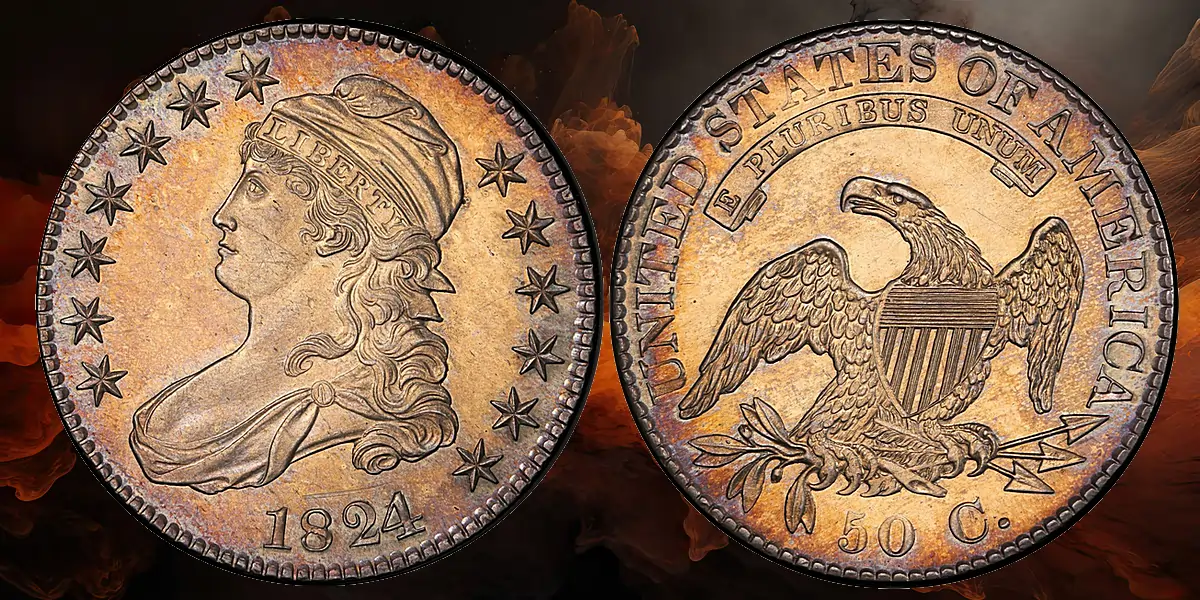
Scotsman describes the coin as the first known certified Proof 1824/1 half dollar and places a conservative estimate of $75,000 to $90,000 on the lot.
“This is an astonishing discovery coin,” said Scotsman Vice President John B. Woodside.
A Half-Century in the Opa Collection
According to Scotsman, the coin belongs to the Opa Collection, a group assembled by a Midwest collector more than 50 years ago. The family reports that the collector acquired this half dollar in 1972.
After his death, his heirs consigned the coins to Scotsman in raw form, meaning they had never been certified by a third-party grading service. Scotsman then submitted the collection to PCGS.
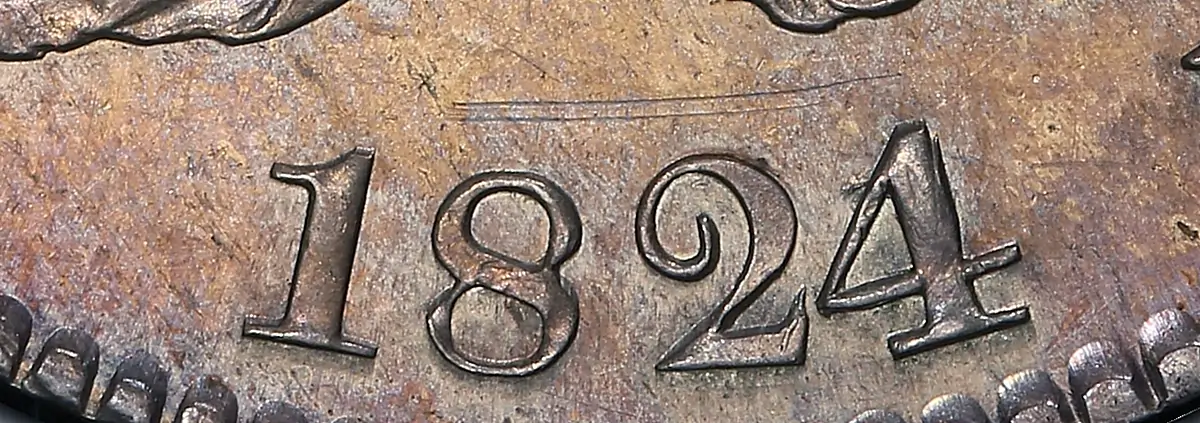
PCGS identified the coin as an 1824/1 O-101 overdate and graded it PR63. The final “4” in the date is struck over an underlying “1.”
The timing matters. The collector bought the coin 14 years before PCGS opened in 1986 and 15 years before NGC launched in 1987, which explains why it remained uncertified for decades.
Why the “First Certified Proof” Distinction Matters
PCGS CoinFacts estimates that roughly 750 circulation-strike examples of the 1824/1 half dollar survive across all grades and varieties, including O-101, O-101a, and O-102.
Scotsman reports that it found no previously certified Proof examples at PCGS, NGC, or other major services. PCGS has now created a separate Proof issue (No. 917255) for the type.
However, one historical record complicates the broader claim. PCGS’s database includes a March 2002 Stack’s auction listing described as “PR,” but without a grading service or certification number.
As a result, the strongest evidence supports this conclusion:
This coin is the first known certified Proof example, even if earlier coins may have been described as Proofs without modern authentication.
Evidence for a Proof Strike
Scotsman cataloger James Garcia identifies the coin as an early “perfect dies” O-101 state, a term specialists use for a die before it develops cracks. The later O-101a state shows a reverse crack through the tops of UNITED, which this coin does not display.
Garcia also emphasizes the coin’s strike quality. He points to threadlike detail in Liberty’s hair beneath the cap and argues that only multiple strikes in an open collar could produce that level of sharpness.
At the same time, the catalog acknowledges slight weakness at the eagle’s left talon, nearby stem, and the top of 50. Garcia suggests planchet preparation as a possible cause. Importantly, Scotsman notes that these conclusions represent cataloger opinion and invite further research.
An Overdate That Raises Bigger Questions
The overdate itself invites deeper study. Why did Mint workers use an obverse die originally prepared for 1821 to strike a Proof dated 1824?
Garcia also asks why the Mint chose that die instead of one from 1823 or 1822. Still, several Proof issues from 1824 provide precedent. Researchers recognize Proof examples of:
- 1824 cent,
- 1824/2 dime,
- 1824/2 quarter, and
- 1824/1 quarter eagle.
Circulation-strike 1824/2 large cents also exist. Meanwhile, the Mint struck no half cents from 1812 through 1824.
Therefore, a more accurate follow-up question emerges: Could a Proof 1824/2 large cent still await discovery?
“Look at This Beauty”
The collector’s heirs requested anonymity, but they shared the emotional impact of the discovery.
They said they felt “deeply honored and humbled” when PCGS graded the coin. They also described it as the finest known example, with no higher-graded specimen currently reported.
Their father began collecting at age 14 and spent a lifetime studying American numismatics. He focused on the history, artistry, and stories behind each coin.
The family believes he understood the coin’s importance but never submitted it for grading. As a result, the discovery after his passing feels both remarkable and bittersweet.
Whenever he showed a special coin, he would smile and say, “Look at this beauty.”
His heirs say those words captured his lifelong passion for discovering and preserving numismatic treasures.
Auction Details
Scotsman will offer the 1824/1 Proof Capped Bust half dollar (Lot 725) in its Midwest Summer Sale 2026.
- Bidding opens: July 22, 2026
- Auction closes: August 7, 2026
- Estimate: $75,000–$90,000
For additional information, contact Scotsman Coin & Jewelry at 314-692-2646 or [email protected].