


Paradime is offering this 1879 Gilt Stella – Looks Like Gold, but Its Real Story Is Better
At first glance, the 1879 Coiled Hair Stella gilt pattern looks like one of America’s greatest gold rarities.
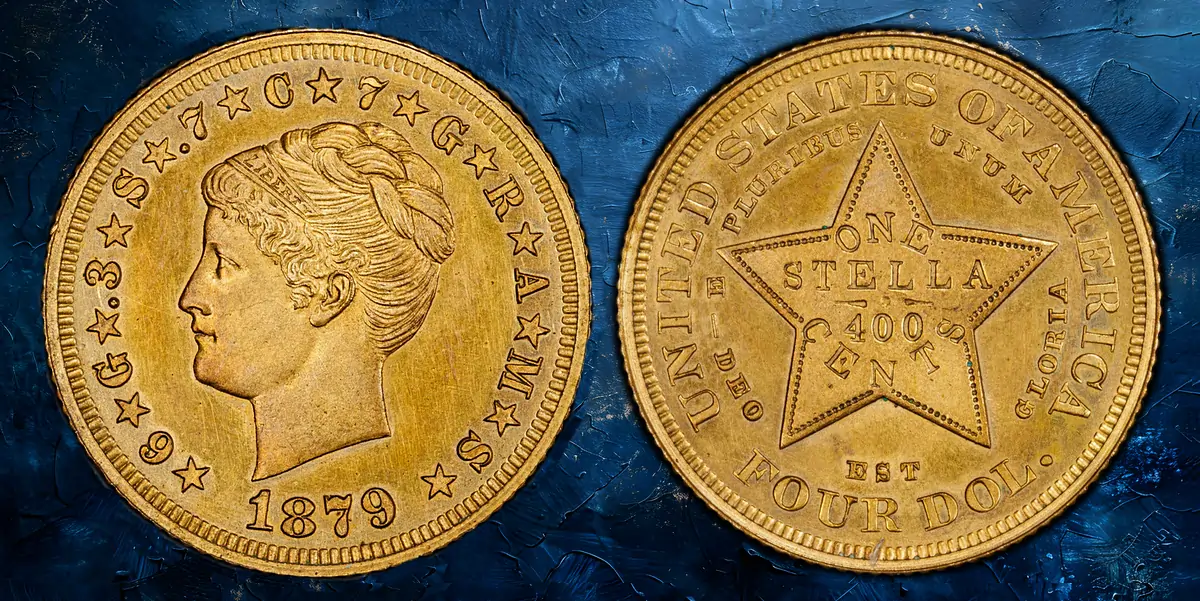
Its warm golden surfaces frame George T. Morgan’s elegant portrait of Liberty. Meanwhile, a large star dominates the reverse. Even the obverse announces a precise formula that includes six grams of gold.
Yet copper forms the coin’s core.
That contradiction does not diminish this remarkable pattern. Instead, it makes the coin more revealing. The gilt Stella shows how the United States Mint used design, metallurgy, and presentation to sell Congress on an international coinage experiment.
It also offers collectors something unusual. The coin recreates the appearance of a million-dollar gold Stella. However, it tells a story that the solid-gold version cannot.
America’s Proposed International Gold Coin
During the late 1870s, American travelers faced a complicated monetary world. Each European nation used its own coins, values, and exchange rates.
Several European countries had already joined the Latin Monetary Union. The agreement standardized the weight and fineness of certain gold and silver coins. As a result, merchants could accept those coins across national borders with fewer calculations.
John A. Kasson, a former congressman then serving as the United States minister to Austria-Hungary, promoted a similar idea for the United States. He wanted an American gold coin that could move more easily through international commerce.
Dr. William Wheeler Hubbell supplied the metallic concept. His patented alloy combined gold, silver, and copper. Alexander H. Stephens, chairman of the House Committee on Coinage, Weights, and Measures, then pressed Treasury Secretary John Sherman to produce patterns for congressional review.
The proposed coin carried a value of four dollars. Its creators called it the Stella, the Latin word for “star.”
However, the plan contained a serious flaw. The stated formula did not align perfectly with Latin Monetary Union standards. PCGS calculates that the proposed metallic content produced an intrinsic value closer to $3.85 than $4.
Therefore, the Stella never became the seamless international trade coin that its promoters imagined.
A Coin That Advertised Its Own Formula
The Stella’s obverse carried one of the strangest inscriptions ever placed on a United States coin:
6 G .3 S .7 C 7 GRAMS
The inscription represented six grams of gold, three-tenths of a gram of silver, and seven-tenths of a gram of copper. Together, those metals totaled seven grams.
In other words, the coin advertised its own proposed recipe.
The reverse continued the international theme. A five-pointed star contained the words ONE STELLA 400 CENTS. The surrounding legends included E PLURIBUS UNUM, DEO EST GLORIA, UNITED STATES OF AMERICA, and FOUR DOL.
On a solid-gold Stella, the obverse formula describes the proposed alloy.
On the gilt copper version, however, the inscription creates a fascinating visual paradox. The surface looks like gold. The design announces six grams of gold. Yet copper lies beneath the thin golden exterior.
No other Stella explains the experimental nature of the project quite so clearly.
Barber and Morgan Give Liberty Two Identities
The Mint prepared two distinct Stella portraits.
Charles E. Barber created the Flowing Hair design. His Liberty wears long, loose hair that falls behind her neck.
George T. Morgan created the Coiled Hair design. His Liberty wears an elaborate braided chignon secured high at the back of her head. A small diadem carries the word LIBERTY.

Morgan already held an important place at the Mint. He had designed the Morgan Dollar, which entered production in 1878. Yet the Coiled Hair Stella shows a different side of his artistic range.
The portrait feels formal and controlled. The intricate hairstyle also reflects upper-class Victorian fashion. Consequently, Morgan’s Liberty looks more like a carefully modeled society portrait than a figure intended for everyday commerce.
Barber designed the shared reverse. Therefore, the Coiled Hair Stella combines Morgan’s obverse portrait with Barber’s bold star motif.
The 1879 Date Hides an 1880 Production Story
The date suggests that the Mint produced the coins in 1879. However, the production record tells a more complicated story.
The Philadelphia Mint struck the first 40 Stella sets on a medal press in January 1880. Congress then requested another 100 sets in March. Mint workers eventually produced several hundred additional 1879 Flowing Hair examples to satisfy interest among lawmakers and government officials.
Morgan’s Coiled Hair design never received similar production.
Researchers estimate that the Mint struck only about 20 gold 1879 Coiled Hair Stellas. Current scholarship documents roughly 13 to 15 survivors. That figure makes the gold Judd-1638 one of the great rarities of 19th-century American numismatics.
Yet the gilt copper coins may prove just as elusive.
Judd-1639, Judd-1639a, and the Gilt Stella Question
The Mint also produced copper impressions from the Coiled Hair dies.
The standard Judd reference identifies those copper patterns as Judd-1639, with the corresponding Pollock number Pollock-1839. Collectors often shorten the attribution to J-1639.
However, cataloging practices vary when a coin carries a gold coating. PCGS often separates the gilt version under the expanded attribution Judd-1639a and service number 92017. Meanwhile, NGC, dealers, and auction houses frequently describe the same gilt type as Judd-1639 Gilt.
Therefore, collectors may encounter both numbers.
The distinction matters. A standard J-1639 retains its natural copper surface and may receive a Brown, Red Brown, or occasionally Red color designation. A gilt example carries a thin golden coating that transforms its appearance.
It does not become a gold Stella. Instead, it remains a copper pattern with a gilt surface.
How Rare Are the Gilt Coiled Hair Stellas?
Stack’s Bowers Galleries cites research by pattern specialist Saul Teichman that traces only 11 or 12 distinct copper examples of the 1879 Coiled Hair Stella. At least eight carry gilt surfaces. Two copper examples reside in institutional collections at the Smithsonian Institution and the Connecticut State Library.
Those numbers could change.
In June 2026, Stack’s Bowers offered a newly identified copper J-1639 that did not appear in the existing Teichman census. That discovery shows why researchers must treat pattern populations as continuing projects rather than permanent totals.
Even so, the evidence supports one important conclusion. The gilt Coiled Hair Stella does not represent a common or inexpensive substitute for the gold coin.
Researchers document roughly as many copper examples as gold examples. The gilt subset may include fewer than 10 distinct coins.
The Featured Proof-63 NGC CAC Stella
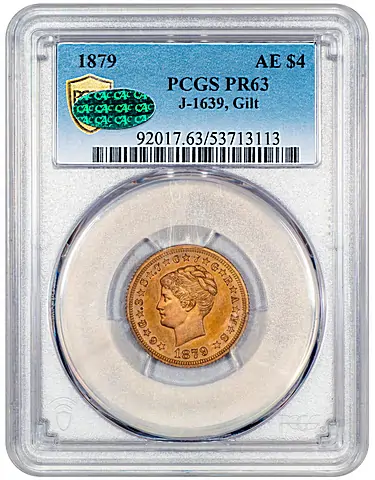
The featured 1879 Coiled Hair Stella carries a Proof-63 grade from NGC and approval from CAC.
Paradime Coins recently listed this coin for sale. Hurry it is going to go quickly!
Its appearance immediately explains the appeal of the gilt format.
Warm orange-gold and amber shades cover the highest portions of Morgan’s portrait. Meanwhile, reddish-gold and burnished chestnut tones gather within the recesses. Subtle olive-gold accents appear near the rims and surrounding devices.
Angled light reveals a mix of softly reflective fields and more satiny areas. Liberty’s braided hair remains sharply defined. The star and interior lettering also show strong detail.
Most importantly, the coin still looks cohesive. The gilt surface has aged rather than appearing newly plated or unnaturally bright.
That visual maturity separates an important 19th-century gilt pattern from a modern gold-colored novelty.
Auction Records Show Two Different Markets
Solid-gold Coiled Hair Stellas occupy the highest levels of the rare coin market.
In April 2025, Heritage Auctions sold a PCGS Proof-62 1879 Coiled Hair Stella for $576,000.
Then, in May 2026, an NGC Proof-67 Cameo example reached $2,135,000. The result established a new auction record for the issue. Heritage reported only 14 documented examples at that time.
The same 2026 auction also produced an $854,000 result for an 1880 Coiled Hair Stella in NGC Proof-62. Only 10 examples of that date currently appear in published rosters.
Gilt copper examples trade in a different market.
PCGS records a Proof-64 CAC gilt J-1639a that sold for $70,200 in December 2016. The same auction archive lists a $129,250 appearance in August 2017.
Those results require context. Gilt Stellas appear so infrequently that collectors cannot rely on a deep series of recent comparable sales. Grade, color, surface quality, pedigree, and CAC approval can all create large price differences.
Nevertheless, the market comparison remains striking. A gilt Coiled Hair Stella can deliver the design, rarity, and visual impact of the famous gold type without entering the seven-figure market.
What About the Washington Bordello Story?
Few American coins carry more colorful folklore than the Stella.
A long-running story claims that members of Congress used the coins in Washington’s expensive brothels. Some versions say women working in those establishments later wore the Stellas as jewelry.
Collectors should treat that account as numismatic lore rather than proven history.
PCGS notes that several surviving Stellas show evidence of jewelry mounting. That evidence supports the narrower conclusion that owners converted some examples into pendants or other ornaments. However, it does not prove who wore them or how the coins entered Washington nightlife.
Moreover, no solid evidence directly connects the gilt J-1639 patterns to the bordello story.
The documented congressional distribution, international coinage proposal, and surviving jewelry damage already provide enough drama. The story does not need embellishment.
Why the Gilt Stella Deserves More Respect
Collectors sometimes describe gilt patterns as substitutes for coins struck in gold.
That view misses the larger point.
The gold Judd-1638 represents the Stella proposal in its intended metallic form. The gilt Judd-1639 represents the same idea as a presentation object. Its gold-colored exterior gave viewers the appearance of the proposed coin while its copper core reduced the cost of experimental production.
In addition, the gilt pattern captures the central contradiction behind the Stella program. The coin promised international practicality. Yet Congress never adopted it. Its inscription promised a precise gold alloy. Yet the gilt version concealed copper beneath its surface.
Therefore, the gilt Stella does more than imitate gold. It exposes how pattern coins worked.
They served as prototypes, political tools, artistic demonstrations, and collector objects. They did not always follow the same rules as circulating money.
A Coiled Hair Stella for an Advanced Type Set
Collectors often include Stellas alongside regular-issue United States gold denominations, even though the Mint created them as patterns.
A collector who wants the full four-dollar design story needs both the Flowing Hair and Coiled Hair portraits. However, a solid-gold Coiled Hair example now demands a high-six-figure or seven-figure budget.
A gilt J-1639 offers another path.
It provides the complete Morgan design. It also carries extraordinary rarity and undeniable historical importance. However, owners and sellers must describe it accurately as a copper pattern with a gilt surface.
That distinction does not weaken the coin.
It defines the coin.
The Stella’s Most Revealing Version
Congress rejected the four-dollar denomination. The United States never joined the proposed international system. Travelers never carried Stellas through European markets.
Still, the Stella became one of America’s most famous numismatic experiments.
The gilt 1879 Coiled Hair Stella may offer the clearest explanation of why.
It looks like gold, carries a gold formula and presents one of George T. Morgan’s finest portraits. Yet copper forms its foundation.
That tension transforms the coin from a less expensive version of a gold rarity into something far more interesting: a surviving artifact from the moment when the United States tried to create an international currency and dressed an experimental idea in gold.





I have always liked Stellas since I saw a complete set of them at a Coin Convention held in downtown Detroit back in the early 1960’s!!! They were part of a large collection on display owned by a wealthy plumbing contractor!!!
$4 Stella Gold Coin – my favorite US minted coin. I did not know about the gilted copper version. Your site provides so much history and facts. Thanks
You can never stop learning about our coin history.