


The Only Gold CAC Mint State 1796 Quarter Heads to Auction
A remarkable 1796 Draped Bust Quarter will offer collectors a rare combination of history, condition, and exceptional third-party approval.
Stack’s Bowers Galleries will present the coin as a Browning-2, High 6 variety graded NGC MS-62. It also carries a gold CAC sticker and a CMQ-X designation. Moreover, it comes from the Charles “Cheech” Litman Collection.
That combination sets this coin apart.
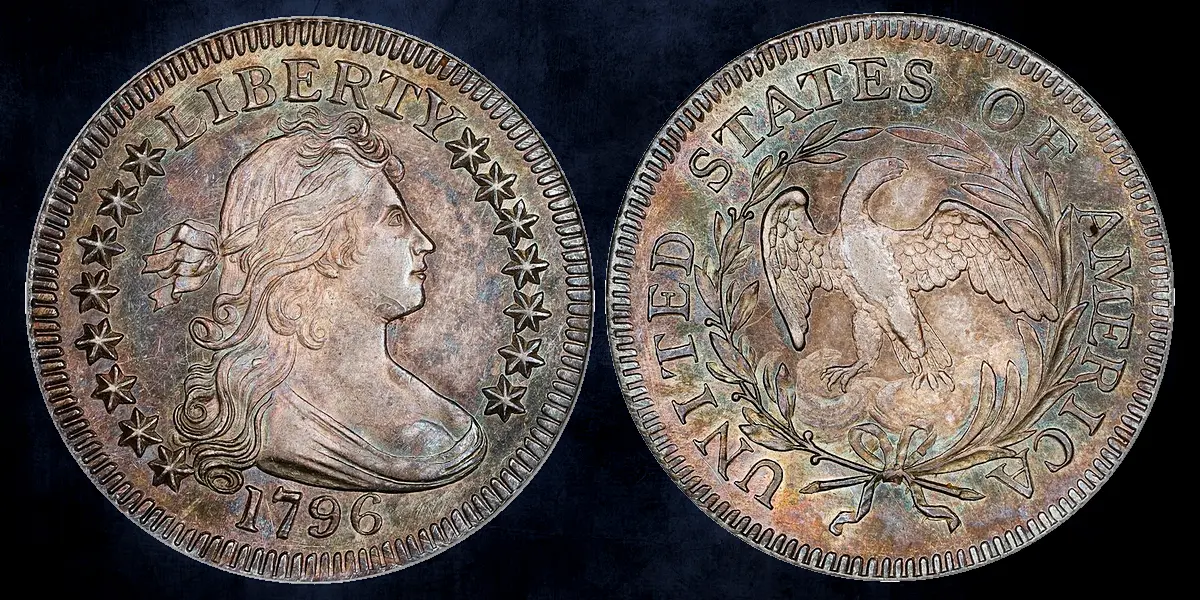
According to the auction catalog, CAC has awarded gold stickers to only two 1796 quarters in all grades. One grades AU-50. The Litman coin grades MS-62. Therefore, it stands as the only Mint State 1796 quarter with gold CAC approval reported by the catalog.
For one of America’s most important early silver coins, that distinction creates a major auction event.
America’s First Quarter Dollar
Congress authorized the quarter dollar through the Coinage Act of April 2, 1792. However, the United States Mint did not strike quarters for circulation until 1796.
The delay reflected the unusual structure of the early Mint. Private depositors brought silver and gold bullion to the facility. They could then request specific denominations. Yet few depositors wanted quarters.
Spanish colonial two-real coins already circulated widely in the young United States. Americans commonly called them “two bits.” Since those coins carried roughly the same value as a quarter, commerce had little immediate need for a federal replacement.
As a result, the Philadelphia Mint produced only 6,146 quarters bearing the 1796 date.
The Mint delivered the coins in four groups. It released 1,800 pieces on April 9, 1796. Another 2,530 followed on May 27. Then, the Mint delivered 1,564 coins on June 14. Finally, it recorded a delivery of 252 additional 1796-dated quarters on February 28, 1797.
After that final delivery, quarter production stopped. The Mint did not strike another quarter dollar until 1804.
A One-Year Design Type With No Second Chance
The 1796 quarter carries Robert Scot’s Draped Bust portrait of Liberty on the obverse. Fifteen stars surround the portrait. Eight appear to the left, while seven appear to the right.
The reverse shows a small eagle perched on clouds. Laurel and palm branches surround the bird. The inscription UNITED STATES OF AMERICA follows the border. The coin carries no denomination. Early Americans had to recognize silver coins by their size, weight, and familiar designs.
This design appeared on no other quarter.
When the Mint resumed quarter production in 1804, it retained the Draped Bust obverse. However, it replaced the Small Eagle with the larger Heraldic Eagle design.
Consequently, the 1796 quarter holds two major distinctions. It became the first federal quarter dollar. It also became the only quarter with the Draped Bust and Small Eagle combination.
In fact, it remains the only United States quarter struck during the 18th century.
Every complete United States type set needs one. However, the Mint made only 6,146 examples. That conflict between supply and demand has driven intense collector interest for generations.
The Browning-2 “High 6” Variety
The Philadelphia Mint used two obverse dies and one shared reverse die to produce the entire issue. Numismatists identify the resulting die marriages as Browning-1 and Browning-2.
The auction coin represents Browning-2, or B-2. Specialists classify it as Rarity-3. It survives more often than the B-1, although both varieties remain scarce.
Collectors call B-2 the “High 6” variety. The final digit in the date sits unusually close to the bottom of Liberty’s bust. By contrast, the B-1 variety carries the familiar “Low 6” designation.
Other details also identify the B-2. The word LIBERTY sits slightly farther left. In addition, the second curl of Liberty’s hair aligns beneath the lower arm of the letter E. Star 13 also rests farther from the bust than it does on B-1 examples.
Modern research suggests that the Mint used the B-2 marriage first. The variety likely accounted for the April and May deliveries. The obverse die later developed cracks and eventually shattered. The Mint then turned to the scarcer B-1 obverse.
A Mint State Survivor With Original Character
Most surviving 1796 quarters entered circulation. Many show heavy wear. Others display adjustment marks, weak details, or surface problems that reflect the difficult conditions inside the early Philadelphia Mint.
Mint State coins occupy a far different level of rarity.
PCGS estimates that perhaps 50 to 60 examples survive in Mint State. The grading service also notes that many high-grade survivors belong to the B-2 variety.
The Litman coin offers strong visual appeal for its assigned NGC MS-62 grade. Rich, original patina covers both sides. Under direct lighting, the surfaces reveal a varied range of color.
The Mint centered the strike well. Most design elements show sharp definition. Some softness appears on the eagle’s head, breast, and left leg. However, those areas often show weakness on 1796 quarters.
The surfaces also appear unusually smooth for the grade. In addition, the coin displays frosty texture with traces of semi-reflective character. Prooflike and semi-prooflike surfaces appear on several Mint State 1796 quarters, likely because Mint workers polished the dies before striking the coins.
Why the Gold CAC Sticker Matters
CAC uses a green sticker to identify a coin that it considers solid or premium for its assigned grade.
A gold sticker carries a stronger judgment. CAC states that a gold-stickered coin exceeds the grade printed on its holder. The company also says such a coin would qualify for a green sticker at the next numeric grade.
Therefore, the gold CAC sticker on this NGC MS-62 quarter indicates quality beyond the assigned grade.
The auction catalog reports only two gold CAC-stickered 1796 quarters in all grades. The other example grades AU-50. That makes the Litman coin the only reported Mint State example with a gold CAC sticker.
The coin also carries the CMQ-X designation. Collectible Market Qualified reserves CMQ-X approval for a small percentage of coins that its reviewers consider exceptional within their certified grades.
Together, the NGC grade, gold CAC sticker, and CMQ-X approval present three separate assessments of the coin’s quality.
A Rarity Built for an Advanced Type Set
The 1796 quarter does not need a famous pedigree or a lofty grade to attract attention. Its status as America’s first quarter and a one-year design type already guarantees demand.
However, this example adds several important layers.
It survives in Mint State, and represents the more available but still scarce B-2 High 6 variety. It carries original toning. Moreover, it holds the only Mint State gold CAC approval reported for the issue.
According to the auction catalog, the NGC Census for both 1796 die marriages lists five coins in MS-62 and 23 finer. The finest NGC-certified example carries a grade of MS-66 Star. Population reports remain subject to change because of new submissions, crossovers, and resubmissions.
For most collectors, any problem-free 1796 quarter represents a major acquisition. A Mint State example reaches a much smaller audience. Meanwhile, a gold CAC-stickered Mint State coin enters territory that few collectors will ever encounter.
The Charles “Cheech” Litman specimen brings all those qualities together in one historic silver coin.
It does not simply fill a hole in a type set. It marks the moment when the United States finally placed its own quarter dollar into circulation.
1796 Draped Bust Quarter Specifications
- Country: United States
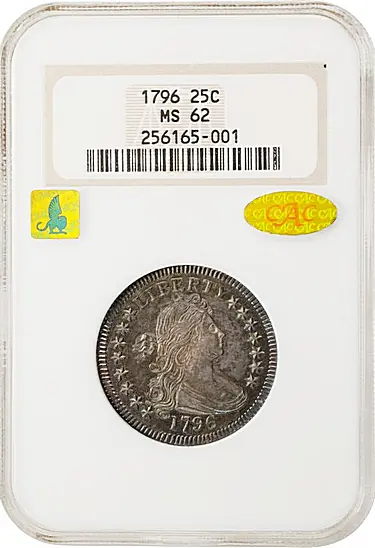
1796 Draped Bust Quarter. B-2. Rarity-3. MS-62 (NGC). Gold CAC. - Year: 1796
- Denomination: Quarter Dollar
- Face Value: 25 Cents
- Mint: Philadelphia
- Mintmark: None
- Mintage: 6,146
- Designer and Engraver: Robert Scot
- Composition: 89.24% silver and 10.76% copper
- Weight: 6.74 grams
- Diameter: 27.5 mm
- Edge: Reeded
- Obverse: Draped Bust Liberty
- Reverse: Small Eagle
- Variety: Browning-2, High 6
- Rarity Rating: Rarity-3
- Grade: NGC MS-62
- Additional Approvals: Gold CAC and CMQ-X
- PCGS Number: 5310
- NGC ID: 23RA




Beautiful quarter! Gold CAC – Amazing!
Great article as usual.
Obtaining a 1796 Draped Bust quarter has been on my Bucket List for a long time. Still don’t have one, and the rate I’m going now it will never happen. :(
Very interesting article. I would love to own a coin like that one.