


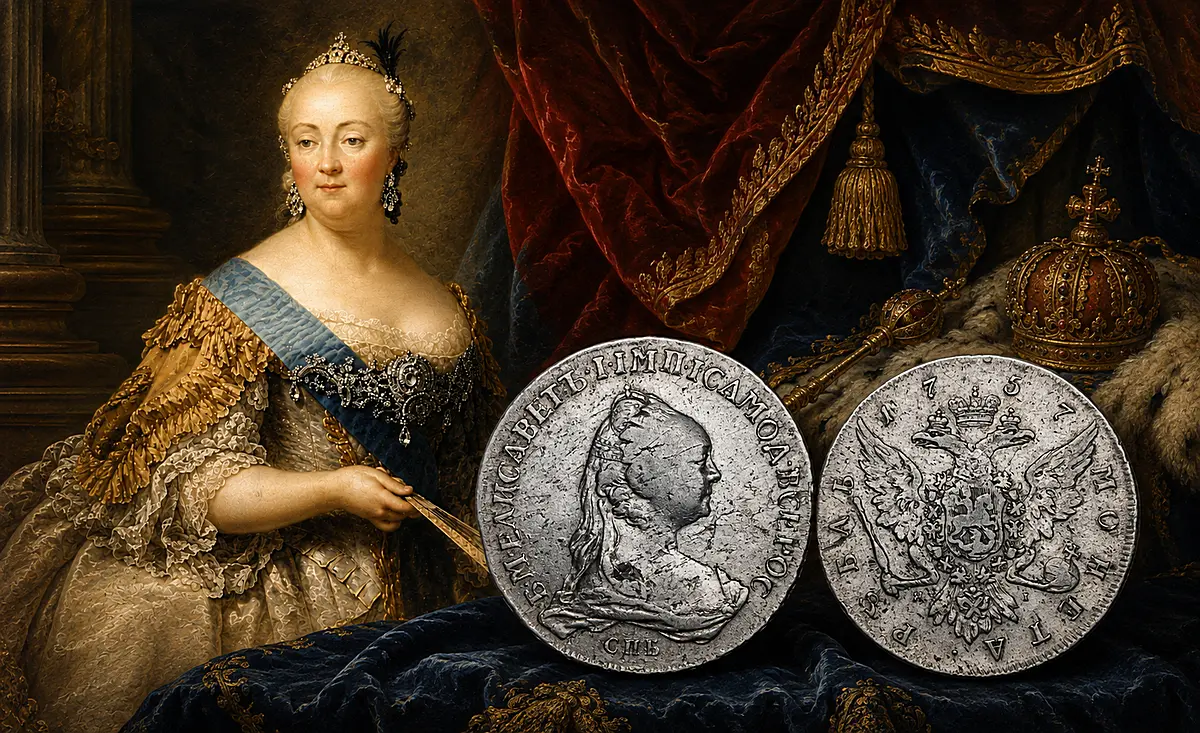
Elizabeth Hated This 1757 Rouble Portrait. Collectors Now Call It a Masterpiece
For a brief moment in 1757, one of Europe’s greatest medallists transformed the Russian silver rouble.
Then Empress Elizabeth changed her mind.
The Saint Petersburg Mint halted the new design after only about three months. As a result, Jacques-Antoine Dassier’s elegant portrait became one of the great rarities of Imperial Russian numismatics.
Collectors now prize the 1757 Dassier Rouble for more than scarcity. The coin captures a decisive moment in Russian art. It also records a clash between European neoclassical taste, imperial expectations, and the hard limits of 18th-century minting technology.
Moreover, the story still holds mysteries. Researchers continue to debate why Elizabeth rejected the portrait. They also study several die combinations, unusual trial pieces, and a second Dassier rouble that disappeared after the mint submitted it for approval.
Peter the Great Looks West
Russia had recruited foreign engravers long before Dassier arrived in Saint Petersburg.
Peter the Great began that policy as he modernized the Russian monetary system. He needed specialists who understood European die making, machinery, portraiture, and medallic relief.
Jean-Georg Breuer, also known in Russian records as Jagan Breuer, helped establish gold chervonets production at Moscow’s Kadashevsky Mint in 1701. That facility struck Russia’s first regular gold chervonets during Peter’s reforms. Researcher I.V. Shiryakov has examined Breuer’s role in that project.
Other European artists soon followed. French-born Solomon Gouin and Saxon engraver Gottfried Haupt produced important coin and medal dies during Peter’s reign. Haupt also helped train Russian craftsmen. Their work helped establish the foundations of Russia’s medallic tradition, although foreign specialists continued to play major roles for decades.
Benjamin Scott Gives Elizabeth a Familiar Face
By the mid-1750s, the Saint Petersburg Mint used a portrait of Elizabeth created by Scottish engraver Benjamin Scott.
Scott had entered Russian service under a four-year contract in 1748. His portrait appeared on Saint Petersburg roubles beginning in 1754. It showed the empress in a formal imperial style, complete with elaborate dress, jewelry, and carefully arranged hair.
However, the court soon searched for a fresh artistic approach.
That search led to Jacques-Antoine Dassier.
A European Celebrity Comes to Russia
Dassier belonged to a celebrated Genevan family of medallists. He trained in Paris and Italy before moving to London. There, he joined the Royal Mint’s engraving staff in 1741.
He also produced a famous medal series that portrayed prominent British intellectuals and public figures. Subjects included Alexander Pope, Edmond Halley, Abraham de Moivre, Sir Hans Sloane, and Sir Robert Walpole. The British Museum describes the group as a famous series of contemporary English intellectuals.
On August 3, 1756, Russian representatives and Dassier signed a two-year contract in London. The agreement required him to cut coin and medal dies. In addition, he had to teach Russian students and help locate a skilled steelworker.
His annual salary reached 2,500 roubles. Russia also covered travel expenses and provided money for an assistant. After two years, Dassier negotiated an even larger salary.
The contract also required Dassier to use steel imported from London and Germany. Russia already excelled at iron casting and general metalworking. However, mint engravers needed exceptionally durable tool steel. Fine portrait dies had to survive repeated blows without quickly losing their sharpest details.
Dassier’s salary certainly offered an incentive. Yet money may not tell the whole story. His family already operated a successful Genevan workshop. Russia also gave him a rare artistic opportunity. He could create imperial portraits for one of Europe’s largest and most mysterious courts.
No surviving document, however, proves that romantic curiosity motivated him.
Elizabeth Initially Approves the New Rouble
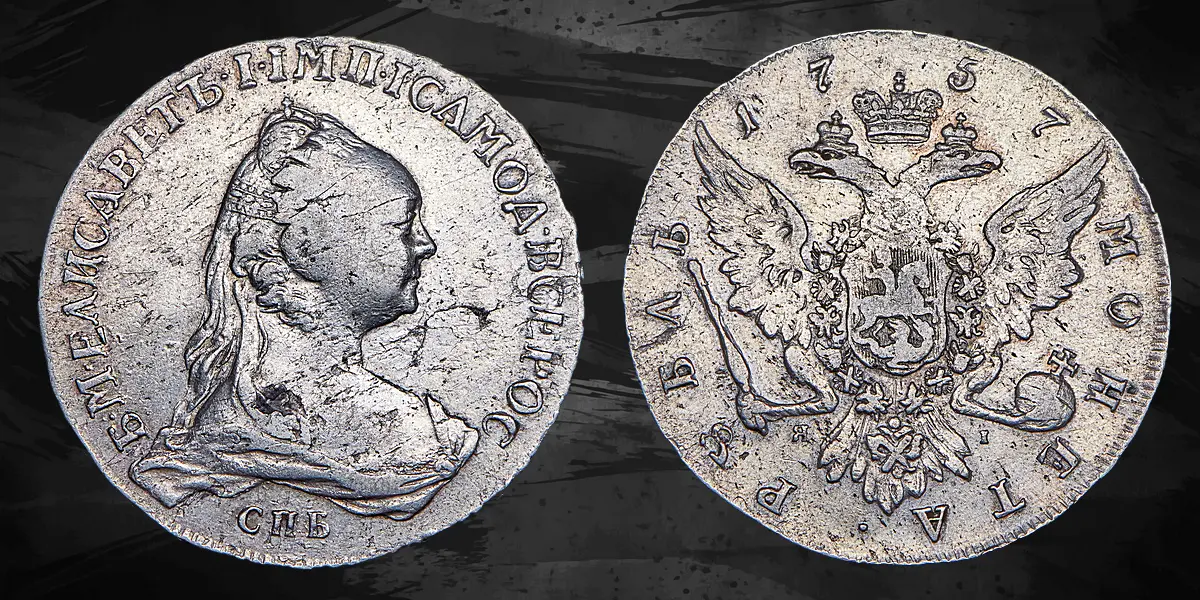
In July 1757, the Mint Chancellery sent the Senate a trial rouble struck from Dassier’s new die.
The portrait broke sharply with Scott’s established design. Dassier gave Elizabeth a large, right-facing bust. Loose curls flowed across her shoulders. A small crown sat above her hair. Meanwhile, light classical drapery replaced the heavy imperial costume that collectors saw on earlier roubles.
The result looked less like a formal state portrait and more like an antique heroine rendered in silver.
Elizabeth initially approved the design. By early August, the court had authorized the mint to strike roubles from the new dies.
Then the empress reversed her decision.
On November 10, 1757, Elizabeth ordered the mint to set the die aside. She instructed Dassier to prepare another portrait with clothing and ornaments similar to those on Scott’s 1755 roubles. Consequently, the Saint Petersburg Mint used the Dassier type for only about three months.
Did the Empress Dislike Her Ears?
The surviving records document Elizabeth’s rejection. However, they do not explain her precise objection.
Later numismatic lore supplied a colorful answer.
According to one story, Dassier portrayed Elizabeth’s ears too accurately. The empress supposedly considered them too large and preferred hairstyles that concealed them.
Another account claims that she disliked the portrait’s freely flowing curls. Court appearances demanded careful grooming, rich fabrics, and controlled imperial splendor. Dassier instead created an intimate and almost informal image.
Collectors should treat both stories as legends. No known decree mentions Elizabeth’s ears or curls.
Minting technology offers a more practical explanation. Dassier modeled the portrait in unusually high relief. Therefore, ordinary striking pressure may not have brought up the full design. Surviving examples often show softness in Elizabeth’s hair and other high points.
Some researchers believe this production problem led the mint to abandon the type. Yet the archival order focused on the empress’s dress and adornment. Therefore, artistic preference and technical difficulty may both have influenced the decision.
A Portrait That Outlived Its Rejection
Elizabeth outlived her rejected rouble by only four years. She died on December 25, 1761, according to the Russian calendar then in use, or January 5, 1762, under the modern Gregorian calendar.
She never restored Dassier’s portrait to regular production.
Nevertheless, later scholars praised the design. Russian numismatist V.V. Uzdenikov considered it one of the finest portraits in Elizabeth’s coinage. Today, many specialists rank it among the most expressive imperial portraits ever placed on a Russian circulation coin.
The irony gives the coin much of its appeal. Elizabeth rejected the image. Collectors later celebrated it as a masterpiece.
Design of the 1757 Dassier Rouble
The obverse presents a large bust of Elizabeth facing right. A small crown rises above her hair, while long curls fall behind her shoulder.
The surrounding legend abbreviates:
Б.М. ЕЛИСАВЕТЪ I ИМП. I САМОД. ВСЕРОС.
The inscription translates as: “By the Grace of God, Elizabeth I, Empress and Autocrat of All Russia.”
The mintmark СПБ, for Saint Petersburg, appears below the bust.
The reverse displays the crowned double-headed eagle of the Russian Empire. Three crowns appear above the eagle. A shield on its breast depicts St. George slaying the dragon.
The eagle grips a scepter and orb. Meanwhile, the chain of the Order of St. Andrew surrounds the central shield. The date 1757 appears above, while the denomination appears below as МОНЕТА РУБЛЬ, or “Rouble Coin.”
The lettered edge reads:
С. ПЕТЕРБУРХСКАГО МОНЕТНАГО ДВОРА
The inscription identifies the Saint Petersburg Mint. The spelling reflects 18th-century Russian usage. Conros confirms the denomination’s .802 silver standard, 25.85-gram weight, and lettered edge.
One Design, Several Rare Varieties
At first glance, surviving Dassier roubles appear uniform. Closer study reveals several distinct die combinations.
Dassier created the principal portrait model and hub. Mint workers then prepared individual working dies. They added letters with punches, strengthened details, and adjusted the layout.
Specialist literature also identifies Andreas Cavelar as Dassier’s pupil and workshop assistant. Although documents formally described him as a student, researchers credit him with helping prepare working dies.
That production process created small but important differences. Collectors now study:
- Letter spacing and alignment
- The portrait’s position relative to the border
- The shape and placement of the date
- Mintmaster initials beneath the eagle
- Minor die defects and identifying marks
Modern researchers have described at least six principal Dassier rouble varieties. Some coins combine Dassier’s portrait with different eagle dies. In addition, rare hybrid pieces pair Benjamin Scott’s portrait with a reverse attributed to Dassier.
Grand Duke Georgii Mikhailovich singled out one especially balanced variety as No. 301 in his Corpus of Russian Coins. He called it “very rare.” On that die, the engraver gave both the portrait and legend more room. Some researchers believe Dassier personally completed more of that die’s details.
The Smithsonian’s Holed Trial Rouble
The Smithsonian Institution preserves a holed 1757 Elizabeth rouble from the Willis H. du Pont Collection.
The hole appears near the upper-left section of the obverse. Russian numismatists have connected similar holes with mint approval and archival procedures. Mint officials could thread a cord through a trial coin, attach a seal, and store it with the related paperwork.
Therefore, researchers have interpreted the Smithsonian coin as a possible official trial or reference piece. The surviving object confirms both the date and the unusual hole. However, the hole alone cannot prove every detail of its original administrative use.
The Second Dassier Rouble That Vanished
Dassier obeyed Elizabeth’s order and prepared another portrait.
On January 22, 1758, the Mint Chancellery reported that it had sent the Imperial Cabinet a new rouble struck from Dassier’s replacement die. The new portrait reportedly restored formal dress, imperial regalia, and the heavier appearance seen on Scott’s 1755 roubles.
Then the coin disappeared.
No confirmed example has entered a museum collection. No auction house has offered one. Researchers know it only through archival records.
Later Saint Petersburg roubles used portraits associated with Russian engraver Timofei Ivanov. Some specialists believe Ivanov adapted elements from Dassier’s missing replacement model. However, the absence of a confirmed trial coin prevents a final comparison.
Dassier’s Final Years

Dassier left a broader legacy during his Russian service.
He created portrait dies for the rare 1757 gold 10-rouble coin. He also produced medals connected with Ivan Shuvalov and the opening of Moscow University. His Russian portraits retained the refinement that had made his earlier European medals famous.
However, tuberculosis steadily weakened him.
Dassier left Russia by ship in the autumn of 1759. He intended to return to Western Europe, but he reached only Copenhagen. He died there later that year while staying in the home of Danish statesman Count Bernstorff.
Authoritative biographical references agree that he worked at the Russian court from 1756 through 1759, although published sources vary on the exact converted date of his death.
A Rarity Recognized for Generations
Early Russian coin catalogs already recognized the Dassier Rouble’s importance.
Petrov valued the type at 25 roubles. Ilyin assigned a value of 15 roubles. Those figures represented substantial sums when the catalogs appeared. Modern references continue to rank the coin as a major rarity, with individual die varieties receiving different rarity ratings.
Condition also matters greatly.
In January 2014, Heritage Auctions sold an NGC-graded MS64 example from the Willy Fuchs Collection for $176,250. Heritage reported that it could trace only two Mint State examples at that time.
However, the coin’s importance extends beyond auction prices.
The 1757 Dassier Rouble records Russia’s effort to absorb Europe’s finest medallic traditions. It also reveals the tension between artistic genius and imperial control. Finally, it preserves a portrait that failed to please its subject but fascinated collectors for more than two centuries.
Elizabeth dismissed the die.
History overruled her.
1757 Dassier Rouble Specifications
Country: Russian Empire
Ruler: Empress Elizabeth Petrovna
Denomination: One Rouble
Date: 1757
Mint: Saint Petersburg
Mintmark: СПБ
Mintmaster initials: Usually ЯI; rare varieties lack the initials
Designer and engraver: Jacques-Antoine Dassier
Composition: Silver
Fineness: .802 silver
Standard weight: 25.85 grams
Actual silver weight: Approximately 20.73 grams, or .6665 troy ounce
Diameter: Approximately 40–42 mm
Edge: Lettered
Production period: About three months in 1757
Mintage: No reliable separate mintage figure survives for the Dassier subtype
Major catalog references: KM-C19c.3; Davenport 1680; Bitkin 282–284; Diakov varieties 433–435






Very interesting article about a coin , I know little about.