

Did the U.S. Mint Quietly Change Coin Die Design? The 2026-P Dime May Hold the Answer

A New Look at a Fundamental Change in Coin Die Design
For nearly two centuries, United States coin dies followed a remarkably consistent engineering principle. Since 1836, the Mint has manufactured working dies with a convex spherical face rather than a flat surface. Engineers adopted this approach after discovering that flat dies suffered excessive breakage and wear. A curved die face improved metal flow during striking, lowered striking pressure, reduced stress on the dies, and ultimately extended die life. [1]
Although collectors often focus on varieties, doubled dies, and striking errors, the shape of the die itself rarely receives attention. Yet the curvature of a die influences nearly every aspect of the striking process. It affects how metal moves, how pressure distributes across the die face, and even where fatigue eventually develops.
Recent examination of the 2026-P Emerging Liberty Dime suggests the U.S. Mint may have introduced a more sophisticated approach to die curvature, one made possible by modern computer-controlled manufacturing. If correct, this represents a significant departure from more than a century of traditional die geometry. [2]
From Fixed Radius to Computer-Controlled Geometry
Historically, every denomination received a carefully engineered die radius that remained constant across the entire working face.
During the nineteenth century, Mint technicians produced this curvature through a process known as basining, using specially manufactured Radius Plates to impart the desired spherical profile. Later improvements shifted this work to the hubbing process, allowing the master hub to transfer the proper curvature directly into subsequent dies.
Today, however, the process differs substantially. Modern Computer Numerical Control (CNC) milling machines engrave master dies with extraordinary precision. Instead of relying upon a single fixed radius, engineers can program virtually any three-dimensional surface directly into the die. [2]
This capability gives the Mint far greater flexibility than earlier generations of engravers ever possessed.
Relief Determines Curvature
Before examining the 2026 dime, it is important to understand a long-established principle of die engineering.
Design Relief Dictates Die Shape
The relationship between relief and curvature has guided Mint die production for well over a century.
Simply stated:
Higher relief requires deeper die curvature to ensure proper metal flow during striking. [3]
When relief increases, the die must encourage metal to move efficiently into recessed design elements. A steeper curvature helps accomplish this task while also improving strike quality and maintaining stackability for circulating coinage.
This engineering principle has remained remarkably consistent, even as manufacturing technology evolved.
Two Different Curvatures on One Coin
The most intriguing characteristic of the 2026-P Emerging Liberty Dime is the apparent presence of two distinct die geometries rather than one continuous spherical surface.
Evidence presented through three-dimensional scanning indicates that portions of the die exhibit a traditional spherical curvature, while other areas appear to follow an exponential curvature. [4][5]
This distinction becomes possible because CNC programming no longer limits designers to a single constant radius across the die face.
Instead, different regions can receive different mathematical profiles.
That represents a dramatic change in how a working die may be engineered.
Understanding the Difference
A spherical curve behaves predictably.
Its curvature remains constant because every point shares the same radius from the sphere’s center.
An exponential curve behaves differently.
Initially, it appears comparatively flat. Then, as distance increases, the curve steepens at an accelerating rate.
This difference becomes visually apparent when the two profiles are compared.
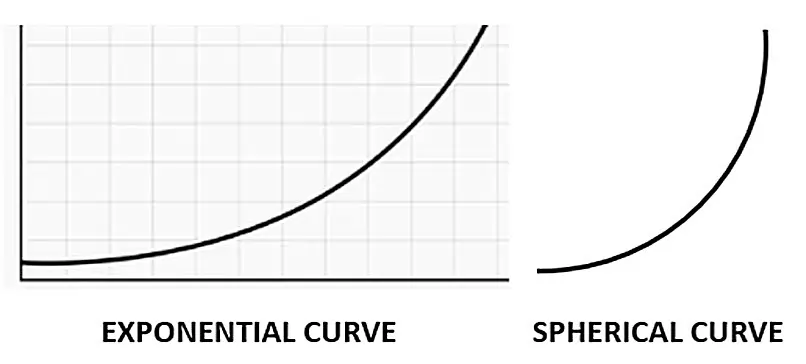
The flatter initial section of an exponential curve allows the die face to transition more gradually before rapidly increasing in slope. By contrast, the spherical curve begins increasing immediately.
That distinction becomes especially important when different portions of a coin require different metal-flow characteristics.
Transitioning Between Two Curvatures
Although discussion often refers to “two” curvatures, reality proves considerably more complex.
If one mathematical surface gradually transforms into another, the transition cannot occur abruptly. Instead, the die face passes through an almost limitless sequence of intermediate profiles before arriving at the second curvature.
This gradual transformation becomes visible in cross-sectional scans taken around the circumference of the 2026-P dime.
The images below resulted from the author’s submission of the coin to Shawn Tew of the Rabbit Hole Research Group, who arranged scanning at the Michigan State University Center for Advanced Microscopy using White-Light Interferometry / 3D Optical Profilometry.
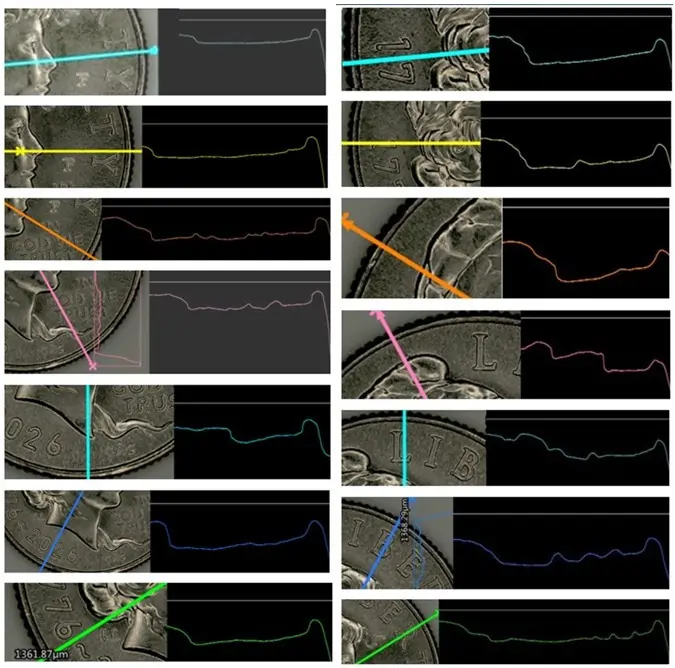
These scans reveal a continuously changing die profile rather than a single fixed-radius surface.
More importantly, they reinforce the long-standing principle that design relief governs die curvature. Higher-relief areas consistently correspond to steeper curvature, while lower-relief regions transition more gradually. The scanning data therefore supports the engineering relationship established long before the introduction of CNC technology.
Why Earlier Mint Technology Could Not Produce This Design
Before CNC machining entered Mint production, creating multiple mathematically distinct curvatures on a single die would have been impractical.
Traditional manufacturing depended upon maintaining one constant radius across the die face. Every basining operation, every radius plate, and later every hub reflected that requirement.
As a result, changing curvature locally simply was not feasible within normal production methods.
A classic example appears on the reverse of the 1909 Lincoln cent.
Cross-sectional analysis shows that its profile closely follows a 25-inch spherical radius, represented in the overlay below by the heavy black curve. [6]

This profile illustrates the consistency of traditional die geometry. The surface maintains one continuous spherical curve rather than transitioning between different mathematical forms.
Modern CNC Manufacturing Opens New Possibilities
The Mint has already demonstrated its familiarity with exponential surface geometry.
Official Mint documentation confirms the use of exponential curvatures in modern die development, including work associated with the 2021 Jefferson Nickel. [7][8]
Consequently, the appearance of exponential geometry on the 2026-P Emerging Liberty Dime should not come as a surprise.
Instead, it may represent another step in the Mint’s ongoing evolution toward highly customized die surfaces designed through advanced CNC programming rather than constrained by the limitations of fixed-radius engineering.
If this interpretation proves correct, it marks a notable advancement in modern U.S. coin die design, one that collectors, researchers, and error specialists will likely continue to study as additional evidence emerges.
How Lady Liberty’s Off-Center Portrait Influences Die Curvature
Unlike many classic U.S. coin designs, the obverse of the 2026-P Emerging Liberty Dime features a portrait positioned noticeably closer to one edge of the coin than the other. That asymmetrical layout creates an engineering challenge for die designers.
The amount of space between the portrait and the rim differs dramatically from one side of the coin to the other. Consequently, the die does not have the same distance over which to transition from the central design to the raised rim.
When this unequal spacing combines with varying relief heights, die curvature can no longer remain uniform if the goal is to optimize metal flow during striking.
Instead, different portions of the die may require different geometric solutions.
Limited Space Behind the Portrait
The area immediately behind Lady Liberty’s head presents the most restrictive conditions on the obverse.
Here, the portrait sits relatively close to the rim while also exhibiting comparatively high relief. Those two factors leave very little lateral distance for the die face to transition upward.
Under these conditions, an exponential curve would not have sufficient room to develop its gradual, flatter beginning before increasing in steepness.
Instead, a traditional spherical curvature provides the more practical solution because it begins climbing immediately and reaches the required rim height over a shorter horizontal distance.
This interpretation remains consistent with the long-established engineering principle that higher relief requires steeper die curvature. [3]
More Space Creates Different Requirements
Conditions change dramatically in front of Lady Liberty’s face.
This side of the design provides considerably more lateral distance between the portrait and the rim. At the same time, the relief measures approximately 50 to 70 microns lower than the area behind the head.
These two characteristics create a very different engineering problem.
Rather than demanding an immediate increase in curvature, the additional space allows the die face to begin with a much flatter profile before gradually transitioning toward the rim. An exponential curvature appears well suited for this purpose because its initial section remains comparatively flat before increasing more rapidly farther outward.
Likewise, the lower relief permits the surrounding field to occupy a different plane than the higher-relief portions of the portrait.
Taken together, these observations suggest that the Mint may now tailor die curvature to the specific geometric needs of individual design elements rather than relying upon a single radius across the entire die face.
CNC Technology Gives Designers Greater Flexibility
If CNC programming allows engineers to vary die curvature across the working die, artists gain greater freedom when creating relief models.
For much of the Mint’s history, sculptors had to work within the limitations imposed by a fixed die radius. Every element of a design needed to remain compatible with that single geometric surface.
Modern manufacturing appears to relax that restriction.
Instead of requiring an entire design to conform to one constant curvature, CNC programming allows different regions of the die to accommodate different relief heights while maintaining efficient metal flow.
For artists, that represents a meaningful technological advancement.
One cannot help but wonder how designers such as Victor David Brenner might have benefited from such flexibility. [9]
Freedom Still Has Limits
Greater flexibility does not mean unlimited artistic freedom.
Current U.S. Mint design specifications continue to impose strict engineering requirements intended to maximize die life and ensure reliable coin production.
The Mint advises artists to avoid excessive relief, unnecessary design volume, and overly complex detail near the rim. [10]
Likewise, specific standards govern lettering size, line width, spacing between design elements, and field clearance.
Designs may either extend to the rim or remain safely inside it, but every design element must terminate cleanly where it meets the field. The Mint specifically discourages fading transitions such as wispy clouds or gradually disappearing details. [10]
In practice, Mint sculptors develop the artistic models, while tooling specialists establish overall die depth and curvature through CNC programming.
As a result, much of the engineering responsibility now resides in digital manufacturing rather than traditional hand preparation.
Although artists may enjoy somewhat greater freedom regarding relief variation, engineering constraints continue to define the practical limits of every circulating coin design.
Localized Stress Begins to Appear
One of the most interesting consequences of transitioning die curvatures may be the creation of localized stress concentration zones.
Whenever changing geometric surfaces intersect with varying relief heights, internal stresses within the die steel become less evenly distributed.
Those stresses may eventually manifest themselves as minor die deterioration.
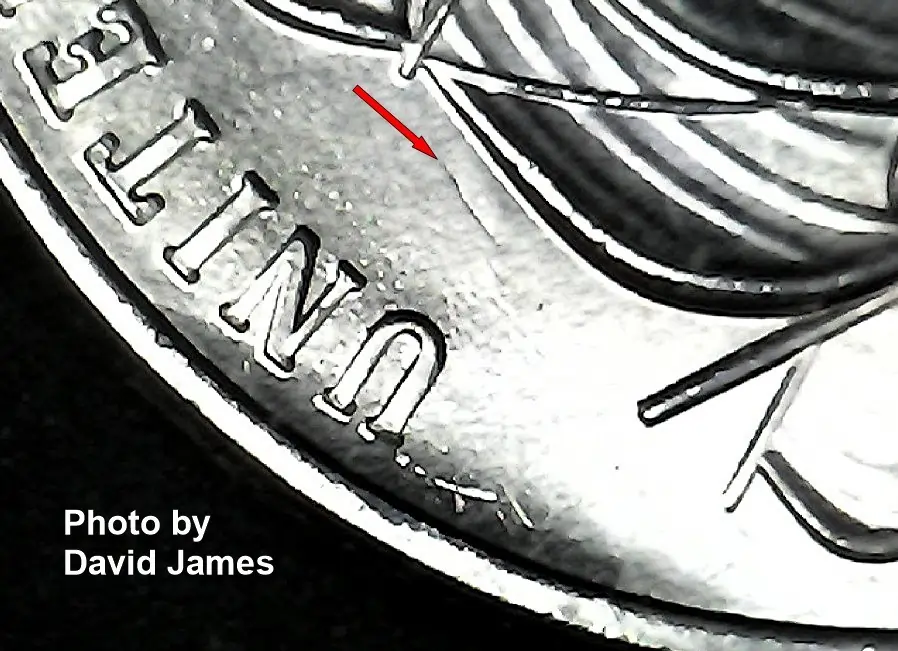
During examination of multiple 2026-P Emerging Liberty Dime dies, the author identified numerous small die cracks and die breaks measuring approximately 1 square mm to 4 square mm beneath Lady Liberty’s bust.
An example shared by Kenneth Chapman appears to show a retained internal die break measuring at least 4 square mm in this same location.
Comparable examples can also be found across numerous online sales venues.
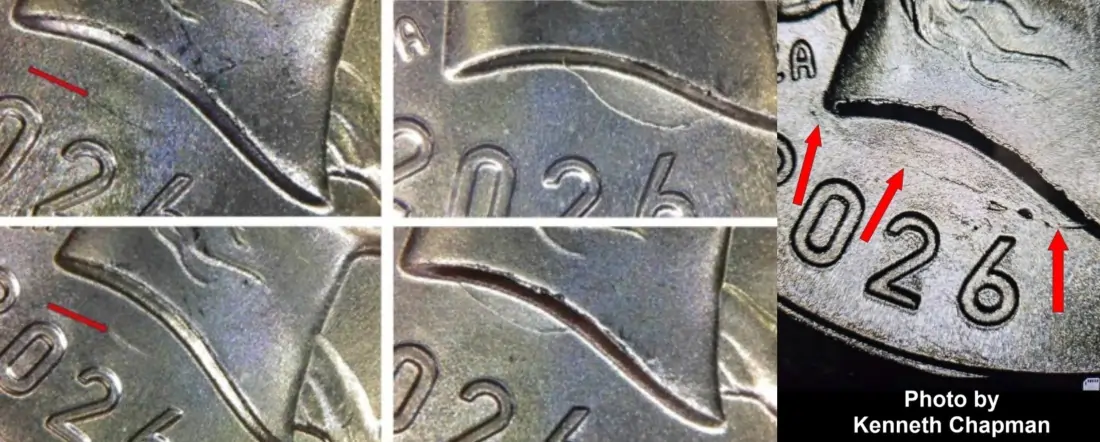
The repeated appearance of these features in nearly identical locations suggests that the area beneath the portrait may experience unusually high mechanical stress during striking.
Although additional research remains warranted, the consistency of these observations makes stress concentration a plausible explanation.
Mapping the Stress Zone
Three-dimensional profile analysis provides additional insight into why this portion of the die appears especially vulnerable.
The cross-sectional scan below shows that the die surface closely follows an exponential curve, represented by the dark blue mathematical overlay.
The point at which that exponential profile begins accelerating into a steeper slope is marked by the red arrow.
This location corresponds to an area where compressive forces may increase within the die steel during repeated strikes.
A second potential stress source appears where the lower portion of Lady Liberty’s neck terminates abruptly.
This feature, identified by the red ellipse, creates another localized concentration of force.
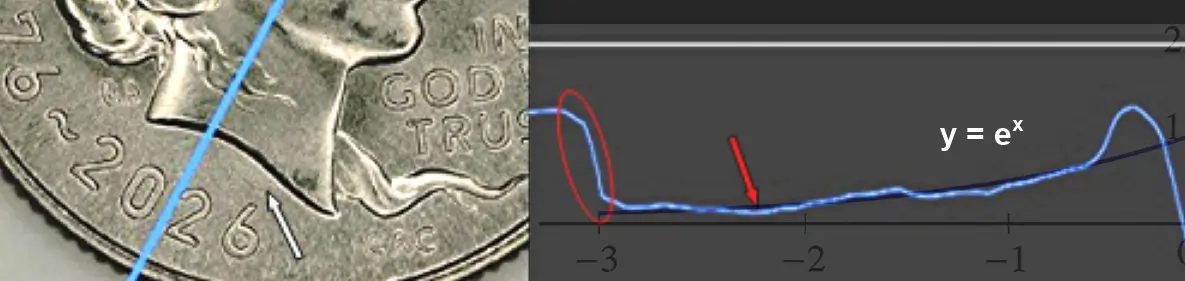
The proximity of these two stress-producing features may explain why cracks, ripples, and retained die breaks repeatedly occur beneath the portrait.
The white arrow identifies the small retained break illustrated in the previous figure.
Rather than representing isolated defects, these anomalies may reflect the interaction between changing die geometry and localized design relief.
Cracks Above the Date May Tell the Same Story
Additional evidence appears elsewhere on the coin.
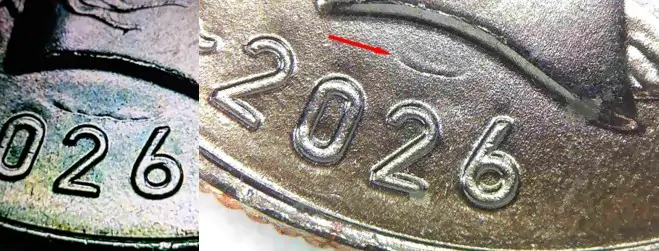
Minor cracks and ripple-like features located above the 2026 date often follow an arc that partially mirrors the curvature of the coin’s edge.
That observation may prove significant.
If these features consistently parallel the region where an exponential curve begins increasing in steepness, they could reflect another localized stress zone produced by the die’s changing geometry.
Although this interpretation remains an inference requiring additional study, the repeating pattern warrants careful attention.
Not Every “Scratch” Is Actually a Scratch
Collectors frequently encounter small raised or recessed lines on modern coins.
Many online listings simply describe these features as scratches.
Closer examination, however, suggests that some examples represent something quite different.
Several observed features appear incuse, while others display characteristics consistent with both indentation and cracking.
Because an indentation on the struck coin would originate from a raised feature on the die, these marks may instead result from minor die ripples or localized deformation.
This possibility introduces another important concept.
Rather than viewing these features as isolated defects, researchers should also consider the mechanics of die ripple formation.
Understanding Ripple Mechanics
A traditional spherical die distributes striking pressure relatively uniformly as the metal flows outward.
An exponential die surface behaves differently.
Pressure increases gradually near the center before accelerating more rapidly once the curvature begins steepening.
As repeated strikes concentrate compressive reaction forces in this transition zone, localized stress may eventually exceed the steel’s elastic limits.
One possible result is the formation of a subtle ripple on the die face.
Because the underlying curvature changes continuously rather than remaining perfectly concentric, these ripples need not form in perfect circles around the die.
Instead, they may develop along the changing geometry dictated by the die’s mathematical surface.
This mechanism offers a possible explanation for many of the small ripple-like anomalies observed on 2026-P Emerging Liberty Dimes.
While additional metallurgical research and Mint documentation would help confirm this interpretation, the available scanning data provides a compelling engineering framework for understanding these recurring features.
Could Other 2026 Coins Use the Same Engineering?
The 2026-P Emerging Liberty Dime may not be the only modern U.S. coin to incorporate variable die curvatures.
If the Mint has adopted CNC-generated curvature profiles for one circulating design, it is reasonable to investigate whether similar engineering appears elsewhere in the 2026 coinage lineup. At present, however, this remains a hypothesis that requires additional study rather than a confirmed conclusion.
Future three-dimensional scans of other 2026 coins should determine whether the Mint has applied multiple curvature profiles beyond the Emerging Liberty dime.
The Mayflower Quarter Deserves Closer Examination
One candidate for further research is the 2026 Mayflower Quarter.
Visual inspection suggests that portions of the design, particularly the section of the foresail nearest the rim, display noticeably greater relief than adjacent design elements.
Between that sail and the rim, collectors have reported numerous small die cracks and ripple-like features. In several cases, these anomalies appear to follow an arc that roughly parallels the edge of the coin.
If those observations are confirmed through cross-sectional scanning, they could indicate another example of an exponential die-face curvature transitioning into a different geometric profile.
At present, however, only detailed optical profilometry or similar three-dimensional analysis can verify whether that interpretation is correct.
Why This Matters to Collectors
Modern minting technology continues to evolve, often in ways that are invisible to the casual observer.
For collectors who specialize in die varieties, mint errors, and production diagnostics, understanding changes in die engineering can provide valuable context for interpreting newly discovered anomalies.
Historically, researchers often explained small die cracks, retained die breaks, ripples, and similar features as isolated failures of the die steel.
The observations presented here suggest another possibility.
If localized stress develops where changing die curvatures intersect with varying relief heights and asymmetric design placement, then some recurring anomalies may represent predictable outcomes of the die’s engineered geometry rather than random defects.
That possibility deserves continued investigation as additional examples become available.
A New Chapter in Coin Die Engineering?
For more than 100 years, United States coin dies generally relied upon a single, fixed-radius curvature.
Advances in CNC machining now allow the Mint to engineer far more sophisticated die surfaces than earlier manufacturing methods permitted.
The evidence presented in this study suggests that the 2026-P Emerging Liberty Dime may demonstrate how those capabilities are being applied to circulating coinage.
If correct, the die no longer relies upon one continuous spherical radius. Instead, it appears to transition between multiple mathematically distinct curvature profiles that better accommodate differences in relief height and available space across the design.
Such an approach would represent an important evolution in modern die engineering.
Implications for Modern Error Research
The interaction between transitioning die curvatures, relief height, and design placement may create predictable zones of mechanical stress within the die itself.
Those stress concentrations could help explain why certain areas repeatedly develop:
- Minor die cracks
- Retained internal die breaks
- Ripple-like deformations
- Other localized die deterioration
Rather than viewing each feature independently, future research may benefit from evaluating these anomalies within the broader context of die geometry.
If additional scanning confirms similar curvature transitions on other modern coins, researchers could gain an important new diagnostic tool for understanding the origin of many contemporary die varieties.
Looking Ahead
Whether variable die curvature ultimately proves widespread or limited to selected designs, this research highlights how advances in manufacturing technology continue to influence modern U.S. coinage.
As more collectors, researchers, and institutions apply three-dimensional imaging techniques to current production coins, our understanding of die design will likely continue to evolve.
The 2026-P Emerging Liberty Dime may represent an early example of that evolution.
Continued study, additional scanning, and future Mint documentation will ultimately determine how broadly these engineering principles have been adopted.
For now, the evidence presented here offers an intriguing framework for interpreting several recurring die characteristics observed on modern U.S. coinage while inviting additional research from the numismatic community.
Article and Research by Pete Apple
CITATIONS
[1] Philadelphia Mint Errors: Why They Outnumber Denver Varieties, by Pete Apple.
What is Meant by Die Radius? by David Lange.
https://www.ngccoin.com/news/article/489/
[2] The Case of the Missing Master Hub, by Pete Apple, March 27, 2026.
[3] Letter from Frank Leach, Superintendent, to George E. Roberts, Director of the Mint, RG104 Entry 229, Box 207, Letters Received by Mint Headquarters, December 1903–January 1904, pp. 121-123.
https://nnp.wustl.edu/library/book/627045
[4] 2018 Biennial Report to the Congress as required by the Coin Modernization, Oversight, and Continuity Act of 2010 (Public Law 111-302), p. 7.
[5] Coin Die Design for the 21st Century: Did the 2026-P Dime Break a 100-Year Mint Rule? by Pete Apple, June 25, 2026.
Coin Die Design for the 21st Century: Did the 2026-P Dime Break a 100-Year Mint Rule?
[6] Photos cropped and modified from images used with permission from The Rabbit Hole of the 1909 Lincoln Wheat Cent, by Shawn Tew, pp. 63-65.
[7] 2022 Biennial Report to the Congress as required by the Coin Modernization, Oversight, and Continuity Act of 2010, United States Mint, Department of the Treasury, 2022, p. 13.
[8] Ibid., p. 13.
[9] Coin Die Design for the 21st Century: Did the 2026-P Dime Break a 100-Year Mint Rule? by Pete Apple.
[10] United States Mint Solicitation No. 2031JG26R00004, Call for Artists, p. 2.
https://www.usmint.gov/content/dam/usmint/news/call-for-artists/TermsAndConditions.pdf
Nice article – thank you.
Missed the chance to purchase this when it first came out. Wanted the two rolls. Last weekend the Mint informed me 2026 dime bags available and I finally secured the Semiquicentennial Dime. Very pleased about this.
Great article with great explanations of this technology.
I like the new dimes. A little nostalgia feel!!!
Excellent article! I wasn’t aware of all the engineering that goes into minting process.
Can I buy this Dime if so where please reply.
That’s a heck of a place for the mintmark.
Newer isn’t better – I am not a fan of the 2026 coin designs – the mint sets look like plastic play money.
Very interesting hypothesis, I am doing a study and explains pretty much everything that I’m seeing. It’s called The Phantom of Larose, it is a die crack that intercepts another die crack and makes a bird anomaly on the front of the mast on the reverse. You should check it out. I think this explains a lot of what I’m seeing on my research.
It is a very nice eye pleasing design to go with upgraded tech.
4or 5 coins
I only want one.
Minting is a very complex process. All of the language is a little dry to read, but still interesting. Soda like there will be a lot of minor imperfections with this new die. I think we should go back to using lady liberty on our coinage. Maybe honoring individuals is a thing of the past. We see how that is going now with the current sorting president wanting to be on coins and currency. It was not meant to be that way, so let’s just honor lady liberty.