


The 1943-S Quarter That Turned a Tiny Minting Slip Into an $18,800 Rarity
Millions of Washington Quarters poured from the San Francisco Mint in 1943. Americans spent them on groceries, transportation, and countless other necessities during World War II.
Almost every coin looked normal.
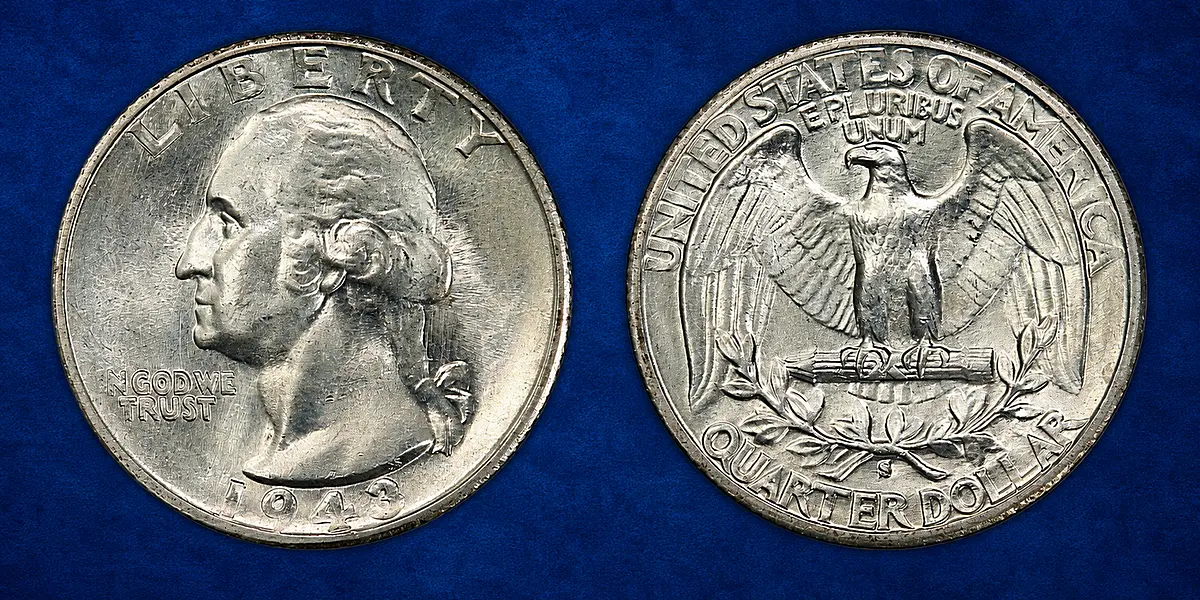
However, one obverse die carried a second, slightly displaced image. That die left bold doubling across George Washington’s portrait and the surrounding inscriptions. Most people never noticed it. Instead, the coins entered circulation alongside millions of ordinary quarters.
Today, collectors call this variety the 1943-S Doubled Die Obverse Washington Quarter, FS-101. It ranks among the most important Washington Quarter varieties of the 1940s. Moreover, the finest examples can command five-figure prices.
That makes the coin much more than a wartime curiosity. It represents a moment when a small mistake in die production created a lasting numismatic prize.
A Familiar Quarter With an Unfamiliar Secret
The Washington Quarter had already become a familiar American coin by 1943.
The United States Mint introduced John Flanagan’s Washington design in 1932. The new quarter marked the 200th anniversary of George Washington’s birth. Flanagan placed Washington’s portrait on the obverse. Meanwhile, his reverse showed an eagle standing on a bundle of arrows, with olive branches below.
The Mint retained that basic reverse through 1998, except for the temporary Bicentennial design of 1975 and 1976. The original silver composition lasted through 1964. Then, in 1965, the Mint replaced silver with copper-nickel clad metal for circulating quarters.
In 1943, the San Francisco Mint produced 21,700,000 Washington Quarters. Each contained 90% silver and 10% copper. Therefore, the regular 1943-S quarter remains readily available in circulated grades.
The FS-101 doubled die tells a different story. The Mint did not record how many coins came from the affected die. Consequently, collectors must estimate the surviving population rather than rely on an official variety mintage.
What Created the 1943-S Doubled Die?
Collectors sometimes describe doubled dies as coins that received two strikes. However, that explanation confuses two very different minting events.
A genuine doubled die begins during die production.
During the traditional hubbing process, Mint employees pressed a raised design hub into a steel die blank. The die often required more than one hub impression to receive the complete design. If the hub or die shifted between those impressions, the second impression landed in a slightly different position.
As a result, the working die carried two offset versions of part of the design. Every coin struck from that die then displayed the same doubling.
A double-struck coin develops differently. In that case, the press strikes an individual planchet more than once. A doubled die affects every coin produced from the die. A double strike affects only the coin that remained inside the press.
That distinction matters. The 1943-S FS-101 does not represent a random one-coin accident. Instead, it represents a repeatable die variety.
How to Identify the 1943-S FS-101 Quarter
The strongest diagnostics appear on the obverse.
First, examine IN GOD WE TRUST. The motto shows a clear spread between the primary design and the secondary image. PCGS identifies this area as one of the variety’s main pickup points.
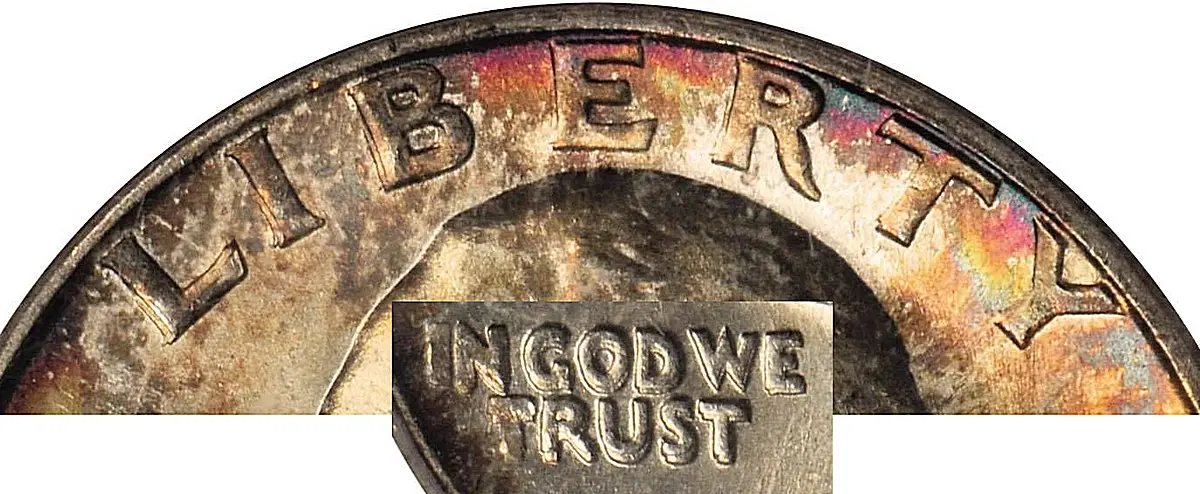
Next, inspect LIBERTY above Washington’s head. The letters show noticeable separation. In addition, the serifs display notching that confirms genuine die doubling.
Heritage Auctions also notes strong northwest doubling on:
- The date
- Washington’s hair
- Washington’s ribbon
- Portions of the motto and LIBERTY
These features separate FS-101 from ordinary strike or machine doubling.
Machine doubling usually creates flat, shelf-like edges. It also removes part of the normal design instead of adding a complete secondary image. Genuine hub doubling often produces rounded secondary details, split serifs, or clear notching.
Therefore, collectors should study the letter shapes rather than rely on a general “doubled” appearance. A coin with flat shelving may show mechanical doubling but not the valuable FS-101 variety.
Finally, check the reverse for the S mintmark. The San Francisco attribution separates this variety from the Philadelphia 1943 doubled dies. The Philadelphia Mint produced 99,700,000 quarters that year and used several different doubled obverse dies. Those coins carry separate PCGS and FS attributions.
The Only Known 1943-S Doubled Die Obverse
The 1943-S issue includes several repunched mintmark varieties. However, Heritage identifies FS-101 as the only known Doubled Die Obverse variety for the date and mint.
The variety also appears in the Guide Book of United States Coins, better known as the Red Book. Therefore, collectors can pursue it as a nationally recognized major variety rather than an obscure specialist attribution.
PCGS lists the specific FS-101 attribution under coin number 145154. Heritage’s April 2020 catalog also listed PCGS major-variety number 5823 and Greysheet identification number 374338 for the offering.
The variety also qualifies for several advanced PCGS Registry Set categories. As a result, it appeals to both Washington Quarter specialists and collectors building broader sets of major U.S. coin varieties.
How Rare Is the 1943-S Doubled Die Quarter?
PCGS estimates that approximately 3,500 examples survive across all grades.
That figure makes the FS-101 scarce, but not unobtainable. In fact, PCGS believes roughly 2,000 surviving coins remain in Mint State. However, quality drops quickly above the lower uncirculated grades.
PCGS estimates that only about 10% of the Mint State population qualifies for MS65 or better. That estimate suggests a surviving Gem population of approximately 200 coins.
The unusually large Mint State survival rate may indicate that collectors identified the variety relatively early. Once specialists recognized the doubling, they likely removed examples from circulation and saved rolls or individual coins.
Still, collectors should treat all survival estimates as estimates. Grading-service population reports count certification events. They do not always count unique coins. Resubmissions and crossover attempts can inflate those totals.
Value and Market Performance
Grade drives the market for the 1943-S FS-101.
In November 2025, PCGS reported that heavily circulated examples could sell for less than $100. However, values climbed above $200 by the XF40 level. Mint State coins generally started above $500, while MS65 examples brought about $1,200.
Those figures provide useful benchmarks. Nevertheless, actual prices depend on strike, luster, surface preservation, color, certification, and buyer demand.
Premium Gem examples can bring substantially more.
Heritage offered a PCGS MS66 example with CAC approval in April 2020. The coin displayed strong design definition, frosty luster, mainly brilliant surfaces, and small traces of golden toning. It sold for $2,100.
At the time, Heritage reported a PCGS population of 19 in MS66, including four in MS66+, with none graded numerically finer. CAC reported 10 approved coins in MS66 and none finer. Those figures reflected the certification data available in April 2020 and should not serve as current population totals.
An $18,800 Washington Quarter
The market reached another level in February 2021.
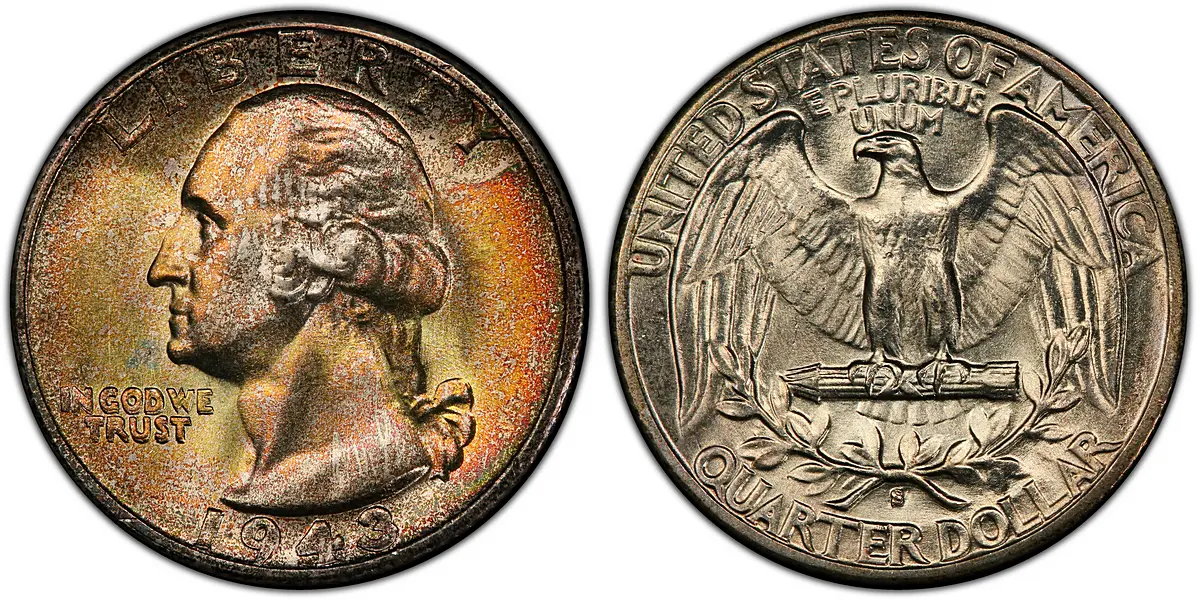
Legend Rare Coin Auctions sold a PCGS MS67 example with CAC approval for $18,800. PCGS Auction Prices identifies that result as the auction record for the variety.
The coin combined exceptional preservation with strong visual appeal. It also displayed bold doubling at LIBERTY and IN GOD WE TRUST. At the time of the sale, PCGS reported only one example at MS67 with none finer.
PCGS CoinFacts currently highlights a different MS67 that Heritage sold for $12,600 on October 5, 2025. However, the 2021 Legend result remains the higher public auction record documented by PCGS.
The difference between those two results demonstrates an important market truth. The grade on the holder matters, but so do eye appeal, color, strike, CAC approval, timing, and competition between bidders.
Why Collectors Keep Searching
The 1943-S Doubled Die Obverse Quarter offers several paths into the hobby.
A circulated example gives the variety collector an affordable wartime coin with visible diagnostics. A Mint State example adds original luster and sharper design separation. Meanwhile, a Gem or Superb Gem can anchor an advanced Washington Quarter collection.
The coin also offers the thrill of discovery.
The regular 1943-S quarter remains common enough that collectors can still examine dealer inventories, old collections, and unattributed certified coins. Most pieces will prove ordinary. Some will show machine doubling. However, an authentic FS-101 can hide behind decades of circulation wear or an incomplete catalog description.
That possibility keeps the hunt alive.
After all, the difference between a common silver quarter and a major variety may sit inside a few notched letters in IN GOD WE TRUST.
1943-S Doubled Die Obverse Quarter Specifications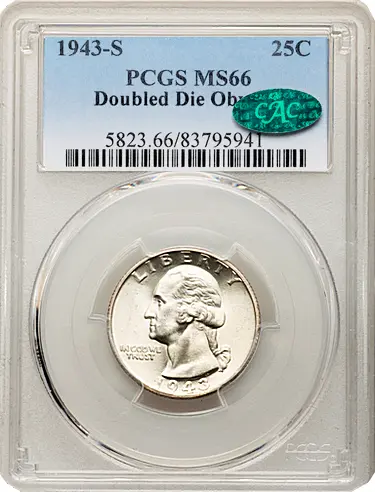
- Denomination: Quarter Dollar
- Date and Mint: 1943-S
- Mint Facility: San Francisco Mint
- Designer: John Flanagan
- Regular-Issue Mintage: 21,700,000
- Variety Mintage: Unknown
- Composition: 90% silver and 10% copper
- Standard Weight: 6.25 grams
- Diameter: Approximately 24.3 mm
- Actual Silver Weight: Approximately 0.18085 troy ounce
- Edge: Reeded
- Variety: Doubled Die Obverse, FS-101
- PCGS Variety Number: 145154
- Guide Book Status: Listed major variety



I’ll have to keep an eye on the quarters I save for BBQ Days bingo games!
Another error coin, whats going on.
Great looking coin, interesting article
Very interesting article wish I had one.
Really nice coin.
place a comment
I was not aware of this double die coins, very interesting.
Good to know. I’ve got to a better job at examining my change.
Have to get my coin collection out of the safe deposit box and check my quarters.
with only 3500 in circ finding this one is not worth the time.
Would be a nice addition to my collection.
Nice.
a welcome addition to my collections
Stunning
Now I have to go thru my coins again.
This coin would be so cool to have!!!
Thanks for explaining how the doubling happens.
Hiding in plain sight if this was still the 1960’s.
Interesting error.
Cool error coin
So much to learn and so many fakes. I need to brush up.
I Love Cool facts About Cool Historic Coins.
How worn does this coin have to be before this error would not be easily noticeable?
I do enjoy reading about error coins. Hope to find one some day
Will watch closely
Amazing coin. Great article.
This would be a great addition to my collection!
One reason I continue to be part of COINWEEK. COM is because you educate me on details of coin collecting. THANK YOU. I have some 43-S in my safety deposit box. Now I’ll look closer at them. Maybe I’ll be lucky.
Very interesting article
Thanks
One more on my wish list!
Will be looking for this one…..great information!
I would love to find a $18,000 quarter.
Never heard of this one
Cool one to find!
It is very cool when you actually discover a rare coin in change. I remember not too long ago when I received a ww2 nickel
Think I’ll go take a look through my boyhood collection again! I have a feeling I may have more than fond memories.
I recently found a 1973d d.d.o. quarter in a Denver mint souvenir set.