


Golden Echoes: Five Ancient Coins That Changed the World
Gold has always represented more than just wealth. In antiquity, it symbolized the divine, immortal, untarnished, and reserved for gods and kings. Ancient civilizations struck coins from gold not to enrich the masses but to finance empires, pay armies, and project power. These coins were rarely seen by the average citizen. Instead, they served diplomatic, economic, and military purposes that shaped the ancient world.
Below, we explore five remarkable ancient gold coins and the incredible stories they tell, each a gleaming fragment of human history.
1. Lydia’s Heavy Gold Stater: The Birth of Bi-Metallic Coinage
In the mid-sixth century BCE, Lydia led the world into a new economic age. Under King Croesus, the Lydians introduced the first true series of gold coins, marking a pivotal shift from electrum to refined gold and silver.
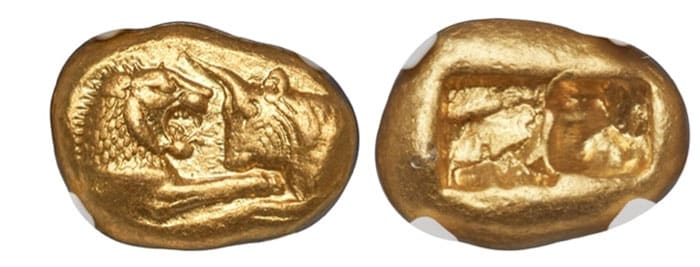
Before Croesus, Lydian coins were minted in electrum, a natural alloy of gold and silver that made standardization difficult. This changed with the innovations developed in the Lydian capital, Sardis. Refining techniques enabled Croesus to issue pure gold and silver coins with consistent weights.
A Short-Lived Standard
The earliest gold staters in this system weighed 10.89 grams and were matched by silver staters of equal weight. However, this approach quickly proved impractical. Due to the wide gap in intrinsic value between silver and gold, trade suffered. To address this, Lydia adjusted the standard: ten silver staters now equaled one gold stater weighing 8.17 grams, reflecting a more realistic silver-to-gold ratio of 13.3:1.
These early “heavy” staters became obsolete but are now highly prized by collectors due to their rarity and historical significance.
Design and Symbolism
One notable design features a lion facing a bull, symbolizing strength and fertility, core attributes of the Lydian monarchy. As Harlan J. Berk noted in 100 Greatest Ancient Coins, this imagery reinforced Lydia’s status as the dominant power in Asia Minor at the time.
2. Alexander the Great’s Gold Distater: Funding an Empire
As Alexander the Great swept across the Persian Empire in the 4th century BCE, he seized vast quantities of gold and silver. When Persepolis fell, historians estimate he controlled over 200,000 talents of precious metals, equivalent to millions of days’ wages.
The Distater’s Purpose
To manage this sudden wealth and fulfill promises to his troops, Alexander struck high-value gold distaters. Each soldier was promised one talent of silver, a massive sum. Rather than paying this in silver tetradrachms, which would have required cumbersome shipments weighing over 50 pounds per person, Macedonian authorities issued gold coins to simplify the process. With a value equivalent to about two months’ pay, a single distater drastically eased troop payments.
Struck at Amphipolis
The example in focus was struck at the Amphipolis mint, a city originally founded by Athens but later absorbed into Macedonian power. Amphipolis served as a major military and economic hub, playing a key role in minting Alexander’s coinage. Remarkably, this coin has escaped the heavy wear seen in many surviving examples, offering collectors a rare glimpse of its original detail and artistry.
3. The Mnaieion of Arsinoe II: Power Beyond the Grave
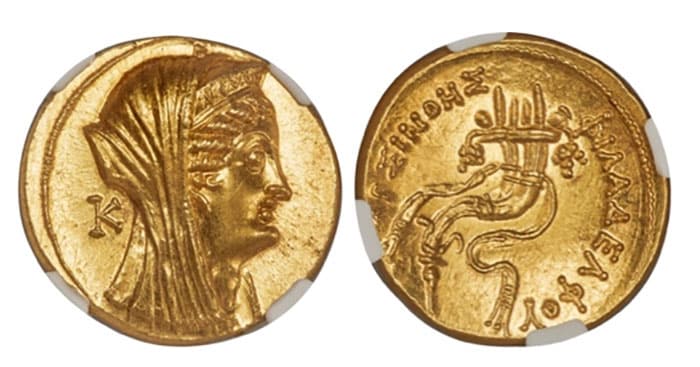
Gold coinage in Ptolemaic Egypt wasn’t just about commerce, it was also about dynastic messaging. The mnaieion issued in honor of Queen Arsinoe II exemplifies this dual role.
Who Was Arsinoe II?
Born in 316 BCE to Ptolemy I and Queen Berenike, Arsinoe II lived a dramatic life. She married three times: first to Lysimachos of Thrace, then briefly to her half-brother Ptolemy Keraunos, and finally to her full brother Ptolemy II. After fleeing Keraunos during a volatile succession struggle, she returned to Egypt and became a powerful political figure.
A Posthumous Portrait… or Is It?
Although the coin features Arsinoe’s name, it was struck decades after her death, between 193 and 116 BCE during the reign of either Ptolemy V or Ptolemy VIII. The obverse shows a veiled and deified queen wearing a stephane, symbolizing high status. A small “K” next to the bust may indicate the die series.
Interestingly, some scholars argue this “K-type” portrait might actually depict Cleopatra II, given the dissimilarity to earlier coins of Arsinoe II. As such, this mnaieion may represent a shifting narrative, one coin telling two intertwined stories of power, legacy, and royal identity.
4. Octavian’s Aureus of 43 BCE: Claiming Caesar’s Legacy
In the aftermath of Julius Caesar’s assassination, his adopted heir Octavian (later Augustus) fought a propaganda war as fierce as any battle. One of his most compelling tools? A gold aureus minted in 43 BCE.
A Mint on the Move
Struck by a traveling military mint in southern Gaul, this coin coincided with Octavian’s first consulship. It wasn’t just currency, it was a message. On the reverse stands a deified Caesar, surrounded by his titles, mirroring lifelike portrait denarii issued during his lifetime.

For Octavian’s legions, many of whom had served Caesar, this image reinforced loyalty. It reminded them that Octavian was Caesar’s rightful successor, not Marc Antony.
Political Design
The obverse boldly reads “Consul Caesar,” emphasizing Octavian’s legitimacy. These coins likely helped finance his march on Rome later that year. They also hinted at his long-term strategy: to align himself with the slain dictator and slowly assume his mantle.
The provenance of this example can be traced back over 80 years, attesting to its appeal among historians and collectors alike.
5. Caligula’s Aureus: Divine Ancestry as Imperial Armor
A decade after Octavian’s coin, his descendant Caligula issued a similarly styled gold aureus. While the designs differed, the goal was the same: legitimize rule through dynastic lineage.

The Obverse: Power in Profile
The obverse depicts Caligula in a stern, almost severe portrait style, encircled by imperial titles. It projects control and seriousness, vital for an emperor with little military reputation.
The Reverse: Ancestral Ambiguity
Scholars debate who appears on the reverse. Some believe it’s Caligula’s father, Germanicus (often conflated with Tiberius). Others suggest it represents Divus Augustus, Caligula’s grandfather. Two six-pointed stars flank the radiate head, symbols often used to indicate divinity.
There’s another version of this coin that features the legend “DIVVS AVG PATER PATRIAE”, clearly referencing Augustus. Since Caligula issued coins honoring multiple relatives, it’s plausible this version depicts Germanicus, with the stars symbolizing Augustus and Julius Caesar.
Why It Mattered
Unlike Augustus, Caligula had no major conquests to bolster his authority. Coins like this were essential for portraying his right to rule as stemming from a divine bloodline. In doing so, he tapped into Rome’s powerful legacy of god-kings and family mythmaking.
Conclusion: More Than Metal
These ancient gold coins were not minted for markets or merchants. They were forged to finance wars, immortalize rulers, and shape imperial narratives. Today, they serve as enduring links to civilizations long gone but never forgotten.
From the workshops of Sardis to the mints of Roman Gaul, these coins echo the ambitions, triumphs, and intrigues of history’s most influential empires. Each is a compact biography, struck not in ink but in gold.
By Tyler Rossi for CoinWeek …..
Sources
https://www.brown.edu/academics/archaeology/publications/alexander
https://studenttheses.universiteitleiden.nl/access/item%3A2659805/view
* * *






Love the ancient coins. They always make me wonder how many people handled these coins throughout history and where they’ve been
Beautiful gold coins!
Nice intro to some beautiful ancient coins.
I love gold coins!