


By Mike Markowitz
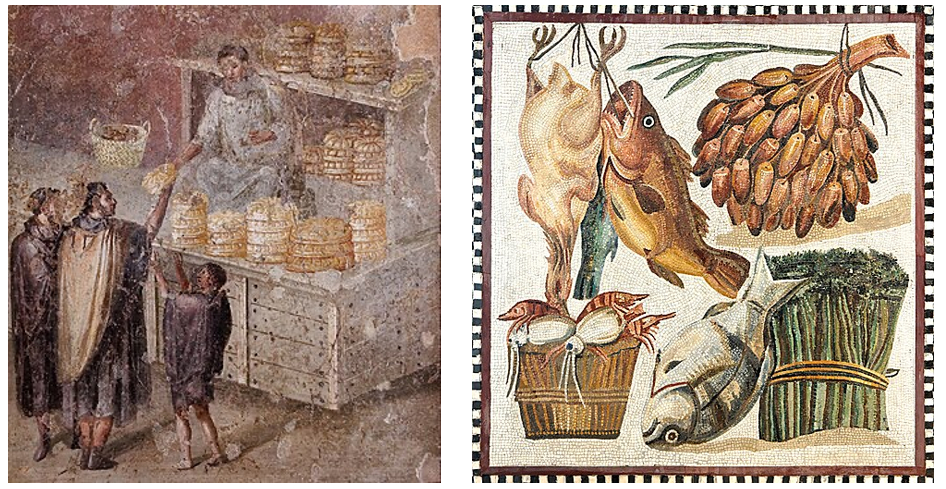
Most ancient people lived close to hunger. One bad harvest could bring starvation. Therefore, food supply mattered to every ruler, city, and empire.
Ancient coins show this concern clearly. Grain, fruit, seafood, livestock, and food containers appear early and often on Greek and Roman coinage. These images also reveal the roots of the healthy “Mediterranean diet.” That diet still depends on simple foods such as bread, olive oil, grapes, fish, and meat.
Barley on Ancient Coins
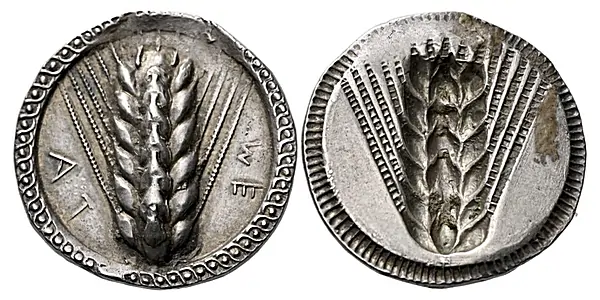
People domesticated barley as early as 9000 BCE. Barley grows better than wheat in hot, dry climates. However, it does not make good bread. Instead, ancient people boiled it for soup or porridge. They also brewed it into beer.
Barley appears very early on ancient coins. The earliest numismatic example comes from Metapontum [1] in southern Italy. An ear of barley appears on both sides of a silver nomos. The city struck this coin between 540 and 520 BCE.
Moreover, Metapontum kept the barley ear as its civic emblem for centuries. A later stater of Metapontum, struck around 340 BCE, ranks as #36 on Harlan Berk’s list of the 100 Greatest Ancient Coins [2].
Wheat, Bread, and Ceres
“Man shall not live by bread alone” (Matthew 4:4). Even so, bread formed the base of the diet for most ancient Greeks and Romans.
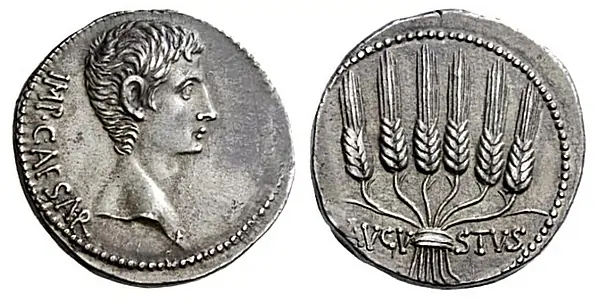
Plain round loaves did not make strong coin designs. Therefore, ancient die engravers used wheat stalks instead. Wheat appears very often on ancient coinage. Much later, from 1909 to 1959, two wheat stalks also decorated the reverse of the U.S. cent.
Ceres, goddess of cereal, also appears on coins. Artists often showed her with stalks of wheat woven into her hair.
A silver tetradrachm from Pergamum, struck under Roman rule around 27 BCE, shows six ears of wheat bound together [3].
Olive Oil and the Panathenaic Amphora
Olive oil played a vital role in the ancient diet. People often dipped bread in it. They also burned it in lamps, rubbed it on the skin, and used it for many other purposes.
Ripe olives taste very bitter. So, people cured them in brine, salt, or oil before eating them [4].
The olive appears on coins in several ways. A sprig of olive leaves appears above the owl on the reverse of the famous Athenian silver tetradrachm [5]. Some coins also show olive trees.
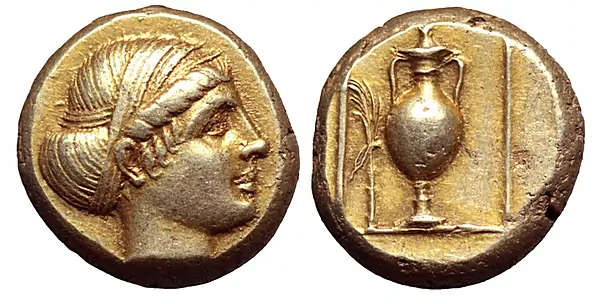
However, coins often show the olive through its container. The “Panathenaic amphora” [6] held olive oil. Athens awarded this large ceramic jar of oil to winners in an athletic contest held every four years.
This amphora appears on the reverse of an electrum hekte from Mytilene on the island of Lesbos. The coin dates to about 375–326 BCE [7].
Grapes, Wine, and Dionysus
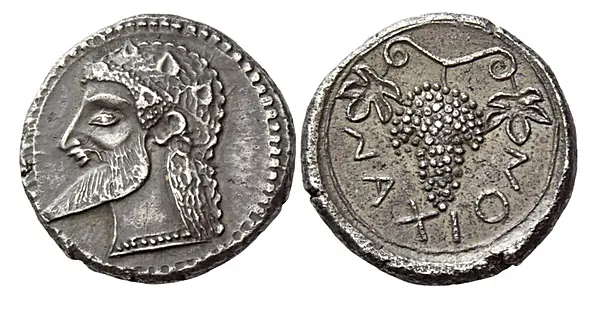
Ancient people mainly consumed grapes as wine. A rare silver drachm from Naxos on Sicily shows a bunch of grapes on the reverse [8]. The coin dates to around 500 BCE.
Dionysus, the god of wine, appears on the obverse. This design fits Sicily well. Its rich volcanic soil still produces excellent wine.
In addition, ancient people ate grape leaves. They often stuffed them with boiled barley.
The Pomegranate of Side
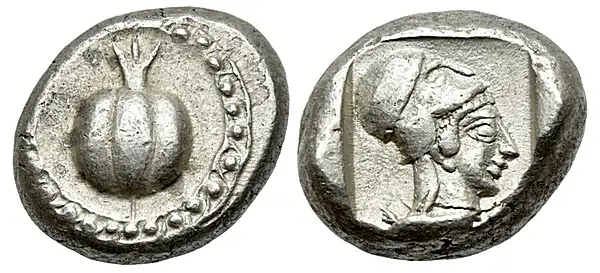
People first cultivated the pomegranate in the region of Iran about 5,000 years ago. The fruit later became the emblem of Side in Pamphylia [9]. In the local language, “Side” meant pomegranate.
A silver stater of Side, dated to around 460–430 BCE, shows a pomegranate within a dotted border [10].
The pomegranate also played a powerful role in Greek myth. Hades, god of the underworld, abducted Persephone. Because she ate six pomegranate seeds there, she had to spend six months in the underworld each year.
During that time, her mother Demeter mourned. As goddess of grain, Demeter then withheld fertility from the earth.

The Apple of Melos
The small island of Melos in the Aegean Sea used an apple as its emblem. The reason came from language. The Greek word for apple, µ??? (melo), sounds like the island’s name.
From the sixth century BCE until Athens destroyed the city in 416 BCE, Melos issued coinage on the “Milesian” weight standard. Its stater weighed just over 14 grams.
The fruit appears on the obverse of the coin [11]. Some sources wrongly describe it as a pomegranate.
Most surviving examples come from one hoard. People found about 84 coins on the island in 1907. On Harlan Berk’s list of the 100 Greatest Ancient Coins, the stater of Melos ranks as #91 [12].
Date Palms, Honey, and Ancient Sweets
Dates and honey supplied the most important sweets in the ancient world. Sugarcane came from New Guinea. India received it around 500 BCE. However, Greeks and Romans treated sugar as a rare and exotic spice.
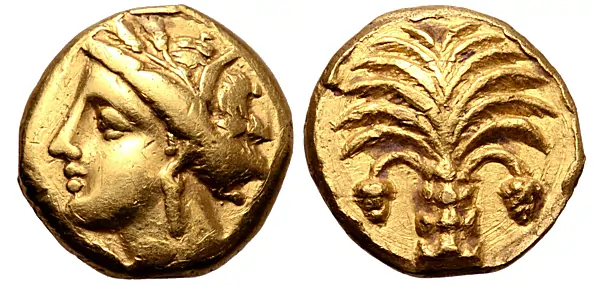
The date palm served as a traditional emblem of Judaea. It also represented Carthage in North Africa, where the tree grew abundantly.
A small gold quarter stater of Carthage, dated to about 350–320 BCE, shows a palm tree with two clusters of dates on the reverse [13].
Octopus on Greek and Sicilian Coins
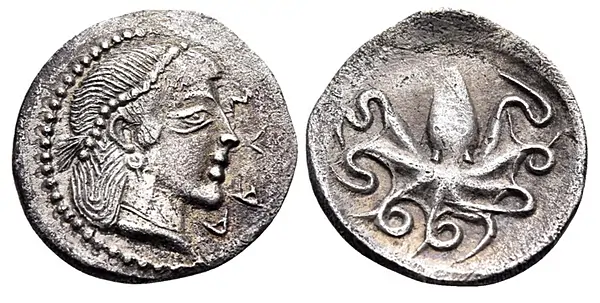
Grilled octopus remains a favorite Greek menu item today. Ancient cities also placed the creature on their coins.
These cities included the Etruscan town of Fufluna, also called Populonia. Kroton, Eretria, Motya, and especially Syracuse also used octopus designs.
A silver litra of Syracuse, dated to about 467–465 BCE, shows a strikingly realistic octopus on the reverse [14].
Gray Mullet and Ancient Seafood
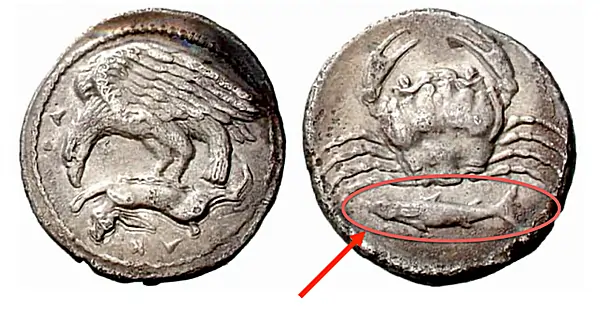
Ancient people prized several Mediterranean sea creatures. They especially valued the gray mullet [15], or Mugil cephalus. They also prized the scarce red mullet, or Mullus surmulatus, although it belongs to a distant family.
People raised gray mullet in saltwater ponds. Some Roman owners even named their fish and fed them by hand.
They valued the tender flesh. They also dried the roe, or eggs, for food.
Gray mullet appears on coins of Akragas and Kamarina in Sicily. On the reverse of a silver hemidrachm of Akragas [16], the fish appears below a freshwater crab. The crab also served as food.
Pork and the Roman Table
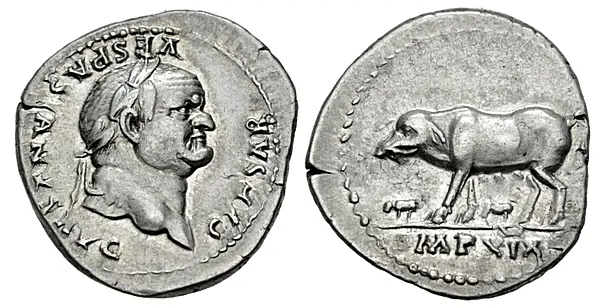
Pork ranked as a favorite meat among Greeks and Romans. The elite especially prized wild boar. These animals fed on acorns from oak forests.
However, domestic hogs also appear on coins. A silver denarius of Vespasian from the mint of Rome shows a sow with piglets on the reverse [17]. The coin dates to about 77–78 CE.
Sheep’s Milk, Wool, and Cheese
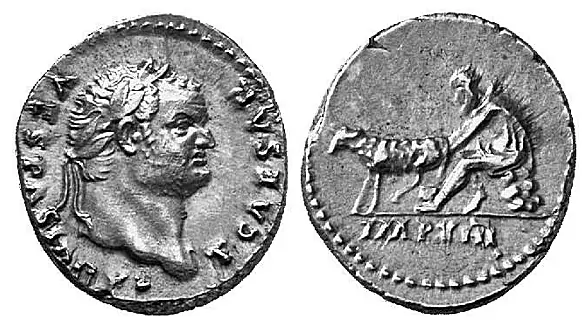
Sheep gave ancient people several valuable products. They supplied wool, meat, and milk. People used sheep’s milk mostly to make cheese.
Sheep’s milk contains more protein than cow’s milk. Many people also digest it more easily.
A Roman denarius of Titus as Caesar shows a shepherd seated on a stool while milking a ewe [18]. The coin dates to 77–78 CE, during the reign of Titus’ father, Vespasian.
Veal as a Luxury Food
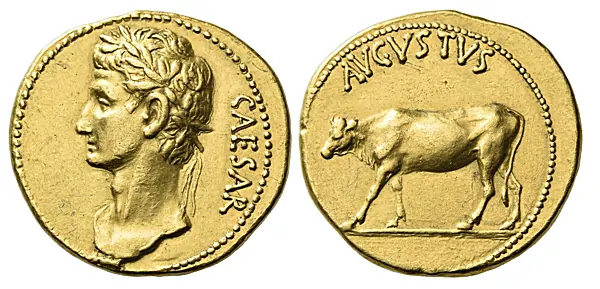
Veal comes from young calves. People have long treated it as a luxury food.
Many people today see the slaughter of calves as especially cruel. Ancient people showed less sentiment about meat.
A very rare gold aureus [19] of Augustus depicts a heifer, or female calf. The coin comes from an uncertain mint and dates after 27 BCE.
The image drew from a famous bronze statue by the Athenian sculptor Myron [20]. Myron lived around 485–440 BCE.
Food on Ancient Coins Shows Daily Life
Food on ancient coins tells us more than what people ate. It also shows what cities valued. Barley identified Metapontum. The pomegranate represented Side. The apple named Melos. Meanwhile, fish, livestock, wheat, and olive oil reflected survival, wealth, trade, and civic pride.
These coins still speak clearly. They connect ancient economies, religious myths, local identities, and daily meals. As a result, food on ancient coins remains one of the most direct ways to understand life in the Greek and Roman world.
References
- https://en.wikipedia.org/wiki/Ancient_Greek_cuisine
- https://en.wikipedia.org/wiki/Ancient_Roman_cuisine
- Berk, Harlan J. 100 Greatest Ancient Coins, third edition. Pelham, AL (2023)
- Kraay, Colin. “The Melos Hoard of 1907 Re-examined.” Numismatic Chronicle (1964)
- Rambach, Hadrian and Alan Walker. “The Heifer Aurei of Augustus.” Schweizerische Numismatische Rundschau (Swiss Numismatic Review) 91 (2012)
Citations
- [1] https://en.wikipedia.org/wiki/Metapontum
- [2] Berk (2023) page 62
- [3] NAC Auction 86, October 8, 2015, Lot 48, realized $16,546
- [4] https://en.wikipedia.org/wiki/Olive
- [5] On many U.S. coins, the eagle holds an olive branch in one talon, symbolic of peace.
- [6] https://en.wikipedia.org/wiki/Panathenaic_amphora
- [7] Roma Numismatics Auction 8, September 28, 2014, Lot 574, realized $8,122
- [8] NAC Auction 116, October 1, 2019, Lot 48, realized $100,261
- [9] https://en.wikipedia.org/wiki/Pomegranates_in_culture
- [10] NAC Autumn Sale, November 9, 2025, Lot 2551, realized $1,177
- [11] NAC Auction 133, November 21, 2022, Lot 100, realized $14,715
- [12] Berk (2023) page 42
- [13] Roma Auction XXII, October 7, 2021, Lot 159, realized $2,724
- [14] Nomos bolos 35, December 15, 2024, Lot 1102, realized $563
- [15] https://en.wikipedia.org/wiki/Flathead_grey_mullet
- [16] Astarte Auction XIX, May 6, 2006, Lot 750, realized $1,796
- [17] CNG Electronic Auction 593, August 13, 2025, Lot 527 realized $700
- [18] New York Sale III, December 7, 2000, Lot 655, realized $1,400
- [19] NAC Auction 146, May 8, 2024, Lot 2317, realized $660,720
- [20] https://en.wikipedia.org/wiki/Myron




I have a small bronze coin in my collection from Roman Judaea, dated to AD 6, depicting a date palm on the reverse.
Very interesting article! Thanks!
I wish I knew where to get food related coinage. Food is a huge part of my life and it would so cool to see or hold a piece of history that celebrates it
Interisting, I love type collectioms by subject matter.