


Arizona Coin & Bullion Acquires a Landmark U.S. Paper Money Rarity
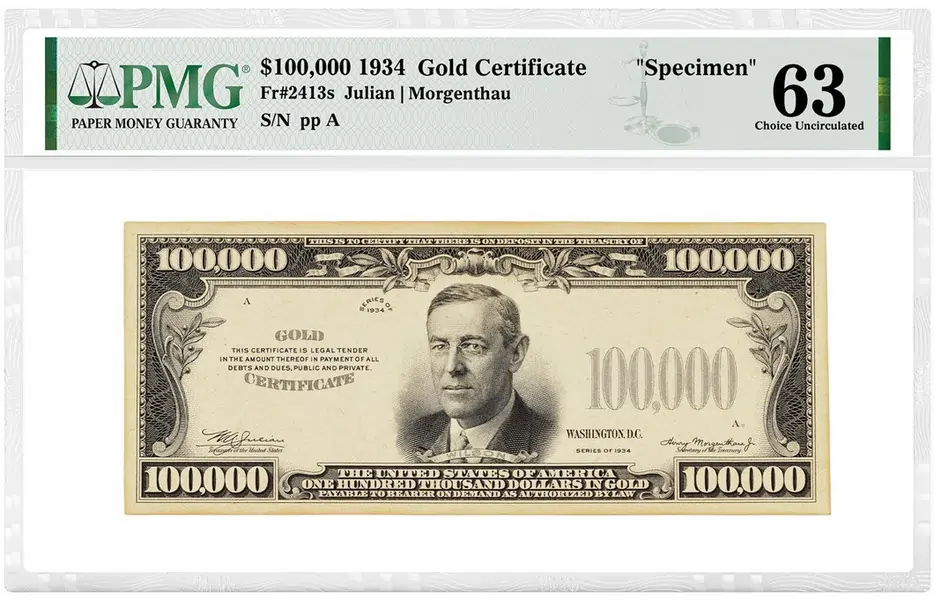
In August 2025, Arizona Coin & Bullion acquired one of the greatest trophies in American numismatics: the only 1934 $100,000 Gold Certificate Uniface Front Specimen known in private hands.
PMG graded the note Choice Uncirculated 63. As a result, this extraordinary certificate stands at the summit of U.S. paper money. It combines extreme rarity, major historical importance, and superb engraving.
The acquisition also brings the note back to Arizona’s collector community. For Arizona Coin & Bullion, the purchase marks a major moment. For collectors, it offers a rare chance to study a piece that may not reach the market again.
A Singular Treasure in U.S. Currency
The 1934 $100,000 Gold Certificate carries a unique place in American financial history. It represents the highest denomination of U.S. paper money ever produced.
However, the public never used these notes. The government created them only for interbank transfers between Federal Reserve Banks.
Officials produced 42,000 notes from December 18, 1934, to January 9, 1935. After use, officials destroyed most of them. Today, institutions hold the surviving issued examples. These include the Smithsonian, the Bureau of Engraving and Printing, and Federal Reserve Banks in Richmond and San Francisco.
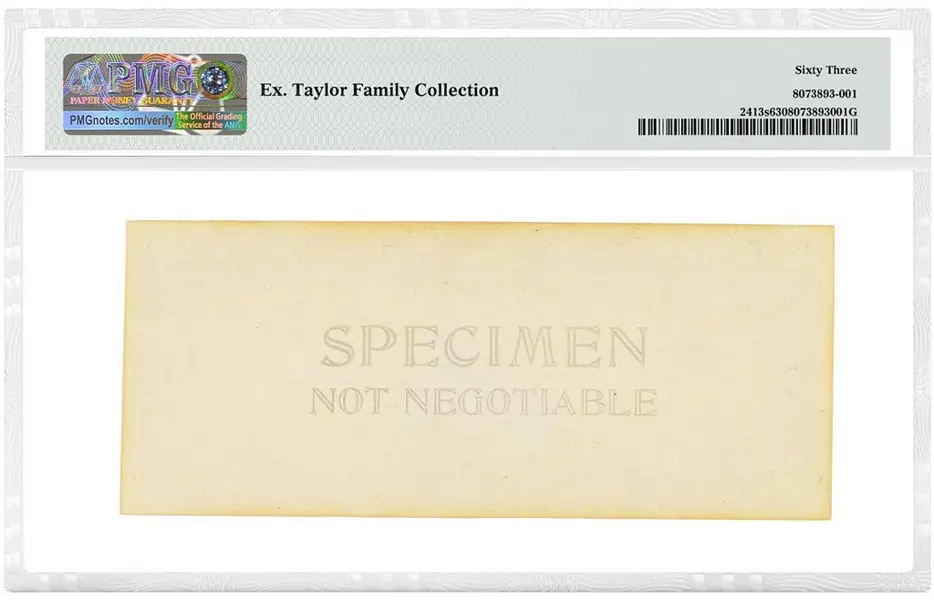
Issued notes carry distinctive bright orange backs. Arizona Coin & Bullion’s note differs in a crucial way. It represents a Uniface Front Specimen. Therefore, it has a blank back.
Silver lettering on the back reads: “SPECIMEN NOT NEGOTIABLE.”
That detail separates this note from the issued certificates. Moreover, it strengthens its appeal as a unique artifact from a turning point in American monetary history.
The Only Known Example Available to Collectors
This specimen carries a pedigree to the Taylor Family Collection. More importantly, collectors know of no other 1934 $100,000 Gold Certificate Uniface Front Specimen in private hands.
That status makes Arizona Coin & Bullion’s acquisition exceptional.
PMG assigns the note a Choice Uncirculated 63 grade. The grade reflects strong preservation. In addition, subtle toning adds visual depth and character.
For specialists in high-denomination paper money, this certificate represents a pinnacle object. It also connects rarity, condition, and national financial history in one piece.
A Window Into the Great Depression
The Treasury issued the $100,000 Gold Certificate during the Great Depression under the Gold Reserve Act of 1933.
At the time, the United States had moved away from the traditional gold standard. Large financial transfers between Federal Reserve Banks still required secure settlement tools. Therefore, the $100,000 Gold Certificate served a practical purpose inside the banking system.
The note features a portrait of President Woodrow Wilson. G.F.C. Smillie engraved the portrait.
It also carries the signatures of Treasurer William A. Julian and Treasury Secretary Henry Morgenthau Jr.
The certificate includes this inscription:
“This is to certify that there is on deposit in the Treasury of the United States of America one hundred thousand dollars in gold payable to bearer on demand as authorized by law.”
Those final words, “as authorized by law,” carry major historical meaning. They reflect the restricted redemption policies of the period. They also point to the federal government’s shift away from gold redemption.
Why This Note Matters
Federal Reserve Banks used these certificates only briefly, from 1934 to 1935. During that short period, they helped settle massive financial transfers in a turbulent economy.
Then, government destruction removed most examples from existence.
As a result, collectors rarely encounter any form of the $100,000 Gold Certificate. Issued notes remain in institutional collections. Meanwhile, this Uniface Front Specimen stands alone as the only known example available to private collectors.
That fact gives the Arizona Coin & Bullion note its singular status.
Arizona Coin & Bullion’s Historic Acquisition
The acquisition marks a milestone for Arizona Coin & Bullion. It also reinforces the company’s commitment to bringing world-class rarities to its Arizona-based clientele.
By securing this certificate, ACB added a crown jewel to its inventory. At the same time, the firm brought a piece of numismatic history back to the Grand Canyon State.
Local collectors and enthusiasts can now connect with one of the most important objects in U.S. paper money.
The note’s path to Arizona Coin & Bullion also highlights the firm’s expertise in sourcing ultra-rare collectibles.
Heritage Auctions offered this specimen in February 2005. At that sale, it realized $74,750. Since then, specialists have described it as the sole example available to collectors.
Now, its return to Arizona underscores ACB’s role as a steward of numismatic heritage.
The Million-Dollar Question: What Is the Note Worth?
The 1934 $100,000 Gold Certificate Uniface Front Specimen, graded PMG Choice Uncirculated 63, invites a serious valuation discussion.
Recent sales of 1934 $10,000 Federal Reserve Notes help frame the market. In May 2025, a Boston $10,000 Federal Reserve Note graded PMG 64 sold for $372,000.
That result matters. Approximately 350 examples of 1934 $10,000 Federal Reserve Notes survive. By contrast, collectors know of only one privately held 1934 $100,000 Gold Certificate Uniface Front Specimen.
Therefore, the $100,000 certificate deserves a significant rarity premium.
A fractional sale also adds context. The $500,000 to $625,000 NFT valuation may not fully reflect traditional auction dynamics. Competitive bidding could move the price higher or lower, depending on collector turnout.
Estimated Value: $750,000 to $1,500,000
Market evidence supports a likely traditional auction value of $750,000 to $1,500,000 for the 1934 $100,000 Gold Certificate Uniface Front Specimen.
Several factors drive that estimate.
First, the note stands as the only privately held example. Next, it carries deep historical importance. Finally, the market for high-denomination U.S. notes remains strong.
The May 2025 sale of the $10,000 Federal Reserve Note for $372,000 shows strong demand for trophy-level paper money. Yet roughly 350 $10,000 notes exist. The $100,000 Gold Certificate offers vastly greater rarity.
The 2025 NFT sale range of $500,000 to $625,000 provides a useful floor. However, competitive bidding could push the note toward or beyond $1 million.
Given the upward trend in high-denomination note prices, Arizona Coin & Bullion’s 1934 $100,000 Gold Certificate ranks among the most important U.S. paper money rarities in private hands.




Amazing!
I agree. I never knew this existed.
Super cool!
great article very informative
I would love to own this!!!
Wow!
Wow. I didn’t know that bills ever went that high. That bill has been well taken care of.
So cool, didn’t realize bills ever went that high
I remember touring a bank while on a grade school field trip and when we went in the vault they showed us one of the bank – to – bank transfer notes, but it wasn’t this denomination. Impressive.
Cool history!
Why Wilson?
Supposedly, Woodrow Wilson was placed on the $100,000 Gold Certificate (Series 1934) to honor his leadership and, specifically, his role in establishing the Federal Reserve System in 1913. Issued during the Great Depression, these notes were never for public use, but were instead used exclusively for transferring funds between Federal Reserve Banks.
I guess I will not buying one of these if it becomes available, I’d rather keep my house.
I’m not much of a bill collector, but this would be awesome to own.
Amazing certificate of that denomination and condition
Another truly informative article !! THANKS.
I’m just curious if this note or another high denomination note is in the Guiness Book of World Records ??
Wow the ultimate bill !!
Wayyyyyy outta my league! But fascinating back story.
I saw one of the real ones at a numismatic exhibition years ago
I would love to see one in person.
Agreed. Why Wilson?
Supposedly, Woodrow Wilson was placed on the $100,000 Gold Certificate (Series 1934) to honor his leadership and, specifically, his role in establishing the Federal Reserve System in 1913. Issued during the Great Depression, these notes were never for public use, but were instead used exclusively for transferring funds between Federal Reserve Banks.
Owning a gold certificate is so cool. Wish we were still on the gold standard.
It’s a shame there’s no reverse. It’s amazing.
What a gem!
Very interesting article, I didn’t even know that one of these were in private hands!!
Wow!
Amazing
Nice Specimen!!!
Sweet
Just spectacular!!
Such an interesting piece of history. Any spares handy?
Interesting story!
stuff dreams are made of
An awesome piece of history
I saw the example that’s in the Smithsonian back in the first part of last month. Their numismatic exhibit is really amazing!
That was an lot of money back then.
Beaut
Very interesting article
Very interesting article. Thank-you
Great story and amazing history!
Amazing
The Only $100,000 Gold Certificate in Private Hands – AMAZING – SUPER COOL – A great historical Bill. I wish I owned it. Maybe someday.
I need this bill.
interesting
Very nice
Cool
Eye popping note! Good luck on the coin giveaway everybody.
I have one of these in my private collection! Oh wait, mine’s the 100 Grand Candy Bar ;)
so if there is a 100K is there a 50K ?
@Carl Nocera: A quick online search shows only four types of 1934 gold certificates were printed, all denominated in powers of ten: $100, $1000, $10,000, and $100,000. No other denominations were needed for internal transfers.
How did this get into private hands–is there more to the story–and isn’t it technically property of US government if only a specimen??
To bad the back is blank!!!
A rarity among rarities!
nice one!
Very impressive, even if its just a specimen.
That’s quite a collector’s item.
Nice
A remarkable piece!
I could use about 10 of those for my depleted wallet.
That is in incredibly good condition and it’s amazing that it’s the only known specimen
Interesting article. I wish we had a larger denomination than $100.00 to use in our current environment. I would like to see a $250.00 and $500.00 dollar bills to use with general population.
@Chris Guzdial: My 2¢ (!) is that we should stick to the standard 1-2-5 ratios used in most currency systems including our own notes. Not that a lot of people would be using a $200 bill but those ratios turn out to mean fewer bills (or coins, for that matter) on average are needed. FWIW the only reason we have quarters instead of double dimes was so that people back in the early 1800s could make change for Spanish milled dollars.
Could I cash it in for $100,000 in gold?
@Thomas Sims: Redemption of bills for gold was halted in 1933. Silver redemption ended in 1968.
Wilson has been reported to having regretted overseeing formation of the Federal Reserve Act of 1913, as being the worst mistake of his Presidency. His 2nd wife Edith was essentially the acting President for almost 2 years, while Mr. Wilson was hanging onto life after suffering a stroke.
Incredible. I never knew, It existed.
Just imagine having the ability to acquire one of these in the 30’s! What a life you’d have had.
They were strictly for institutional use only. Ie, banks, government etc.
I’m sure this’ll fetch a pretty penny at auction.
Interesting
Awsome!
This is cool a guy on Facebook posted it a couple weeks ago on his Facebook page so cool that it’s in Arizona I’ll have to stop in and see it
Amazing! I didn’t even know these existed.
WOW! Nice looking note.
The $100,000 dollar currency only a very few have one in there collection. I would love to know someone that has the larger dollar denominations in collection an was a relative to that person are a very good & dear friend that he left this to me in his will.
Very interesting article
Amazing piece of history!!!
WOW! how awesome would it be to find one of these at an estate sale!
this is some pocket money indeed
i wish i had the disposal income to even place a bid.
Wow never knew it exist.
A beautiful note & a very informative article!
Cannot afford to collect these
U.S. paper currency has ALWAYS held my fascination in the monetary world, and a $100,000 dollar bill- WHOA! A great honor for President Woodrow Wilson!!
simply amazing!!!!
It’s a crying shame that folks didn’t hold on to these paper currencies as long as they could. I remember when the banks stopped handing these out and wanted them all returned.
@Michael J Dalpiaz: To clarify things a bit, there were different policies for gold certificates, silver certificates, and high-denomination FRNs.
> Gold certificates were mandatorily withdrawn in 1933 and exchanged for other forms of currency. Holding onto them was technically a crime; they were retained mostly people who could afford to take the risk (and financial hit) of keeping a certificate hidden for years.
> Silver certificates were never withdrawn. Production ended in the mid-1960s and exchanging them for metal was halted in 1968 but the bills remained legal tender.
> High-denomination bills were (and still are) subject to a so-called “soft recall”. Even though the last ones were printed in 1945 banks stocked and dispensed them like any other form of currency. In 1969 the government ordered banks to halt distribution of all denominations above $100, citing increased use in illegal transactions. Even so the bills remained legal tender but with the proviso that any bank receiving a high-value bill had to return it to the Treasury for exchange and ultimate destruction. So technically you can still spend one at face value, but it would be a bad financial move as nearly all that still exist are worth more as collectibles.
Imagine walking into a store and pulling that out and asking if they have change for a hundred G’s
that was an interesting read.
Extraordinary note; well-written piece. Thank you.
The value is slowly eroding away to nothing!
Thank-you
Great article. I collect paper currency off and on and even look to build a modern set. The one that I really would like to own is a $500 bill. They discontinued them the year I was born. If only my parents had some extra savings at the time to get one.
Yes! he Wilson $100,000 dollar bill I would love one in my collection but that is dream just like having $4 gold dollar “Stella” it will always be a dream.
Out of reach even at face value (!)