


This 1885 Cent Was Struck in a Metal Once Treated Like Treasure
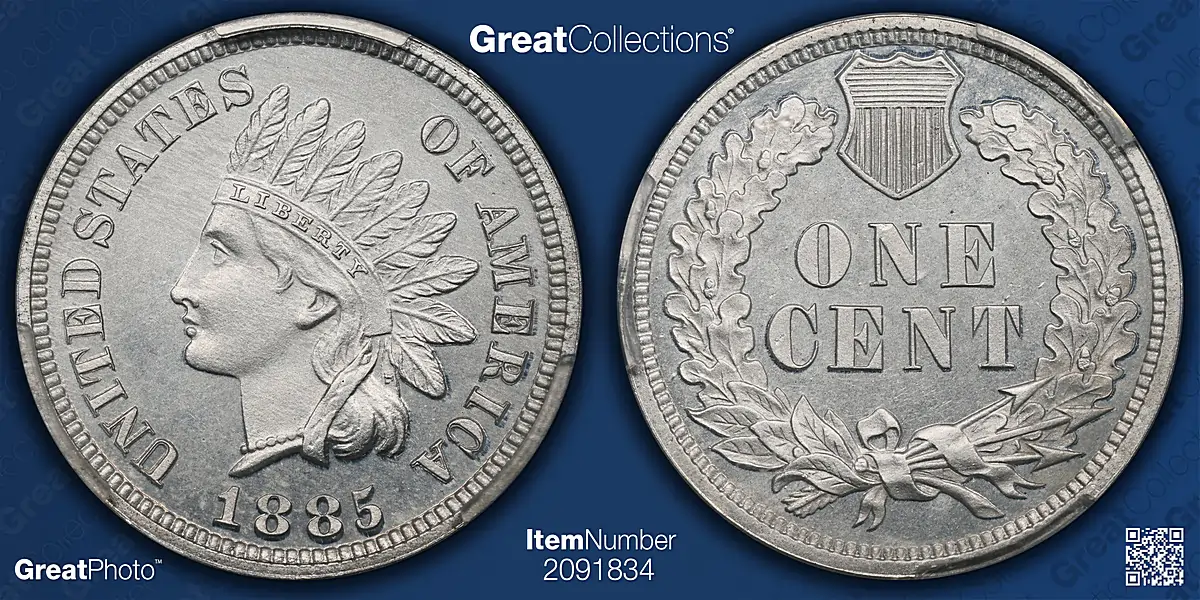
The 1885 aluminum Indian Head cent looks familiar at first. James B. Longacre’s Indian Head design appears on the obverse. The familiar shield reverse appears on the other side. Yet the coin itself tells a much stranger story.
This is not a regular bronze cent. Instead, the United States Mint struck this experimental piece in aluminum with a plain edge. Collectors know it as Judd-1739 and Pollock-1952. PCGS certified the present example as Proof-65. GreatCollections now offers it as part of The Cremorne Collection of Patterns and Test Pieces, with bidding scheduled to close on May 17, 2026. The firm lists the coin as “One or Two Known,” with 51 bids and a $16,500 current bid at the time checked.
A Cent From the Eve of the Aluminum Age
The backstory gives this coin its power. In 1885, aluminum did not belong to the world of soda cans, aircraft, or kitchen foil. It still carried an aura of rarity and modern science.
The breakthrough came one year later. In 1886, Charles Martin Hall produced aluminum by running electric current through aluminum oxide dissolved in molten cryolite. The American Chemical Society notes that aluminum ranked as a semiprecious metal before Hall’s economical process made it widely available.
So this pattern cent sits at a remarkable moment. The Mint struck a one-cent coin in a metal that still felt futuristic. In other words, the piece pairs America’s most humble denomination with one of the 19th century’s most glamorous industrial materials.
What Makes Judd-1739 Different?
A normal 1885 Indian Head cent belongs to the bronze era of the series. References list the 1864-1909 Indian Head cent composition as 95% copper and 5% tin and zinc, with a plain edge and Longacre’s design.
Judd-1739 breaks that formula. It uses the regular Indian Head cent dies for 1885. However, the Mint struck the coin in aluminum instead of bronze. Therefore, it does not represent a new design proposal. It represents a test of metal, finish, and presentation.
That distinction matters. Pattern coins often show designs that never reached circulation. This coin does something different. It asks a simple but fascinating question: What would a regular Indian Head cent look like in aluminum?
One or Two Known
The rarity reaches the highest level. Heritage Auctions cataloged the coin as R.8 and described it as “One or Two Known” when it appeared in the September 17, 2020 Bob R. Simpson Collection sale. The same catalog identified it as an 1885 Indian Head Cent, Judd-1739, Pollock-1952, PR65 PCGS, ex: Simpson.
Heritage also noted that the variety does not appear in the Davis or Adams-Woodin references. Pollock cited a single example, ex: Farouk. Meanwhile, USPatterns.com listed two. One traced to Newcomer and carried a description as bent. The other traced to Brenner’s 1914 American Numismatic Society appearance and Virgil Brand.
The catalog then connected another clue. Doyle Galleries offered an 1885 aluminum cent in the Loye Lauder Collection in December 1983, lot 541. That coin reportedly had a convex obverse and may match the bent Newcomer piece. The Doyle description also mentioned a spot on the neck that Heritage did not see on the Simpson coin. As a result, Heritage suggested that the PR65 Simpson coin may represent the Brenner, Brand, and likely Farouk specimen.
That chain of names gives the coin a deep pedigree. It also shows how difficult it can become to track a pattern when only one or two examples survive.
The Simpson Connection
Bob R. Simpson adds another layer of importance. Heritage describes Simpson as a Texas Rangers part-owner, philanthropist, Texas energy executive, and a legendary figure in the rare coin hobby. Heritage also praised the depth and diversity of his collection.
Pattern coins formed a major strength of Simpson’s cabinet. Simpson spent a reported $36 million to acquire a significant pattern collection intact. Simpson also explained that he valued patterns because their mintages remain tiny and their designs often surpass regular-issue coins in beauty.
Therefore, the Simpson pedigree does more than add a famous name. It places Judd-1739 inside one of the great modern pattern cabinets.
The Cremorne Collection Appearance
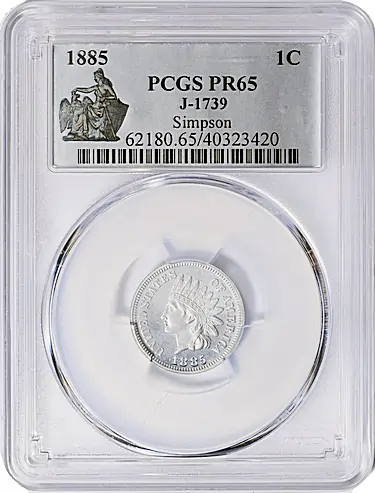
Today, the coin comes from The Cremorne Collection of Patterns and Test Pieces. GreatCollections lists the item as PCGS Proof-65, certification number 40323420, PCGS/industry number 62180, and a Proof strike. The listing also describes it as an Indian Head cent struck in aluminum with a plain edge.
PCGS CoinFacts lists the 1885 1C J-1739 as a Philadelphia Mint pattern with PCGS number 62180. It also records the $21,600 Heritage auction record from September 17, 2020.
The current PCGS Population Report, last updated May 8, 2026, lists only one total PCGS PR example for 1885 1C J-1739.
A Delicate Survivor
Condition makes this coin even more impressive. Aluminum marks easily. It can scuff, haze, and oxidize. Yet this coin survived in Gem Proof condition.
Heritage described both sides as brilliant, with thickly frosted devices. The catalog also noted golden-gray blushes around the borders and a small U-shaped lintmark under the right part of the shield.
That description matters because it gives specialists diagnostics. It also reminds us that this object did not merely survive. It survived with character.
Why Collectors Should Care
Judd-1739 combines several forces that drive elite pattern collecting.
First, it links directly to the Indian Head cent series. Specialists understand the regular design at a glance. Then the aluminum composition changes everything.
Second, it stands at the edge of an industrial revolution. The Mint struck it before the Hall process transformed aluminum from luxury metal to modern commodity.
Third, the rarity leaves almost no room for collectors. R.8 status means the market may wait years, or decades, for a comparable opportunity.
Finally, the provenance gives the coin a cabinet-level story. Farouk, Brand, Brenner, Newcomer, Lauder, Simpson, and Cremorne all orbit the research trail.
A One-Cent Coin With a Museum Story
Most cents speak of commerce. They passed through tills, pockets, and purses. This one speaks of experiment.
The 1885 aluminum Indian Head cent turns a familiar American design into a laboratory artifact. It also captures the moment just before aluminum changed the modern world. For Indian Head cent specialists, pattern collectors, and students of Mint history, Judd-1739 offers more than rarity. It offers a tiny metallic snapshot of American innovation.




Awesome
Beautiful coin
Coins for the elite. The good old days when the mint was a free for all to the rich or night janitors.
Everytime I see a coin minted in aluminum, i can’t help but wonder why the mint didn’t switch to it for continued production. Was it cheaper or more expensive than copper alloys?
@Jodie Griffin When this coin was struck in 1885, aluminum was a semi-precious metal because it was difficult to extract and refine. As an illustration, France’s Emperor Napoleon III famously held a state dinner where lower-ranked attendees used gold dinnerware while the upper-upper types used aluminum!
As the article notes, just a year later a much less expensive process for refining aluminum was developed but it took time for it to become widespread. While that might have been a reason to not adopt it at the time, I couldn’t find any specific information. That said, a common reason for rejecting aluminum could easily have been its weight, roughly one-third that of copper. Given that the Mint had faced public dissatisfaction over the light weight of other contemporary denominations (e.g. the trime, half-dime, and gold dollar), it’s certainly a reasonable possibility.
Amazing!
I had no idea this coin existed. One of my favorite US coins.
I learn something new on the site all the time, never knew they struck these in Aluminum, what a beautiful coin!!!
Nice!!
Very cool
Interesting article and a beautifully struck coin. I guess aluminum is easy enough on the dies to make a full, sharp and clear strike.
Yes, aluminum carries such a ‘modern’ aura that a 19th c. coin minted in it feels like an anachronism.
Nice article! Very interesting coin from a time when aluminum was quite valuable.
I always enjoy your well-written articles. I always learn something new.
Yes, but not much to comment ,maybe next time.
Love this minted coins they are nice too have around
Yes it would have been nice to made a few years of this coin I’ve got several German and Italian coins in this metal,very light but probably very soft,I can’t believe that the bidding is only at 16500 I thought it would sell for millions or it would have been confiscated by the secret service like some of the other coins that got out of the mint then considered illegal to own
I have a 1886 Indian Head Penny that looks just as good as yours could it be worth something
@Arlene Guerrero You’ll need to have your coin examined in person by an expert. There were two different varieties struck; they’re distinguished by the arrangement of the headdress’ feathers. You can find out more by searching for 1886 Indian cent Type I versus Type II.
File this under “you learn something new everyday “! As a collector for over fifty years, I never knew there was an aluminum Indian test piece. Beautiful specimen
So often I read these articles and wish I had a time machine so I could get this amazing coin.
This coin is truly rare. I’d love to have it in my collection.
I have a 1859 Indian head penny
This is an amazing coin. Considering the age and condition it survived this long.
Fascinating, did not know the mint had experimented with aluminum this early, especially as noted for a 1 cent coin. Before the discovered process that made aluminum inexpensive, as noted it was semi-precious. Napoleon had a set of dinnerware made from aluminum and reserved it for his most honored guests, using gold for the less honored, it was that valuable.
I wish I had one in my collection! The history shared on this site is priceless!
I look forward to reading your informative articles. Awesome history lesson. Thank you.
Never heard of it but now looking.
This was a very informative article. Were any other coins struck experimentally like this one? nickels, quarters?
I just learned something new.
The aluminum does not present as well as the copper, but the rarity makes it a great investment.
Interesting article. I’ve wondered why no aluminum coins in the US.
Another great article. TY. I have two Israeli 1 agarot aluminum coins, a 1 won aluminum coin (1968-first year of issue) from S. Korea, and a 1 jiao from Taiwan from the late 50s or early 60s. Our country should have made (or be making) aluminum coins as solid as the wons and the jiaos.
New to this and never have put aluminum together with coinage from the 1800’s.
First I’ve ever heard of it! It’s a beautiful coin in aluminum or copper!
A special coin
Noice!