


The Unauthorized Silver “Dollar” That Launched South America’s Coinage Story
Before Potosí became the great silver engine of the Spanish Empire, Lima struck a coin that should not have existed.
In 1569, the Lima Mint produced an 8 reales under Philip II and assayer R, Alonso Rincón. The coin came without proper authorization. Authorities quickly ended the issue. Yet that brief moment created one of the most important coins in Latin American numismatics.
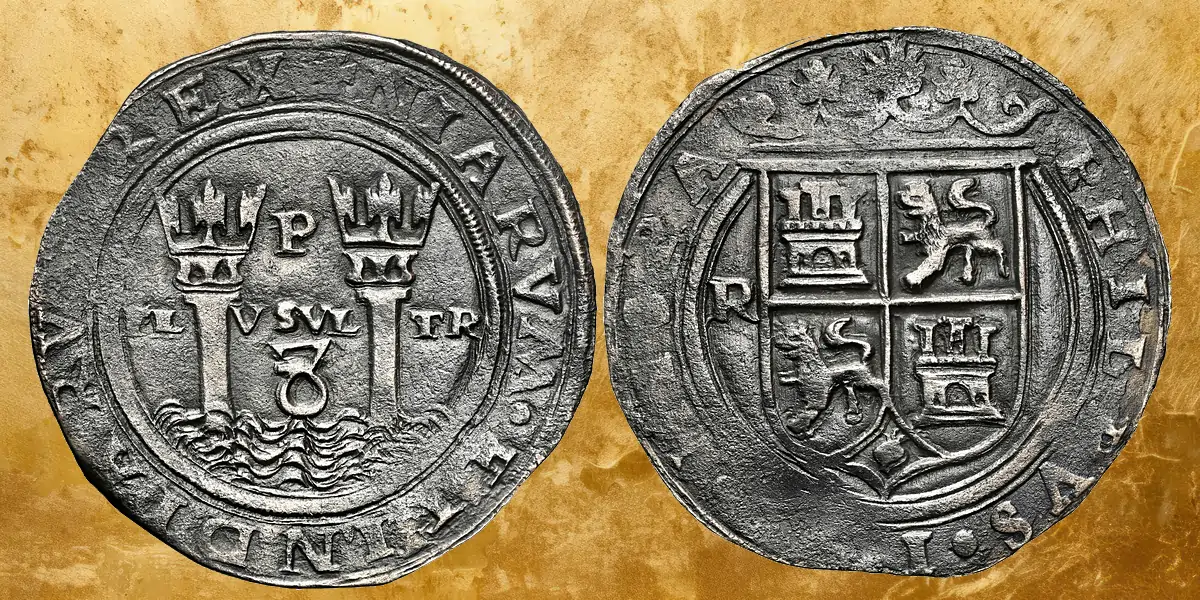
Collectors know it today as the first “dollar” struck in South America.
This example carries the king’s name as PHILPVS. The shield side shows HISPA, while the pillars side continues with NIARVM. The motto reads PL-VSVL-TR. NGC certified the coin as AU Details / Environmental Damage.
It also carries two major pedigrees: ex-Ugaz and ex-Ponte.
A Rare 1569 Lima 8 Reales of Philip II
This Peru, Lima, 8 reales presents a remarkable portrait of an unauthorized issue. The coin names Philip II and shows the assayer R for Rincón to the left.
It weighs 25.57 grams. Standard references list it as S-L1; KM-13; Cal-651.
The coin shows superb full inner details. It also displays a nearly full crown and strong legends on a full, round flan. The strike shows no doubling. The interiors remain bold, though the peripheries show more weakness. Even so, the king’s name remains clear.
The surfaces show dark toning. A hint of surface porosity explains the NGC details grade. Still, the coin ranks among the finest known examples of this important issue.
The Rincón Backstory
The story grows even larger when we look across the Americas.
The three main cob-producing mints in the Spanish Americas were Mexico, Lima, and Potosí. Each began with an assayer named Rincón. At each mint, the Rincón assayers produced 8 reales in very small numbers.
As a result, all three Rincón 8 reales hold major rarity and strong collector demand today.
The Potosí Rincón 8 reales dates to 1575. It ranks as the most available of the three, though only a few dozen examples survive. The mint struck it shortly before Alonso Rincón’s death.
The Mexico Rincón 8 reales sits at the other extreme. Francisco Rincón, Alonso’s brother, oversaw that issue. Only three examples survive from what appears to have been an experimental run in 1538. Reports point to the difficulty of making such large silver coins.
The Lima Rincón 8 reales sits between them in both rarity and chronology. Alonso Rincón oversaw this issue. Researchers record a known population of 17 examples. Collectors prize it because Lima struck it in 1569, without proper authorization, and then quickly stopped the issue.
Why This Coin Matters
This coin stands at the start of South America’s large silver coinage.
It came from a brief, unauthorized experiment. Yet that experiment created the first South American 8 reales. Later generations would know the 8 reales as a global trade coin. It became the model for the “dollar” idea across the Atlantic world.
That gives this Lima Rincón 8 reales a rare mix of history, mystery, and numismatic importance.
It does not just represent a scarce colonial coin. It marks the moment South America entered the world of crown-sized silver money.
Die Variety Details
Researchers use two key obverse traits and two key reverse traits to classify the Lima Rincón 8 reales.
On the obverse, the king’s name appears as either PHILIPVS or PHILPVS. The crown above the shield also shows two flower styles. Some dies show three equal flowers. Others show a larger middle flower between two smaller flowers.
On the reverse, the legend continues as either -NIARVM or -RVM. The motto appears in one of three forms: PL-VSVL-TR, PL-VSV-LT, or PLV-SVLT-RA.
Based on those traits, researchers have identified three obverse dies and four reverse dies.
Obverse Dies
Die Description Known Examples
1 Legend reads PHILIPVS . II . D . HISPA with three equal flowers in the crown 7
2 Legend reads PHILPVS . II . D . HISPA with three equal flowers in the crown 1
3 Legend reads PHILPVS . II . D . HISPA with a larger, different middle flower in the crown 8
Reverse Dies
Die Description Known Examples
A Legend reads NIARVM . ETINDIARVM . REX with motto PL-VSVL-TR 7
B Legend reads NIARVM . ETINDIARVM . REX with motto PL-VSV-LT 6
C Legend reads NIARVM . ETINDIARVM . REX with motto PLV-SVLT-RA 2
D Legend reads RVM . ETINDIARVM . REX with motto PL-VSVL-TR 1
Known Die Combinations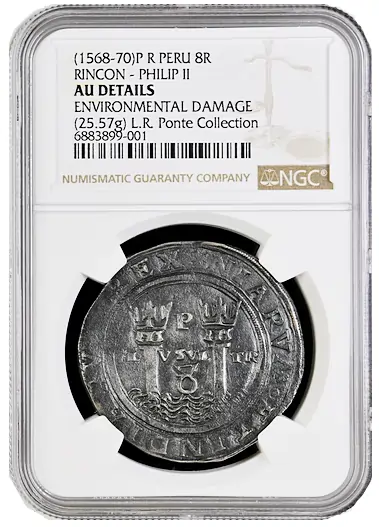
Known Examples
1A 1
1B 4
1C 2
2D 1
3A 6
3B 2
Unreadable 1
This Example: Die Pair 3A
The present coin belongs to die combination 3A.
That means the obverse spells the king’s name PHILPVS, without the second “I.” It also shows a larger middle flower in the crown, with smaller flowers on each side.
The reverse begins with NIARVM. The motto reads PL-VSVL-TR.
That places this coin in a group of only six known 3A examples.
A Coin With Authority, Rarity, and Drama
Great coins often carry more than rarity. They carry a story.
This Lima Rincón 8 reales does exactly that. It links Alonso Rincón to the start of large silver coinage in South America, and connects Lima to Mexico and Potosí through the Rincón name. It also preserves an unauthorized chapter in Spanish colonial monetary history.
The coin’s full round flan, strong inner detail, clear king’s name, and major pedigrees add even more appeal.
For collectors of Spanish colonial coinage, the Lima Rincón 8 reales stands as a landmark. For historians, it marks the birth of South America’s “dollar.”
Offered in Sedwick & Associates Auction 39
Collectors will have a chance to pursue this landmark Lima Rincón 8 reales in Sedwick & Associates Treasure, World, U.S. Coin & Paper Money Auction 39. The sale runs May 6-9, 2026, in Winter Park, Florida. Sedwick lists this coin as Lot 614.
The lot carries a $45,000 starting price and a $60,000 to $90,000 estimate. Sedwick places it in the Coins & Paper Money / Cobs – Lima Silver category. The lot page also notes that this example appears on the back cover of the printed catalog.
That placement fits the coin’s importance. This is not just another high-grade colonial cob. It is one of only 17 known Lima Rincón 8 reales. It also represents the first “dollar” struck in South America. For advanced collectors of Spanish colonial coinage, Lot 614 offers rarity, pedigree, and a dramatic origin story in one coin. Good Luck !



Love the history and intrigue, WAY outta my price range, heck I’d be happy with any 8 resale in decent condition to just hold(not without gloves!) and ponder the journey it made to reach today,!
Wonderful history. Great condition for a cob coin. A keeper for sure!
Excellent article.
Interesting coin