

How to Build the Next Legendary Numismatic Cabinet
By John Kraljevich – Rewritten for CoinWeek
Great coin collections rarely begin with money alone.
They begin with a point of view.
They also begin with patience, taste, discipline, and a willingness to look where other collectors do not. We focus here on Three major colonial coin collections to illustrate “greatness”: the Jack Royse Collection, the Ted L. Craige Collection, and the Rob Retz Family Collection. These were sold a decade ago, and we could also examine any number of more recent great collections like Pogue, Simpson, Eliasberg, Ford, Newman and more. All earned the word “great.” Yet each collector built in a very different way, no matter what era or specialty they focused on.
That contrast matters. In fact, it explains why some coin collections become famous while others fade.
Three Collectors, Three Different Paths
Jack Royse spent about 40 years building a colonial type set. He bought mainly from Stack’s auctions and from a small group of advanced dealers. That circle included Harvey and Larry Stack, Anthony Terranova, and Richard Picker. His collection contained just over 100 coins.
Ted Craige took a different path. His buying spanned the 1960s. During that time, he gathered thousands of coins from auctions, major dealers, small dealers, fellow collectors, and overseas contacts.
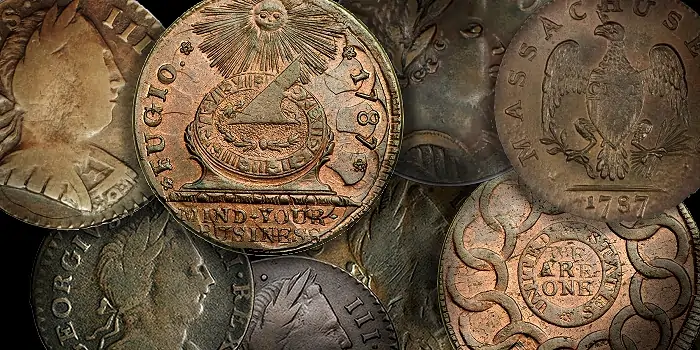
Rob Retz followed yet another route. He chased Fugio cents for about 15 years. He found a little more than 60 coins from eBay, private collectors, and major auctions.
All three collections had stature. However, they shared little in structure.
Royse built quietly. Craige became a force in colonial numismatics. Collectors and dealers knew him well. He also served as both friend and foil to John J. Ford Jr. Retz, meanwhile, brought personality to scholarship. He was funny, sharp, irascible, and serious about coins. Yet he liked his friends even more than he liked his coins.
So what made all three collections great?
The answer comes down to five traits.
1. Depth: Go Beyond One of Everything
Depth does not mean duplicates.
Instead, depth means that a collection reaches past the basic checklist. It shows that the collector understood the series from the inside.
A type collector adds depth through varieties. A variety collector adds depth through die states. Then, a die-state collector can go even further. Planchet variants, striking errors, color differences, grade ranges, counterstamps, and love tokens can all add another layer.
For Royse, depth appeared inside a type collection. His three very different die states of the Hercules Head Connecticut copper proved that point.
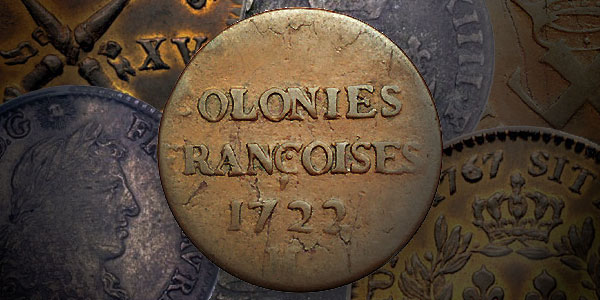
For Craige, depth defined the cabinet. His collection contained more 1721-22 French Colonies coppers than any single collection cataloged by the author. He chased every major colonial series by die variety. Even so, he also kept odd die states, misstrikes, and coins across many grades.
For Retz, depth came through Fugio cents. His goal resembled a variety hunt. Yet he expanded that goal through rare die states, rotational alignments, planchet errors, striking errors, and other distinctive pieces.
That lesson still applies. First, define the goal. Then, go one step beyond it. A deep collection requires knowledge. However, it also requires instinct. You must recognize something scarce and different when it appears.
2. Quality: Build With an Educated Eye
Quality may seem obvious. Yet collectors often misunderstand it.
High grade does not automatically equal high quality. A great collection shows a refined eye at every grade level. In fact, finding attractive coins in lower grades often takes more skill than buying the highest-graded example available.
This point matters in copper. Color and surface can matter as much as sharpness. Sometimes they matter more.
A cabinet full of Condition Census coins can impress anyone. However, a collector needs deeper knowledge to spot a truly superior coin in the wild. Great quality requires more than money. It requires connoisseurship. It also requires confidence when the right coin appears.

The Craige Collection showed this strength. It contained 89 Saint Patrick’s coppers, and only a few lacked strong quality. The Royse Collection also leaned heavily on quality. A few exceptions existed, including his NE sixpence and Confederatio copper. Yet those coins had such rarity that quality became a secondary concern.
That distinction matters. Sometimes quality means knowing when a coin cannot realistically improve. A collector who waits forever for a better example may miss a unique opportunity.
Retz’s Fugio cents also showed consistent quality. Many examples had superb color and surfaces, even when worn. Several rarities ranked at or near Condition Census level.
Therefore, quality asks a hard question: Does the coin belong in the collection because it advances the story, not just because it fills the hole?
3. Expansiveness: Build a Collection With Range
Expansiveness creates another form of greatness.
However, it may also be the hardest trait to achieve. Most collectors have limited money, time, and access. Therefore, few can collect “everything” without compromise.
Colonial collectors often pursue several series by die variety. Yet one series usually receives the most attention. The others may lag behind.
The Tanenbaum Collection, for example, had great Connecticut coppers but less impressive New Jersey coppers. The Scherff Collection included variety sets of many colonial series and many rare type coins. Yet that broad scope came with a trade-off. Quality suffered.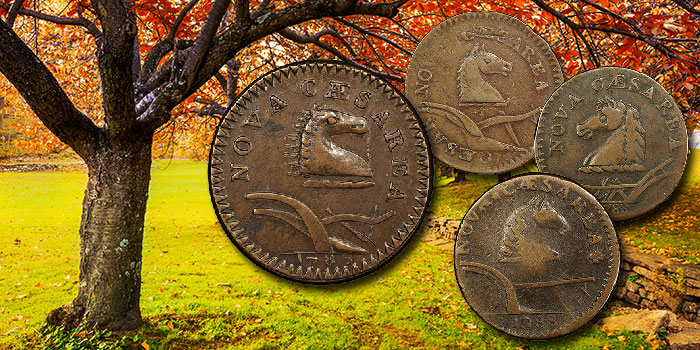
Most collectors would rather own one box of nice coins than 10 boxes of unattractive coins. So, a collection that achieves expansiveness without major quality concessions becomes truly important.
Among the three November 2012 cabinets, Craige best fit this standard. That fact also explains why Stack’s Bowers offered only Part I at that time. Future offerings included New Jersey coppers, Connecticut coppers, Washington pieces, Rosa Americana coins, Wood’s Hibernia coppers, and more.
Expansiveness can amaze. Still, it works best when the collector controls the material rather than allowing the material to control the collector.
4. Completeness: Define the Finish Line
Completeness sounds simple. It is not.
In coin collecting, completeness depends on how the collector defines the collection. A better term may be “not-missing-anything-ness.”
If a specialist can view your cabinet and ask, “Why isn’t there a ____?” then the collection still has a gap.
Of course, fairness matters. No one blames a Fugio cent collector for lacking a unique variety. Yet if a collector does secure a unique coin, that purchase moves the collection closer to greatness.

Retz did not own every Fugio variety that appeared during his collecting era. However, he did acquire, cherrypick, and locate major rarities. That achievement gave the cabinet a strong sense of completeness.
Royse also deserves credit here. His collection held only about 100 coins. Even so, it included enough major pieces to overwhelm the missing types. It lacked an NE shilling, but it included an NE sixpence. That coin represents the type and carries even greater rarity.
This point offers practical advice. Do not define a collection in a way that your budget or patience can never support.
Instead, set creative boundaries. Then, complete the goal. After that, keep building within the same vision.
Completeness does not always mean owning everything. Often, it means building a collection that answers its own question.
5. Pioneering Nature: Collect Before the Crowd Arrives
Very few collections truly pioneer a field.
Yet a pioneering collection can become great even without enormous value. It only needs one condition: other collectors must eventually follow.
Ted Craige offers a strong example. He assembled more than 40 examples of the 1721-22 French Colonies nine deniers issue at a time when almost no one cared. Some collectors included one or two pieces as type coins. However, few studied the die varieties, weights, planchet stock, date rarity, or mintmark rarity.
Even John J. Ford Jr. did not keep the examples he encountered. Ford acquired the Boyd holdings, which included major colonial specialties. Yet he sold certain French Colonies pieces to Craige rather than upgrading the lower-quality pieces he had.
Today, only a small group studies those coins in depth. Even so, Craige’s foresight makes the collection pioneering.
Saint Patrick farthings and halfpence offer another example. Many collectors now associate die-variety collecting in that series with John Griffee. Yet Craige assembled dozens of Saint Patrick pieces by die variety decades earlier.
Royse and Retz built great collections. However, neither cabinet qualifies as pioneering in the same way.
Another cabinet may gain that status over time: the Wnuck Collection of circulating counterfeit Spanish colonial coins. Few collectors study these pieces. Yet the Wnuck cabinet of counterfeit two reales marked only the third major auction offering of those early American-related items. Other denominations have received even less attention.
Pioneering takes courage. It means collecting something that few people understand. It also requires organization and scholarship. Bonus points go to the collector who writes the book.
What Legendary Collections Teach Us
A collection does not need all five traits to become great. In fact, most great collections meet three or more of the standards.
The Garrett Collection clearly ranks as great. Yet does it qualify as pioneering? Does it show depth, or mainly expansiveness? One can debate those points. Still, it scores highly for quality, expansiveness, and completeness.
The Ford Collection also ranks as great. So does the Boyd Collection, which helped build it. Both meet all five standards. However, Ford pioneered different areas than Boyd. Ford’s pioneering strength included Western material and Betts medals. Boyd’s greatness also grew through his acquisition of the Ryder Collection, itself a great collection.
That fact reveals the easiest way to build a great collection: buy someone else’s great collection.
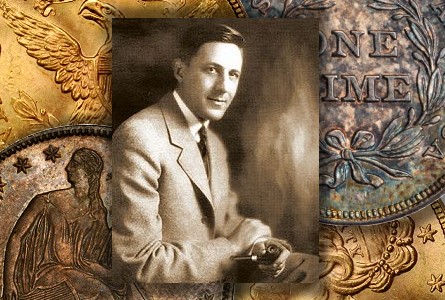
Louis E. Eliasberg Sr. followed a similar route. He built the only complete United States collection by denomination, date, and mintmark. He also acquired the Clapp Collection intact in 1942 through Stack’s of New York. Stack’s Bowers notes that the $100,000 transaction ranked as the largest American numismatic transaction up to that time.
The Clapp Collection had its own pioneering strengths. It included early acquisitions of high-grade branch mint coins and superb Latin American coins. Eliasberg’s collection became legendary. However, the pioneering work largely began before him.
Norweb and Pittman: Two 20th-Century Models
By these standards, two of the ultimate 20th-century cabinets were the Norweb and Pittman collections.
The Norweb Collection combined pedigree, reach, and depth. Mrs. Norweb showed early interest in American die varieties. She acquired varieties in many colonial series before researchers wrote the main references for some of them. The Norweb colonial offerings included rare early American issues and die varieties, and PCGS notes that the Norweb cabinet of United States and colonial coins formed the basis for major 1987 and 1988 auction catalogues.
Her relationship with Richard Picker also mattered. Picker served as a major source for Royse and Craige as well. That gives us another lesson: a great dealer can help build a great collection.
John Jay Pittman offers a different model. His collection had remarkable range. It included great American, Canadian, and world coins. His interests in American Proofs and modern Canadian rarities also showed pioneering vision. Numismatic News has noted the extraordinary scope of Pittman’s Canadian holdings, while other summaries emphasize the breadth of his world material.
Pittman did not build with unlimited modern wealth. Instead, he used knowledge, nerve, timing, and conviction. That made his cabinet even more instructive.
The Real Difference Between a Good Collection and a Great One
Great collections exist in every field.
Many do not carry famous names. Many do not hold seven-figure coins. Some may not look impressive to a casual observer. Yet they can still matter.
The difference comes down to connoisseurship, vision, and taste.
Anyone can build a great collection. Wealth helps, of course. But numismatics contains countless side roads. Many remain open to collectors with creativity, patience, and discipline.
So, become a pioneer. Develop an eye for quality. Learn the difference between rare and merely expensive. Then, wait for the right coins.
The next great coin collection may not require unlimited money.
It may only require a collector who sees the opportunity before everyone else does.

Good article. My Grandfather started me collecting about 55 yrs. ago & this is helping to rekindle my deire. Have no coins left & had quite a few top quality complete sets but ran in to financial troble & had to piece them out. Mad me sick to my stomach everytime I had to sell & do mean I had a number of quality complete sets or nearly complete. And I’ve made evry mistake listed hear. Of course when I was forced to sell, it took about another year & 1/2 before coins just took off. Still get daily info. on comp. & still get sick to my stomsch. There woould be no way to rebuild what I had plus the cost would be simply outrageous.,You have to be a pretty rich man to replace what I had to sell plus would be impossible to replace them all.
Sincerly,
L.H. McDaniel,lll
P.S. Blowing off some steam I suppose & the truth is, it’s the beuty & work collesting them that’s more important than the vLUE OF THE COINS. i ENJOY LOOKING AT AN INEXPENSIVE COIN IN TOP GRADE NEARLY AS MUCH AS AN EXPENSIVE ONE IN A GOOD GRADE.
I am fixated on the last two lines of this article, and particularly the final send-off: building a great collection “may be easier than you think.” My complete16-piece compilation of French 20-franc gold roosters, rated No.1 by a Set Registry, but by no means “great” if respective census figures are considered, ground to a sudden halt early this year when I hit a glass wall: non-availability, yes, even with the bull market in precious metals. Excellent article!
I have a one hundred cents silver coin and one dollar from 1794
When my father passed away in 1994 I was surprised to find large cigar boxes full of wheat back Lincoln cents. The bottom of his closet was full of these boxes. When I started going through the coins I noticed that they were all in excellent condition most of them are like new. At the time the value of most of these coins was just a few cents each with a few exceptions. Going through one box I found 20 steel cents and two 1909 VDB s along with a double strike 1955.
Not having the patience to go through everything and not needing the money I packed everything up. I will leave them for my son and maybe they’ll be worth more after I’m gone
Well written article and informative. I will put these points into practice with my own collection.
I use many of these traits building my collection. For instance, my Indian Head Cent collection album, albeit circulated, has a key varieties, mint errors or something unique about it. This simply adds value to my collection and knowing that I did my due diligence as a numismatist and collector. Putting a set together also requires patience to stay the course instead of filling a open slot in a coin book.