1926-D Peace Dollar: CAC MS-66 Gem Heads to Auction
In 1934, an American coin collector could order an Uncirculated 1926-D Peace Dollar directly from the U.S. Treasury. The price? Just one dollar, plus first-class postage.
More than nine decades later, finding a truly exceptional example presents a much greater challenge.
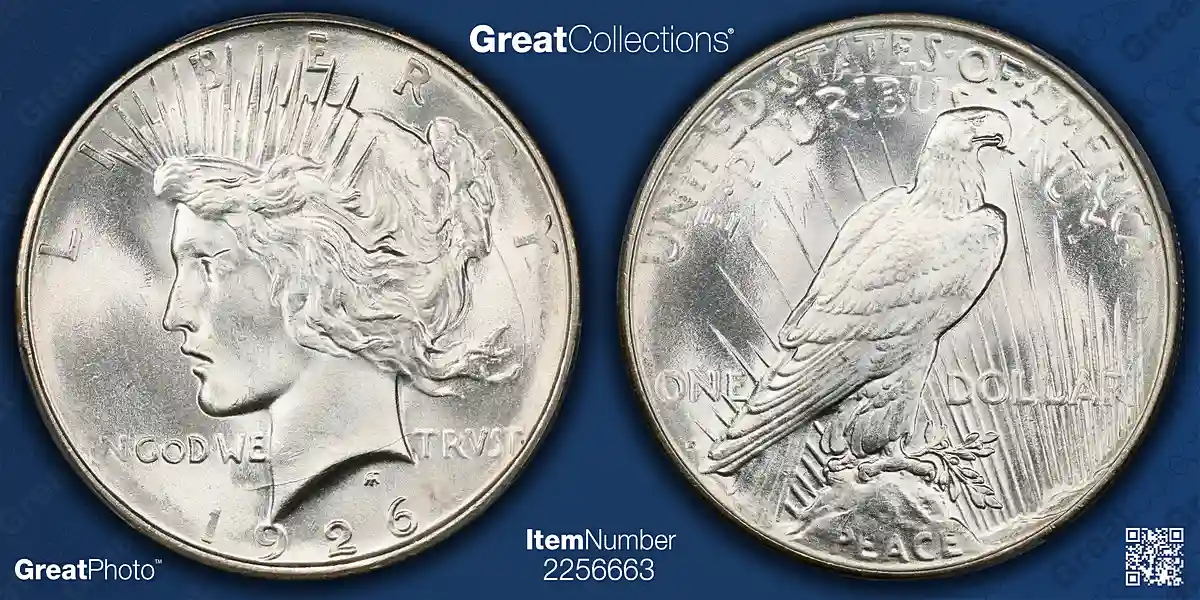
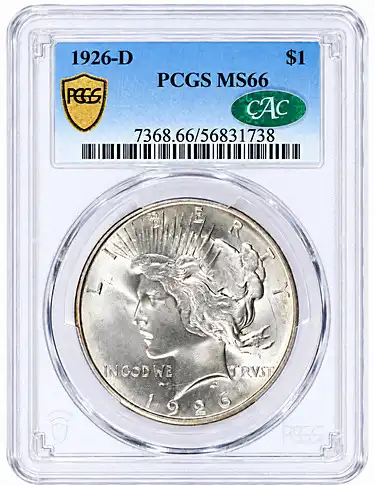
On Sunday, October 18, 2026, GreatCollections will offer a 1926-D Peace Silver Dollar graded PCGS MS-66 with CAC Green approval. The coin represents a premium-quality survivor of an issue that collectors can readily find in lower grades.
However, its story involves much more than an impressive grade. It begins with the aftermath of World War I, a sweeping government silver program, and millions of coins that faced years of storage and handling.
A Silver Dollar Born From War and the Hope for Peace
Few American coins capture their era as effectively as the Peace Dollar.

In 1921, the United States introduced Anthony de Francisci’s design to celebrate the restoration of peace following World War I. The young sculptor created a striking image of Liberty wearing a radiant crown.
Meanwhile, the reverse portrayed an eagle resting on a mountaintop. The bird holds an olive branch and faces the rays of a rising sun. Below, the word PEACE declares the coin’s message.
Yet an entirely different story helped bring these silver dollars into existence.
The Pittman Act of 1918 authorized the melting of millions of Morgan Silver Dollars. The government then sold much of the recovered silver to Great Britain, which needed bullion to support its currency requirements in India during the war.
Importantly, the legislation also required the Treasury to replace the melted dollars through new coinage.
Consequently, silver dollar production resumed in 1921 after a 16-year suspension. The Mint first struck Morgan Dollars before introducing the Peace Dollar in December.
By the middle of the decade, the government continued producing replacement dollars even though the economy had little need for additional silver coins in everyday commerce.
Many went into Treasury storage and bank vaults. Others eventually entered circulation, particularly in regions where silver dollars remained popular.
This combination of government policy and limited commercial demand would shape the surviving population of the 1926-D Peace Dollar.
Denver Returns to Silver Dollar Production in 1926
After producing Peace Dollars in 1923, the Denver Mint suspended silver dollar production during 1924 and 1925.
Then, in 1926, Denver returned to the series with a mintage of 2,348,700 pieces.
The figure makes the 1926-D a relatively accessible date. Indeed, collectors can locate circulated examples and lower Mint State coins without extraordinary difficulty.
But the Denver Mint also produced some particularly attractive Peace Dollars.
Numismatist Q. David Bowers described the issue as generally well struck, often displaying rich, satiny luster. Many examples show strong design details, especially compared with weaker strikes from San Francisco during this period.
Nevertheless, not every coin left the presses with perfect definition. Some display weakness near the reverse center, along the rims, or around the date. Others exhibit small die cracks.
Therefore, collectors must consider strike quality and preservation together when evaluating premium examples.
The Curious 1926 Motto Modification
The 1926 Peace Dollar also contains an unusual design detail that collectors sometimes overlook.
Look closely at the obverse motto, IN GOD WE TRVST.
The word GOD rises noticeably higher than the surrounding lettering.
This difference did not happen by accident. Chief Engraver John R. Sinnock reinforced those three letters on the 1926 obverse master die.
Earlier Peace Dollars frequently displayed shallow motto lettering. As working dies deteriorated, certain letters lost definition. Strengthening the word GOD helped address that problem.
However, the modification also inspired an intriguing historical theory.
Some numismatists have suggested that the change reflected the national controversy surrounding the 1925 Scopes Trial in Tennessee. That famous courtroom battle placed the teaching of evolution and religious beliefs at the center of American public debate.
No conclusive evidence establishes that connection.
In fact, die wear provides a practical explanation for Sinnock’s decision. Regardless of his motivation, the unusually prominent lettering appears on 1926 Peace Dollars from Philadelphia, Denver, and San Francisco.
It remains one of the date’s most interesting design characteristics.
Why the 1926-D Peace Dollar Becomes Scarce in MS-66
A coin’s original mintage tells only part of its story. For the 1926-D Peace Dollar, the real challenge involves surviving quality.
During the 1920s, Mint employees routinely packed silver dollars into heavy canvas bags containing hundreds or thousands of coins. As workers moved, stacked, and transported those bags, the coins repeatedly struck one another.
Even coins that never entered circulation could accumulate scratches, abrasions, and contact marks.
Lady Liberty’s broad cheek and neck offered particularly vulnerable surfaces.
Meanwhile, decades of Treasury storage, bank handling, and eventual release created additional opportunities for damage.
As a result, collectors encounter numerous Uncirculated 1926-D dollars with attractive luster but noticeable marks.
Finding an example with strong design definition, clean focal areas, and outstanding eye appeal becomes increasingly difficult as the grade climbs.
That is where the GreatCollections offering stands apart.
PCGS has assigned the coin a grade of MS-66, placing it among the finer certified survivors of this Denver issue.
According to the PCGS Population Report dated October 15, 2026, the grading service has recorded 387 examples at MS-66, with another 100 graded higher.
Those higher certifications include MS-66+, MS-67, and MS-67+ examples.
Although certification totals can include resubmissions, the figures illustrate how sharply the available population narrows near the top of the grading scale.
For collectors assembling high-quality Peace Dollar sets, that distinction matters.
The CAC Green Sticker Adds Another Level of Confidence
The GreatCollections specimen also carries a green sticker from Certified Acceptance Corporation (CAC).
CAC independently evaluates eligible coins already certified by services such as PCGS. Its green sticker identifies a coin that meets the company’s standards for solid or high-end quality within its assigned numerical grade.
In other words, the sticker provides an additional expert assessment beyond the PCGS certification.
However, CAC Green does not indicate an automatic upgrade to the next grade. Rather, it recognizes quality within the grade already assigned.
For an MS-66 Peace Dollar, collectors place considerable importance on original surface quality, pleasing luster, limited distracting marks, and balanced eye appeal.
The combination of PCGS MS-66 certification and CAC approval makes this 1926-D especially appealing to collectors who value quality over grade alone.
From a Treasury Dollar to a Premium Numismatic Survivor
Perhaps the most remarkable part of the 1926-D story comes from an ordinary Treasury announcement.
As late as June 1934, collectors could still purchase Uncirculated examples directly from the government for face value plus mailing costs.
Today, the date remains available in many grades. Yet the finest survivors occupy a different part of the numismatic market.
For perspective, another 1926-D Peace Dollar graded PCGS MS-66 with CAC approval realized $3,840 during Stack’s Bowers Galleries’ April 2025 Spring Showcase Auction.
That earlier transaction does not establish the value of the present coin. Nevertheless, it demonstrates collector interest in premium examples of this otherwise accessible issue.
The GreatCollections specimen offers an opportunity to acquire a high-grade Denver Peace Dollar with two respected assessments of its quality.
More importantly, it represents the remarkable journey of American silver coinage.
Born from legislation responding to a world war, struck during the prosperity of the Roaring Twenties, and preserved through generations of collectors, the 1926-D Peace Dollar tells a story that reaches far beyond its original one-dollar face value.
And in MS-66 with CAC approval, that story becomes especially compelling.
1926-D Peace Silver Dollar Specifications
- Denomination: One Dollar ($1)
- Year: 1926
- Mint: Denver Mint
- Mintmark: D, on the reverse below ONE
- Mintage: 2,348,700
- Designer: Anthony de Francisci
- Composition: 90% silver, 10% copper
- Weight: 26.73 grams
- Diameter: 38.10 mm
- Silver Content: 0.77344 troy ounce
- Edge: Reeded
- Obverse: Radiant Liberty
- Reverse: Eagle with olive branch, perched above PEACE
Auction Information
- GreatCollections will offer the 1926-D Peace Silver Dollar PCGS MS-66 (CAC Green) in its Sunday, October 18, 2026, auction.
- GreatCollections Item: 2256663
- PCGS Certification Number: 56831738
- View the 1926-D Peace Dollar at GreatCollections