


America’s Legendary $100 “Watermelon” Note
Some great American currency earned fame through artistry. Other notes became famous through rarity. The 1890 $100 Watermelon Treasury Note managed both. Then it added a Civil War naval hero, a national battle over silver, and one of the strangest nicknames in American numismatics.
Now, one of these legendary notes has returned to the auction block.
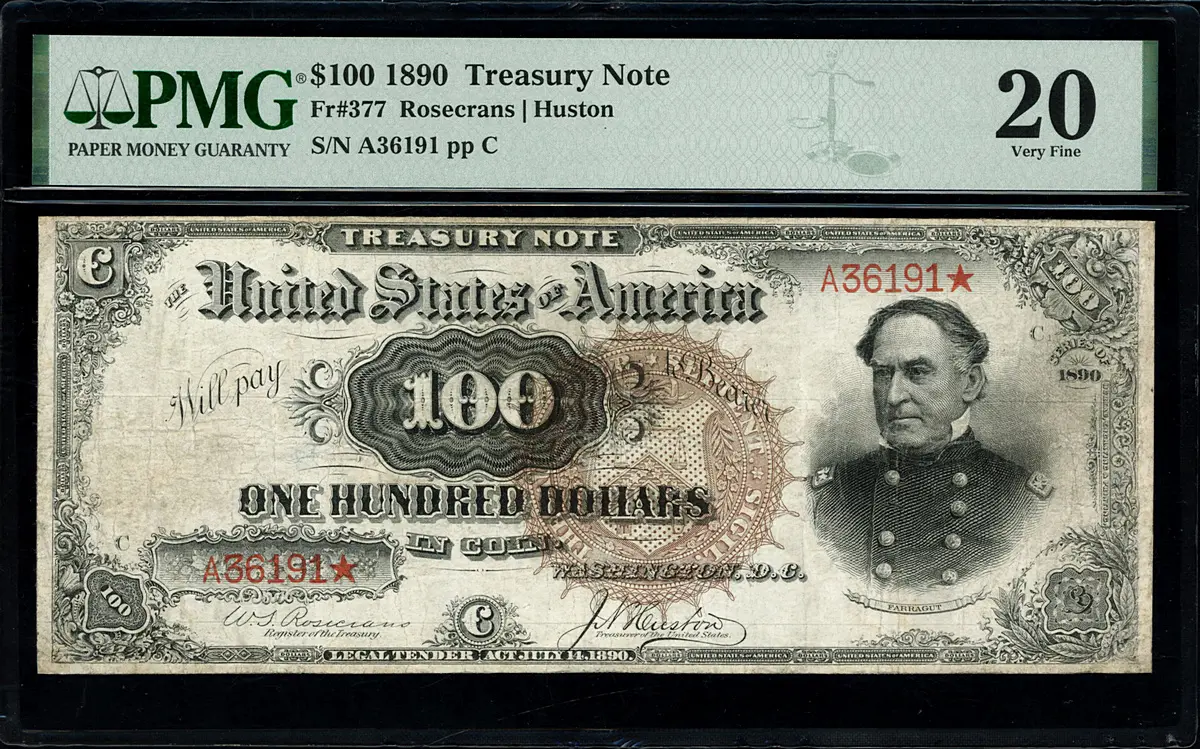
GreatCollections will offer a Friedberg 377 1890 $100 Treasury Note, graded PMG Very Fine 20 with a Restoration notation, on Sunday, October 4, 2026. The note comes from the Schwenk Family Collection of 100 Greatest American Currency Notes. GreatCollections lists the closing time as 7:11:50 p.m. Pacific Time.
Only about 35 examples of Fr. 377 survive from an original production of 120,000 notes. Moreover, institutions hold seven or eight of those survivors, depending on the census source. That leaves fewer than 30 potentially available to collectors.
In other words, only about one Watermelon $100 survives for every 3,400 originally produced.
A $100 Note Born From America’s Battle Over Silver
The story behind the Watermelon Note begins far from the engraving room.
Congress passed the Sherman Silver Purchase Act on July 14, 1890. The law directed the Treasury to purchase as much as 4.5 million ounces of silver bullion each month. In return, the Treasury issued a new form of paper money. Collectors now call these issues Treasury Notes or Coin Notes.
Unlike a Silver Certificate, a Treasury Note carried a particularly powerful promise. The government could redeem it in either gold or silver coin at the Treasury secretary’s discretion. The notes also served as legal tender.
That monetary experiment left its purpose directly on the face of the $100 note. The obligation states that the United States will pay the bearer one hundred dollars in coin. The Smithsonian’s National Numismatic Collection confirms both that language and the note’s legal-tender wording.
Therefore, the Watermelon Note does more than represent spectacular 19th-century engraving. It captures one of the most contentious monetary debates in American history.
Admiral Farragut Gives the Watermelon Note a Civil War Connection
The face gives the note another powerful historical link.
A portrait of Admiral David Glasgow Farragut dominates the right side. A large “100” counter sits to the left of center. Floral engraving fills the corners. Meanwhile, a large brown spiked Treasury Seal anchors the design.
Farragut became one of the great naval figures of the Civil War.
The Navy promoted him to rear admiral in 1862. Two years later, on August 5, 1864, he led Union forces into Mobile Bay, Alabama. Confederate mines–then called torpedoes–protected the channel. After the monitor USS Tecumseh struck a mine and sank, Farragut drove his fleet forward.
History remembers the moment through the famous command, “Damn the torpedoes, full speed ahead!” The exact words varied in contemporary recollections, but the U.S. Naval History and Heritage Command recognizes the famous shortened version.
Later that year, Farragut became the Navy’s first vice admiral. Then, in 1866, congressional action made him the first full admiral in United States Navy history.
That makes Fr. 377 an unusual intersection of monetary history and Civil War history.
Yet Farragut does not explain the note’s fame.
For that, collectors need to turn it over.
How Two Giant Green Zeros Created the “Watermelon”
The reverse contains one of the most recognizable designs ever placed on American paper money.
Heavy green geometric engraving covers much of the note. Most importantly, the two enormous zeros in “100” contain intricate lathework. Their oval shapes and patterned interiors reminded observers of watermelons.
The nickname stuck.
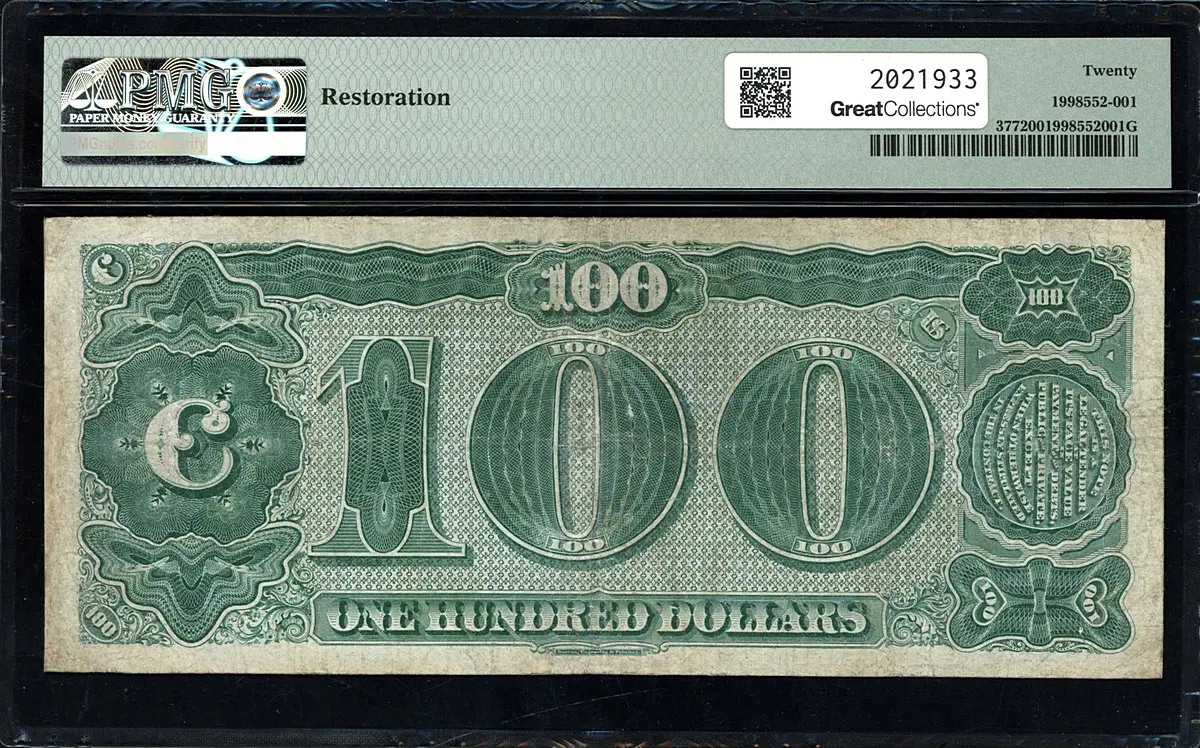
Collectors generally call the 1890 $100 the Watermelon Note or Baby Watermelon. Its far rarer $1,000 sibling, with three giant zeros on the reverse, became the Grand Watermelon.
Ironically, the elaborate engraving that collectors prize today did not last.
Treasury officials soon favored a more open reverse design. They believed open spaces encouraged bank tellers and others to inspect the printing more carefully. Therefore, Series 1891 $100 Treasury Notes abandoned the dense Watermelon reverse for what collectors now call the “Open Back.”
The spectacular Watermelon design effectively became a one-series experiment.
That short life helped create an American currency icon.
From 120,000 Notes to About 35 Survivors
The Bureau of Engraving and Printing produced 120,000 Series 1890 $100 Treasury Notes of the Fr. 377 type.
Today, census research tracks only about 35 survivors. Heritage cited Track & Price data in 2024 that counted 35 examples, including eight in institutional collections. Stack’s Bowers has previously cited at least seven institutional examples.
Those numbers put the survival rate at roughly 0.03% of the original production.
They also explain why even circulated Watermelon Notes attract serious attention.
The Schwenk Family example carries a PMG grade of Very Fine 20. PMG also notes Restoration on the holder. Its certification number is 1998552-001. The note occupies the Watermelon slot in the Schwenk Family’s registry collection devoted to 100 Greatest American Currency Notes.
The Grand Watermelon Casts a Million-Dollar Shadow
The $100 Watermelon also benefits from its association with one of America’s ultimate paper-money trophies.
Q. David Bowers and David M. Sundman ranked the 1890 $1,000 Grand Watermelon Treasury Note No. 1 in their 100 Greatest American Currency Notes. The $100 Watermelon ranks No. 18.
Prices for the $1,000 version explain the mystique.
In 2018, Stack’s Bowers sold the finest-known Fr. 379a Grand Watermelon for $2.04 million. Only two Fr. 379a examples resided in private hands at that time.
An even rarer Fr. 379b small-seal Grand Watermelon reached $3.29 million at Heritage in January 2014. Heritage described that particular variety as unique in collector hands.
Against that backdrop, the $100 Watermelon represents the relatively attainable member of one of America’s most famous currency families.
“Attainable,” of course, remains relative.
What Have $100 Watermelon Notes Sold For?
Recent auction records show how strongly grade, originality, restoration, and eye appeal can affect the market.
Heritage sold a PMG Very Fine 20 example with restoration for $114,000 in September 2024. A PMG Very Fine 30 brought $228,000 in May 2024, while another VF30 realized $336,000 in January 2023.
At the other end of the condition spectrum, the D. Brent Pogue Collection contained a PMG Choice Uncirculated 63 EPQ example. PMG described it as the finest graded and the only example that it had certified in an Uncirculated grade. That note realized $372,000 in March 2020.
Those results also show why collectors should resist simple price comparisons. With a population this small, each note brings its own combination of condition, paper quality, restoration, margins, color, and provenance.
1890 $100 Watermelon Treasury Note Specifications
- Country: United States
- Series: 1890
- Denomination: $100
- Note Type: Treasury Note, also called a Coin Note
- Friedberg Number: Fr. 377
- Printer: Bureau of Engraving and Printing
- Authorization: Act of July 14, 1890
- Face Portrait: Admiral David Glasgow Farragut
- Signatures: William Starke Rosecrans, Register of the Treasury; James Nelson Huston, Treasurer of the United States
- Treasury Seal: Large brown spiked seal
- Reverse: Green “Watermelon” design with two large ornamented zeros
- Original Production: 120,000
- Known Survivors: About 35
- Institutional Holdings: Seven to eight reported
- Approximate Dimensions: 7.8 × 18.8 cm, or about 3 1/16 × 7 13/32 inches, based on the Smithsonian example
- GreatCollections Example: PMG Very Fine 20, Restoration
- PMG Certification: 1998552-001
- Provenance: Schwenk Family Collection of 100 Greatest American Currency Notes
- Auction Close: October 4, 2026, at 7:11:50 p.m. Pacific Time
A Currency Design the Treasury Abandoned, and Collectors Never Forgot
The Watermelon Note offers something that many great rarities cannot.
Its appeal makes sense instantly.
You do not need a loupe to find the feature. You do not need an attribution guide. Turn the note over, look at those enormous green zeros, and the nickname becomes obvious.
However, the deeper story makes the note important.
Congress created Treasury Notes during a national fight over silver. Farragut connects the face to one of the Civil War’s defining naval victories. Treasury officials quickly abandoned the heavily engraved reverse. Then redemption and time eliminated virtually the entire original issue.
More than 135 years later, about 35 survive.
That combination of history, rarity, design, and an unforgettable nickname explains why the 1890 $100 Watermelon Treasury Note remains one of the great trophies of American paper money.
And on October 4, another collector will have a chance to own one.





Very unique name for this famous note.
Another great article!
Been getting into paper currency lately. Very interesting.
A wonderful note and fine article, but it really isn’t collectible.