


The Byzantine Emperor Whose Beard Grew Across His Coins
“As presented to us by the scanty records of his time, the man we are led to visualize as Constans II is a callous, loveless prince at the outset of his reign, ripening, as the years go on, into a grim, friendless monarch, hateful alike to his subjects and himself.”– Hugh Goodacre, Handbook of the Coins of the Byzantine Empire (1960), p. 102
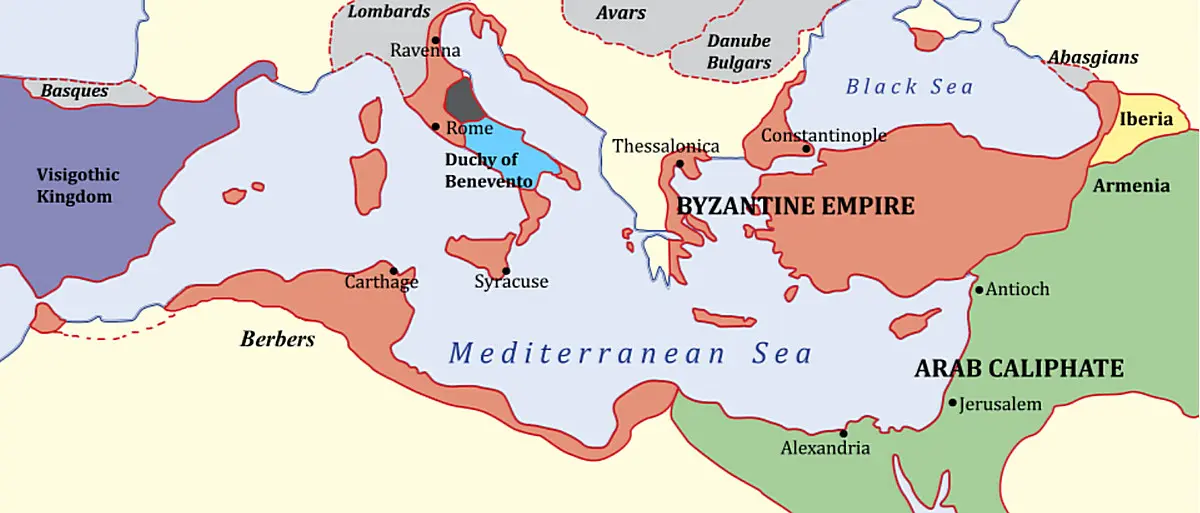
A boy inherited the Byzantine Empire at one of the darkest moments in its history.
Yet collectors can still watch that boy grow older. His face changes across his coins. First, he appears young and clean-shaven. Then, a short beard emerges. Finally, an enormous beard dominates his portrait.
Few ancient rulers left such a clear visual record of aging.
The coins of Constans II also document a collapsing frontier, a bitter religious conflict, a troubled dynasty, and one of the strangest imperial murders in Byzantine history.
A Dynasty Collapses in Constantinople
Byzantine Emperor Heraclius [1] died on February 11, 641. He was 66 years old and had ruled for almost 30 years.
The empire stood in grave danger. Arab armies serving the Muslim Caliphate had occupied much of Egypt. They also continued to advance through Syria.
Heraclius left the throne to two sons by different mothers. The elder, Heraclius Constantine, was about 28. However, tuberculosis had left him gravely ill.
The younger son, Heraclonas, was only 15. His mother, Martina, held considerable influence at court. Many people in Constantinople deeply disliked her.
Heraclius Constantine died on May 25, 641. Almost immediately, rumors spread that Martina had poisoned him. Her death motive seemed obvious to her enemies. Heraclonas could now rule alone.
However, the arrangement did not last.
Late in 641, a military coup removed Martina and Heraclonas. The conspirators then placed Constans, the 10-year-old son of Heraclius Constantine, on the throne.
Constans would rule for almost 27 years. Today, his coins rank among the most available and affordable issues in the Byzantine series.
Constantine, Constans, and the Birth of “Big Beard”
The young emperor ruled under the name Constantinus. His coins present that name in several abbreviated and sometimes garbled forms.
History, however, remembers him as Constans.
The nickname helped writers distinguish him from the earlier Roman Emperor Constans I, who ruled from 337 to 350 CE. Constans I was the youngest son of Constantine the Great. Modern Greek speakers still commonly shorten Konstantinos to Kostas [2].
Later Byzantine tradition also associated Constans II with the Greek nickname ho Pōgōnatos, or “the Bearded.” Older scholarship sometimes attached that title to his son, Constantine IV. Nevertheless, the spectacular beard on Constans II’s later coinage makes the nickname especially appropriate.
The Young Emperor Appears on Gold
A new emperor needed coins bearing his portrait as quickly as possible. Money carried the ruler’s image across the empire. Therefore, coins introduced the emperor to subjects who would never see him in person.
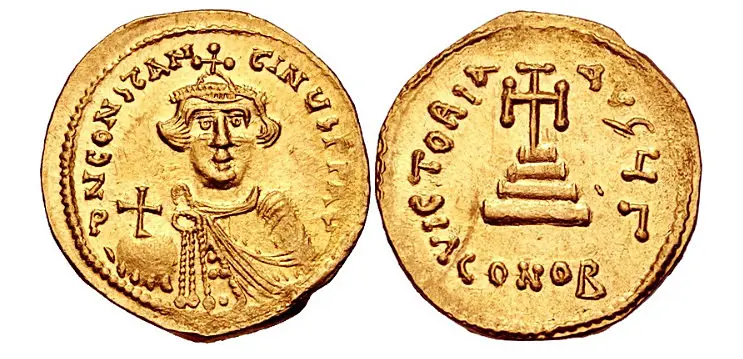
The earliest gold solidi of Constans II do not show a child. Instead, the engravers created the idealized portrait of a beardless young adult.
The obverse legend reads:
dN CONSTANTINUS PP AVG
The inscription abbreviates Dominus Noster Constantinus Perpetuus Augustus, or “Our Lord Constantine, Perpetual Augustus.”
The reverse carries a cross potent on three steps. The hopeful inscription VICTORIA AVG proclaims “Victory of the Emperor.”
Below the cross, the letters CONOB identify Constantinople and its refined gold standard. Numismatists traditionally expand the letters as Constantinopolis obryzum, or “refined gold of Constantinople.” In addition, the Greek numerical value of OB equals 72. That number recalled the solidus standard of 72 coins to the Roman pound.
Classical Numismatic Group sold the illustrated early solidus for $475 in 2015 [3]. Surviving examples usually weigh about 4.3 to 4.5 grams.
A Beard, and a Date Appears
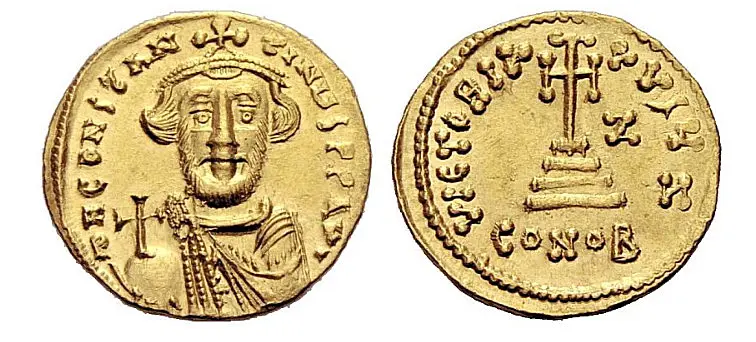
By 648, Constans had begun to appear on his coins with a short beard [4].
Some solidi also carry a Greek letter beside the reverse cross. This letter gives an indictional date.
The Byzantine government used a repeating 15-year indiction cycle for taxation and official dating. Therefore, the letter did not identify a year by itself. The user also needed to know the correct 15-year cycle.
On the illustrated coin, the Greek letter zeta, or Z, identifies the seventh indiction. That date corresponds to 648-649 CE.
The Byzantine calendar began its year on September 1. As a result, a Byzantine year usually spans parts of two modern calendar years.
Another Greek numeral appears at the end of the reverse inscription. This letter identifies the officina, or workshop, within the Constantinople Mint.
For example, zeta represented the seventh of 10 workshops. On the illustrated coin, the engraver cut the letter backward. Such errors appeared often on Byzantine dies.
Theology, Imperial Censorship, and the Great Beard
Byzantines argued intensely over theology. Moreover, they often accused opponents of heresy.
During the seventh century, one dispute centered on the nature of Christ.
The Orthodox or Dyothelite position held that Christ possessed two wills or energies. One was human. The other was divine.
Monothelites [5] argued that Christ possessed one will that united the human and divine.
Constans viewed the conflict as a threat to imperial unity. Therefore, in 648, he issued an edict known as the Typos. It forbade further public discussion of whether Christ possessed one will or two.
The order satisfied neither faction. Instead, it angered both.
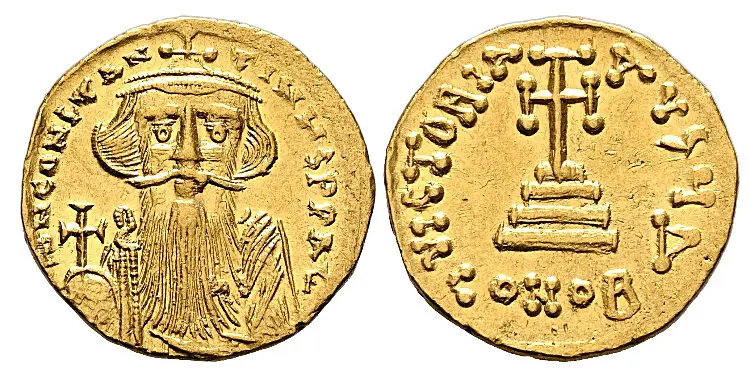
Meanwhile, the emperor’s coin portrait changed dramatically. Between about 651 and 654, Constantinople produced solidi showing Constans with an exceptionally long beard and mustache [6].
His face almost disappears behind the mass of engraved hair.
The portrait created one of the most recognizable imperial types in Byzantine coinage. It also turned the emperor’s physical aging into a method for dating his coins.
![Constans II, with Constantine IV, 641-668. Solidus (Gold, 19 mm, 4.43 g ), Constantinople, circa 662-667. dN C AN Crowned and draped facing busts of Constans II, on left with a plume on his head, and Constantine IV; above, between their heads, cross. Rev. VICTORIA - AVSЧ [...] / CONOB Cross potent, on base and three steps, between Heraclius, on the left, and Tiberius, on the right. SB 964.](https://coinweek.com/wp-content/uploads/2026/08/fig4.webp)
Constans Builds a Dynasty on His Coins
Constans II’s eldest son, the future Constantine IV, was born around 650. The exact year remains uncertain.
Constans wanted to secure an orderly succession. Therefore, he elevated Constantine to the rank of co-emperor in 654.
The boy soon appeared beside his heavily bearded father on the gold solidus.
Then, in 659, Constans elevated his younger sons, Heraclius and Tiberius. The mint placed their full-length figures on the reverse. They stand on either side of the traditional cross potent on steps.
The result transformed one gold coin into a dynastic portrait.
Constans and Constantine occupy the obverse. Meanwhile, Heraclius and Tiberius flank the cross on the reverse. The arrangement announced that the Heraclian dynasty had four imperial members and, at least in theory, a secure future [7].
In practice, the succession would prove far more violent.
The Emperor Abandons Constantinople
By the early 660s, heavy taxation and Constans’ religious policies had made him increasingly unpopular in Constantinople.
In 662, he left the capital.
The emperor traveled west and visited Rome in 663. He then moved his court to Syracuse, Sicily. His decision marked a remarkable attempt to shift the center of imperial power closer to the threatened provinces of Italy and North Africa.
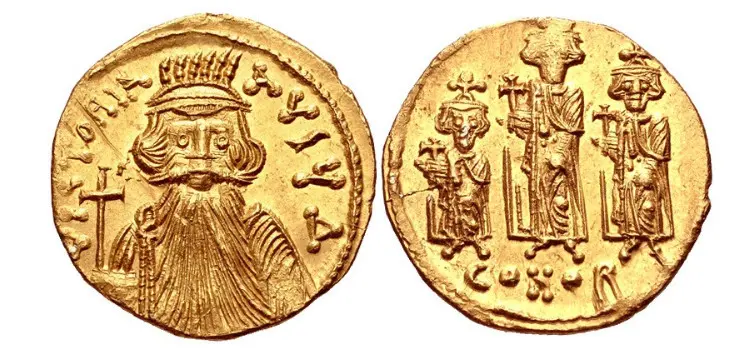
The last solidi struck for Constans at Constantinople, from about 663 to 668, rank among the most unusual Byzantine gold coins.
They omit the reigning emperor’s personal name.
Instead, the obverse carries VICTORIA AVGU, a formula that normally appeared on the reverse. The reverse shows standing figures of the emperor’s three sons above the mint mark CONOB [8].
These coins advertise the dynasty. Yet they almost erase the man who created it.
Murder in the Imperial Bath
Constans never returned to Constantinople.
On July 15, 668, a court chamberlain murdered the emperor while he bathed in Syracuse. Constans was only 37 years old.
One version of the story claims that the assassin struck him with a heavy bronze bucket or soap dish. Whatever the weapon, the attack ended one of the most turbulent reigns of the seventh century.
It also triggered a short-lived revolt and produced one of the rarest gold coins in the Byzantine series.
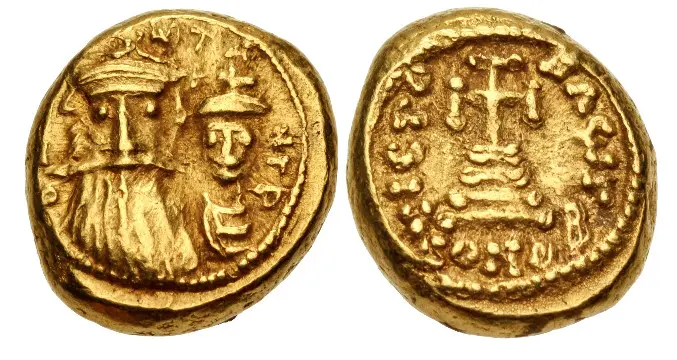
The “Dumpy” Gold of Carthage
Carthage, located in present-day Tunisia, remained an important Byzantine outpost. The city also maintained an active mint.
Its gold coins have a distinctive appearance.
Engravers created crude and highly stylized portraits. Mint workers struck the coins on small, compact, and unusually thick blanks. Collectors often describe these flans as “dumpy.”
However, the awkward appearance can mislead. Carthage usually maintained the expected weight and gold purity.
The inscriptions often tell a different story. Some remain barely legible. Others contain garbled letters. Still others shrink the imperial legend to a handful of marks.
The mint may have obtained some of its gold through the trans-Saharan trade. Camel caravans carried West African gold north toward Mediterranean markets. However, direct evidence does not allow scholars to identify the source of every Carthaginian solidus with certainty [9].
Mezezius: Seven Months and a Legendary Rarity
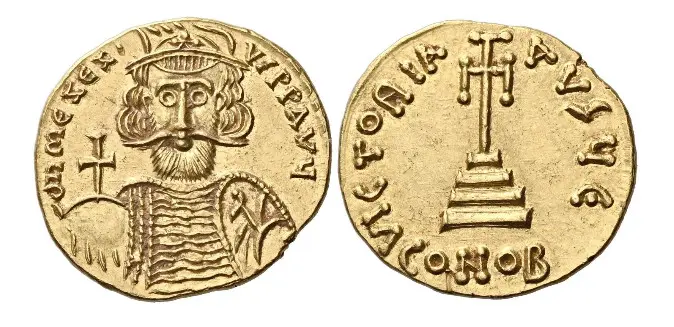
Mezezius, also spelled Mizizios, was an Armenian noble and a commander in the army of Constans II.
After the emperor’s murder, troops in Sicily proclaimed Mezezius emperor.
Some accounts claim that he accepted the title unwillingly. Nevertheless, he maintained control of Sicily for about seven months, from July 668 until early 669.
During that brief reign, his government issued gold coins at Syracuse.
Today, these solidi rank among the greatest rarities in all Byzantine coinage. Numismatica Ars Classica sold the illustrated example for 240,000 Swiss francs in May 2025 [10].
Constantine IV did not tolerate the challenge. He sent an expedition to Sicily, crushed the revolt, and executed Mezezius.
The Gold Semissis
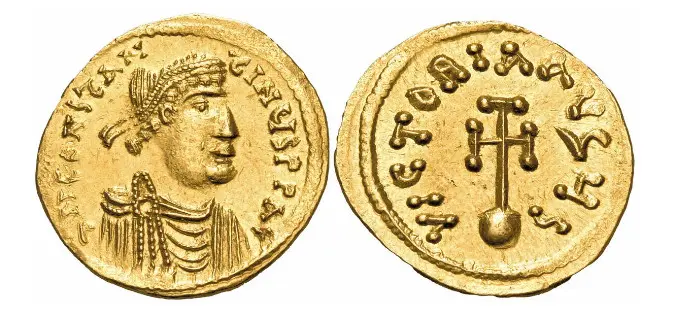
The gold semissis carried a value of one-half solidus. The imperial mints produced it in much smaller quantities than the full solidus.
Its design presents a curious numismatic puzzle.
The obverse shows the emperor in profile. However, the portrait never gives Constans his enormous full beard. In fact, the basic portrait closely resembles the semissis of his grandfather, Heraclius.
The type continued with few meaningful changes under Constantine IV.
Therefore, the portrait functions less as an individual likeness and more as a traditional mark of denomination.
The reverse carries a simple cross potent on a globe. Surviving examples usually weigh about 2.1 to 2.2 grams [11].
![Constans II, 641-668. Tremissis (Gold, 16 mm, 1.46 g,), Constantinopolis. δ N [CO]STANTINЧS P P AVDiademed, draped and cuirassed bust of Constans II to right. Rev. VICTORIA AVζЧ S Cross potent on base. DOC 45. SB 984.](https://coinweek.com/wp-content/uploads/2026/08/fig9.webp)
The Small Gold Tremissis
The tremissis carried a value of one-third solidus. It generally weighs about 1.4 to 1.5 grams.
Its obverse repeats the profile portrait used on the semissis. The reverse displays a cross potent, which has a short bar at the end of each arm.
These small coins circulated widely. Their thin flans also exposed them to considerable wear and damage.
As a result, collectors rarely encounter sharply struck, high-grade tremisses of Constans II [12].
Silver for an Empire in Crisis
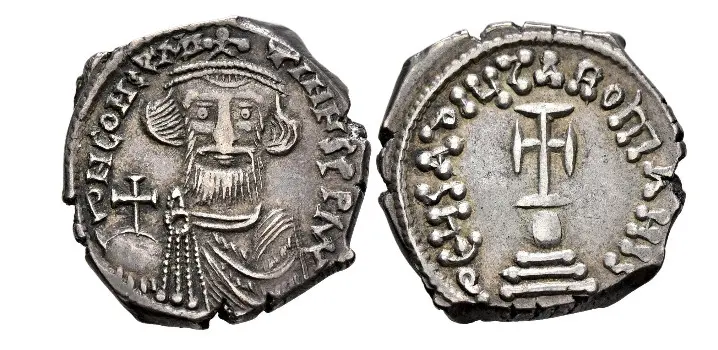
Around 615, Heraclius introduced an emergency silver denomination called the hexagram.
The empire needed money to pay soldiers and officials. At the same time, decades of war had placed severe pressure on its gold reserves.
The government obtained much of the required silver by requisitioning church plate, including altar vessels. Mint workers then hammered irregular blanks and struck them at a standard of 48 coins to the Roman pound.
A full-weight hexagram weighed about six grammata, or approximately 6.8 grams. That weight gave the denomination its modern name.
The government valued 12 hexagrams at one gold solidus. This official exchange rate overvalued the silver content.
The reverse carries a cross potent on a globe above three steps. Around it appears the Latin plea:
DEUS ADIUTA ROMANIS
The phrase means, “O God, help the Romans.”
Few coin inscriptions capture an empire’s desperation more clearly.
Constans II issued hexagrams in considerable volume. Moreover, the changing portraits on his silver coins closely followed the portrait sequence on his solidi [13].
Regular production declined under Constantine IV. However, occasional ceremonial issues continued into the early eighth century.
Bronze Coinage Reaches the Breaking Point
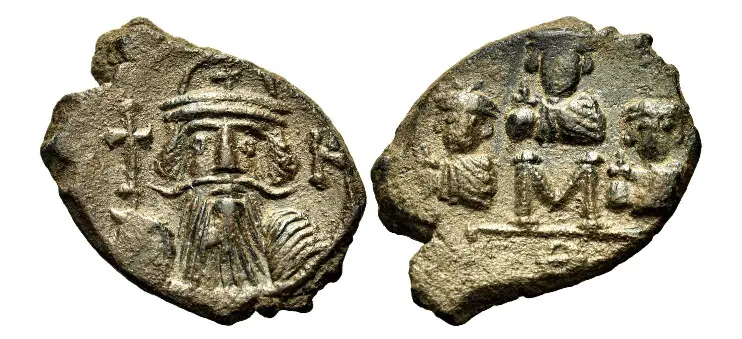
During the seventh century, the empire’s bronze coinage suffered a dramatic decline in both weight and workmanship.
Under Justinian I, who ruled from 527 to 565, a bronze follis could weigh almost 24 grams.
Under Constans II, the same 40-nummi denomination often weighed less than six grams [14].
The reduction reflected inflation, metal shortages, fiscal pressure, and the shrinking economic reach of the imperial government. In addition, mint workers frequently struck the coins carelessly. Weak impressions, double strikes, irregular flans, and incomplete designs became normal.
Philip Grierson offered a memorable assessment:
“Though the designs show a good deal of ingenuity and inventiveness, if not a high level of aesthetic judgment, the standard of striking was almost unbelievably bad: they represent perhaps the most slovenly work with which any numismatist will ever be brought into contact.” [15]
The criticism sounds severe. Yet anyone who has searched through a dealer’s tray of Constans II folles will understand it.
A well-centered and clearly struck example can prove much harder to find than the denomination’s low prices suggest.
Constans II Coin Specifications
The following figures represent normal standards or typical surviving examples. Actual weights and diameters vary by mint, period, circulation, and preservation.
Denomination Metal Value Typical Weight Typical Diameter Principal Design
- Solidus Gold 1 solidus About 4.3-4.5 g About 18-21 mm Facing imperial bust or dynastic portraits; cross potent on steps
- Semissis Gold 1/2 solidus About 2.1-2.2 g About 16-18 mm Profile bust; cross potent on globe
- Tremissis Gold 1/3 solidus About 1.4-1.5 g About 14-17 mm Profile bust; cross potent
- Hexagram Silver Traditionally 1/12 solidus About 6.8 g About 20-24 mm Imperial portrait; cross and DEUS ADIUTA ROMANIS
- Follis Bronze 40 nummi Commonly under 6 g late in the reign Highly variable, often 20-28 mm Imperial bust or standing figure; large denomination mark
Collecting “Big Beard”
The coins of Constans II offer collectors an unusually clear path through an emperor’s life.
A basic portrait sequence can begin with a beardless early solidus. The collector can then add a short-beard issue, a dramatic long-beard solidus, and a dynastic coin showing Constantine IV.
Collectors with larger budgets can pursue Carthage and Syracuse issues. Meanwhile, the silver hexagram offers one of the most powerful inscriptions in ancient coinage.
Bronze provides the most affordable entry point. However, collectors should not confuse availability with quality. Most folles show poor centering, weak strikes, worn dies, or irregular flans. Therefore, a well-made bronze coin deserves a premium.
The standard scholarly reference remains the multi-volume Catalogue of the Byzantine Coins in the Dumbarton Oaks Collection and in the Whittemore Collection. Volume 2, Part 2, published in 1968, covers the reign of Constans II.
Collectors often abbreviate the catalogue as DOC or D.O.
David Sear’s Byzantine Coins and Their Values, second edition, remains the most widely used collector handbook. Although the 1987 edition now shows its age, dealers and auction houses continue to cite its SB numbers.
Coins of Constans II appear regularly in major American and European ancient coin auctions. Dealers also maintain a steady supply, especially of bronze pieces.
That availability creates an unusual opportunity.
A collector can assemble coins that show a frightened child emperor growing into the grim, heavily bearded ruler described by Goodacre. At the same time, those coins trace the survival of an empire under military, religious, and financial pressure.
Constans II left few friends and a troubled reputation.
However, he also left one of the most vivid numismatic biographies in history.
Citations
[1] Mike Markowitz, “Heraclius: The Greatest Emperor You’ve Never Heard Of,” CoinWeek.
[2] In modern Greek, men named Konstantinos often use the familiar form Kostas.
[3] Classical Numismatic Group, Electronic Auction 342, January 14, 2015, Lot 835; realized $475.
[4] SINCONA Auction 3, October 25, 2011, Lot 3284.
[5] “Monothelitism,” historical overview and bibliography.
[6] Leu Numismatik, Web Auction 34, July 5, 2025, Lot 3859; realized 384 CHF.
[7] Nomos Auction 38, May 31, 2026, Lot 55; realized 2,800 CHF.
[8] Classical Numismatic Group, Electronic Auction 412, January 17, 2018, Lot 730.
[9] Classical Numismatic Group, Electronic Auction 571, September 25, 2024, Lot 1250.
[10] Numismatica Ars Classica, Auction 154, May 19, 2025, Lot 1517; realized 240,000 CHF.
[11] Nomos Auction 37, November 16, 2025, Lot 279; realized 700 CHF.
[12] Leu Numismatik, Web Auction 29, February 24, 2024, Lot 2613; realized 180 CHF.
[13] Leu Numismatik, Web Auction 34, July 5, 2025, Lot 3977.
[14] Nomos Auction 38, May 31, 2026, Lot 56; realized 700 CHF.
[15] Philip Grierson, Byzantine Coins (1982), p. 110.
References
- Goodacre, Hugh. Handbook of the Coins of the Byzantine Empire. London, 1960.
- Grierson, Philip. Catalogue of the Byzantine Coins in the Dumbarton Oaks Collection and in the Whittemore Collection. Volume 2, Part 2. Washington, 1968.
- Grierson, Philip. Byzantine Coins. Berkeley, 1982.
- Hendy, Michael. Studies in the Byzantine Monetary Economy c. 300-1450. Cambridge, 1985.
- Kaldellis, Anthony. The New Roman Empire: A History of Byzantium. Oxford, 2024.
- Kazhdan, Alexander, et al., editors. The Oxford Dictionary of Byzantium. Oxford, 1991.
- Sear, David. Byzantine Coins and Their Values. Second edition. London, 1987.




These all look amazing!
I have a very few Byzantine coins in my collection. I need to see if I can find a bronze or silver coin issued under Constans II.
What an excellent article (as are all those by Mr. Markowitz!)!
I love ancient coins. Good luck on the coin giveaway everybody!
These coins look so good.