


A Tiny “L” Reveals the Secret Behind This 1863 Indian Cent
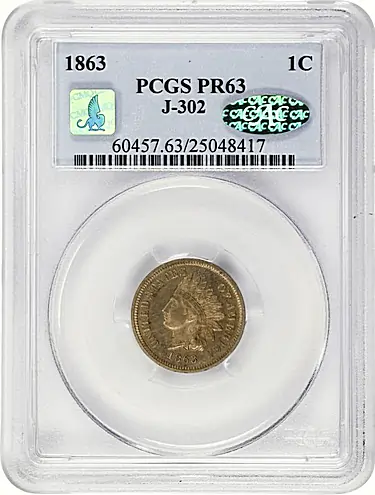
1863 L on Ribbon Indian Cent. Judd-302, Pollock-365, Snow-PT3a. Rarity-7+. Copper-Nickel. Plain Edge. Proof-63 (PCGS). CAC. CMQ.
The 1863 L on Ribbon Indian Cent ranks among the most intriguing small cent patterns of the Civil War era.
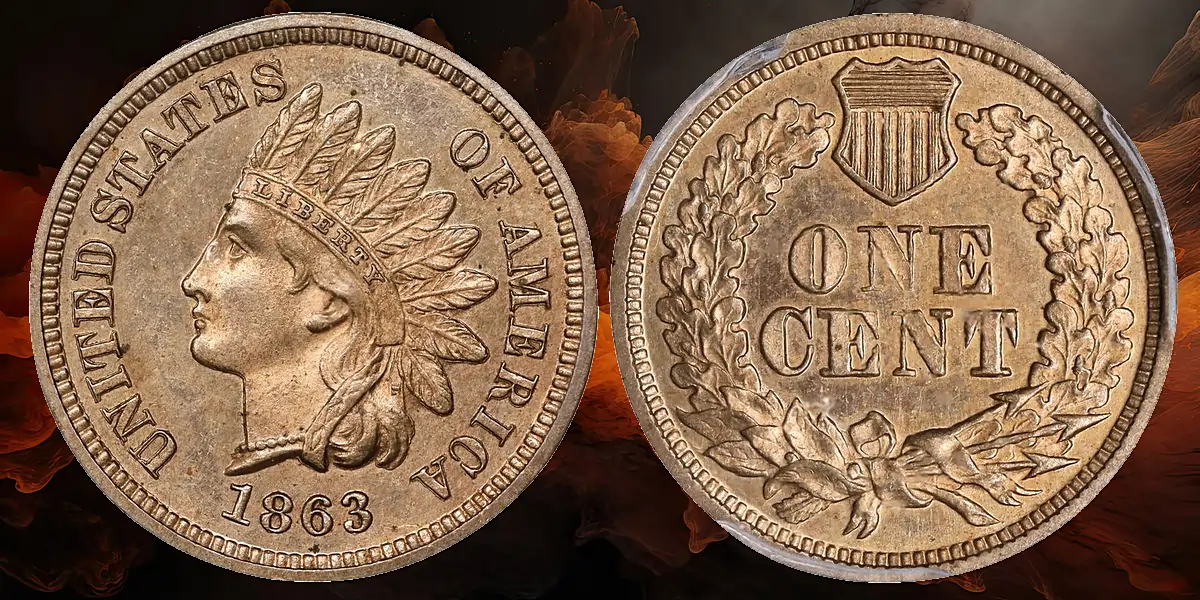
At first glance, it looks like an 1863 Indian Head cent. However, a tiny detail changes the story. The lower ribbon carries James B. Longacre’s small “L” initial. Collectors usually associate that feature with the 1864 bronze cent.
Therefore, this coin raises a fascinating question. Why does an 1863-dated copper-nickel cent carry a feature that belongs to the 1864 design?
A Rare Indian Cent Pattern
This Judd-302 Indian cent survives in very small numbers. Specialists believe that only about a half dozen copper-nickel examples exist. Rick Snow traced seven distinct specimens in his 2014 reference, The Flying Eagle & Indian Cent Attribution Guide. This coin appears in the Snow census.
The piece offers strong visual appeal for the Proof-63 grade. Nicely mirrored fields frame the design. In addition, sharp strike detail highlights the devices. Light patina accents the copper-nickel planchet. Meanwhile, frosty mint finish covers Liberty and the reverse elements.
A few trivial hairlines appear around the denomination on the reverse. Even so, the obverse suggests a higher grade.
Longacre’s Indian Head Cent Design
James B. Longacre designed the Indian Head cent. The United States Mint first issued the type in 1859.
On the obverse, Liberty faces left in profile. She wears a Native American headdress inscribed LIBERTY. The legend UNITED STATES OF AMERICA surrounds the portrait. The date appears below.
The Mint used a laurel wreath reverse in 1859. Then, in 1860, the Mint changed the reverse to an oak wreath. That wreath surrounds the denomination ONE CENT. A Union shield appears at the top. At the bottom, a ribbon ties together the wreath ends and three arrows.
The Tiny “L” That Changes Everything
The 1863 L on Ribbon Indian Cent uses the adopted 1864 obverse style. It shows the pointed bust truncation and Longacre’s initial “L” on the lower ribbon.
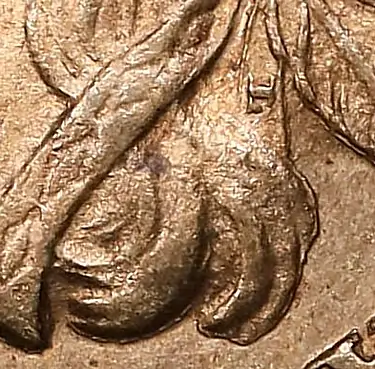
However, the reverse follows the design used on 1863 cents. That combination makes Judd-302 one of the most important Indian cent pattern issues for specialists.
Rick Snow’s die research adds another layer. Snow found that this reverse die first appears on regular-issue coinage in 1871. As a result, the evidence points to a restrike made for collectors in the 1870s.
That conclusion gives the coin its “wow” factor. It does not simply preview the 1864 cent. Instead, it likely reflects the Mint’s later collector market, when officials created special pieces from unusual die combinations.
A Restrike Made for Collectors
USPatterns.com connects these pieces to a broader family of restrikes. These include the 1863 two-cent, three-cent silver, half dime, and dime restrikes. The Mint offered them with the quarter, half dollar, and dollar pieces that carried the motto IN GOD WE TRUST on the reverse.
Therefore, the 1863 L on Ribbon cent fits into a larger story. It belongs to a period when Mint officials used older dates, newer hubs, and special dies to satisfy advanced collectors.
The same 1863 L on Ribbon design also appears in other metals. Bronze examples appear as Judd-301, with at least eight known. Aluminum examples appear as Judd-304, with at least four known. In addition, an oroide example, Judd-303, has appeared in references, though specialists have not confirmed it.
William E. Hidden Reports the Discovery
A 1903 letter to the editor in The Numismatist adds important period testimony. William E. Hidden wrote about his discovery of the small capital “L” on an 1863 nickel cent.
He explained that collectors usually credited the “L on ribbon” feature to the 1864 bronze cent. However, Hidden noted that his 1863 piece also carried the tiny initial.
Hidden wrote that the “L” was “extremely small,” yet clearly intentional. He believed Longacre placed it there to mark his artistic work. At the time, Hidden knew of no other example. His coin came from William P. Brown among a group of Proofs.
That letter gives the variety an early collector pedigree. It also shows how long this coin has puzzled Indian cent specialists.
Provenance
This example carries a strong auction history.
It appeared in Superior’s October 1992 sale of the Clark E. Adams and Duncan MacMillan Collections as lot 1174. After passing through unknown intermediaries, it appeared in Heritage’s sale of the Bob Simpson Collection during the August 2010 Boston ANA Signature Auction as lot 3703.
Next, Stack’s Bowers offered the coin in its Philadelphia ANA Auction of August 2012 as lot 11596. Later, Stack’s Bowers offered it again in the March 2020 sale of the Harrington Collection as lot 3084.
Population Data
PCGS lists a population of one at the Proof-63 level for this category, with three finer. The finest listed grade stands at Proof-65.
CAC lists one stickered at this level, with two finer.
Why Collectors Care
The 1863 L on Ribbon Indian Cent matters for several reasons.
First, it links two important phases of the Indian Head cent. It carries an 1863 date, a copper-nickel planchet, and the 1864-style “L” obverse. Next, it connects Longacre’s evolving design to the Mint’s pattern and restrike practices. Finally, it shows how 19th-century collectors shaped the survival of some of America’s most fascinating numismatic rarities.
For advanced Indian cent collectors, Judd-302 offers more than rarity. It offers a mystery in miniature. A tiny letter on a ribbon turns this cent into a window on design change, collector demand, and Mint experimentation during one of the most complex periods in American coinage.
Auction Information
This 1863 L on Ribbon Indian Cent will appear in the Stack’s Bowers Galleries June 2026 Showcase Auction — Session 2: Rarities Night Featuring the Young-Dakota Collection.
Stack’s Bowers lists the session for Tuesday, June 16, 2026, at 12:00 PM PDT, with lots 2001 through 2309 included in the Rarities Night session.
The coin appears as Lot 2266:
Collectors can view the lot and bidding details through Stack’s Bowers Galleries.



First time I’ve heard of this pattern. Better check my 1863 cent again.
Right same here
I love the different varieties that can be found on coins
Interesting I have never heard of this L or E
very interesting article
Wouldn’t that be amazing to look at our 1863 cent and see that “L”!! That would be a great moment!
Time to reinvestigate my collection for details like this
Sounds good, and would love to have one, for a collection piece of
Coins
I wish I could find some of these rare varities in the coins I go through at shops!
I have a 1900 Indian head coin for sale if interested my email is listed below, thanks
Did not know this, will be checking mine for sure
Never knew about that coin.
Nice
I never knew about this error. Love seeing these kind of things.
I have never heard of this variety before. An amazing discovery and an interesting story!
I have never heard of this Indian Cent variety before. An amazing discovery and an interesting story!
I have never heard of this Indian cent variety. A rare find and an interesting story!
I have never heard of this Indian cent variety. A rare find and an interesting story, thanks for sharing!
Great variation.
This article makes alot of “cents”! Sorry folks, I’m here all week!
I need to go through my Grandpa’s coin collection again sometime. He has some late 1800’s pennies in there, I just need to update the inventory list.
I was never aware of this feature.
Love learning this information.
I have several of these but you have to get a high grade one to clearly see the “L”.
What I find intriguing is that the Mint was busy making small changes to our coinage throughout the American Civil War.
Signing a masterpiece???
Just phenomenal!!
What a cool coin and a great history. Thanks for the article!
It’s interesting that errors turn up on so many coins. Do they do this on purpose?
Interesting!!!
Heard about this a few days ago for the firat time and now seeing it for the 2nd time ever, kinda crazy how things work out like that.
BEST CENT.
WOW. So many ” variations ” that are out there.
Great article, interesting coint
Great article, interesting coin
This is definitely a new one for me. I have scored a few 1864 “L” cents on eBay.
I’ve only ever seen a few Indian Head cents anyway
New information to me!
I dug out all my ’63 & ’64 Indians to double check, no such luck.
Very interesting
Information of which all collectors and students should be aware!
Is there a name for the copper-nickel blend used on these pre-1864 cents? I believe they are sometimes called “white cents” but I don’t know if there’s a name for the specific alloy.
Wow, had no idea about this one.
good looking coin
My Indians are all heavily circulated fro change when air was a kid.
Wow! How very cool. I wish I had some 1864 cents to check for this. I may just have to try my luck and try to find one!
I’m going to put mine under a microscope. Maybe I will have a lowball.
nice looking coin
What a rarity!
Good looking coin!
Great article! Appreciate the history!
Wow!
I have one of those Indian one cent
Thank you for a very interesting article
Very interesting!
Wow 1863 Indian Head – Such a beautiful Coin
Love the Indian head cents!!@
From that picture, it looks more like an “H.” Cool coin!
I thought the same thing!
These articles are so interesting! Knowing more about the history of these coins truly enhances my facination and appreciataion of these important, defining pieces of our history.
That “L” I sometimes really hard to see on circulated coins.
Indian cents are one of my favorites.
Small mintages are intriguing.
I love to find a 1877 penny it the one for completing my set of Indian Head Penny
That is an interesting variety. Great research on this coin.
Great read – interesting
Amazing the history associated with many coins
You go into such amazing detail on these coins. It is very much appreciated to learn about things I never could conceive.
TY
I got some bad ass old coins if anyone’s interested in adding to there collection I need the money here’s my email [email protected]
My name is Des btw
Lmk
I wasn’t aware of the 1863 L variety. I subscribe to the 1870’s restrike theory
Now I now where Warren Robinett got his inspiration from (Atari’s hidden spot in Adventure).
Indianhead cents are what got me into coin collecting.
I guess I need to check all my penny’s now.
I’d have to stare for a long time to see that L
One of the things I love about coin collecting is that obscured history behind some coins
Love to look for interesting varieties in common coins making them uncommon.
Every time I come to this site I learn something new!
Thanks for the backstory on this rare Civil War coin.
Tiny little secrets!
Hidden little secrets!
Would love to find a coin with that little L!
Interesting article.
I have one.