


The WWII Penny Made of Glass: America’s Strangest Cent Pattern
In 1942, the United States Mint faced a wartime problem that reached all the way down to the humble cent.
Copper mattered more to the war than to pocket change. The metal went into ammunition, electrical equipment, and other military needs. Therefore, the Mint had to ask a question that still sounds strange today: What could replace copper in the one-cent coin?
The answer led to steel cents in 1943. However, before the Mint settled on zinc-coated steel, officials tested a remarkable list of materials. They tried metals, plastics, fiber, rubber, and even glass.
That last idea produced one of the most unusual pattern coins in American numismatics: the 1942 experimental glass cent.
A Wartime Search for a Copper Substitute
World War II changed American coinage almost overnight.
The five-cent piece lost its normal copper-nickel alloy during the war. From 1942 through 1945, the Mint struck Jefferson nickels in an alloy of 56% copper, 35% silver, and 9% manganese. Collectors know them today as wartime silver nickels.
The cent faced an even more urgent challenge. Copper stood high on the list of strategic war materials. As a result, the Mint explored substitutes for the common Lincoln cent.
In 1943, the Mint struck cents in zinc-coated steel. Those “steelies” became famous. They also became unpopular. They looked too much like dimes, they could rust, and vending machines could mistake them for steel slugs.
Yet the steel cent had one clear advantage. It worked well enough for mass production.
Glass did not.
Why Would the Mint Test Glass?
The glass cent did not begin as a novelty. It came from a serious wartime emergency.
The Mint invited private companies to help test substitute materials. Plastic manufacturers joined the effort. Button makers also tested cent-sized pieces. Meanwhile, the Blue Ridge Glass Company of Kingsport, Tennessee, asked for a chance to test glass.
The Mint supplied test dies. These dies did not carry the familiar Lincoln cent design. Instead, Mint Engraver John Sinnock prepared cent-sized experimental dies for outside testing.
Blue Ridge then obtained tempered glass blanks, also called preforms, from Corning Glass. These blanks had a yellow-amber transparent appearance.
From there, the company tried to turn hot glass into a coin.
The Design: Not Lincoln, But Liberty and a Wreath
The 1942 glass cent pattern uses a design that separates it from regular U.S. cents.
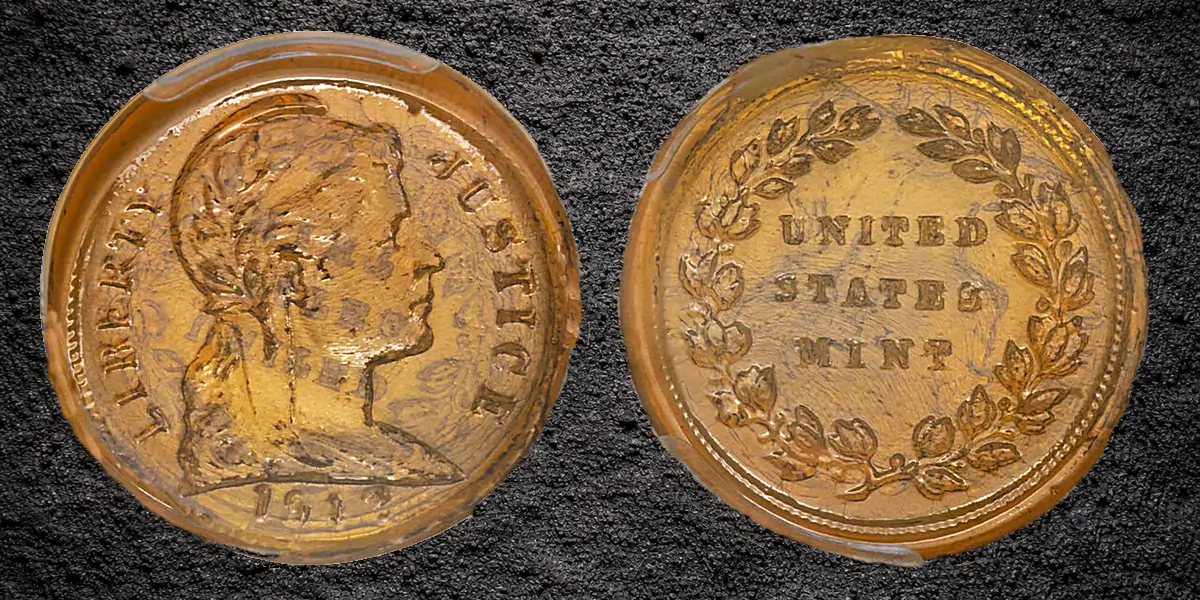
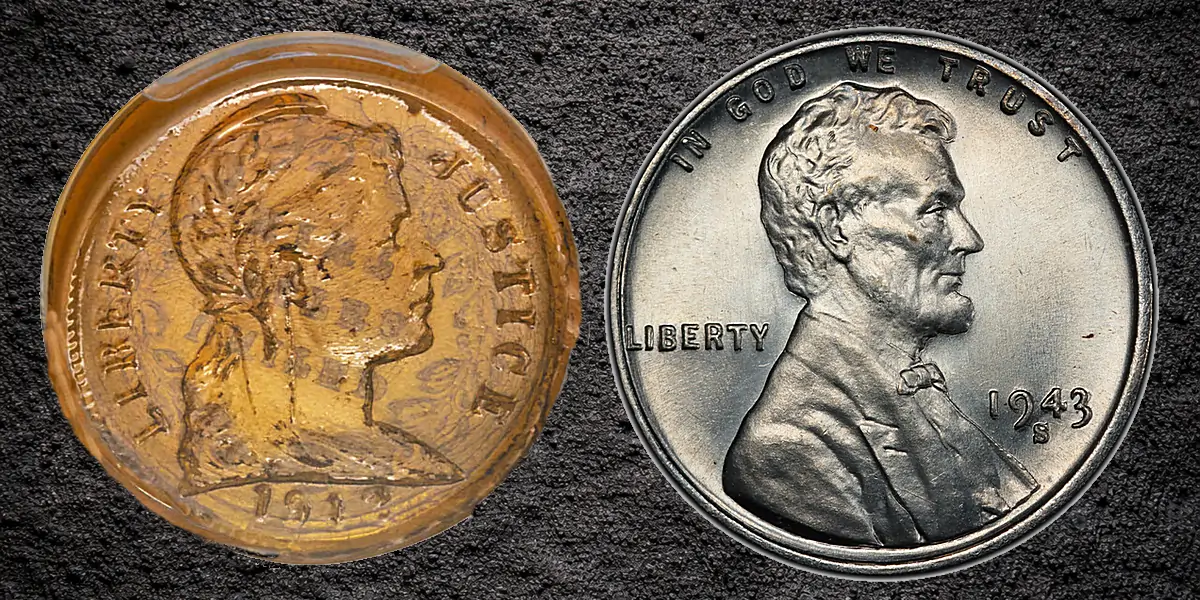
The obverse shows a Liberty head based on a Colombian two-centavo design. The experimental die also includes the words LIBERTY and JUSTICE.
The reverse carries a simple open wreath around the words UNITED STATES MINT. Modern references tied to Roger W. Burdette and NGC identify the wreath source as a 19th-century Anthony C. Paquet design. Some earlier auction text described the wreath differently, so the Paquet attribution now deserves the clearer mention.
The glass cent also has a plain edge.
How Blue Ridge Made the Glass Cent
Blue Ridge faced a problem that metal coiners never had to solve.
A coin press normally strikes metal planchets between steel dies. Metal can flow into the die cavities under pressure. Glass behaves differently. It can crack, chip, craze, or fail to take sharp detail.
For the glass test, Blue Ridge used hot glass and cold steel dies. Ideally, both the dies and glass needed heat near the proper glass-working temperature. Then the piece needed fast cooling to preserve the design.
However, Blue Ridge could not heat the dies. That single limitation hurt the entire experiment.
As a result, the glass cents show soft details. Their surfaces also show irregular flow patterns, tiny cracks, bubbles, and crazing. These features do not point to mishandling. Instead, they reveal how difficult the experiment was.
The blanks also ran slightly larger and thicker than a normal cent. Workers manually smoothed the edges. Therefore, weight and dimensions vary from piece to piece.
One documented intact example weighed about 1.52 grams. It measured about 19.85 millimeters in diameter and about 2.36 millimeters thick.
The Pocket Test That Glass Failed
The glass cent failed for a simple reason. It could not survive ordinary use.
Roger W. Burdette’s research records a telling test. Before Blue Ridge completed its work, company employees carried glass blanks in their pockets for a few days. The blanks chipped. Worse, they created sharp edges.
That detail gives the glass cent its unforgettable backstory.
This was not just a fragile pattern. It was a potential pocket hazard. A coin that chipped in a worker’s pocket could never succeed in national circulation.
By December 1942, the glass experiment had run out of time. The Mint needed a working solution for 1943. Zinc-coated steel won.
Glass moved into the history of American pattern coinage.
The 2016 Discovery That Rewrote the Story
For decades, collectors knew the Blue Ridge glass cent only from limited documentation and a broken survivor.
Then, in 2016, researcher Roger W. Burdette discovered an intact 1942 glass experimental cent. PCGS certified the piece as PR64. The certification identified it as Judd-2069, RB 42-70.
At that time, the discovery looked astonishing. Numismatists knew of one other glass cent, but that piece had broken in half. Therefore, the Burdette discovery stood as the only intact example then publicly known.
The coin had a transparent yellow-amber color. It also showed the expected soft details, glass flow, and microscopic cracking.
Collectors immediately understood its importance. The piece linked wartime urgency, Mint experimentation, private industry, and the limits of material science.
The Heritage Sale and the $70,500 Result
Heritage Auctions offered the intact glass cent in its January 2017 FUN U.S. Coins Signature Auction in Fort Lauderdale.
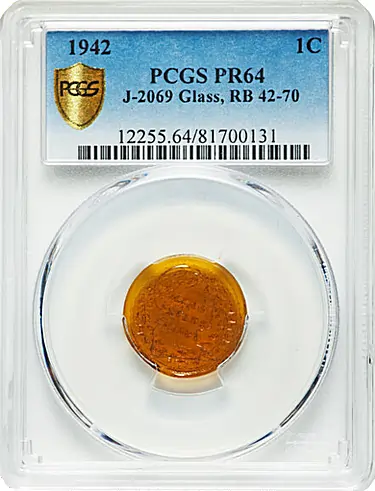
The lot carried powerful catalog language for good reason. At the time, Heritage described the coin as the sole unbroken piece known. The coin also carried a PR64 grade from PCGS.
On January 5, 2017, the glass cent sold for $70,500.
That result gave the experimental glass cent national attention. It also showed the market’s appetite for wartime pattern coins with a dramatic story.
However, the census did not stand still.
The Census Changed Later in 2017
In July 2017, NGC announced that it had certified 17 experimental glass cents and tokens from Blue Ridge Glass Corporation.
That group changed the known population.
It included nine glass pattern cents. Seven were intact, and two were fragments. All appeared on amber-colored glass blanks. NGC graded the intact pattern cents from MS62 to MS64. The fragments received attribution but no numerical grade.
NGC also certified eight glass tokens struck by Blue Ridge at the same time. Some tokens show the Blue Ridge Glass Corp. factory and the text BLUE RIDGE GLASS CORP. Others use simpler design elements. Most intact tokens graded between MS64 and MS66, while two token pieces survived only as fragments.
Therefore, modern writers should not call the glass cent “unique” without context. The 2016–2017 PCGS coin was the first intact example to emerge publicly after nearly 75 years. It was not the last intact piece identified.
That distinction matters.
Pattern, Token, or Coin?
Collectors often call these pieces “glass cents” or “glass pennies.” Those names work as shorthand. Still, these pieces never circulated as money.
The Judd-2069 glass cent belongs to the pattern and experimental series. It tested a possible emergency composition for the one-cent coin. It also used test dies rather than the regular Lincoln cent design.
The related Blue Ridge glass tokens occupy a connected category. They came from the same wartime experiment. However, they do not carry the same one-cent pattern design.
Both groups matter. Together, they document one of the strangest private-industry collaborations in U.S. Mint history.
Why Collectors Still Care
The glass cent pattern commands attention because it tells a story that a regular coin cannot tell.
It shows the pressure of World War II and how far the Mint would go to save strategic metals. It also shows why coinage must survive the real world.
A coin must stack. It must travel in pockets, pass through counting machines, resist normal wear and must also feel safe in the hand.
Glass failed those tests.
Yet that failure created the “wow factor.” The United States nearly had a penny you could see through. Then the experiment cracked, chipped, and disappeared into the pattern books.
Today, every surviving Blue Ridge glass cent carries that backstory.
How the Glass Cent Fits Into the 1942 Experimental Series
The glass cent did not stand alone.
In 1942, the Mint and private contractors tested bronze, brass, zinc, zinc-coated steel, manganese, white metal, aluminum, lead, rubber, fiber, plastic, Bakelite, and glass. The tests reflected the urgency of the moment.
Wrong-planchet wartime cents also form part of the broader story. A few 1943 and 1944 Lincoln cents exist struck on silver dime planchets. Those pieces are mint errors, not intentional glass experiments. Still, they show how unusual the wartime cent years became.
By contrast, the glass cent came from deliberate testing. It was an experiment by design.
A Fragile Survivor From a Hard Year
The 1942 glass cent pattern survives because the Mint and private industry tried almost everything.
The experiment failed. However, the failure teaches more than a success might have taught. It shows that a coin’s material matters as much as its design. It also shows that national emergencies can push the Mint far beyond normal practice.
The glass cent never jingled in American pockets. It never paid for a newspaper, a streetcar ride, or a piece of candy. Instead, it became a transparent relic of a moment when even the smallest coin had to serve the war effort.
For collectors, that makes the 1942 glass cent pattern one of the most remarkable “what if” coins in United States numismatics.
CoinWeek Notes
- Issue: 1942 Experimental Glass Cent Pattern
- Catalog Numbers: Judd-2069; RB 42-70
- Maker: Blue Ridge Glass Company / Blue Ridge Glass Corporation, Kingsport, Tennessee
- Glass Blanks: Corning Glass
- Composition: Tempered yellow-amber transparent glass
- Edge: Plain
- Design: Liberty head based on Colombian two-centavo obverse; open wreath reverse around UNITED STATES MINT
- Known Context: WWII emergency cent-composition experiments
- Major Sale: PCGS PR64 example sold by Heritage Auctions in January 2017 for $70,500



This would be so awesome to have.
I’m amazed that they bothered experimenting with glass.
I never knew they tried to make a glass cent! You learn something new everyday!
Did any of the other test material peenies survive? I’d like to hear about the fiber and plastic ones..
Amazing info, thanks.
Interesting! Glass Cent!
Cool
Very interesting
Bizarre!
beautiful piece
It seems that experiment didn’t make much cents…. but seriously, as much as I would like to add one to my collection, this is a little out of my price range. I love the pattern coins, though.
Love these articles as I learn something new when I read them.
Even before I got to the part about the pocket trial I thought glass would be dangerous but desperate times call for desperate measures, you are never sure until you try something.
Very interesting
I knew they tried various metals, but didn’t know that they tried non-metals like plastic, rubber and glass.
I remember this sale, I couldn’t believe it sold so low.
Interesting. I never knew that.
Well, I’ve heard of wooden nickles.
how cool
Just getting into coin collecting and trying to learn as much as I can. Your site is a valuable tool in doing so.
Very interesting
I have a wheat penny 1943 & 1909
I would be interested in seeing an article about the Bakelite experimental cent pattern. It would seem to be slightly less fragile than glass.
Interesting article showing an unusual piece of history.
A truly amazing story!
Very interesting article. I didn’t know about this coin till I read the story!!!
A glass coin! What a pane… [ducking]
Very interesting article. I/m old and have never stopped learning fascinating articles
such as the trial of various materials used to substitute for copper.
I never knew they used glass for a penny. Good luck everybody!
Very cool!!!
Glass cents? First I’ve ever heard of it.
Good article, never knew there was a glass cent
Great story! I’ve never heard of it before!
Great story! I’ve never heard of it before! Just wow!
Very interesting trial
Was unaware of this particular experimental piece. It does show out of the box thinking, though logically it seemed inevitable that this composition would fail. I still am surprised with the decision of steel over aluminum.
Fascinating article! Thanks.
I really like these articles about these rarities.
Other countries have used aluminum. I wonder why that didn’t work out?
@Jon Bennett: The Mint’s considered aluminum cents on a couple of occasions. The most recent attempt (albeit half a century ago) was during the years 1973-75 when over 1.5 million trial pennies were struck. All were dated 1974 in anticipation of possible release but Congress rejected the idea due to lobbying by copper-mining and vending machine interests. One was saved for the Smithsonian collection. All of the remainder were supposed to be returned for melting; since then several specimens have been found in private hands.
@Jon Bennett: I’m not sure why aluminum was rejected for wartime cents, but the last time the idea was proposed (early 1970s) the vending machine and copper-mining lobbies went into overtime to kill the idea. Even though Philadelphia and Denver had already made an initial run of over 1.5 million coins, Congress ordered a halt to production and the melting of all outstanding coins except for one to be kept by the Smithsonian. Despite that, a dozen or so are known to have been kept by members of Congress.
EDITORS: Duplicate post – can this be deleted? Thanks!
@Jon Bennet: Based on what I’ve read, aluminum was rejected because
a) Its light weight raised fears that pennies could blow away in a moderate wind
b) Pediatricians were concerned that if a child were to swallow an aluminum coin it wouldn’t register on the comparatively primitive scanners then in use.
EDITORS: Another dupe due to browser glitch :(. Can you delete this post as well?
I enjoy learning about coins and their history….amazing
Thanks for sharing!
I have an interest in WWII numismatics and find this fascinating
Had never heard this, glass definitely had limitations but would be cool to own one
I learned alot. thanks
didn’t sound like a good idea from the beginning. but desperate times call for desperate measures.
WOW! I learn so much from your blog!
In hyper-inflationary post-WWI Germany, many of the German cities and states issued their own coins and tokens, called “notgeld”, made in various materials: ceramics, paper, cardboard, tin, zinc, pewter, plastic, iron, steel, etc. They even issued tokens made by affixing a postage stamp to a carboard disc surrounded by a metal rim. I have owned examples of some of these but sold most of them a few years ago when I was trying to raise funds to buy my house.
@Allen Muckleroy: To add a bit more for readers who aren’t familiar with German, the word “Not” isn’t a negative; it means “necessity” or “emergency”. Thus “Notgeld” didn’t mean (as I’ve heard some people assume) these pieces were “not money” – it was that they were “emergency money” during that time of hyperinflation.
I knew a few people who’d lived in Saxony during those terrible years. They showed me a few banknotes valued in the _billions_ of marks that barely would have paid for a loaf of bread. The bills issue dates actually included the month AND the day because purchasing power had to be recalculated so often. They also had a few porcelain “coins” that were manufactured by the famed Meißen Pottery Works because clay was less expensive than metal.
Their collection was fascinating numismatically, but ultimately it was shockingly sad.
I kept waiting for mention that glass is a liquid of high viscosity. That fact alone would seem to color the long term prospects of holding such a piece in a serious coin collection. What will the design look like in 100 years? What shape will the coin assume in 1000?
This is very interesting!
Great article! I had no idea they experimented with glass.
Wow, I never knew about them trying to use glass.
Very interesting, an all in effort by Americans during WWII is not surprising.
Interesting article, American ingenuity always at work.
How it was given a 64 is waaay beyond me
another great article, another learning moment
great information, I learn something new.
thank you
Unfortunate that the penny will no longer be produced as it’s such a fine coin to study and collect. This article is a perfect example of it’s importance.
I think it would have been cool if they went with this instead of the steel
Wild they thought that a glass penny could work.
Well……I just learned something new! Never had I ever heard of this experiment. Way cool!!
What a very interesting story never heard of the glass sent until now That’s why I love these articles
very interesting article
Drop a glass coin and you’ll really know the meaning of “broke”.
Never heard of this, very cool!
Fascinating story. I’ve always liked hearing about these.
why not plexiglass?
Very interesting. I had never heard that story, Never new a glass cent existed.
Never heard of these. Dumb idea.
A really unusual pattern!
Glass wow I didn’t know that . So how do I know if I’ve gain the extra entries
Very interesting to learn about the glass cent. Never knew there was such a thing!
I had no idea abou these!
Just imagine if the glass penny would have passed and they wouldv’e actually went to circulation. Those would be some pricy collectables for the ones that survived. I know, it wasn’t the smartest ideal. But what if…… They could have found a way to make glass not break