


A 1908 Indian Quarter Eagle has reached a level that almost no coin in the entire series has achieved.
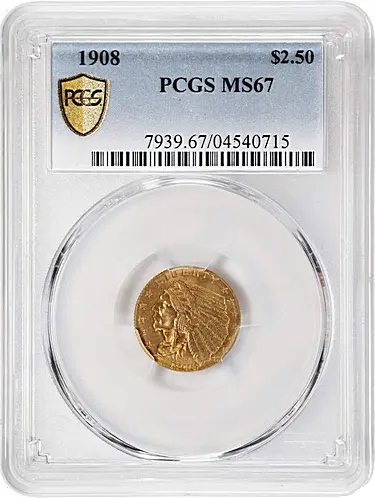
Stack’s Bowers Galleries offered the 1908 Indian Quarter Eagle graded MS-67 by PCGS as Lot 2237 in its Summer 2026 Global Showcase Auction. The coin sold for $67,100
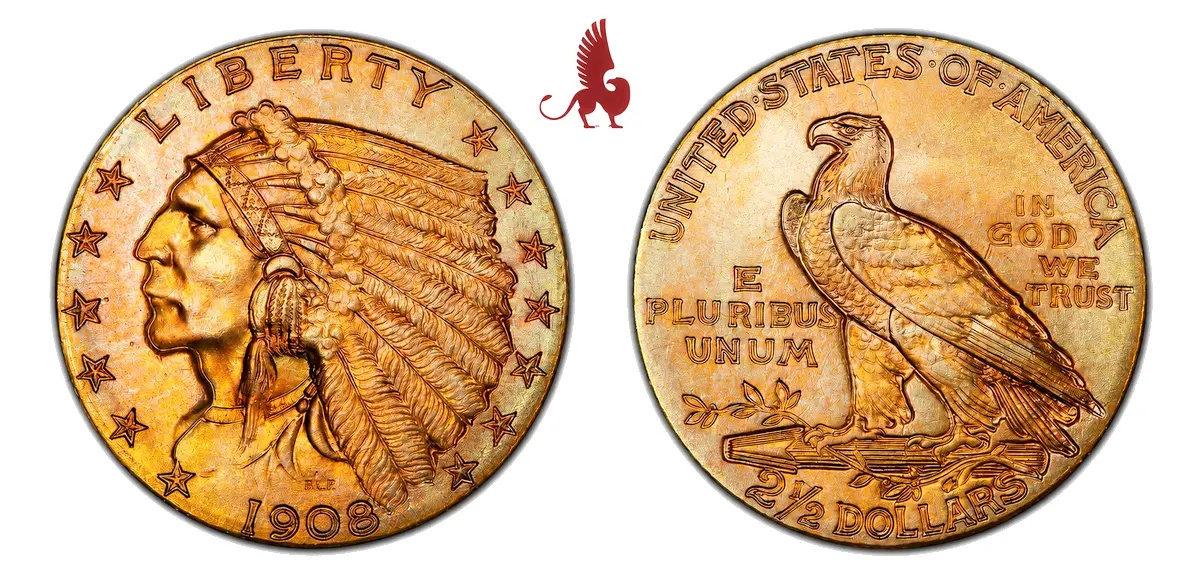
The date itself does not rank among the great rarities of the series. In fact, collectors often choose a 1908 for a type set. The Philadelphia Mint struck 564,821 examples, and many people saved the new coins because of their radical design.
However, that familiar story ends long before MS-67.
As of August 18, 2026, the PCGS Population Report lists only six grading events for the 1908 Indian Quarter Eagle at MS-67, with none finer. Even more remarkable, PCGS reports only eight MS-67 grading events for the entire circulation-strike Indian Quarter Eagle series. Six carry the 1908 date. One dates to 1914. The final example dates to 1929. PCGS reports no Indian Quarter Eagle at MS-68.
That puts the Stack’s Bowers coin at the absolute ceiling of the PCGS census.
A Radical Gold Coin Born in 1908
The 1908 Indian Quarter Eagle did more than replace an aging design. It challenged one of the basic conventions of American coinage.
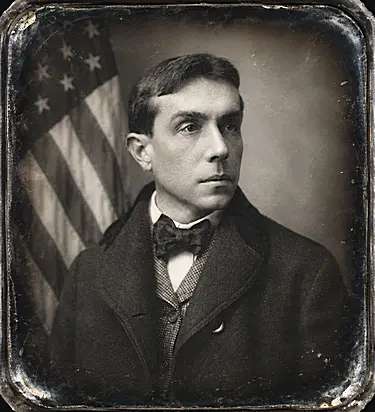
Sculptor Bela Lyon Pratt, a student of Augustus Saint-Gaudens, created the new quarter eagle and half eagle designs as the United States entered one of the great artistic periods in its coinage history.
Saint-Gaudens had already transformed the $10 and $20 gold pieces. After his death in 1907, attention turned toward the smaller gold denominations.
Pratt took the project in a completely different direction.
Instead of placing the portrait, lettering, and eagle above the coin’s fields, Pratt placed the design below the surface. Numismatists call this an incuse design.
No other United States coins struck for regular circulation share that distinction. Pratt used the concept for both the $2.50 Indian Quarter Eagle and the $5 Indian Half Eagle.
The result looked unlike anything Americans carried in their pockets.
And not everyone liked it.
Critics Thought the New Gold Coins Could Carry Germs
The controversy surrounding Pratt’s design adds one of the most colorful chapters to early 20th-century U.S. numismatics.
Philadelphia coin dealer Samuel H. Chapman became one of its most vocal critics. He argued that the recessed areas could trap dirt. He also worried about germs and questioned whether counterfeiters could exploit the unusual design. The criticism reached President Theodore Roosevelt. Nevertheless, the design survived the attack and entered circulation.
Time completely reversed the verdict.
Collectors now prize the Indian Quarter Eagle precisely because Pratt broke with tradition. The recessed portrait and eagle give the small gold coin an unmistakable appearance. Moreover, the design makes the series instantly recognizable even to collectors who specialize elsewhere.
Yet the incuse format created another problem.
The coin’s broad, flat fields form its highest surfaces. Therefore, contact with other coins can leave abrasions in highly visible areas. That characteristic makes genuinely pristine Indian Quarter Eagles extremely difficult to find. PCGS notes that handling tends to emphasize marks on these coins, especially in the higher Mint State grades.
That fact helps explain why MS-67 represents such rarefied territory.
Why the 1908 Indian Quarter Eagle Survives in High Grade
The first-year 1908 issue enjoys one major advantage over many later dates.
People saved it.
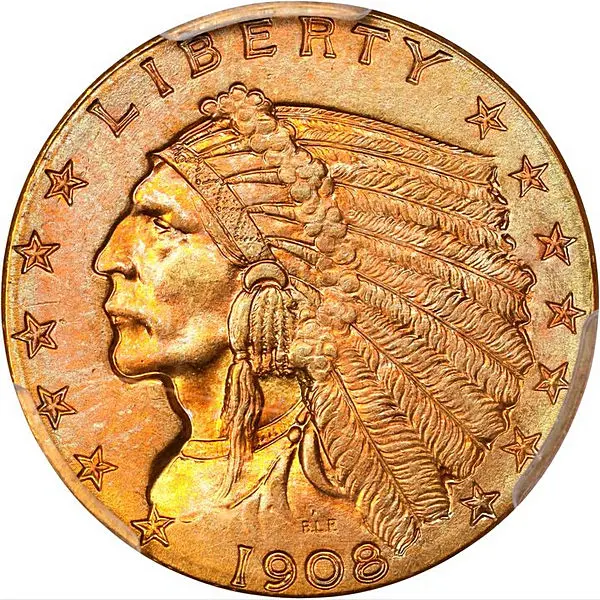
PCGS estimates that more than 41,000 examples survive across all grades and more than 26,000 survive in Mint State. PCGS also estimates about 1,016 survivors at MS-65 or better. Those estimates include certified and uncertified coins.
Numismatist David Akers also noted that collectors saved many 1908 quarter eagles as souvenirs or novelties because they represented the first year of the new design. As a result, collectors can find attractive Mint State examples without extraordinary difficulty.
Then the population falls off a cliff.
PCGS currently reports 123 grading events at MS-66, another 14 at MS-66+, and just six at MS-67. None appear beyond that point.
Therefore, this coin does not derive its importance from the rarity of the date.
It derives its importance from condition rarity at the highest possible level.
That distinction matters.
A collector can buy another 1908 Indian Quarter Eagle. Finding another PCGS MS-67 represents a very different challenge.
A Superb Gem With Exceptional Color
The Stack’s Bowers example combines technical preservation with unusually strong visual character.
Deep honey-orange gold forms the foundation of the coin’s color. Meanwhile, softly mottled powder-blue and pinkish-apricot accents move across the surfaces. The coin also displays strong, frosted luster.
Just as importantly, the strike shows exceptional definition for the issue.
That point deserves attention because the 1908 can show limited detail in portions of the eagle’s wing. PCGS attributes that characteristic primarily to the original die work rather than weak striking. Later issues received improved die detail.
On this MS-67 example, however, the overall sharpness, remarkably clean fields, color, and luster combine to create a coin that sits comfortably among the finest representatives of Pratt’s Indian Quarter Eagle design.
For a top-ranked PCGS Registry collection, that makes the coin important.
For a type collector, it offers something even more intriguing: a chance to represent one of the most innovative American gold coin designs with an example at the very top of the PCGS grading scale.
1908 Indian Quarter Eagle Specifications
- Denomination: $2.50 Quarter Eagle
- Year: 1908
- Mint: Philadelphia
- Mintage: 564,821
- Designer: Bela Lyon Pratt
- Composition: 90% gold, 10% copper
- Actual Gold Weight: approximately 0.121 troy ounce
- Weight: 4.18 grams
- Diameter: 18 mm
- Edge: Reeded
- Obverse: Native American portrait facing left
- Reverse: Standing eagle on arrows and an olive branch
- Grade of auction coin: PCGS MS-67
- PCGS Number: 7939
- NGC Universal ID: 288Y
- PCGS Population: 6 in MS-67; none finer, as of August 18, 2026
PCGS confirms the mintage, composition, dimensions, designer, and other primary specifications. NGC also identifies the issue under Universal ID 288Y and lists an actual gold weight of approximately 0.121 troy ounce.
From Controversial Experiment to Condition Rarity
In 1908, Pratt’s tiny $2.50 gold coin looked almost revolutionary.
Its portrait sank into the surface. Critics worried about dirt and disease. Collectors debated its appearance. Yet the Mint pressed ahead.
More than a century later, that controversial design has become one of the unmistakable icons of classic American gold.
The MS-67 coin in Stack’s Bowers’ Rarities Night takes that story another step. The 1908 may rank among the most accessible dates in the series. However, virtually no examples survive at this level of preservation.
PCGS records thousands of certified 1908 Indian Quarter Eagles.
Only six grading events have reached MS-67.
And the census stops there.




How much for 1
The coin is beautiful, and if one looks closely, he or she will see just the vestige of shoulder feathers on the eagle. I have one that is “only” MS64 but has quite visible shoulder feathers. The absence of shoulder feathers was a die design flaw corrected by the next year (1909s ALL should have shoulder feathers if uncirculated). It took me almost three years to find mine, and I looked at scores of specimens. One has to locate an example from well-sunk dies struck early in the die’s life to find a feathered example, and for my money, I would take feathers over the MS67 rating any day of the week.
Should I get a discount because I’m a native American, just wondering
I have. Atwo half. Dollar. 1925 gold Coin WHATS ‘tis. Value
Pre 33 gold is such beautiful gold. My goodness! Thank you for sharing
Exceptional design – what a great coin. Thanks for this wonderful article.
I would love to see the US Mint produce a series of Native American coin showing every tribe with it unique seal or tribe symbol.
Oh, to own one!!