Eleven of America’s most notorious gold coins will come together in public for the first time this month.
The United States Mint will bring all 11 government-owned 1933 Saint-Gaudens Double Eagles to Pittsburgh on August 28. That alone would make the 2026 World’s Fair of Money a major numismatic event.
However, collectors will find much more.
The American Numismatic Association (ANA) says visitors can see more than $100 million in historic coins, currency, and related treasures during the five-day convention. Highlights range from a 1792 Half Disme to a 1913 Liberty Head Nickel and an 1804 Draped Bust Dollar.
The ANA will hold the 2026 World’s Fair of Money from August 25-29 at the David L. Lawrence Convention Center in downtown Pittsburgh. More than 500 dealers will fill the sold-out bourse floor. They will buy and sell coins, paper money, gold, silver, and other collectibles. In addition, experts will offer free informal evaluations of items brought in by the public.
For collectors, the result amounts to a temporary museum, marketplace, classroom, and treasure hunt under one roof.
America’s First Money Meets Its Most Infamous Gold Coins
America’s 250th anniversary gives the 2026 show an unusually strong historical theme.
Douglas Mudd, curator and museum director of the ANA’s Edward C. Rochette Money Museum, says the museum has planned a showcase built around American history, artistry, and numismatic treasures. Mudd continues to serve as the ANA’s museum director in 2026.
Meanwhile, ANA President Mark Lighterman says the exhibits will trace money that circulated through the colonies and the young United States. Coins, tokens, medals, and paper currency help tell a much larger story about American commerce, politics, war, and daily life. Lighterman currently serves as president of the association.
The Colonial Coin Collectors Club, better known as C4, will reinforce that theme with its America 250 Display. Four exhibit cases will follow the country from the years before the Revolution through independence, the Confederation period, and the creation of a stronger federal government.
A 1792 Half Disme Goes Back to the Beginning
One of the smallest coins at the convention carries one of the biggest stories.
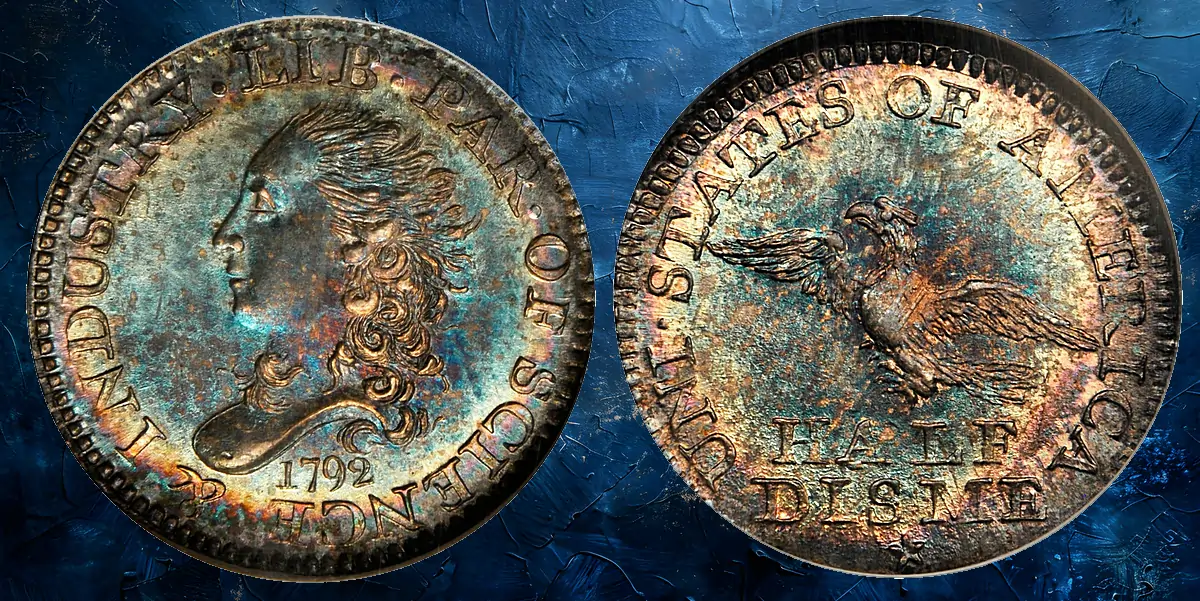
Visitors can see a silver 1792 Half Disme, using the early spelling of “dime.” The coin belongs to the first federal coinage produced after Congress passed the Coinage Act of 1792.
The story predates normal operations at the Philadelphia Mint. Workers struck roughly 1,500 Half Dismes in Philadelphia during 1792 while the new Mint still prepared for regular production. Thomas Jefferson recorded receiving the coins and later spending them during his return trip to Washington.
That history gives the Half Disme extraordinary significance. It represents the moment when the monetary system described in federal law began turning into actual American coins.
The $3 Million Nickel That Should Not Exist
Another showcase attraction jumps forward 121 years.
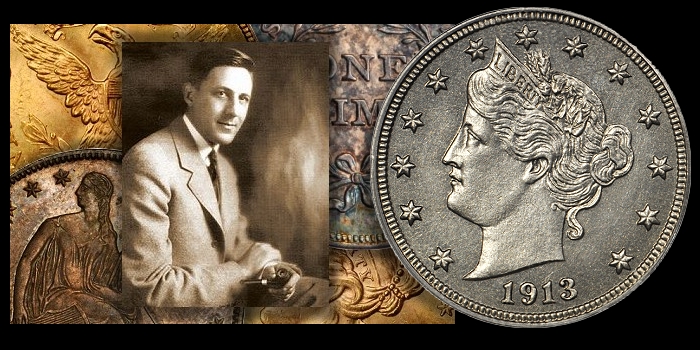
The ANA will display one of the five known 1913 Liberty Head Nickels. ANA press materials value the rarity at approximately $3 million.
The mystery surrounding the coins has lasted for more than a century. The United States had already replaced the Liberty Head Nickel with James Earle Fraser’s Buffalo Nickel design for 1913. Yet five Liberty Head pieces carrying the 1913 date eventually surfaced.
No definitive record explains why someone made them.
Consequently, the five coins became some of the most recognizable rarities in American numismatics. The ANA describes them as consistent leaders in the rare-coin market.
An 1804 Dollar With a $4 Million Pedigree
Then comes another American numismatic paradox: a dollar dated 1804 that the Mint did not strike in 1804.

The ANA plans to show an 1804 Draped Bust Dollar, which its press material values at roughly $4 million.
Only 15 examples of the 1804 Dollar remain known. Moreover, the Mint struck no silver dollars carrying that date during 1804. Instead, the famous 1804-dated pieces originated later, beginning with special diplomatic presentation coinage.
That unusual history helped give the 1804 Dollar its enduring nickname: “The King of U.S. Coins.”
11 1933 Double Eagles Together for the First Time
Yet Friday, August 28, may deliver the show’s defining moment.
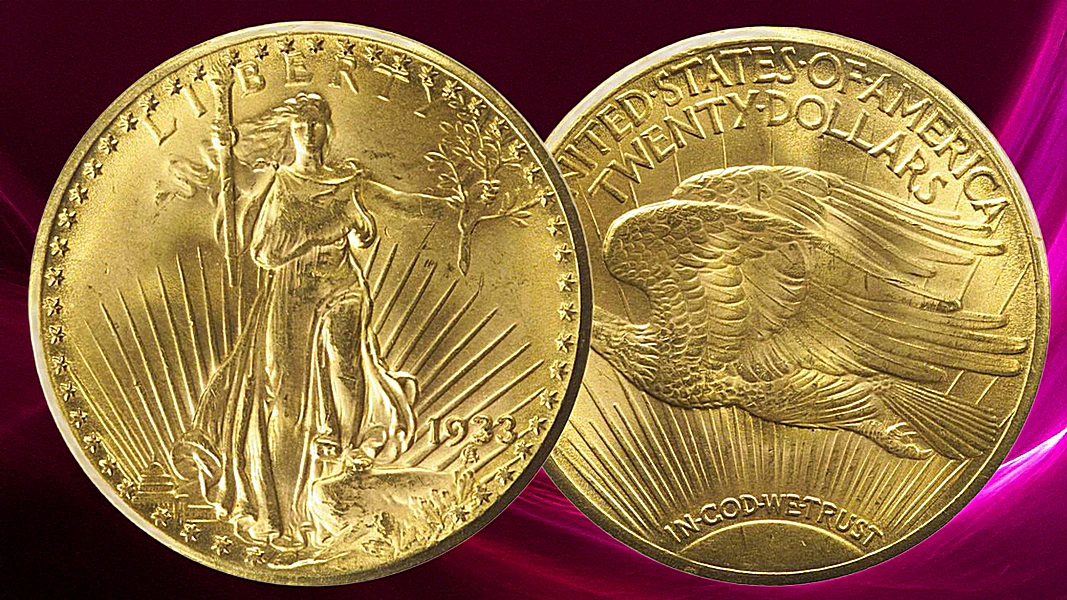
For one day only, the United States Mint will place all 11 government-owned 1933 Saint-Gaudens $20 Double Eagles together in public for the first time. The special exhibit will appear at the Mint’s area on the bourse floor.
The story behind these coins ranks among the greatest dramas in American numismatics.
The Philadelphia Mint produced 445,500 Double Eagles dated 1933. However, President Franklin D. Roosevelt’s sweeping changes to U.S. gold policy stopped the coins from entering normal circulation. The government eventually melted the production run. The Mint says only two examples lawfully left its custody at the time. Those two went to the Smithsonian Institution for preservation in the National Numismatic Collection.
Other examples escaped the Mint without authorization.
A Secret Service investigation that began in 1944 recovered nine pieces during the following decade. Authorities later melted those coins.
Then another example surfaced in 1996. A legal settlement ultimately allowed that coin to enter private ownership. The government formally monetized it during its 2002 auction by accepting an additional $20 payment.
That same coin returned to auction at Sotheby’s on June 8, 2021. It brought $18.9 million, setting an auction record for a coin.
The story grew even stranger in 2004. The family of Philadelphia jeweler Israel Switt revealed another 10 examples. Years of litigation followed. In 2011, a jury found for the federal government, and a judge subsequently ruled that those Double Eagles remained property of the United States.
The Mint later acquired an 11th example when a private citizen voluntarily surrendered it. Therefore, the Pittsburgh display will unite the government’s complete group of 11 coins for the first time.
For collectors who know this story, seeing all 11 coins side by side will mark a genuine numismatic milestone.
From Ancient Greece to Wartime Hawaii
The convention will also reach far beyond classic U.S. rarities.
The ANA Money Museum Showcase includes ancient Greek-inspired coinage from the Achaemenid Persian Empire. Some pieces portray historical rulers rather than gods or allegorical figures. The coins illuminate the collision of Persian and Greek cultures more than 2,300 years ago.
Another exhibit explores Hawaii emergency currency from World War II. The U.S. government issued these notes with distinctive HAWAII overprints. Officials could quickly demonetize them if Japanese forces captured the islands and seized American currency.
Together, these exhibits push the World’s Fair of Money far beyond the boundaries of a traditional coin show.
The Declaration of Independence in Pittsburgh
The America 250 theme will also extend beyond coins.
Visitors can examine an 1848 Peter Force engraved copy of the Declaration of Independence. Peter Force published the piece as part of his American Archives. William J. Stone had created the underlying copperplate in 1823 after Secretary of State John Quincy Adams commissioned the project.
The exhibit will also include an engraved 1820 facsimile of Thomas Jefferson’s original rough draft of the Declaration. Jefferson’s handwritten rough draft represents the earliest surviving complete draft of the document.
Therefore, visitors can move from colonial money to the Declaration itself and then forward to some of the most famous federal coins ever produced.
As Lighterman notes, bringing these objects together gives collectors an unusual opportunity to encounter major pieces of American history at one event.
Bring Your Own Coins
The World’s Fair of Money does not limit the experience to million-dollar rarities.
More than 500 dealers will buy and sell on the convention floor. In addition, numismatic experts will provide free, informal evaluations of coins and other collectibles that members of the public bring to the show.
The ANA will also offer educational presentations throughout the week. Families can visit Ernie’s Treasure Treehouse, where younger visitors can play numismatic games, including Treasure Trivia, and earn prizes.
2026 Pittsburgh World’s Fair of Money Admission and Hours
The 2026 World’s Fair of Money runs August 25-29 at the David L. Lawrence Convention Center, 1000 Fort Duquesne Blvd., Pittsburgh, Pennsylvania.
Public hours run from 1 p.m. to 5:30 p.m. Tuesday; 10 a.m. to 5:30 p.m. Wednesday through Friday; and 10 a.m. to 3:30 p.m. Saturday.
General admission costs $10 per day Tuesday through Friday. A full-week pass costs $25. The ANA offers free admission to everyone on Saturday, August 29. ANA members and children under 12 also receive free admission throughout the convention.
For anyone within traveling distance of Pittsburgh, the combination looks difficult to duplicate: America’s first federal coinage, a nickel that officially should not exist, the King of U.S. Coins, Revolutionary-era history, ancient money, and 11 legendary 1933 Double Eagles together for the first time.
That gives the 2026 World’s Fair of Money something even a nine-figure valuation cannot fully measure.