1971-S Eisenhower Dollar Prototype: Only 3 Known
In February 2008, collector Lee C. Lydston attended the Long Beach Coin Expo with his wife, Denise. While examining a dealer’s inventory, he spotted something unusual inside a tube of ordinary Eisenhower silver dollars.
The coin carried the familiar 1971-S date and mintmark. However, its surfaces and design details looked different. Lydston recognized the possibilities and purchased the dollar for less than $10.
That modest purchase became one of the most remarkable modern coin discoveries in American numismatics.
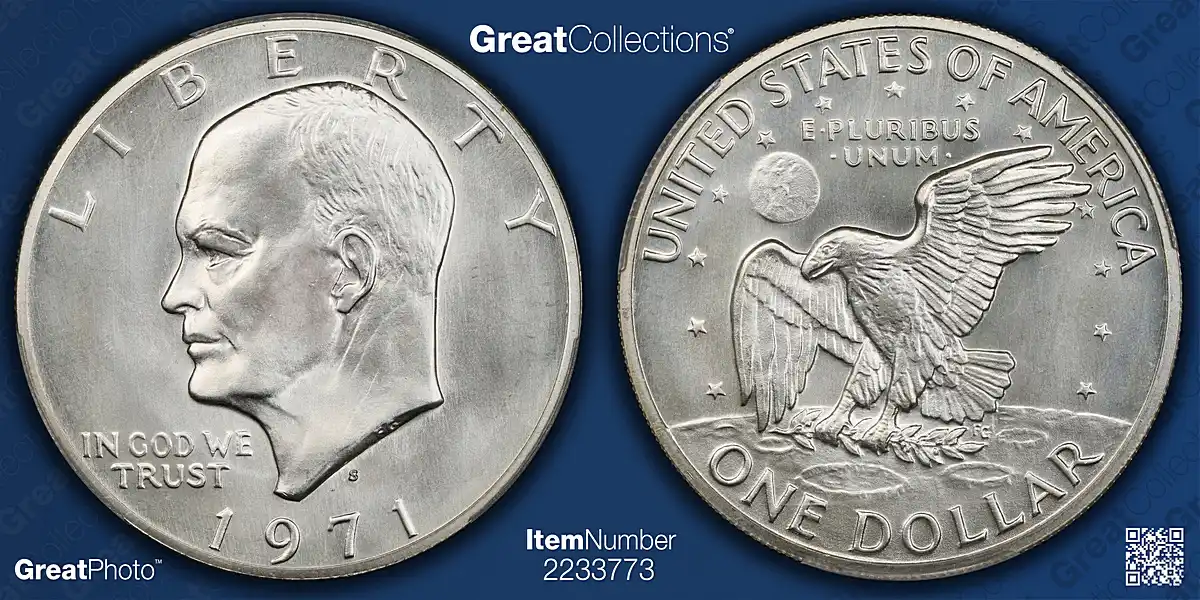
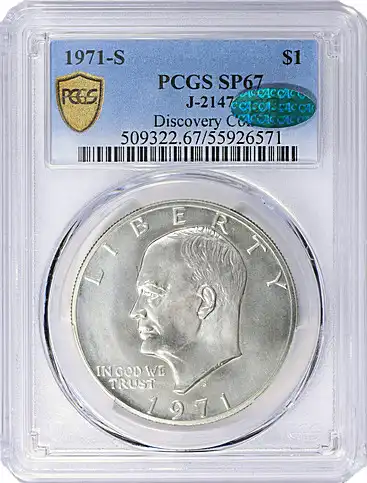
Today, experts recognize the coin as a 1971-S Eisenhower dollar prototype, cataloged as Judd-2147. Only three examples have surfaced. The discovery specimen earned a PCGS Specimen-67 grade and now carries CAC Green approval.
In January 2022, Heritage Auctions sold the same coin for $264,000. Now, the famous discovery example returns to the auction block at GreatCollections on October 18, 2026.
Yet its extraordinary value tells only part of the story.
A Dollar Born From Two Defining Moments in American History
The Eisenhower dollar brought together two major chapters in American history: World War II and the Space Age.
President Dwight D. Eisenhower died in March 1969. Four months later, Apollo 11 astronauts landed on the Moon. Congress eventually chose to honor both achievements on America’s first new dollar coin since the Peace dollar ended production in 1935.
President Richard Nixon signed the legislation authorizing the new coin on December 31, 1970.
Chief Engraver Frank Gasparro had a personal connection to Eisenhower’s image. In June 1945, Gasparro watched the victorious general pass through New York City during a massive homecoming celebration.
That brief encounter left a lasting impression. Years later, Gasparro drew on that memory when designing Eisenhower’s portrait for the dollar.
For the reverse, Gasparro adapted the Apollo 11 mission insignia, which astronaut Michael Collins helped develop. His design featured an eagle descending toward the lunar surface with an olive branch in its talons.
Meanwhile, Congress authorized two versions of the new dollar. The Philadelphia and Denver Mints produced copper-nickel coins for circulation. The San Francisco facility struck special 40% silver versions for collectors.
Production of the San Francisco silver dollars began on March 31, 1971.
However, before regular production started, the Mint experimented with prototype designs. Three surviving coins now provide an extraordinary glimpse into that process.
The Missing Moon Craters That Revealed a Secret
What makes the 1971-S Eisenhower dollar prototype different from an ordinary silver Ike?
The answer begins on the Moon.
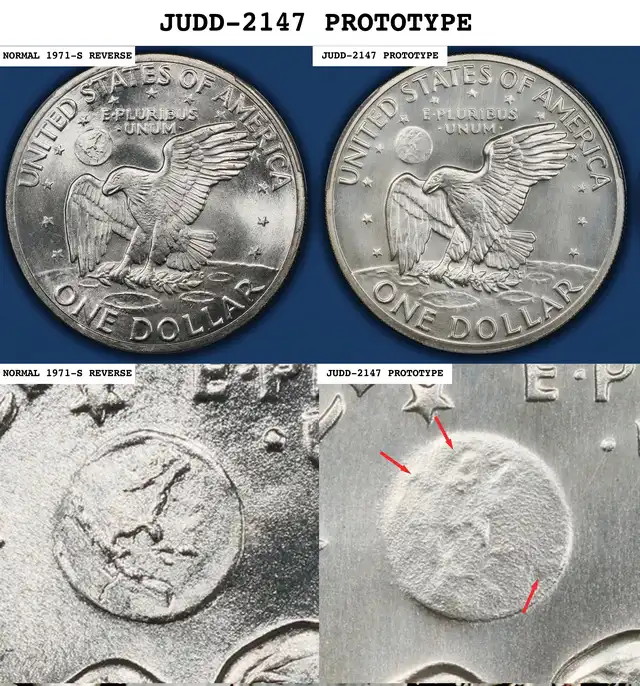
The prototype reverse displays several lunar craters that collectors will not find in the same form on regular-production Eisenhower dollars.
These additional details match an earlier version of Gasparro’s design. Researchers connected the unusual reverse to the engraver’s original 1970 models, including a galvano preserved at the Dwight D. Eisenhower Presidential Library and Museum in Kansas.
Gasparro simplified portions of the lunar landscape before the Mint finalized the production design. Consequently, the surviving prototypes preserve details that disappeared during development.
The coins also reveal differences in their manufacturing characteristics.
The discovery specimen combines satiny surfaces with areas of prooflike reflectivity. It also displays unusually sharp design details, prominent die-polishing lines, unfinished metal around portions of the lettering, and evidence of device doubling.
Together, these features pointed researchers toward an experimental striking rather than a previously unknown ordinary die variety.
Specialists from the Ike Group, including researcher Rob Ezerman, examined Lydston’s discovery and helped establish its importance.
The evidence eventually connected the unusual dollar to the Mint’s early work on the Eisenhower design.
January 25, 1971: When the Mint Opened Its Doors to Reporters
The mystery becomes even more compelling when we examine two original U.S. Mint announcements from January 1971.
On January 19, Mint Director Mary T. Brooks announced an unusual event.
For the first time, the Mint would allow news reporters and photographers to witness experimental coin strikes and observe the engraving process.
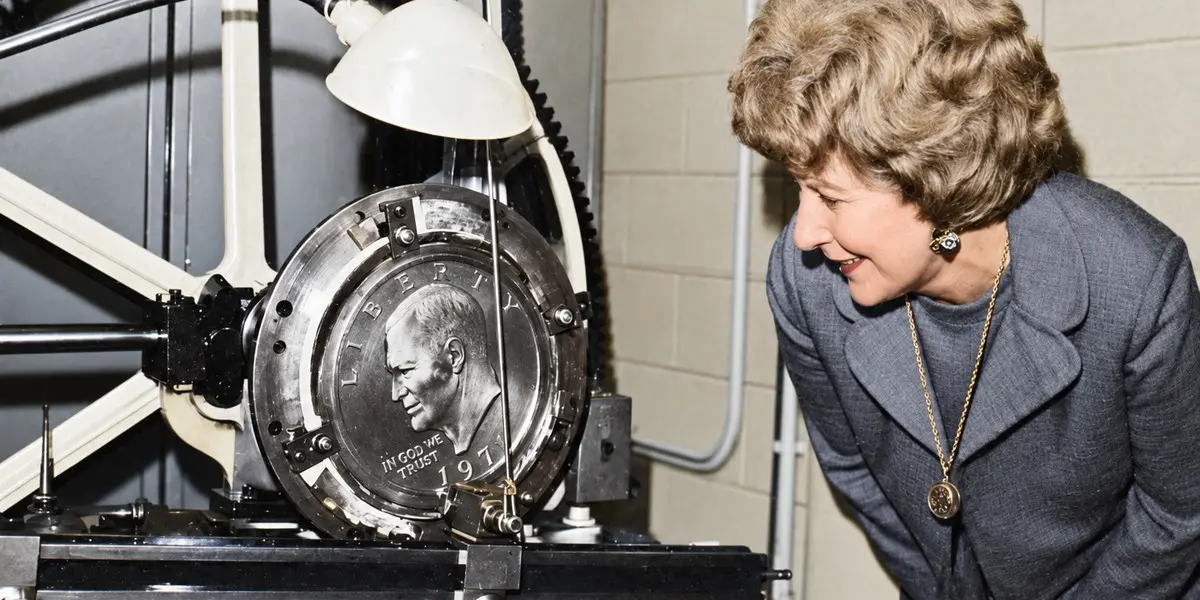
The demonstration would take place at the Philadelphia Mint on January 25, 1971, at 11 a.m.
The Mint wanted to show the public how it developed the new Eisenhower dollar, the first dollar denomination to return to production since 1935.
A second document, distributed for the January 25 event, provided unusually detailed information about the experimental work.
The Mint confirmed that its engravers had prepared multiple trial dies for the obverse and reverse. Workers used specially prepared 40% silver blanks to test different combinations of dies, collars, and planchet characteristics.
These experiments served a practical purpose.
Even dies carrying the same basic design could produce different results. Relief height and the shape of the background affected how metal flowed under pressure.
If the relief rose too high, the press might require excessive force to bring up the design. In extreme cases, that pressure could damage the dies or the coining equipment.
Therefore, Mint technicians needed to determine which combination would produce attractive, consistent coins without overstressing their machinery.
The January 25 document also confirmed that the prototype dies still needed substantial refinement.
Mint engravers expected to spend several more weeks removing tiny defects and sharpening design details. Only afterward would they complete the official master dies and hubs for the 1971 production dies.
The documents establish that the Mint conducted genuine Eisenhower dollar prototype experiments using the same general silver composition as the surviving pieces.
But they also introduce another mystery.
The Mint Ordered Its Trial Strikes Destroyed
The January 25 press document included a strict requirement.
A special committee, which included representatives of the Mint Director, the Philadelphia Mint, the engraving department, and the coining division, had to supervise the experiments.
Furthermore, the Mint required the committee to destroy the prototype trial strikes.
How, then, did three Eisenhower dollar prototypes eventually enter private collections?
Researchers have proposed several explanations.
One possibility involves experimental pieces that traveled from Philadelphia to San Francisco for additional examination. Some may later have entered the normal packaging process by mistake.
Another theory suggests that San Francisco struck its own trial coins using experimental dies from Philadelphia. The San Francisco facility possessed specialized proof-production equipment, making additional testing there plausible.
The surviving dollars all carry S mintmarks, which adds weight to the possibility of San Francisco involvement.
Moreover, the known examples have connections to the Mint’s original collector packaging.
However, researchers have not established exactly where the three surviving prototypes originated or how they entered the marketplace.
The January 1971 documents confirm the Mint’s experimental work. They do not prove that the surviving Judd-2147 dollars came from the Philadelphia press demonstration.
For collectors, that unanswered question remains one of the coin’s most intriguing historical features.
Three Coins, Two Die Pairs, and Eighteen Years of Research
Lydston’s 2008 discovery started a lengthy investigation.
Initially, experts had never encountered a 1971-S Eisenhower dollar with the same combination of design and striking characteristics.
Then, in 2010, another collector discovered a similar example in an Alabama pawn shop. The buyer reportedly paid just $5.
A third prototype surfaced through an eBay purchase in 2013 for approximately $22.
Researchers eventually determined that the three coins represented two different obverse-and-reverse die pairings. All three share the distinctive early reverse design, while one has a different obverse die.
PCGS subsequently authenticated and graded the surviving specimens. Its examinations included metallurgical analysis, which found the tested coins consistent with ordinary 40% silver Eisenhower dollar planchets.
The discovery coin also underwent professional conservation to remove haze associated with its original Mint packaging.
By 2020, PCGS had documented the three known prototypes. The discovery example earned SP67, tying another specimen for the finest PCGS grade reported for the group.
More recently, numismatic references granted the coins additional recognition.
The prototypes received the pattern catalog designation Judd-2147 and gained a major-variety listing in A Guide Book of United States Coins, commonly known as the Red Book.
That recognition places these extraordinary working prototypes within the established framework of American pattern coin collecting.
From a $10 Discovery to a $264,000 Auction Result
The discovery coin eventually passed from Lee Lydston into the collection of David Frohman, a leading advocate for researching and preserving the prototypes.
In January 2022, Heritage Auctions offered the specimen during its Florida United Numismatists Platinum Night auction.
The sale marked the coin’s first public auction appearance.
Collectors responded enthusiastically. The dollar realized $264,000, demonstrating the extraordinary demand for a modern U.S. coin with a well-documented discovery history and genuine prototype significance.
Now, four years later, the same specimen returns to the marketplace.
GreatCollections identifies the coin as the only known Judd-2147 example with CAC approval. Its PCGS SP67 grade also places it among the finest certified examples.
The auction comes at an important moment. Recognition in the Red Book and the Judd reference gives the prototype a new level of visibility among collectors beyond the Eisenhower dollar series.
For specialists, the appeal extends well beyond its rarity.
This coin preserves an earlier stage of the Mint’s artistic work, connects directly to the development of America’s first post-Peace dollar, and offers a tangible link to the nation’s fascination with Apollo 11.
1971-S Eisenhower Dollar Prototype Specifications
- Country: United States
- Denomination: One Dollar
- Date: 1971
- Mintmark: S (San Francisco)
- Catalog designation: Judd-2147
- Composition: 40% silver, 60% copper; silver-copper clad
- Weight: 24.59 grams
- Diameter: 38.1 mm, standard Eisenhower dollar diameter
- Edge: Reeded
- Designer: Frank Gasparro, with the reverse adapted from the Apollo 11 insignia
- Original mintage: Unknown
- Known surviving examples: Three, representing two die pairs
- Featured specimen: PCGS SP67, CAC Green
- Previous auction result: $264,000, Heritage Auctions, January 14, 2022
A Rare Opportunity to Own a Piece of the Mint’s Design History
The 1971-S Eisenhower dollar prototype occupies an unusual position in American numismatics.
It is not a conventional mint error. Nor is it simply a high-grade example of a common collectible coin.
Instead, the prototype captures a moment in the development of a familiar American design, before Mint engravers completed their final refinements.
Its discovery also demonstrates why collectors continue searching ordinary coins for extraordinary details.
Nearly four decades after the Mint introduced the Eisenhower dollar, a collector noticed something different in a dealer’s tube. That observation eventually uncovered one of the most important modern U.S. coin rarities.
As this famous 1971-S Eisenhower dollar prototype heads to auction once again, its next owner will acquire more than a rare silver dollar.
The coin preserves a design that almost vanished from numismatic history.
GreatCollections will offer the 1971-S Eisenhower Dollar Silver Judd-2147 Prototype/Discovery Coin, PCGS SP67 CAC Green, in its auction closing Sunday, October 18, 2026, at approximately 6:36 p.m. Pacific Time.
Collectors can view the coin and follow bidding under GreatCollections Item #2233773.