

Why the 1652 Pine Tree Shilling Became Colonial America’s Most Famous Silver Coin
The date says 1652. Yet the coin may not have existed until 15 or even 20 years later.
That apparent contradiction sits at the heart of the 1652 Pine Tree Shilling, one of the most recognizable coins of Colonial America. It also helps explain why exceptional survivors now bring five-figure and sometimes six-figure prices.
The Pine Tree Shilling carries more than a date, a denomination, and a crude tree. It records an extraordinary monetary experiment. Massachusetts created its own silver money when England supplied too little coin for a growing colonial economy.
Then Boston kept making it.
Even after the English monarchy returned.
Even after Crown officials objected.
And even as the political consequences grew more serious.
For collectors, that backstory gives Massachusetts silver something that grade alone cannot provide. Every surviving Pine Tree Shilling links the modern collector directly to Boston merchants, Spanish silver, English royal power, and an economy struggling to invent its own monetary system.
Boston Had Commerce. What It Lacked Was Money.
By the middle of the 17th century, Massachusetts Bay had developed a busy commercial economy. However, the colony faced a stubborn problem.

It did not have enough dependable money.
English gold and silver coins remained scarce in America. Coins that reached Massachusetts often flowed back across the Atlantic to pay for imported goods. As a result, colonists relied on an awkward mixture of barter, foreign coins, credit, and other forms of exchange. Wampum also circulated, although its monetary value deteriorated as the century progressed.
Meanwhile, Spanish-American silver played an increasingly important role in Atlantic trade.
That solution brought another problem.
A major debasement scandal at the Potosí Mint damaged confidence in Spanish silver during the late 1640s. Boston merchants also encountered clipped, underweight, and counterfeit foreign coins. John Hull later wrote that counterfeit money had caused substantial losses and had even contributed to a stoppage of trade.
Massachusetts needed money people could recognize, weigh, and trust.
So colonial leaders decided to make their own.
Massachusetts Creates a Mint in 1652
In May 1652, the Massachusetts General Court authorized a mint in Boston. The legislation emerged through proceedings on May 26 and 27, which explains why historical references sometimes use either date.
The colony selected Boston silversmith John Hull as mintmaster. Hull chose fellow silversmith Robert Sanderson as his partner.
Their assignment called for silver shillings, sixpences, and threepences.
The act allowed residents to bring bullion, silver plate, and Spanish coin to the mint. Hull and Sanderson could melt that silver and turn it into standardized Massachusetts money.
This represented a remarkable assertion of colonial authority.
Coinage traditionally belonged to sovereign governments. Massachusetts had no specific royal authorization to operate a mint. Therefore, Boston did more than solve a shortage of small change. It stepped into an area closely associated with political sovereignty.
The timing helped.
Charles I had lost his throne and his life in 1649. England then entered its republican Interregnum. Consequently, Massachusetts acted during an unusual period when no English king sat on the throne.
Massachusetts Created a Shilling That England Would Not Want
The Massachusetts shilling contained high-quality silver. However, it did not match an English shilling in weight.
The colony set its shilling at 72 grains and used the English sterling standard for fineness. An English shilling weighed about 92.9 grains.
Therefore, the Massachusetts coin contained roughly 22.5% less silver by weight than its English counterpart.
That difference mattered.

Inside Massachusetts, the lighter coin still functioned as a 12-pence shilling. Outside the colony, its lower silver content made it less attractive as bullion.
In effect, Massachusetts created a monetary barrier designed to keep money circulating at home.
The strategy did not work perfectly. Merchants still exported Massachusetts silver, and the General Court later tried to restrict that practice. Still, the concept shows considerable economic sophistication. The colony wanted a trustworthy coin that carried greater spending power in Boston than its raw silver could command elsewhere.
That detail makes the Pine Tree Shilling more than colonial money.
It represents an early American experiment in monetary policy.
Before the Pine Tree Came the NE, Willow, and Oak
The famous Pine Tree design did not appear when Hull opened the mint.
The first Massachusetts coins carried a much simpler design.
On one side, workers punched NE, for New England. On the other, they punched the denomination in Roman numerals: XII, VI, or III.
Those crude pieces created an obvious opportunity for clipping. A dishonest holder could shave silver from an edge without removing any important design. Massachusetts quickly responded with a more elaborate coin.
The design then evolved through several stages.
The Willow Tree coinage came first. The Oak Tree series followed. Finally, around 1667, the mint introduced what collectors now call the Pine Tree coinage.
Pine Tree issues continued until the Boston Mint closed in 1682. The mint produced Pine Tree shillings, sixpences, and threepences.
The Pine Tree Shilling became the iconic coin of the entire Massachusetts silver series.
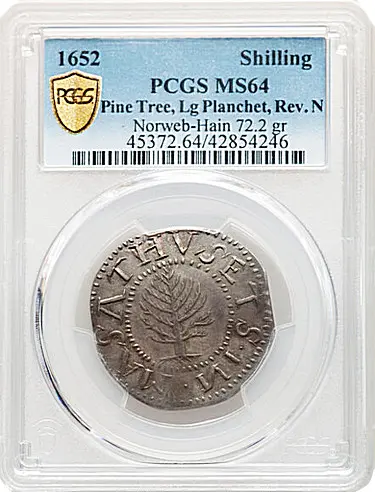
There is a practical reason. It combines a large, instantly recognizable central design with the words MASATHVSETS IN on one side and NEW ENGLAND, the denomination XII, and the date 1652 on the other.
It looks unmistakably American centuries before a United States Mint existed.
Why Does a Coin Struck Around 1670 Say 1652?
 Here the Pine Tree Shilling enters one of the most fascinating areas of American numismatic folklore.
Nearly every Massachusetts Tree coin continued to carry the date 1652, even though production continued for decades. The twopence provides the major exception with its 1662 date.
One popular explanation claims that Massachusetts deliberately froze the 1652 date because England had no king that year. After Charles II regained the throne in 1660, colonial officials could supposedly argue that their coins dated only from the Interregnum.
It makes a wonderful story.
However, CoinWeek believes collectors should treat that explanation as a theory rather than settled fact.
The Smithsonian presents the political-cover explanation as one possibility. It also notes that 1652 may simply commemorate the founding of the Massachusetts mint. NGC goes further and describes the royal-deception explanation as a popular myth, arguing that the date most likely refers to the General Court’s original authorization.
Either way, the frozen date created one of the great curiosities in American numismatics.
A Pine Tree Shilling stamped 1652 may actually have come from the press around 1670, 1675, or even later. Smithsonian catalog records date surviving Pine Tree examples to approximately 1667-1682.
For collectors, that mystery strengthens the coin rather than weakens it.
The date itself becomes part of the story.
What Does the Pine Tree Represent?
The tree appears simple. Yet it carries enormous visual power.
New England timber had major commercial value, especially for shipbuilding. Tall straight pines also supplied valuable mast timber. The Smithsonian therefore notes that the tree may symbolize one of Massachusetts Bay’s important exports.
Still, no surviving mint record definitively explains why Hull and Sanderson chose that particular tree.
That uncertainty deserves attention.
Modern collectors often describe the pine as a deliberate symbol of New England prosperity or independence. Perhaps it became those things. However, the surviving historical record does not prove that Hull intended every meaning later generations attached to it.
What we can say with confidence seems more compelling.
Massachusetts placed a New England tree where European coins normally placed kings, royal arms, or other symbols of sovereign authority.
The result looked radically different from the money of the Old World.
Large Planchet Pine Tree Shillings Show How Boston Made Money
The manufacturing process gives these coins another layer of character.
Collectors divide Pine Tree Shillings into Large Planchet and Small Planchet types.

Large Planchet pieces generally belong to the earlier Pine Tree period. Colonial Williamsburg dates its Large Planchet example to about 1667-1674. Later Small Planchet pieces appeared during the final years of mint production, roughly 1675-1682.
Large Planchet coins show evidence of production with a rocker or roller-style press. As the curved dies impressed the silver, the process often left the finished coin with a wave or an S-shaped bend.
That feature does not necessarily indicate later damage.
It can represent the original minting process.
Later Small Planchet shillings used smaller, thicker blanks and, according to Colonial Williamsburg, a screw press.
Even clipping needs context.
Collectors usually associate clipped coins with dishonest circulation. Yet Massachusetts mint workers sometimes trimmed pieces to bring them close to the authorized weight. Heritage specifically noted mint-made clipping on a major Noe-4 specimen.
Therefore, the best Pine Tree Shillings do not look mechanically perfect.
Their irregularity documents how Boston made them.
That is part of their appeal.
Four Pine Tree Shillings Show What Collectors Really Pay For
Auction results reveal something important about this series.
Grade matters greatly. However, centering, strike, planchet quality, weight, die variety, color, and pedigree can matter just as much.
Consider four important Large Planchet Pine Tree Shillings:
Auction Example Variety and Grade Weight Price Realized
- Noe Plate Coin, ex Boyd-Ford, Stack’s Bowers 2013 ANA sale Noe-1, Pellets at Trunk, NGC MS-65+ 73.9 grains $76,375
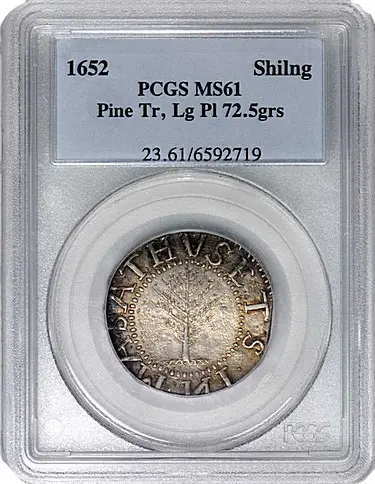
- Stack’s Bowers, March 2015 Noe-2, No Pellets, PCGS MS-61 72.5 grains $25,850
- Mills-Garrett-Weinberg, Heritage 2020 Noe-4, Reversed N, PCGS MS-64 71.45 grains $78,000
- Norweb-Hain, Heritage 2022 Noe-4, Reversed N, PCGS MS-64 72.2 grains $66,000
The results show why buying Massachusetts silver by slab grade alone misses much of the market.
The Noe-1 Plate Coin: A Textbook Pine Tree Shilling
Stack’s Bowers offered one of the most recognizable Large Planchet pieces during its 2013 ANA auction.
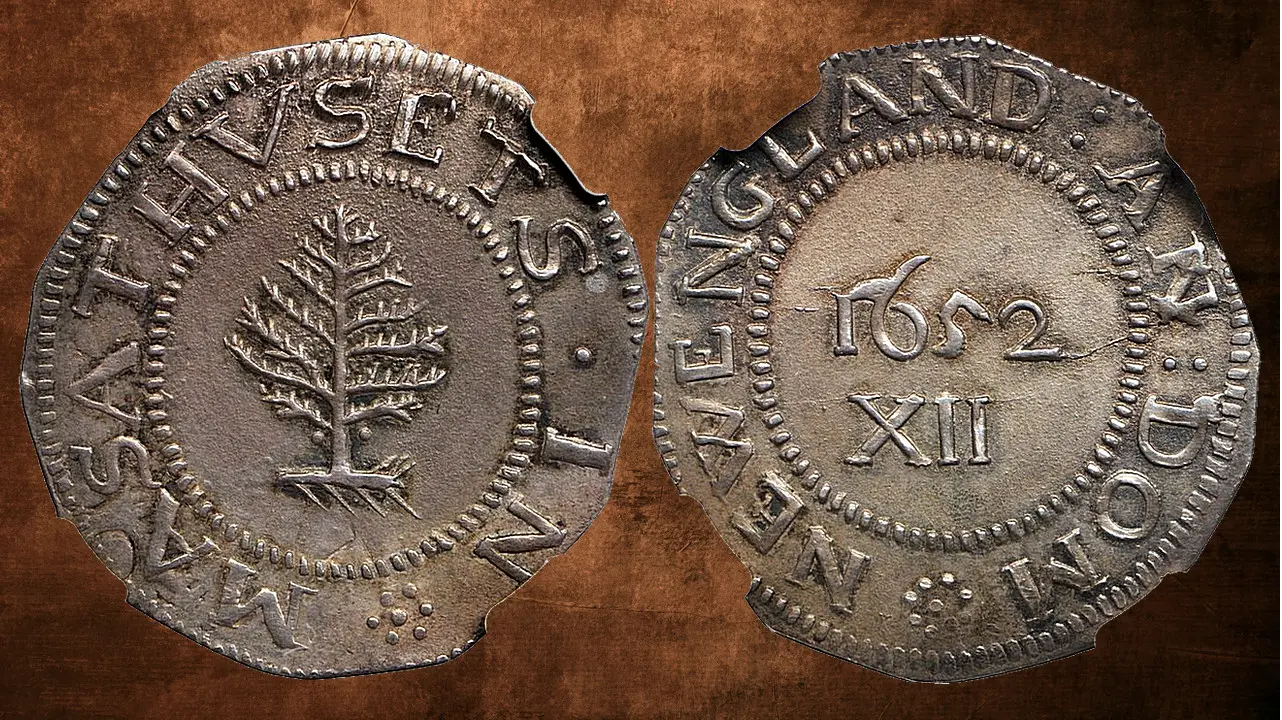
The coin carried a grade of NGC MS-65+ at the time. It weighed 73.9 grains and represented the Noe-1 variety, with pellets flanking the tree trunk.
More importantly, Sydney P. Noe used the coin as a plate specimen in his landmark study of Massachusetts silver.
Its pedigree also included F.C.C. Boyd and John J. Ford, Jr.
Stack’s Bowers described a sharply defined tree, bold legends, and the characteristic bend created during the minting process. The coin realized $76,375. PCGS auction records confirm that result.
For a collector seeking one coin to represent Colonial Massachusetts, Noe-1 offers an especially strong combination of history, design, and recognizability.
A Mint State Noe-2 at $25,850
In March 2015, Stack’s Bowers sold a Noe-2, Salmon 2-C, Rarity-4 Large Planchet shilling graded PCGS MS-61.

It weighed 72.5 grains, almost exactly where collectors want a full-weight Massachusetts shilling.
The coin also offered unusually strong centering. Its peripheral lettering remained nearly complete, while silver-gray surfaces carried mauve-gray and reddish-gold accents.
It brought $25,850.
PCGS records that result and lists the coin among MS-61 representatives of the No Pellets type.
That sale illustrates an important point.
A collector does not need the highest-certified Pine Tree Shilling to own an exceptional example. Full weight, strong centering, clear legends, and an attractive tree can transform a lower Mint State grade into a highly desirable coin.
From $30 in 1904 to $78,000 in 2020
Few Pine Tree Shillings tell the collecting story as dramatically as the Mills-Garrett-Weinberg Noe-4.
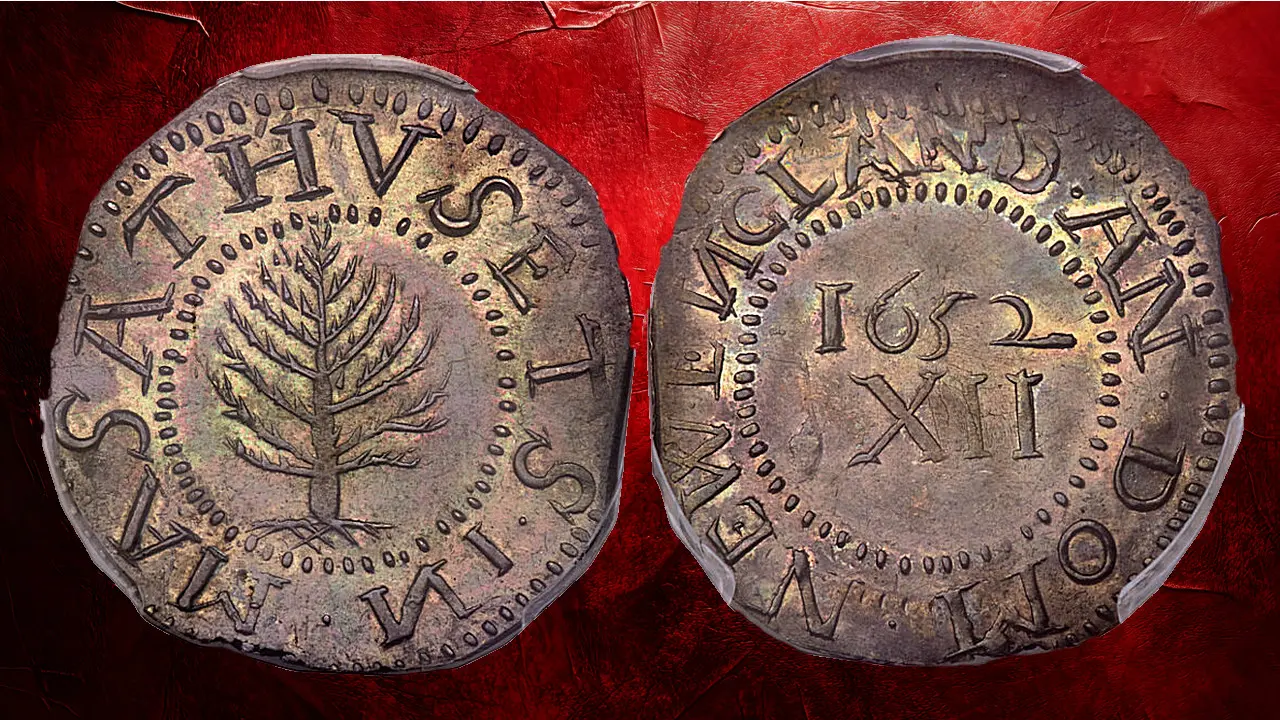
Philadelphia dealers S.H. and Henry Chapman offered the coin in the John G. Mills Collection in 1904.
Robert Garrett bought it for $30.
The coin then passed through the Garrett family to Johns Hopkins University. In the landmark 1980 Garrett sale, Alan V. Weinberg bought it for $35,000.
Forty years later, Heritage sold it for $78,000.
The coin weighed 71.45 grains and carried a PCGS MS-64 grade. It also showed the famous reversed N found on the Noe-4 die marriage.
Heritage noted its exceptional centering, strong legends, bold tree, early die state, and rose-gold color over blue-gray undertones. The coin had also appeared in the American Numismatic Society’s landmark 1991 Massachusetts silver exhibition.
Here, pedigree becomes part of the object.
A collector does not simply acquire a Pine Tree Shilling.
The buyer joins a chain that can include the Chapmans, Garretts, Johns Hopkins, Weinberg, Ford, Norweb, Eliasberg, or other giants of American numismatics.
That connection carries real market value.
Two MS-64 Noe-4 Coins, Two Different Prices
Another Noe-4 makes the point even clearer.
Heritage sold the Norweb-Hain specimen in January 2022 for $66,000.
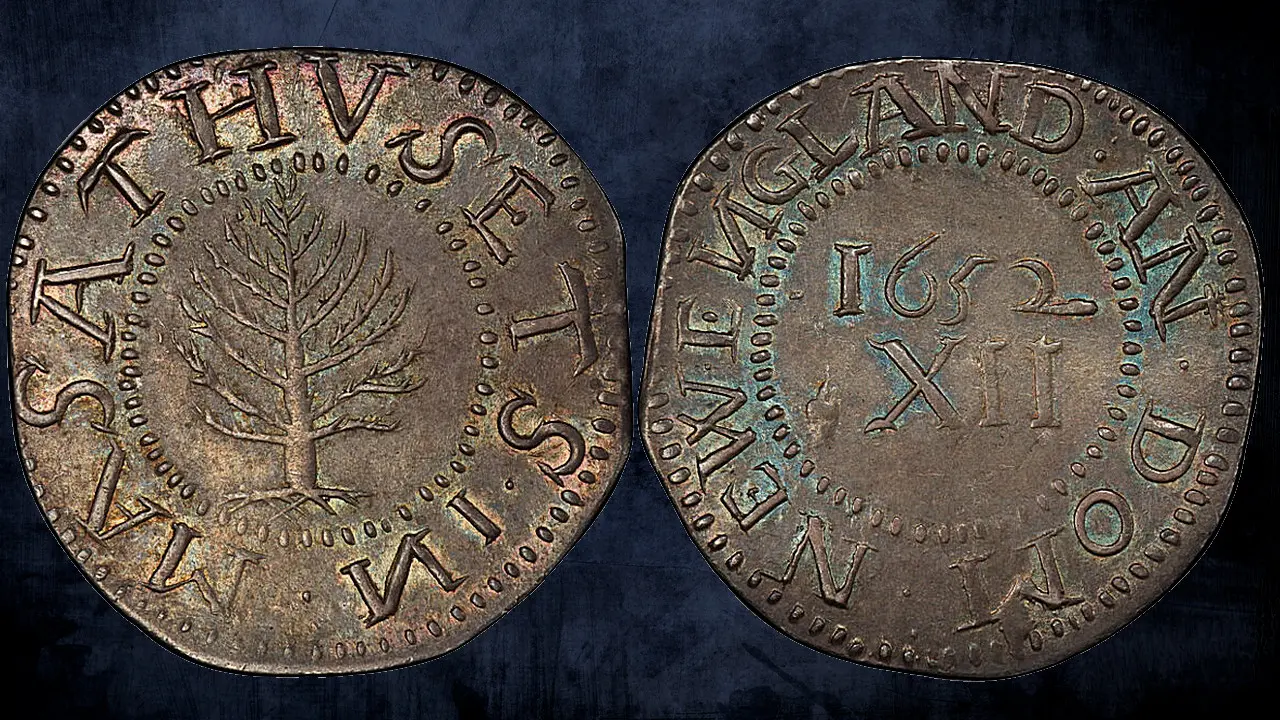
Like the Weinberg coin, it carried a PCGS MS-64 grade. However, it weighed 72.2 grains and carried a different distinguished pedigree. Earlier owners included the Norweb Collection and the Hain Family Collection. It also appeared as Coin No. 87 in the 1991 ANS Massachusetts silver exhibition.
Heritage noted full mint luster, antique-gray color, gold and blue highlights, excellent centering, and nearly complete borders.
Yet it brought $12,000 less than the Weinberg Noe-4 two years earlier.
That does not make one result right and the other wrong.
Instead, it demonstrates how advanced colonial collectors evaluate coins.
A number on a holder cannot capture everything.
Pedigree matters. So does strike, colorm the shape of the planchet and the completeness of the legends. Auction timing and competition matter as well.
With early American silver, every coin becomes its own market.
Noe Numbers Turn One Coin Type Into an Entire Field
A casual collector may see Pine Tree Shillings as one design.
A specialist sees dozens of distinct die marriages and die states.
Sydney P. Noe’s classification system gave collectors the familiar numbers used today. Later researchers, including Walter Breen, Richard Picker, and Christopher J. Salmon, refined the study of Massachusetts silver.
The Noe-4 family alone demonstrates the complexity. Heritage notes that researchers have assigned several Noe numbers to different states of the same basic die pairing.
Therefore, collecting Pine Tree Shillings can become as technical as collecting early large cents, die marriages of Bust halves, or VAM varieties of Morgan Dollars.
The tree gets a collector through the door.
The dies can keep that collector occupied for decades.
Royal Pressure Finally Catches Up With Boston
Massachusetts did not mint its silver without consequences.
After Charles II regained the throne, royal officials challenged the colony’s monetary independence. In 1665, a royal commission specifically demanded repeal of the mint law because coinage represented a royal prerogative.
Massachusetts did not comply.
Hull kept producing money.
Eventually, however, pressure from England became impossible to ignore.
The Hull-Sanderson mint ceased operations in 1682. The Smithsonian links the closure to increased royal scrutiny.
Two years later, the original Massachusetts charter fell.
However, the common claim that Charles II simply revoked the charter because Massachusetts made Pine Tree Shillings goes too far. The Crown objected to a much broader pattern of colonial independence, including trade policies, governance, religious issues, and resistance to royal authority. Minting its own money formed one important part of that larger conflict.
That distinction makes the history better, not weaker.
The Pine Tree Shilling did not single-handedly bring down Massachusetts Bay’s charter.
Instead, it became one visible expression of the independence that increasingly separated Boston from London.
Why the 1652 Pine Tree Shilling Is a Great American Coin
Many valuable coins owe their status mainly to rarity.
The Pine Tree Shilling offers something more.
This Shilling combines rarity with a defining historical moment.
It belongs to the first locally produced silver coinage struck in what became the United States and arose from a shortage of trustworthy money. By turned foreign silver into a standardized local currency, it challenged traditional ideas about who had the right to create money.
Moreover, its physical imperfections tell the story of 17th-century production.
A curved planchet can reveal the press. A clipped edge may reflect mint weight adjustment. A reversed letter can identify a die marriage. A frozen date can open a debate about colonial politics.
Then there are the pedigrees.
One specimen can connect John Hull’s Boston to S.H. Chapman, Robert Garrett, Johns Hopkins University, Alan Weinberg, and today’s auction room.
Few American coins can carry that much history on 72 grains of silver.
That is why the Pine Tree Shilling remains more than a famous colonial coin.
It represents the moment when Massachusetts decided that if England could not provide the money its economy needed, Boston would make the money itself.
And more than 350 years later, collectors still want the evidence.
1652 Pine Tree Shilling Specifications
- Issuing Authority: Massachusetts Bay Colony
- Mint: Boston
- Mintmasters: John Hull and Robert Sanderson
- Date on Coin: 1652
- Approximate Pine Tree Production: 1667-1682
- Denomination: One Shilling / 12 Pence
- Metal: Sterling-standard silver
- Authorized Weight: 72 grains
- Large Planchet: Diameter Variable; examples around 30 mm
- Small Planchet: Diameter Approximately 24 mm
- Obverse: Pine tree with MASATHVSETS IN
- Reverse: NEW ENGLAND, AN DOM, 1652, XII
- Large Planchet: Production Rocker/roller-style press
- Later Small Planchet: Production Screw press
- Mintage: Unknown
- Major References: Noe, Whitman, Salmon
The 72-grain statutory weight comes directly from the Massachusetts monetary standard documented in surviving records. Large and small planchet dimensions vary because workers did not produce these coins with the uniformity of a modern mint.
Every coin has a story to tell this one more than others
Thinking of fluctuating market values: the Mills-Garrett-Weinberg Noe-4 example sold in 1980 for $35,000. Forty years later or 2020(?) it resold for $78,000. The BLS inflation calculator puts the 2020 value of $35,000 in 1980 at about $109,655. Subtract fees and the seller had a significant loss, ameliorated of course by decades of enjoyment.
Would love to own one of these one day! Didn’t realize the history behind it and loved the informative article
What an interesting story!
I learn something new every day.