

A Major Mint Error Hid in This Sealed U.S. Proof Set for 22 Years
For more than two decades, it sat exactly where the United States Mint put it.
The coin never entered circulation. A collector never cracked it out. A grading service never placed it in a holder.
Instead, a 2004-S Proof Roosevelt dime with a dramatic 25% obverse indent remained locked inside its original U.S. Mint-sealed Proof Set lens.
Now it has surfaced.
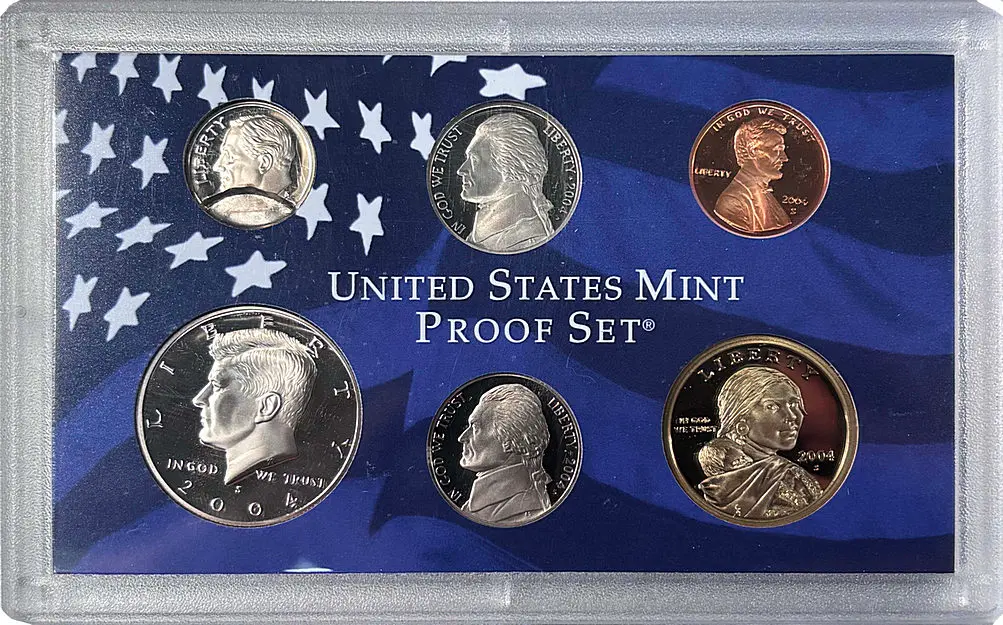
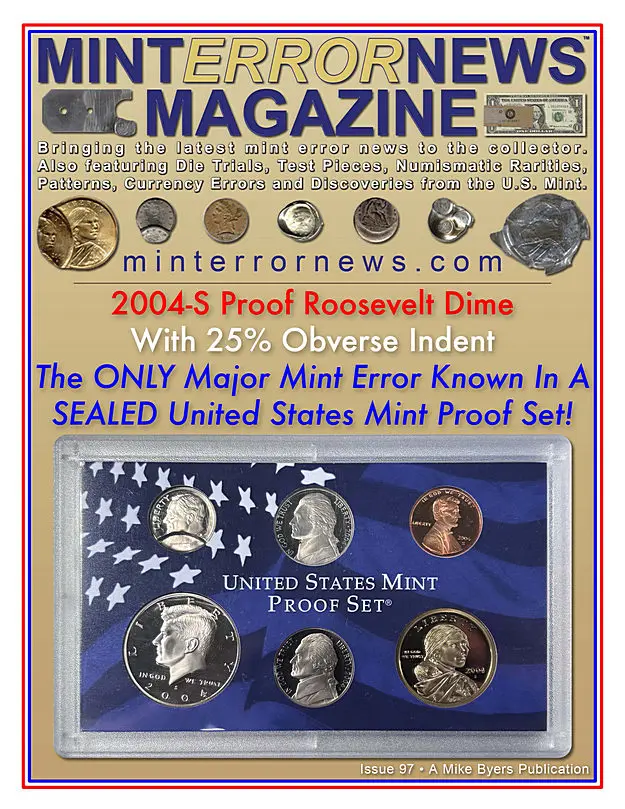
Mint error specialist Mike Byers calls the piece the only major mint error he knows of inside a government-sealed United States Mint Proof Set. During 50 years as a professional numismatist specializing in major errors, Byers says he has never encountered another comparable example. He also checked auction records and consulted other mint error specialists without finding another.
That makes the discovery remarkable for two separate reasons.
The error itself ranks as a major Proof striking error. However, the original sealed packaging may tell an even bigger story.
Somehow, this dime survived the San Francisco Mint’s unusually strict Proof production process, escaped quality control, reached the packaging line, entered a Proof Set, and left the Mint.
Then it remained there for 22 years.
A Major Error Hiding in Plain Sight
An unnamed dealer discovered the set and purchased it during the 2026 American Numismatic Association World’s Fair of Money in Pittsburgh. The ANA held the show August 25-29 at the David L. Lawrence Convention Center.
The dealer recognized that the dime deserved expert attention and contacted Byers.
Byers immediately understood what he was looking at.
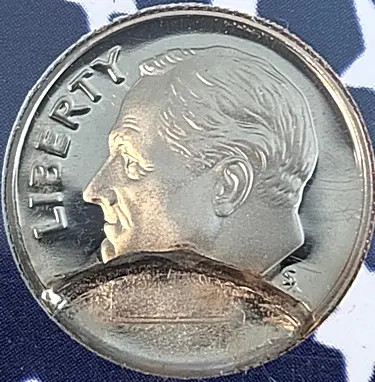
The 2004-S clad Proof Roosevelt dime shows a 25% obverse indent caused by another planchet. Even outside the Mint packaging, a dramatic indent on a modern Proof coin would attract serious attention. Inside an intact Mint lens, however, the error enters largely uncharted territory.
Byers subsequently acquired the set.
Photographs of the discovery show marks on the clear holder. Importantly, Byers states that the visible scratches belong to the plastic lens, not the coins inside.
What Caused the 25% Indent?
The error itself records a mechanical failure during the striking process.
Normally, the press receives one planchet and places it correctly between the dies. The dies then strike the planchet and create the finished coin.
This time, something went wrong.
CONECA defines an indented strike as an error that occurs when two planchets enter the coining chamber together and overlap. During the strike, one planchet blocks part of the die from reaching the other. The overlapping planchet then forces a rounded depression into the affected coin.
NGC describes the same basic process. Two planchets enter the collar, one partly covers the other, and the strike forces the upper planchet into the lower piece.
On this 2004-S dime, the resulting indent covers roughly one-quarter of the obverse.
That alone makes the coin highly unusual.
The fact that it happened to a Proof makes it far more difficult to explain away as simply another production mishap.
Proof Errors Face Several Lines of Defense
The United States Mint does not manufacture Proof coins like ordinary circulation strikes.
In 2004, the Mint produced Proof coins at San Francisco with specially prepared, highly polished dies. The Mint struck each coin at least twice to create sharp design detail, frosted devices, and brilliant mirrored fields.
Then came another obstacle for an error coin: packaging.
NGC has specifically noted that modern Proof errors remain scarce because the Mint applies unusually high quality control to Proof production. Dramatically misshapen pieces also face another chance for detection when workers package the coins for collectors.
In other words, this dime had to survive more than the striking error itself.
It had to survive inspection.
Then it had to reach the correct packaging station.
Finally, someone had to seal it inside the lens.
That sequence gives this discovery its extraordinary appeal.
The Sealed Holder Changes the Story
Major mint errors exist. Proof errors also exist.
However, this coin still sits inside the packaging in which the Mint distributed it.
That distinction matters.
Since 1968, annual U.S. Proof Sets have used rigid plastic holders rather than the earlier soft cellophane packaging. PCGS identifies the 1968 set as the beginning of the modern hard-plastic Proof Set format.
The 2004 set continued that tradition with two sealed presentation lenses.
Therefore, the holder does something a normal certified error coin cannot do quite as dramatically: it preserves the error within its original Mint context.
The coin and the packaging together document the failure of several stages of the Mint’s normal Proof production system.
That may ultimately prove more important to collectors than the dime’s numerical grade.
Why 2004 Already Made an Unusual Proof Set
The error also landed in one of the more interesting annual Proof Sets of the early 21st century.
The Mint released the 2004 United States Mint Proof Set on June 3, 2004, for $22.95. It contained 11 coins with a combined face value of $2.96.
The extra coin came from the Westward Journey Nickel Series.
For the first time since 1938, the nation received new Jefferson nickel reverse designs. The Mint issued the Peace Medal and Keelboat nickels in 2004 to commemorate the bicentennials of the Louisiana Purchase and the Lewis and Clark expedition.
That gave collectors two different 2004 nickels in the same annual Proof Set.
The first sealed lens contained six coins: the Lincoln cent, Peace Medal nickel, Keelboat nickel, Roosevelt dime, Kennedy half dollar, and Sacagawea Golden Dollar.
The second lens held the five 2004 State Quarters honoring Michigan, Florida, Texas, Iowa, and Wisconsin.
The newly discovered error dime remains inside that six-coin lens.
The Mint housed the clad set against a blue flag-themed insert. A Statue of Liberty design appeared on the outer packaging. The Mint also supplied a Certificate of Authenticity.
One Important Mintage Correction
Published information about the 2004 Proof Sets can create confusion because the Mint offered both clad and silver versions.
The standard clad 2004-S Proof Roosevelt dime had a mintage of 1,789,488, according to PCGS CoinFacts.
The often-repeated 1,175,934 figure applies instead to the 2004 Silver Proof Set and its silver dime. NGC records 1,175,934 for the 2004-S silver Roosevelt dime.
Therefore, the newly discovered dime error comes from the much larger 1,789,488-coin clad Proof issue.
Yet among those nearly 1.8 million Proof dimes, no second example with this combination of a major indent and intact annual-set packaging has come to light.
At least not yet.
Is It Really the Only One?
Any “only known” claim deserves careful treatment.
No one can prove that another example does not exist.
However, the available evidence makes this discovery terminology very compelling.
Byers reports that during five decades of specializing in mint errors, he has never seen another major Proof striking error sealed in an annual U.S. Mint Proof Set. Other specialists he consulted also knew of no comparable piece. His auction-record research produced no match.
CoinWeek’s review also found no documentation for comparable major striking error preserved inside an intact annual Proof Set lens.
For now, the best description is both powerful and precise:
This is the only reported major striking error known in a sealed United States Mint Proof Set.
That status could change if another example surfaces.
For the moment, this one stands alone.
2004-S Proof Roosevelt Dime Major Indent Error Specifications
- Country: United States
- Year: 2004
- Denomination: 10 Cents
- Mint: San Francisco
- Mintmark: S
- Strike: Proof
- Error: 25% Obverse Indent From Planchet
- Composition: Copper-Nickel Clad; 75% Copper/25% Nickel outer layers bonded to a pure copper core
- Overall Composition: 91.67% Copper, 8.33% Nickel
- Weight: 2.268 grams
- Diameter: 17.91 mm
- Thickness: 1.35 mm
- Edge: Reeded, 118 reeds
- Designer: John R. Sinnock
- Regular Clad Proof Mintage: 1,789,488
- Original Packaging: Sealed six-coin lens from 2004 United States Mint Proof Set
A 10-Cent Coin That Beat the System
Collectors often describe great errors by asking how the Mint made them.
This discovery raises a more fascinating question:
How did the Mint let it leave?
A second planchet entered the press at exactly the wrong moment. The resulting strike left a dramatic indent across Roosevelt’s obverse. Yet the coin continued through a production system designed specifically to catch imperfections.
Someone packaged it.
The Mint sealed it.
A collector bought it.
Then, for more than two decades, one of the most remarkable modern Proof errors may have been sitting unnoticed among thousands of ordinary 2004 Proof Sets.
That is what makes this discovery bigger than a spectacular Roosevelt dime.
It represents a breakdown in the very quality-control system that makes major modern Proof errors so difficult to find.
And unlike most mint errors, the evidence never left the scene.
It remains sealed around the coin.
How did this get out of the mint?
That’s cool.
How in the world did this get through the system?
Another error, I just cant believe it.
A real ‘one of a kind’. Thank you for bringing another wonderful story to us.
Wow!! I bet everyone is opening those sealed sets now lol.
Amazing rarity and story! Wow!
Interesting read. Thanks
Lol.
Wow
Fascinating, the human factor “strikes” again
Fascinating!
No quality control. Great find for sure.
I’m sure there are others.
Interesting, but, I have opened mint proof sets removed a coin to sell and resealed the plastic packaging. They are not sealed the way a graded coin is in the packaging. How sure are they that the packaging was not opened. Note that the damage obscures the date.
Looks like I need to get one of those proof sets now..
Wow! How did that get by?
Nice. The collar kept it dime-sized so it fit in the packaging.
Makes me want to go look at my proof sets closely
That is such a cool find! Somebody was not paying attention at the Mint.
This is like a million to one shot of finding this, me I would crack it out & get it graded.
Wow!!! I need to check my proof sets.
I wonder if someone did it on purpose?
A real ‘one of a kind’. Thank you for bringing another wonderful story to us.
It’s long past the expiration date for a new dime design to replace FDR. The “USA 250th” 2026 design should be kept on past 2026.
Gonna check mine
Interesting story. Manufacturing systems try to control quality with statistical methods. Statistically speaking, this is apparently an extreme outlier.
Amazing
Wow what an amazing find !!! Thanks for sharing the information!!
Wish I could get that lucky
I wish I was that lucky
I wonder if there are others.
I wish y’all had included a shot of the reverse. It would have been interesting to see how that side was affected by this error.
Very interesting article.