


Five Legendary 1907 Saint-Gaudens Double Eagles Bring a $7 Million Story to Rosemont
For one year, the United States Mint struggled to turn Augustus Saint-Gaudens’ artistic vision into a coin it could actually mass-produce.
Collectors will soon get a rare chance to see that transformation almost step by step.
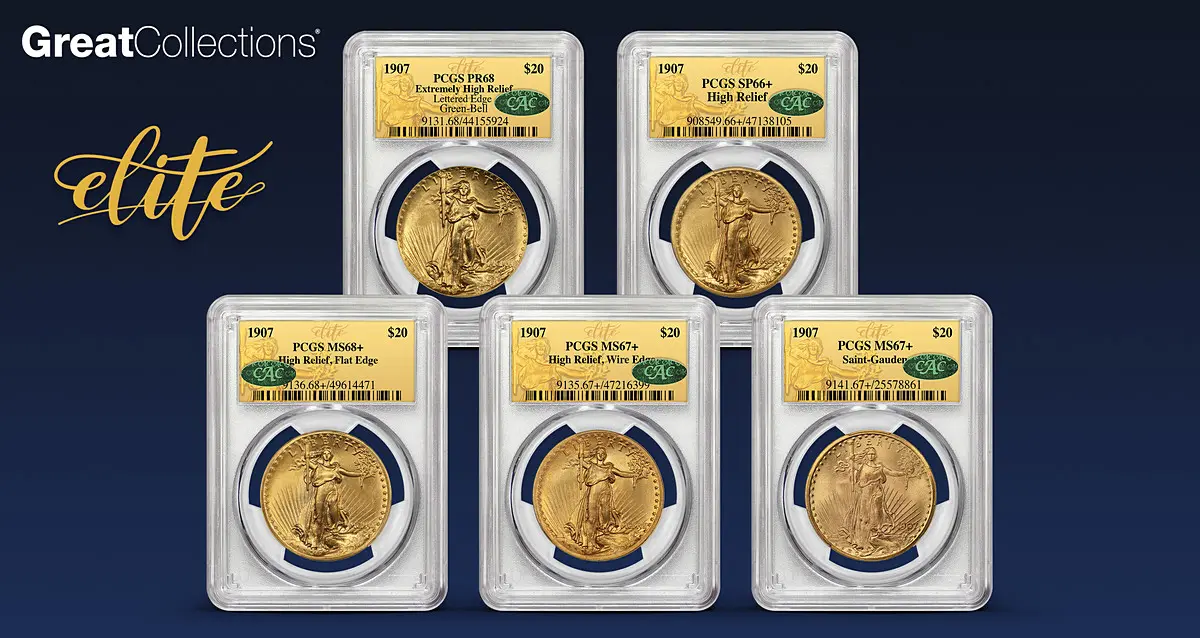
GreatCollections will display five extraordinary 1907 Saint-Gaudens Double Eagles from the Elite Collection during the Great American Coin & Collectibles Show (GACC) in Rosemont, Illinois. GreatCollections values the five coins together at approximately $7 million.
The public show runs October 1-3, 2026, at the Donald E. Stephens Convention Center. Rosemont’s official events calendar confirms the show dates, while PCGS lists its attendance at the convention.
The exhibit starts with Saint-Gaudens’ spectacular Extremely High Relief concept. Then it moves through the celebrated MCMVII High Relief coins and ends with the lower-relief Arabic Numerals version that the Mint could produce in quantity.
In effect, the display tells the story of how one of America’s greatest coin designs moved from sculpture to circulating money.
Roosevelt, Saint-Gaudens, and an American Coinage Renaissance

President Theodore Roosevelt personally asked Augustus Saint-Gaudens to help transform American coinage. Roosevelt wanted U.S. coins to convey the artistic strength and classical character he admired in ancient Greek coinage.
The U.S. Mint confirms that Roosevelt personally commissioned Saint-Gaudens to redesign the $20 Double Eagle and $10 Eagle.
Saint-Gaudens gave the Double Eagle an unusually sculptural design.
On the obverse, Liberty strides forward with a torch in her right hand and an olive branch in her left. The U.S. Capitol appears behind her. On the reverse, an eagle flies above the rising sun. Saint-Gaudens placed E PLURIBUS UNUM on the edge rather than crowding the principal designs.
However, turning Saint-Gaudens’ vision into a practical circulating coin created major problems.
The Mint’s equipment could not efficiently produce the deep relief that Roosevelt and Saint-Gaudens wanted. Therefore, officials repeatedly modified the design during 1907. The Mint eventually reduced the relief and replaced the Roman-numeral date MCMVII with the Arabic date 1907.
The five coins coming to Rosemont capture that evolution.
Ultra High Relief Proof-68 Leads the $7 Million Exhibit
The centerpiece ranks among the most celebrated 20th-century U.S. gold coins.
The 1907 Extremely High Relief, Lettered Edge Double Eagle carries a grade of PCGS Proof-68 with CAC approval.
Collectors commonly call the issue the Ultra High Relief.
PCGS currently estimates that only about 15 Lettered Edge examples survive. Its Price Guide lists the Extremely High Relief Lettered Edge as PCGS number 9131.
This particular coin also carries exceptional provenance. It passed through the collections of Colonel E.H.R. Green and J.F. Bell before later entering the Bob R. Simpson Collection. GreatCollections acquired the coin in a $4.75 million private transaction in 2021. At that time, it graded PCGS Proof-68 and carried CAC approval.
The Elite Collection now owns the coin. Its collection inventory confirms certification number 44155924 and the Proof-68 CAC grade.
GreatCollections President Ian Russell described the Ultra High Relief as a coin that makes a lasting impression when viewed in person.
That reaction comes easily to understand. The Extremely High Relief represents Saint-Gaudens’ concept before the demands of high-speed coin production forced the Mint to flatten much of its sculptural depth.
Wire Edge and Flat Edge High Reliefs Show the Mint at Work
The exhibit then moves to two great MCMVII High Relief varieties.
The 1907 MCMVII High Relief Wire Edge grades PCGS MS-67+ CAC.
The 1907 MCMVII High Relief Flat Edge grades an extraordinary PCGS MS-68+ CAC.
The Elite Collection’s published inventory confirms both coins and grades.
These two varieties also reveal something important about the mechanics of coin production.
The so-called Wire Edge developed when metal flowed into the narrow space where the die and collar met. Mint adjustments to the collar largely eliminated that raised fin of metal and produced the scarcer Flat Edge configuration.
The distinction may sound minor. However, it documents the Mint’s continuing effort to make Saint-Gaudens’ difficult design work.
The Mint ultimately struck 12,367 MCMVII High Relief Double Eagles before moving to a still lower-relief version.
Moreover, the exceptional condition of the two Elite Collection coins allows viewers to study the deep modeling and fine details with little interference from circulation wear or heavy contact marks.
Russell calls the Saint-Gaudens Double Eagle one of the most beautiful coins ever created and says these particular coins rank among the finest survivors of their respective varieties.
From Roman Numerals to a Coin the Mint Could Mass-Produce
The fourth major step appears in the 1907 Arabic Numerals Double Eagle, graded PCGS MS-67+ CAC.
By late 1907, the Mint needed a version that normal coining presses could strike efficiently. Chief Engraver Charles E. Barber therefore reduced the relief substantially. The Mint also abandoned the Roman-numeral MCMVII date in favor of 1907.
The Philadelphia Mint struck 361,667 of these lower-relief coins during 1907. The Mint released them into circulation in December.
Although the new version sacrificed some of Saint-Gaudens’ sculptural depth, it solved the production problem. The basic lower-relief format then carried the series forward.
The Elite Collection inventory confirms its MS-67+ CAC Arabic Numerals example.
Therefore, this one exhibit lets collectors compare the breathtaking but impractical original concept with the version that finally worked on a production floor.
An Unusual Specimen High Relief Completes the Group
A fifth coin adds another level of interest.
The collection will display a 1907 High Relief PCGS Specimen-66+ CAC.
PCGS uses a Specimen designation rather than the conventional Mint State designation for this unusual special striking. The Elite Collection inventory identifies the coin as PCGS SP-66+ CAC, certification number 47138105.
Together, the five coins form an unusually concentrated study of the Mint’s most famous gold-coin experiment of 1907.
Elite Collection Brings Five of Its Great Saints to Rosemont
The five coins come from the Elite Collection, a collection that has long occupied the top position in competitive Saint-Gaudens collecting.
The collection previously assembled a 61-coin Saint-Gaudens set containing 53 circulation strikes and eight proofs. At the time of its 2023 public exhibition, GreatCollections reported that 35 coins ranked either finest known or tied for finest. The set also held the number-one position in its PCGS Set Registry category.
The collection has since grown far beyond the Saint-Gaudens series.
Its most famous coin remains the 1933 Saint-Gaudens Double Eagle, the only example that private collectors can legally own. The coin sold at Sotheby’s in June 2021 for $18,872,250, setting the public-auction record for a coin. PCGS subsequently certified it MS-65, and CAC approved it.
GreatCollections currently values that 1933 Double Eagle at more than $30 million, according to the company.
The Elite Collection inventory confirms that the 1933 remains part of the collection.
A Rare Chance to See the Birth of a Classic
GreatCollections founder and president Ian Russell said the firm considers it an honor to exhibit the five coins at the GACC Show.
GACC producer Larry Shepherd also thanked Russell, Andy Wedding, the GreatCollections staff, and the anonymous owner of the Elite Collection for making the display possible.
For collectors, however, the real attraction extends beyond the $7 million valuation.
These five coins document a remarkable moment at the U.S. Mint.
One shows Saint-Gaudens’ design close to its most ambitious sculptural form. Two others show the Mint wrestling with the physical consequences of that relief. Another presents an unusual special striking. Finally, the Arabic Numerals coin shows the compromise that turned Roosevelt and Saint-Gaudens’ artistic experiment into a practical circulating $20 gold piece.
Few exhibits can show the evolution of a great American coin so clearly.
And few can do it with five coins of this caliber.





Nice, Just like to see them.
Beautiful set
These are absolutely amazing. I would really love to see them in person!
I can’t even imagine what it would feel like to own these!
Just to look at them.
1933… government shenanigans
Awesome
Roman numerals on a u.s. coin!!
GREAT set of coins !!!!!
(My birthday is in March!) Hint, Hint
I would have loved to see these coins!
I would like just one!
I would kike just one!
WOW!
Interesting
Amazingly beautiful coins with a very interesting history behind them!
Very beautiful coins! I won a medal in HS that was called the Saint Gauden’s Medal, and I’ve cherished it!
Beautiful coins!
Wow ! Just Wow !
I really do love the gold coins, and these are so well done!
Wow! What absolutely stunning coins!!!
They are the finest beautiful gold coins ever .I would be honored to own one today.!!!
How very beautiful!!I would love to own one.
My favorite.
What a dream come true just to see.
looks absolutely awesome – thanks
Another great article!
nice looking coins
Beautiful coins I’d love to own!!
Stunning set!
WOW WOW WOW WOW! This would be amazing to have in my safe!
Just to see them
I would settle for an old scratched up common date pocket change double eagle.
Beautiful coins, would love to own them. I have 1 1924 ms61 $20 St. Gaudens. Not quite as nice or rare as these