Two Mint Letters Finally Solve the 1917 Half Dollar Mintmark Mystery
Collectors often ask one question about the 1917 Walking Liberty Half Dollar: Why did the United States Mint move the mintmark?
Over the years, collectors and writers have offered many explanations. Some relied on speculation. Others added invention and bluster. However, two recently digitized U.S. Mint letters now provide a clear answer.
The letters come from U.S. Mint correspondence preserved in National Archives Record Group 104. The Newman Numismatic Portal made the records available online. Together, they document both the verbal order and the reason behind it.
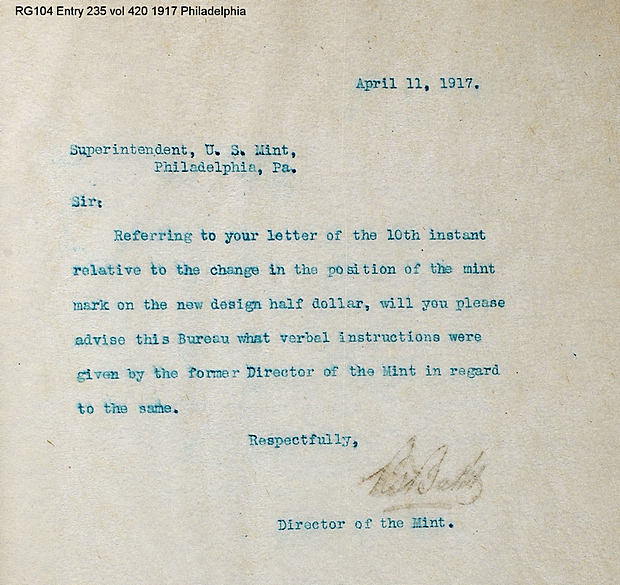
April 11, 1917, letter from Mint Director Raymond T. Baker asking about former Mint Director F.J.H. von Engelken’s verbal instructions.
The First Letter Confirms a Verbal Order
On April 11, 1917, Mint Director Raymond T. Baker wrote to the superintendent of the Philadelphia Mint.
Baker referred to an earlier letter dated April 10. He then asked the superintendent to explain the verbal instructions that former Mint Director Friedrich Johannes Hugo von Engelken had given concerning the mintmark on the new half dollar.
Therefore, the first letter establishes an important fact. Von Engelken had issued his instructions verbally. The Mint Bureau did not yet have a written order in its records.
Why Von Engelken Wanted the Mintmark Moved
Two days later, on April 13, Baker placed the decision into the official record.
Baker confirmed von Engelken’s order to transfer the mintmark from the obverse of the Walking Liberty Half Dollar to the reverse. More importantly, he recorded the former director’s reason.
According to the letter, the mintmark in its original position “had the appearance of a defect in the die” and “was entirely too prominent.”
That direct statement ends the mystery. Von Engelken did not order the change because of striking problems, artistic balance, or production efficiency. Instead, he believed the obverse mintmark looked like a die defect and distracted from the design.
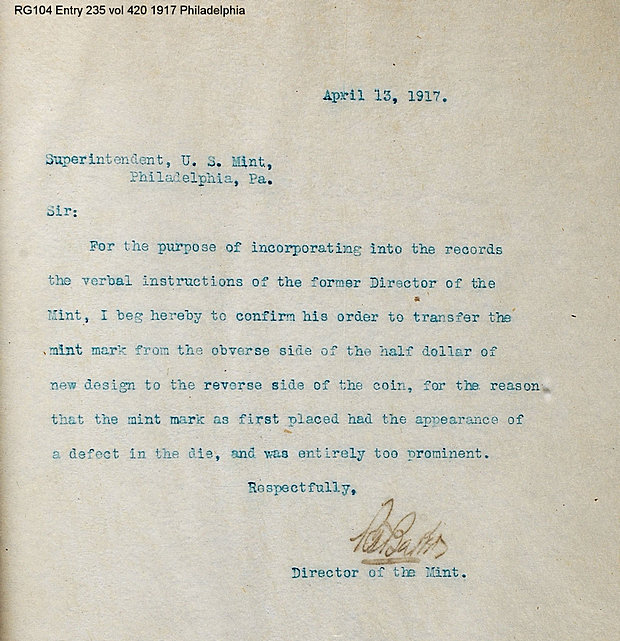
April 13, 1917, letter confirming von Engelken’s order and recording his reason for moving the mintmark.
The Change Spanned Two Mint Directors
Von Engelken served as Director of the Mint from September 1916 through March 1917. Therefore, he directed the Mint only during the latter half of the half dollar’s design process.
Nevertheless, Mint officials approved the hubs and dies during his tenure. The Mint also struck the first 1916-dated Walking Liberty halves in December of that year.
However, von Engelken left office before Mint employees completed the mintmark change. Raymond T. Baker succeeded him in March 1917 and remained director until March 1922.
As a result, one director ordered the change, while his successor documented it and carried it forward.
A Visible Change on the 1917 Walking Liberty Half Dollar
The Mint originally placed the Denver “D” and San Francisco “S” mintmarks on the obverse. The mark appears below IN GOD WE TRUST, behind Liberty.
Later in 1917, Mint employees moved the mark to the lower-left portion of the reverse, near HALF DOLLAR. Consequently, collectors can find both 1917-D and 1917-S Walking Liberty halves with either an obverse or reverse mintmark.
That change gives the 1917 half dollar an unusual place in the series. More importantly, the surviving correspondence replaces long-standing speculation with direct documentary evidence.
The Mint moved the mintmark because Director von Engelken thought the original placement looked like a defect and drew too much attention. Two brief letters now preserve the complete answer.
Roger W. Burdette
Copyright 2026. All rights reserved.