


A Tiny 1820 Manila Copper Coin With a Huge Spanish Colonial Story
An 1820 Philippines Octavo should not stop traffic. It measures only about 17 to 18 millimeters. It carries a value of just 1/8 real. And, in most grades, this small copper coin tells its story quietly.
This one does not.
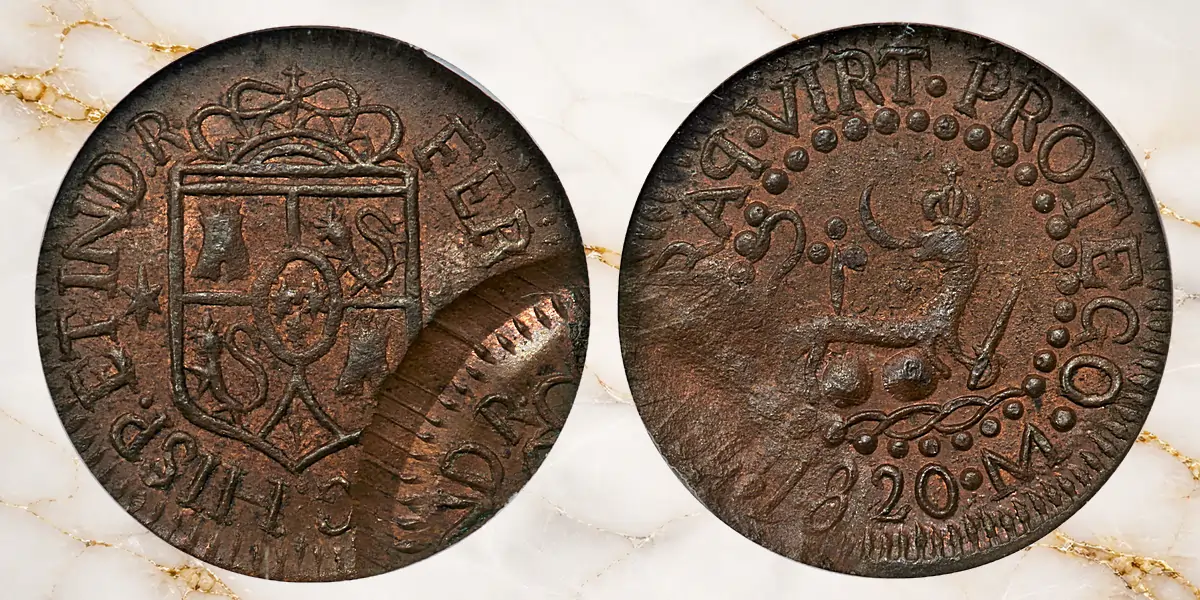
The 1820 Philippines Octavo offered by Heritage Auctions is a Gem Mint State survivor from the Spanish colonial period. Even better, it carries a dramatic double strike. That combination turns a humble copper minor into a world-class conversation piece.
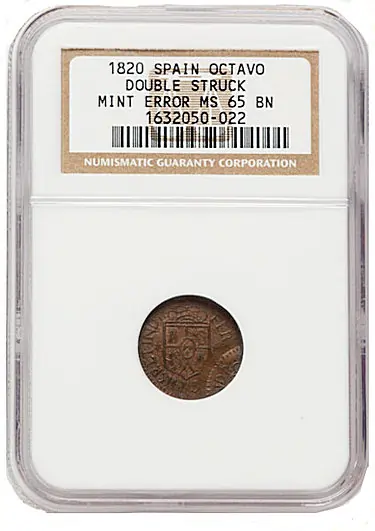
Heritage sold the coin on June 18, 2026, in its HKINF World & Ancient Coins Platinum Session and Signature Auction in Hong Kong. The coin, certified MS65 Brown by NGC, came from the Mahal Collection of Spanish and U.S. Philippines Coins, Part XIII.
For collectors of the Philippines, Spanish colonial coinage, or mint errors, this coin checks every box. It has history, rarity and gem condition. Then, it adds one more thing: a striking mishap that the eye can see immediately.
A Gem From a Crude Series
The 1820 Philippines Octavo belongs to a short-lived copper type struck from 1820 through 1830. It circulated as 1 octavo, equal to 1/8 real. In daily use, coins like this handled the smallest transactions in Spanish Manila.
Collectors know the type as KM-8. Heritage cataloged the coin as Cal-80 and Basso-23. The piece carries the M-F attribution and belongs to the Manila mint series. It was brought to our attention in a MintErrorNews Article
At first glance, the design looks simple. However, it says a great deal.
The obverse shows the crowned Spanish coat of arms, flanked by stars. Around it runs the royal legend of Ferdinand VII, King of Spain and the Indies. The reverse shows a crowned lion holding a sword above two globes and waves within a beaded circle.
That image matters. The coin does not show Ferdinand’s portrait. Instead, it shows empire. It shows royal authority. It also shows Spain’s claim to both hemispheres at a time when that claim had started to break apart.
The Double Strike That Changes Everything
Mint errors on early copper minors often attract attention. However, this 1820 Philippines Octavo moves beyond normal error appeal.
The double strike appears clearly in the lower portion of the flan. It gives the coin movement. It also gives the viewer a rare look at the striking process at a colonial mint.
Most octavos from this issue show weakness, roughness, or uneven detail. That makes sense. These coins had a job. They served commerce, not collectors. They passed through tropical conditions, humid air, and hard circulation. As a result, high-grade survivors rarely appear.
This example survived all of that. More importantly, it survived with Gem surfaces.
Heritage described the coin as the finest certified grade available between NGC and PCGS for the denomination. The firm also called it the finest certified copper minor denomination made for and in the Philippines. That statement gives the coin reach beyond one date, one type, or one error category.
It stands at the top of a much larger colonial copper field.
The Mahal Collection Pedigree
The Mahal Collection adds another layer.
Over multiple Heritage offerings, the Mahal Collection has brought remarkable Spanish and U.S. Philippines coins into the market. Serious collectors have followed the series because it combines depth, quality, and specialization.
This 1820 double-struck Octavo came from Part XIII of that collection. Another important 1820 Octavo from the Mahal Collection sold earlier. On December 6, 2025, Heritage sold a PCGS MS64 Red and Brown example for $15,600 in Hong Kong. Heritage described that piece as the sole highest graded example of the date-type at PCGS and tied with one other at NGC.
That December result shows the power of color, preservation, and pedigree in this series. It also shows how aggressively collectors can chase elite Philippines copper when the right coin appears.
The MS65 double-struck coin followed a different path. It realized $6,100 on June 18, 2026. On paper, that may surprise some collectors. After all, the coin grades higher and carries a major error. Yet auction results often reflect timing, bidder depth, color designation, and the specific tastes of the room.
Even so, the number does not shrink the coin’s importance. If anything, it makes the piece more interesting. It reminds collectors that rarity and price do not always travel in a straight line.
Ferdinand VII and a Shrinking Empire
The 1820 date places this octavo in a tense moment.
Ferdinand VII had returned to power after the Napoleonic upheaval. Spain, however, no longer commanded the world with the same confidence it had held in earlier centuries. Revolts and independence movements spread across Spanish America. Then, in 1821, Mexico gained independence.
That change mattered greatly for the Philippines.
For generations, Manila had looked across the Pacific to New Spain. The Manila galleon tied the Philippines to Acapulco, Mexico, and the wider Spanish American economy. Silver moved west. Asian goods moved east. People, faith, military supplies, and imperial orders followed the same route.
After Mexico broke from Spain, Madrid governed the Philippines more directly. The islands became even more important as Spain’s American empire collapsed. The Philippines remained one of Spain’s last major overseas possessions.
That is the world behind this tiny copper coin.
An octavo did not move in royal salons. It moved in markets, sat in pockets, paid for food, candles, transport, and the small exchanges that kept Manila alive. Therefore, the coin connects grand imperial history to ordinary colonial life.
A Small Coin With Two Stories
The best coins tell more than one story. This one tells several.
First, it tells the story of Spanish authority in Asia. Ferdinand VII never visited the Philippines. Yet his name circled the coin’s rim. Every octavo carried his claim into daily commerce.
Second, it tells the story of Manila after Mexico’s independence. Spain still ruled the islands, but the old Pacific system had changed. The coin belongs to that transition.
Third, it tells the story of survival. Copper does not forgive neglect. Humidity, circulation, and rough handling usually punish early Philippine minors. This coin escaped those fates.
Finally, it tells the story of a mint error. The double strike freezes a production mistake that would have passed unnoticed in 1820. Two centuries later, that same mistake gives the coin much of its trophy status.
Why Collectors Should Care
Collectors often chase large silver coins and gold rarities from the Spanish colonial world. That makes sense. They offer size, weight, and instant visual appeal.
However, copper minors often carry the most intimate history. They show how people actually spent money. They also show how empire worked at street level.
This 1820 Philippines Octavo takes that humble foundation and adds elite condition. Then, it adds a dramatic error. Few coins from the Spanish Philippines can match that blend.
For a Philippines specialist, it represents a top-tier copper minor. But for an error collector, it offers a 19th-century colonial double strike in Gem Mint State. And for a world coin collector, it captures the twilight of Spain’s old Pacific system in one small piece of copper.
That is why this coin matters.
It may measure less than an inch across. Yet it carries the weight of empire, commerce, survival, and chance.
Coin Specifications
- Country: Philippines, Spanish Colony
- Ruler: Ferdinand VII
- Date: 1820
- Denomination: 1 Octavo, equal to 1/8 Real
- Mint: Manila
- Composition: Copper
- Diameter: About 17 to 18 mm, depending on catalog reference
- Catalog References: KM-8, Cal-80, Basso-23
- Grade: NGC MS65 Brown
- Error: Double Struck
- Pedigree: Mahal Collection of Spanish and U.S. Philippines Coins, Part XIII
- Auction: Heritage Auctions, 2026 June 17-19 HKINF World & Ancient Coins Platinum Session , Hong Kong, Lot 35001
- Price Realized: $6,100, June 18, 2026




always something amazing here…..wonderful history indeed
Amazing error coin! Always room in my collection for another error.
Great history lesson. I often hear of U.S. mint errors but seldom of non-U.S. coinage mint errors. A great historical piece with extraordinary condition.