


Rome’s Wildest Ancient Coins Were Minted During an Imperial Meltdown
Rome did not fall in 260 CE. However, it came close enough to terrify anyone who could read the signs.
The empire staggered through the Crisis of the Third Century, a brutal half century of civil war, foreign invasion, plague, inflation, and political collapse that ran from 235 to 284 CE [1]. Then disaster struck at the top. The Persian ruler Shapur captured Emperor Valerian after the Battle of Edessa in 260. Ancient writers later added grisly stories about Valerian’s captivity, including the famous tale that Shapur used him as a footstool [2].
That left Valerian’s son, Gallienus, with a poisoned crown.
Gallienus ruled alone from 260 until his assassination in September 268 . He faced breakaway provinces, military rivals, frontier chaos, and a money system under severe pressure. Yet from that storm came one of the most charming and collectible coin groups of the Roman Empire.
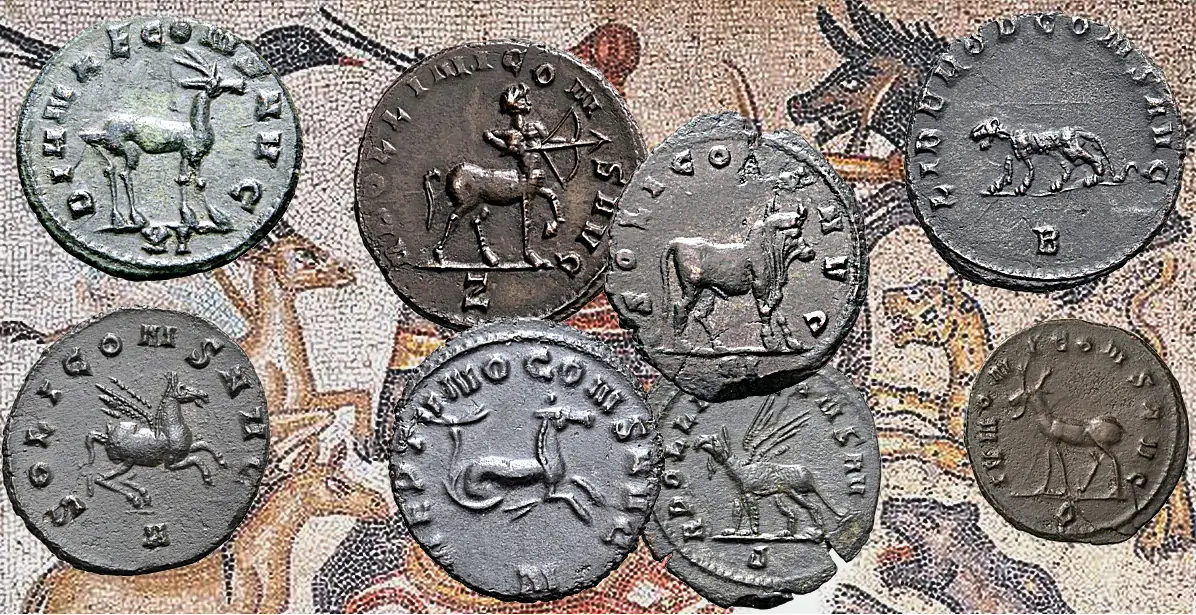
Collectors call it the Zoo Coinage of Gallienus.
These coins do not merely show animals. They show Rome begging the old gods for help.
A Coin Series Built Like a Prayer
Late in his reign, Gallienus issued a remarkable series of antoniniani that paired protective deities with real and mythical creatures. The reverse legends often end with CONS AVG, short for Conservator Augusti, or “Preserver of the Emperor.”
That phrase gives the series its meaning.
Gallienus did not strike a random animal parade. Instead, he placed Diana, Apollo, Sol, Jupiter, Liber Pater, Neptune, Mercury, Hercules, and Juno on the side of the imperial house. The animals served as divine companions, emblems, or mythological clues. Together, they turned pocket change into religious propaganda.
The timing also matters. In the third century, Rome’s traditional religious order faced pressure from Eastern mystery cults and Christianity. Therefore, Gallienus leaned into the old gods. He put their animals into circulation by the millions and sent them into army camps, markets, and provincial purses.
The result still works. These coins remain affordable, visually strong, and full of personality. Better still, they tell a story that begins in myth and ends in imperial survival.
Diana and the Swift Animals of the Hunt
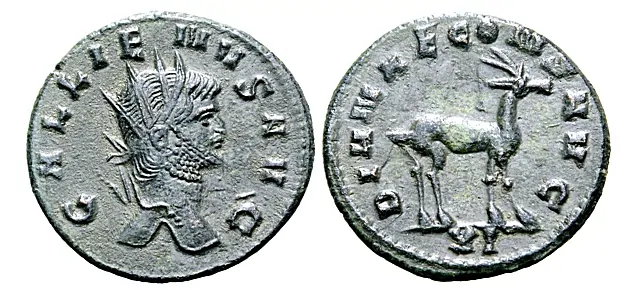
That uncertainty adds charm. The ancient engraver did not need a modern zoology label. He needed the viewer to see speed, grace, and the goddess of the hunt.
Diana types rank among the most common Zoo Series coins. In some hoards, they may account for a large share of the total. As a result, they make a natural starting point for collectors .
Apollo’s Centaur: Healing, Archery, and Myth
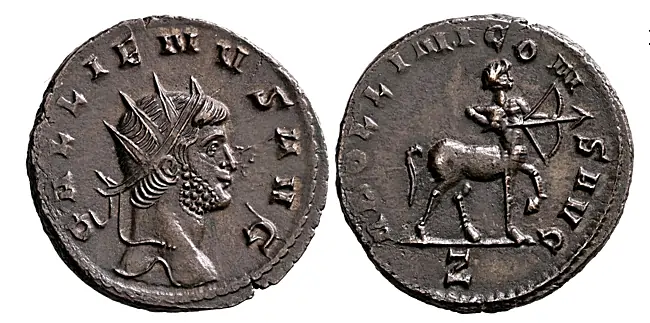
Apollo brought several powers to the Roman imagination. He healed and prophesied. He shot arrows and also belonged to a world where myth and medicine often overlapped.
That makes the centaur a strong companion. Centaurs had the upper body of a man and the body of a horse. Ancient storytellers often associated them with wild strength, but some centaurs also carried wisdom and healing knowledge.
On Gallienus’ coin, the centaur carries a bow and arrow [4]. That detail links the creature directly to Apollo’s role as an archer. It also gives the type one of the most animated designs in the series.
Apollo’s Griffin: A Guardian With Teeth and Wings
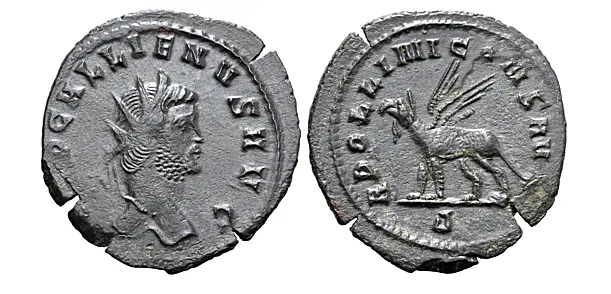
Apollo also appears with the griffin, one of antiquity’s great hybrid beasts [5].
The griffin combines the body of a lion with the head and wings of an eagle. That pairing matters. The lion ruled the beasts. The eagle ruled the sky. Together, they created a guardian creature with royal force and divine reach [6].
By the Middle Ages, writers imagined griffins as guardians of treasure . However, the idea reaches deep into classical antiquity. On the coinage of Gallienus, the griffin guards something even more valuable than gold: the hope that Apollo still protects the emperor.
Pegasus, Sol, and the Power of the Sun
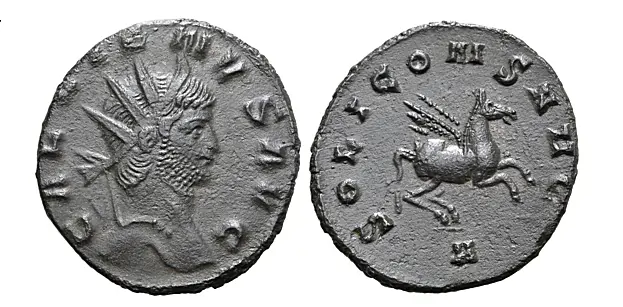
Few mythical creatures travel better on coins than Pegasus. The winged horse appeared often on ancient coinage long before Gallienus [7].
On the Zoo Series coin, Pegasus belongs to Sol, the Unconquered Sun [9]. The pairing creates an image of light, ascent, and divine motion. It also fits the military atmosphere of the age. Sol appealed strongly to Roman soldiers, and Gallienus needed soldiers more than almost anything else [10].
Pegasus may also have carried a regimental echo. Four Roman legions used Pegasus as an emblem, including Legio II Adiutrix, a unit associated with Gallienus’ military world [8].
So this coin works on several levels. It shows myth, honors Sol and may also speak to army loyalty.
The Bull of Sol
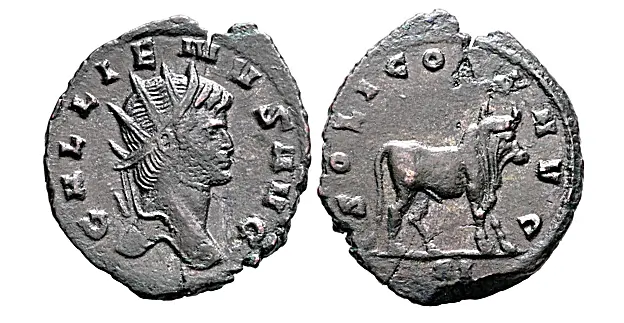
The bull gives Sol a different kind of power.
Where Pegasus rises, the bull stands firm. It speaks of force, fertility, sacrifice, and endurance. Bulls appeared often on ancient coins because ancient viewers immediately understood the symbol.
On Gallienus’ coin, the bull invokes Sol as the emperor’s protector [11]. In a period of fractured authority, the message needed no poetry. Rome needed strength. The bull supplied it.
Jupiter’s Goat and the Memory of Amalthea
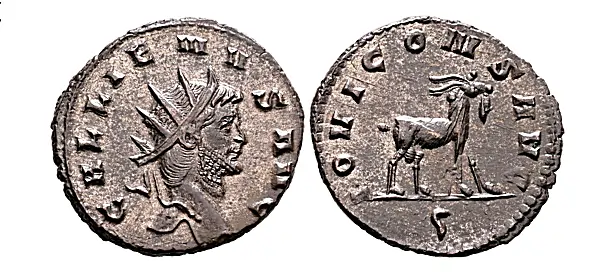
At first, Jupiter’s goat may seem odd. Why would the king of the gods appear with such a humble animal?
Myth gives the answer. As an infant, Jupiter survived because the goat Amalthea nursed him. Therefore, the goat recalls rescue, nourishment, and divine preservation.
The inscription IOVI CONS AVG means “to Jove, Preserver of the Emperor” [12]. That turns the type into a clever appeal. Gallienus asked the once-protected god to protect him in turn.
The myth left a later mark as well. A small moon of Jupiter, discovered in 1892, carries the name Amalthea.
Liber Pater’s Panther, Leopard, or Tiger
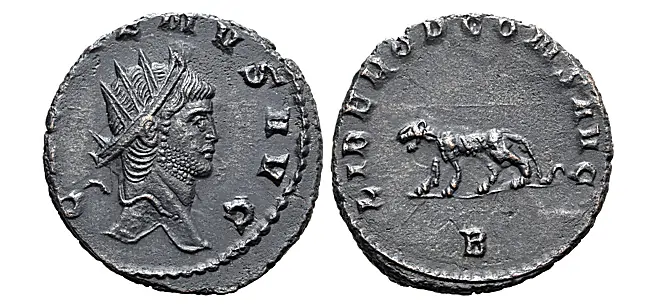
His animal on the Zoo Series coin usually appears as a panther, although some catalogs call it a tiger or leopard [14]. That disagreement makes sense. Ancient die cutters worked at small scale, and the animal’s sacred meaning mattered more than its exact species.
The reverse legend reads LIBERO P CONS AVG, or “to Liber Pater, Preserver of the Emperor”. In a world under stress, Gallienus even enlisted the god of wine and liberation.
Neptune’s Hippocamp
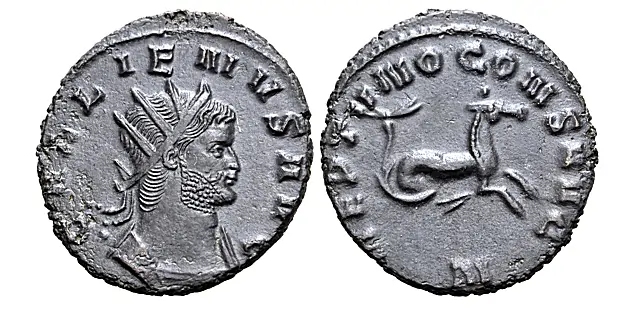
Neptune’s creature brings the sea into the series.
The hippocamp has the forepart of a horse and the tail of a sea serpent or fish. It moves through water as Pegasus moves through the air. On Gallienus’ coin, it invokes Neptune, god of the sea [15].
The creature also gives American collectors a surprising connection. Charles Barber placed a hippocamp on the obverse of the 1915 Panama-Pacific gold quarter eagle. There, Columbia rides the sea-horse as a symbol of American power and the Panama Canal era [16].
So a tiny third-century antoninianus can point forward to a classic United States commemorative gold coin.
Mercury’s Criocamp: The Oddest Beast in the Zoo
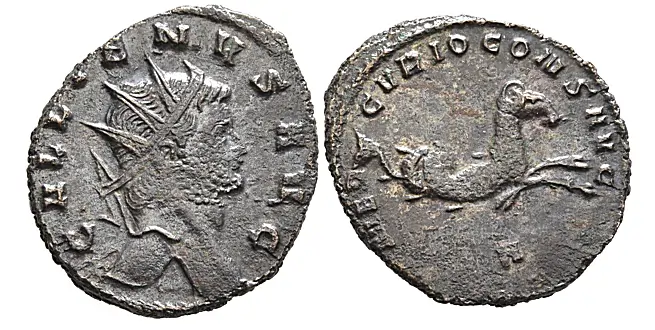
The criocamp may be the strangest creature in the entire Zoo Coinage of Gallienus.
It has the front of a ram and the tail of a sea serpent. In ancient coinage, the type stands out as a true rarity. Gallienus’ issue gives this creature its most famous appearance, paired with Mercury, messenger of the gods [17].
That pairing works. Mercury crossed borders. He moved between gods, mortals, merchants, roads, and the underworld. A hybrid creature suits a god who never stayed in one place.
For modern collectors, the criocamp offers the exact mix that makes ancient coins addictive: rarity, mystery, and a design that starts conversations.
Hercules and the Lion
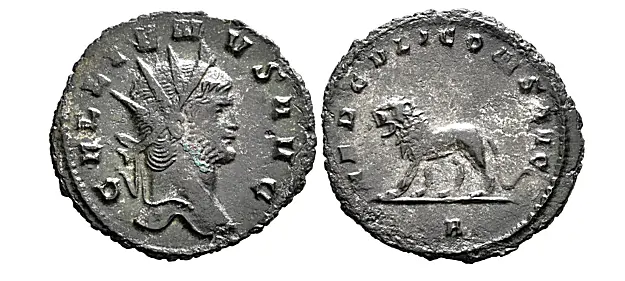
Hercules needed no introduction to Roman viewers. His labors gave artists and coin engravers a deep library of images.
The lion points to the Nemean Lion, the monstrous beast Hercules killed and skinned. He then wore its magical hide as armor [18]. On Gallienus’ coin, the lion invokes Hercules as protector of the emperor .
The lion ranks among the rarest animals in the Zoo Series [19]. It also carries one of the clearest messages. Hercules defeated a monster no ordinary weapon could kill. Gallienus needed that kind of divine muscle.
Hercules and the Boar
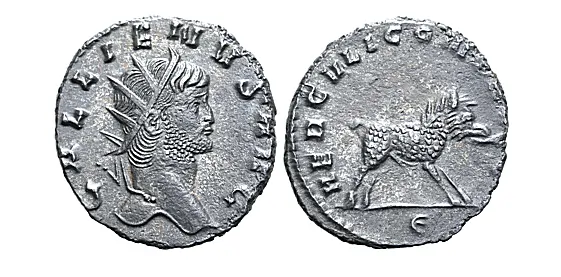
This type recalls the Erymanthian Boar, another savage creature from the hero’s labors [20]. On the coin, the shaggy animal runs right while the legend calls on Hercules to preserve the emperor [21].
The boar may lack the elegance of Pegasus or the weird appeal of the criocamp. However, it brings raw force. In the third century, raw force mattered.
Salonina, Juno, and the Imperial House
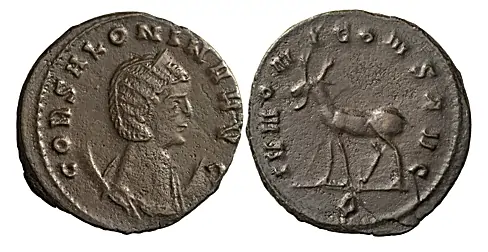
Cornelia Salonina, the wife of Gallienus, also belongs in the Zoo Series story.
She bore three sons: Valerian II, Saloninus, and Marinianus. Her fate after Gallienus’ assassination remains uncertain. She may have survived, or she may have died in the purge that followed .
Salonina’s Zoo Series coin invokes Juno, queen of the gods. That choice fits an empress. However, the animal surprises collectors. Juno usually appears with a peacock, yet this coin shows a goat [22].
The goat may echo Amalthea, or it may preserve a religious association now difficult to recover. Either way, the coin expands the series beyond Gallienus himself. It turns the animal coinage into a dynastic appeal. The gods must protect the emperor, the empress, and the future of the house.
Can Collectors Build a Complete Zoo?
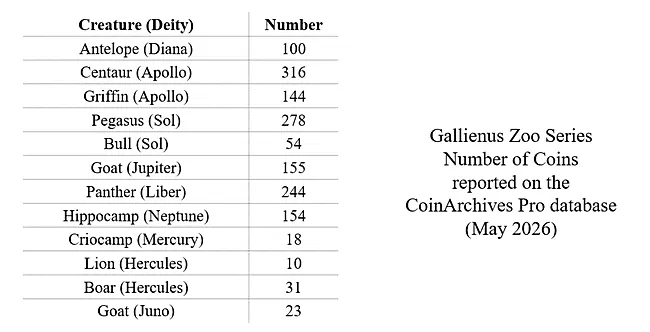
Yes, and that makes the Zoo Coinage of Gallienus unusually satisfying.
A collector can build a basic deity set with nine coins: Diana, Apollo, Sol, Jupiter, Liber Pater, Neptune, Mercury, Hercules, and Juno. A more ambitious collector can chase the major animal types, including the Diana animals, Apollo’s centaur and griffin, Sol’s Pegasus and bull, Hercules’ lion and boar, and Mercury’s criocamp.
The standard printed reference remains The Roman Imperial Coinage, Volume V, Part 1, by Harold Mattingly and Edward Sydenham. David Sear’s Roman Coins and Their Values III also remains useful for collectors. More specialized students should consult R.D. Weigel’s “Gallienus’ Animal Series Coins and Roman Religion” and the modern reference Gallienus Antoniniani by Frank Reinhardt, José de Sousa, and Heidemarie Bieker.
Many common Zoo Series coins trade in solid collector grades for modest prices. Auction records from recent years show Diana, Apollo, Sol, Liber Pater, Neptune, Jupiter, and Juno types selling at accessible levels, while rarer types such as the lion, boar, centaur, and criocamp bring stronger competition.
You Tube video by Classical Numismatics – “Zoo Series” of Gallienus, a curious commemorative series struck during some of the worst years of the third century crisis.
As with most antoniniani of the period, original silvering matters. So do centering, strike, surface quality, and a clear reverse animal. A dark, rough, or off-center piece may cost little. A sharp, fully silvered example with a complete animal can command a premium.
That price range gives the series its magic. A beginner can start with Diana. A specialist can spend years chasing varieties.
Why the Zoo Coinage of Gallienus Still Matters
The Zoo Coinage of Gallienus works because it does more than decorate history.
It brings the Crisis of the Third Century down to the size of a coin, and shows a frightened empire reaching backward to older gods. It shows an emperor using every tool he had, including small silver-washed coins, to insist that Rome still had divine protection.
Diana runs through the woods. Apollo sends the centaur and griffin. Sol rises with Pegasus and the bull. Jupiter remembers rescue through Amalthea. Liber Pater arrives with a sacred cat. Neptune sends a sea-horse. Mercury claims the bizarre criocamp. Hercules answers with the lion and boar. Juno stands beside Salonina and the imperial family.
Then the coins pass from hand to hand.
That is the real power of the series. Nearly 1,760 years later, collectors still hear the message. Rome had cracked. The emperor had enemies. The money had weakened. The gods seemed distant.
Yet on these coins, the animals still ran.
Citations
1 https://en.wikipedia.org/wiki/Crisis_of_the_Third_Century
2 https://en.wikipedia.org/wiki/Gallienus
3 Roma E-Sale 57, May 30, 2019, Lot 1004, realized $76
4 Leu Auction 19, October 18, 2025, Lot 259, realized $755
5 Roma E-sale 116, January 18, 2024, Lot 922, realized $70
6 https://en.wikipedia.org/wiki/Griffin
7 https://coinweek.com/when-horses-flew-pegasus-on-ancient-coins/
8 https://en.wikipedia.org/wiki/Legio_II_Adiutrix
9 Roma E-Sale 117, February 22, 2024, Lot 1039, realized $107
10 https://en.wikipedia.org/wiki/Sol_Invictus
11 Leu Web Auction 38, December 13, 2025, Lot 1623, realized $164
12 Leu Web Auction 38, December 13, 2025, Lot 1622, realized $189
13 https://en.wikipedia.org/wiki/Liber
14 Roma E-sale 118, April 8, 2024, Lot 1431, realized $57
15 Roma E-Sale 100, July 22, 2022, Lot 1230, realized $102
16 https://coinweek.com/hippocampus-strange-mythical-creature-on-a-u-s-coin/
17 Leu Web Auction 20, July 16, 2022, Lot 2710, realized $123
18 https://en.wikipedia.org/wiki/Nemean_lion
19 Leu Web Auction 24, December 3, 2022, Lot 3098, realized $383
20 https://en.wikipedia.org/wiki/Erymanthian_boar
21 Roma E-Sale 107, March 16, 2023, Lot 1126, realized $509
22 Harlan J. Berk, Sale 214, February 18, 2021, Lot 282, realized $120




Interesting pairing of gods and animals. Even a god I didn’t know.