


The complete story of the 1995 Civil War Battlefield Commemorative Coin Program
Congress created the 1995 Civil War Battlefield Commemorative Coin Program to help save historic ground. Lawmakers envisioned an ambitious national fundraiser. They authorized 3.3 million coins and a potential $21.5 million in surcharges.
However, collectors had already grown tired of expensive commemorative programs. Demand collapsed. In the end, buyers purchased only about one-third of the authorized coins.
That failure created an unexpected numismatic legacy.
Today, the 1995-P Civil War Silver Dollar and the 1995-W Civil War Gold $5 rank among the lowest-mintage uncirculated modern commemoratives. Yet the program’s real story reaches far beyond those figures. It involves endangered battlefields, bipartisan politics, collector resistance, aggressive Mint marketing, and a major accounting trap that still causes inaccurate mintage totals.
Fact-Check Alert: The Published Total of 1,000,483 Coins Is Incorrect
Many accounts state that the United States Mint issued 1,000,483 Civil War Battlefield commemorative coins. That total does not count every physical coin.
The Mint’s historical sales table lists 893,468 individual commemorative products under “Total Coins.” It then lists 107,112 Prestige Sets under “Total Other.” However, each Prestige Set contained two Civil War commemorative coins: one Proof silver dollar and one Proof clad half dollar.
Therefore, collectors must add 214,224 physical coins from the Prestige Sets, not merely 107,112.
That calculation produces a corrected total of 1,107,692 physical Civil War Battlefield commemorative coins. The frequently cited 1,000,483 figure counts the Prestige Set silver dollars but overlooks the matching half dollars. It also repeats 330,002 as the standalone Proof half dollar total. In fact, the Mint reports 330,099 standalone Proof half dollars.
Corrected 1995 Civil War Battlefield Mintages
Denomination and Finish Maximum Authorized Final Sales-Based Mintage
- Total Half Dollars 2,000,000 556,731
- 1995-S Clad Half Dollar, Uncirculated Part of 2,000,000 maximum 119,520
- 1995-S Clad Half Dollar, Proof Part of 2,000,000 maximum 437,211*
- Total Silver Dollars 1,000,000 482,980
- 1995-P Silver Dollar, Uncirculated Part of 1,000,000 maximum 45,866
- 1995-S Silver Dollar, Proof Part of 1,000,000 maximum 437,114*
- Total Gold $5 Coins 300,000 67,981
- 1995-W Gold $5, Uncirculated Part of 300,000 maximum 12,735
- 1995-W Gold $5, Proof Part of 300,000 maximum 55,246
Complete Program 3,300,000 1,107,692
*The Proof totals include 107,112 examples of each denomination packaged in Prestige Sets. The Mint published its final table in September 1996.
Collectors purchased only 33.57% of the coins that Congress authorized. Gold sales reached just 22.66% of the maximum. Half dollar sales reached 27.84%. Meanwhile, silver dollar sales performed best at 48.30%.
Why Congress Proposed a Civil War Battlefield Coin Program
The legislation did not commemorate one battle. Instead, it marked the 100th anniversary of the beginning of organized federal protection for Civil War battlefields.
By the early 1990s, development threatened many historic sites. Roads, subdivisions, shopping centers, and commercial construction placed intense pressure on battlefield land. President George H.W. Bush described those development pressures when he signed the legislation. He also promoted the coin program as a public-private funding tool that would not require a direct taxpayer appropriation.
The preservation need extended far beyond Gettysburg, Antietam, or Manassas. The congressionally created Civil War Sites Advisory Commission eventually studied 384 major conflict sites. It identified 50 battlefields that faced the most urgent preservation threats.
Federal funds could not purchase every endangered tract. Therefore, preservation leaders sought private money. Commemorative coin surcharges offered an attractive answer.
Congress directed the money to the nonprofit Civil War Battlefield Foundation. Some later accounts use the name Civil War Trust. However, the 1992 law and the Mint’s official records identify the recipient by its contemporary name, the Civil War Battlefield Foundation.
Bruce Vento Builds a Bipartisan Coalition
Representative Bruce Vento, a Minnesota Democrat and longtime preservation advocate, introduced H.R. 5126 on May 7, 1992.
Vento did not act alone. His original sponsors crossed party and regional lines. They included Ohio Republican Chalmers Wylie, New York Democrat Robert Mrazek, North Carolina Republican Charles Taylor, California Republican Randy “Duke” Cunningham, Indiana Democrat Lee Hamilton, North Carolina Republican Alex McMillan, and several lawmakers from states with strong Civil War connections.
The House passed the amended bill under suspension of the rules on July 1, 1992. The Senate approved it on September 19. President Bush signed the Civil War Battlefield Commemorative Coin Act as Public Law 102-379 on October 5, 1992.
Meanwhile, Senators Dale Bumpers, an Arkansas Democrat, and John Warner, a Virginia Republican, introduced the Senate companion bill, S. 2682. Their partnership reinforced the program’s bipartisan character.
Who Opposed the Civil War Coin Program?
The surviving official bill history does not show a major partisan fight over battlefield preservation. It records a quick House passage under suspension of the rules, Senate approval, and presidential signature. It also identifies no named member who led an organized campaign against H.R. 5126.
Therefore, descriptions of a bitter congressional battle over this specific bill can mislead readers.
The real political fight centered on the expanding commemorative coin system.
By the time the Civil War coins reached collectors in 1995, many buyers believed Congress had authorized too many programs. Critics also objected to high issue prices, unpopular subjects, large mintage ceilings, and a system that treated commemoratives as fundraising vehicles.
Some collectors had advocated a boycott since the late 1980s. Congress also worried about the flood of new programs. In 1992, it created the Citizens’ Commemorative Coin Advisory Committee to recommend themes and reduce proliferation. Then, in 1993, Congress recommended a limit of two commemorative programs per year unless an additional subject showed extraordinary merit.
The pressure increased in August 1994. Treasury Secretary Lloyd Bentsen asked Congress to stop authorizing additional commemoratives until the advisory committee could propose reforms. Five new programs had appeared in one banking bill’s conference report. Consequently, Bentsen feared that Congress would further overwhelm the market.
Then, in July 1995, the chairman of the Senate Banking Committee asked the Government Accountability Office to examine commemorative proliferation, Mint losses, and the long-term health of the collector market. The Civil War coins had entered the market only months earlier.
The GAO later found that Congress had authorized an average of 2.7 programs per year from 1990 through 1995. That average stood at fewer than one per year from 1982 through 1989. Moreover, Mint profits had declined. Some programs lost money even though sponsoring organizations still received their surcharges.
In other words, critics did not oppose battlefield preservation. They opposed the funding model, the number of programs, the high prices, and Congress’s habit of authorizing far more coins than collectors could absorb.
Congress Imagined a $21.5 Million Fundraiser
The law authorized three denominations:
- Clad Half Dollar 2,000,000 $2 $4,000,000
- Silver Dollar 1,000,000 $7 from Eac coin would have raised $7,000,000
- Gold $5 300,000 $35 from Eac coin would have raised $10,500,000
Total 3,300,000 The target was to raise $21,500,000 for the Civil War Battlefield Foundation
Yet the final sales-based mintages imply gross statutory surcharges of approximately $6,873,657. That amount reached only 31.97% of the program’s theoretical ceiling.
Still, the program directed millions of dollars toward preservation. It also helped prove the risks of setting enormous mintage ceilings without considering actual collector demand. Mint reports stated that every sale included the applicable $35, $7, or $2 surcharge.
The Mint Launches an Unusually Ambitious Product Line
All three coins were released by The Mint on March 31, 1995. It offered each denomination in both Uncirculated and Proof formats.
However, the Mint did not stop with six basic coins. They also offered the following sets, a print, two watches and a money clip.
- Two-coin sets
- Three-coin sets
- Six-coin sets
- Photo-case sets
- Framed prints
- Young Collectors Set.
The Mint also placed an Uncirculated half dollar in a wristwatch. It packaged an Uncirculated silver dollar in a pocket watch. Another product turned the half dollar into a money clip.
Those novelty products reveal how aggressively the Mint tried to build demand. Nevertheless, the elaborate packaging could not overcome collector fatigue.
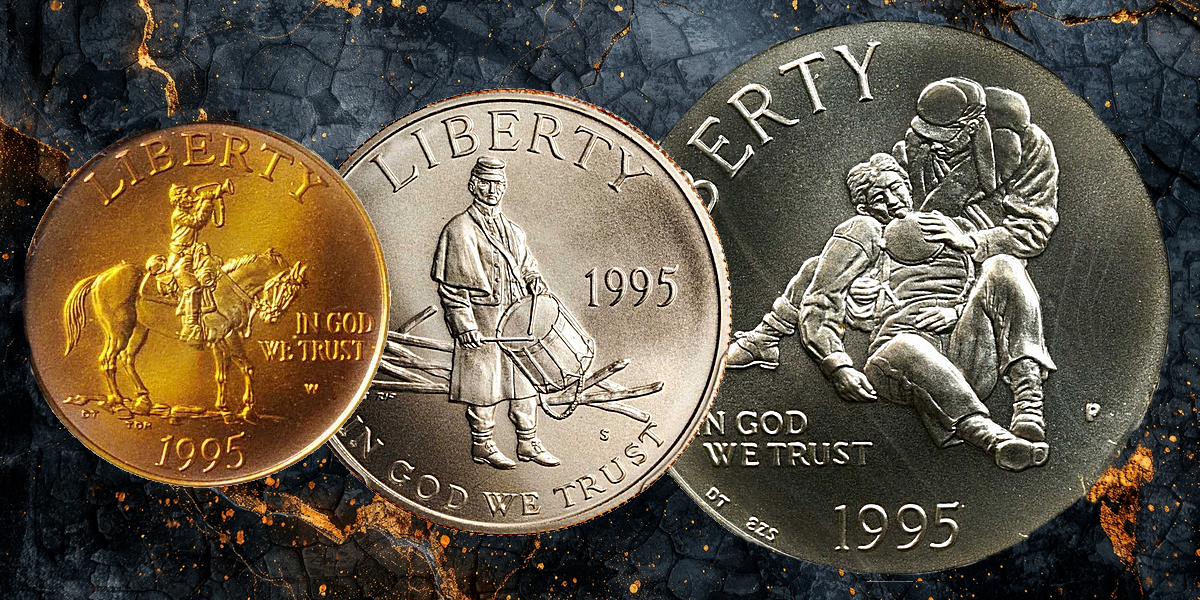
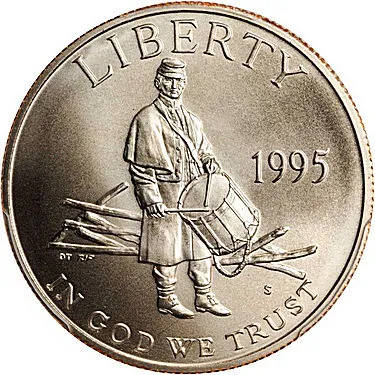
1995-S Civil War Battlefield Clad Half Dollar
The Drummer Boy Carries the Program’s Emotional Message.
Military artist Don Troiani developed the half dollar’s obverse concept. It portrays a young Civil War drummer boy.
Drummer boys did not normally carry rifles into battle. Yet they faced battlefield danger. Their drum calls communicated orders through noise, smoke, and confusion. Therefore, the figure represents both youthful courage and the human cost of the war.
U.S. Mint sculptor-engraver Thomas J. Ferrell created the reverse. It shows a battlefield scene with a cannon and the inscription ENRICHING OUR FUTURE BY PRESERVING OUR PAST.
The Mint produced both finishes at San Francisco. The Uncirculated coin carries the S mintmark, as does the Proof.
1995-S Civil War Half Dollar Specifications
- Denomination: Half Dollar
- Mint: San Francisco
- Mintmark: S
- Composition: Copper-nickel clad over a pure copper core
- Weight: 11.34 grams
- Diameter: 30.60 millimeters
- Edge: Reeded
- Obverse Designer: Don Troiani
- Reverse Designer: Thomas J. Ferrell
- Uncirculated Mintage: 119,520
- Proof Mintage: 437,211, including Prestige Sets
The coin follows the standard copper-nickel-clad half dollar format. PCGS lists a 75% copper and 25% nickel outer alloy over the copper center.
As of July 26, 2026, PCGS reported 307 examples in MS70. It also listed 1,366 coins in MS69.
1995-P and 1995-S Civil War Battlefield Silver Dollars
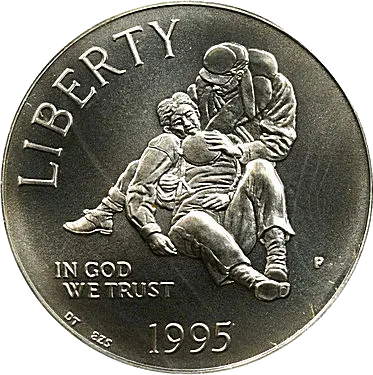
An Act of Mercy Replaces Battlefield Glory.
Troiani’s silver dollar design rejects a triumphant battlefield scene.
Instead, the obverse shows a Union infantryman raising a canteen to the lips of a wounded Confederate soldier. The image focuses on compassion between former enemies. It also gives the program its most powerful narrative.
John Mercanti created the reverse. He placed a long quotation from Union officer Joshua Lawrence Chamberlain over a battlefield landscape. The text begins, “In great deeds something abides.” The words connect battlefield ground with memory, sacrifice, and national reconciliation.
The Mint struck Uncirculated dollars at Philadelphia. It produced the Proofs at San Francisco. The Proof total includes 107,112 coins from the 1995 Prestige Set.
1995 Civil War Silver Dollar Specifications
- Denomination: One Dollar
- Uncirculated: Mint Philadelphia
- Uncirculated: Mintmark P
- Proof: Mint San Francisco
- Proof Mintmark: S
- Composition: 90% silver, 10% copper
- Weight: 26.73 grams
- Diameter: 38.10 millimeters
- Edge: Reeded
- Obverse Designer: Don Troiani
- Reverse Designer: John Mercanti
- Uncirculated Mintage: 45,866
- Proof Mintage: 437,114, including Prestige Sets
The 45,866-coin Uncirculated mintage stands far below the one-million-coin authorization. Consequently, the 1995-P became one of the key low-mintage issues in the modern commemorative dollar series.
As of July 26, 2026, PCGS reported 266 coins in MS70. It listed another 2,348 examples in MS69. The census also included 127 in MS68 and 23 in MS67.
1995-W Civil War Battlefield Gold $5
A Mounted Bugler Sounds the Call to Preserve History.
The gold half eagle delivers the program’s most dramatic design.
Troiani’s obverse shows a mounted Civil War bugler sounding a call to the troops. The horse moves forward while the bugler raises his instrument. The design combines urgency, movement, and military ceremony.
Alfred Maletsky created the reverse. It shows a bald eagle holding a banner with the command LET US PROTECT AND PRESERVE. The message directly states the program’s purpose.
The West Point Mint produced both the Uncirculated and Proof editions. Each coin carries a W mintmark.
1995-W Civil War Gold $5 Specifications
-
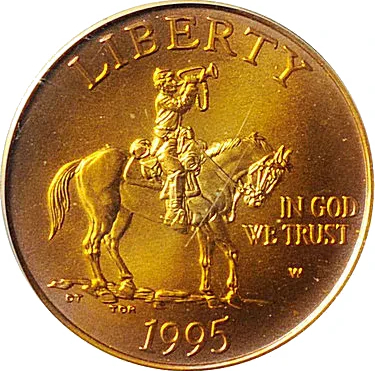
1995-W Civil War Battlefield Preservation Gold $5. MS-69 (PCGS). Denomination: Five Dollars
- Mint: West Point
- Mintmark: W
- Composition: 90% gold, 10% copper
- Weight: 8.36 grams
- Diameter: 21.60 millimeters
- Edge: Reeded
- Obverse Designer: Don Troiani
- Reverse Designer: Alfred Maletsky
- Uncirculated Mintage: 12,735
- Proof Mintage: 55,246
PCGS lists the Uncirculated issue at 8.36 grams, 21.60 millimeters, and 90% gold.
The Program’s Key Low-Mintage Coin
Collectors purchased only 12,735 Uncirculated gold coins. That figure represents just 4.25% of the entire 300,000-coin gold authorization and 22.66% of the authorization after adding the Proofs.
As a result, the 1995-W Uncirculated $5 became the key issue in the program. It also developed a premium beyond its intrinsic gold value.
The Proof sold much better. Collectors bought 55,246 pieces. Even so, that figure fell far below the federal ceiling.
Were the 1995 Civil War Coins a Failure?
The answer depends on the measure.
As a preservation fundraiser, the program generated millions of dollars without a direct congressional appropriation. It also drew attention to endangered battlefield land. Therefore, the program supported its central preservation mission.
As a Mint product, however, it badly missed Congress’s expectations. Buyers purchased only 1,107,692 of the 3.3 million authorized coins. The elaborate packaging could not reverse collector fatigue.
Moreover, the program reached the market during a national debate over commemorative excess. Collectors resisted high prices and too many issues. Treasury officials called for restraint. The GAO then documented shrinking sales, declining profits, and mintage authorizations that exceeded market demand.
The Citizens’ Commemorative Coin Advisory Committee eventually recommended fewer annual programs, lower mintage ceilings, cost recovery before surcharge distributions, and greater Treasury control over themes. Those proposals anticipated reforms that would shape later commemorative programs.
A Program That Became More Important With Time
Collectors largely rejected the 1995 Civil War Battlefield coins when the Mint offered them. Yet that rejection created the low mintages that now define the series.
The 1995-P Uncirculated silver dollar reached only 45,866 pieces. The 1995-W Uncirculated gold $5 stopped at 12,735. Meanwhile, the corrected physical-coin total reveals that the program performed slightly better than many published accounts suggest.
Still, Congress planned 3.3 million coins. Collectors bought just over 1.1 million.
That gap tells the program’s complete story.
The coins tried to save the battlefields where Americans once fought one another. At the same time, the program entered a different conflict, a collector revolt against commemorative excess.
The battlefields gained a funding mechanism. Collectors gained several important low-mintage coins. Finally, Congress gained a warning that good intentions could not guarantee strong numismatic demand.





Glad I read this article very informative!
Now I am looking, thanks
Thank you for this interesting article.
Very informative never new they had printed so many coins. To me it shows times where ruff back then to. Deman was there, but purchasing power was not. I’m learning more as time go’s on,
Very interesting. Never knew this existed.
Love these coins, always colelectable.
With that story, I need to get one of these
great article. Thanks for publishing
I didn’t know that these coins were in a low mintage. I will be on the look for them.
You learn something new everyday around here!!