

The Unique 1910 Lincoln Cent Uniface Die Trial: The Full Story
PCGS called it a uniface test strike. Mike Diamond argued that it looked like a mint error. Later, USPatterns accepted it as a die trial. The only publicly documented example still leaves one question unanswered: Why did the United States Mint make it?
Most Lincoln cents tell their story across two sides. This mysterious 1910 piece offers only half the evidence.
A Lincoln cent obverse appears on one face. The opposite face remains blank. Moreover, an irregular ring of copper extends beyond the struck design.
PCGS graded the piece AU58. The company also placed “Mint Error” and “Uniface Test Strike” on the holder. That certification gave the piece legitimacy. However, it did not settle the larger question.

Did Mint employees deliberately test a 1910 Lincoln cent die? Or did a striking accident create an ordinary cent error with an extraordinary appearance?
For more than two decades, leading error and pattern specialists have debated those questions.
What Is a Uniface Die Trial?
The word uniface describes an object that carries a design on only one side. Therefore, the term accurately describes the physical piece.
The 1910 Lincoln cent obverse appears complete. Lincoln’s portrait, the date, LIBERTY, and IN GOD WE TRUST all show. Meanwhile, the other face carries no Wheat cent reverse.
The planchet also extends beyond the normal border. As a result, the piece has a broad and irregular shape.
However, the term die trial makes a stronger claim. It suggests that Mint employees deliberately used the piece to examine a die, test striking pressure, or evaluate another part of production.
That distinction sits at the center of the story.
A genuine die trial records an intentional Mint experiment. In contrast, a uniface broadstrike can result from an accidental sequence inside a coin press. Both can produce a one-sided coin. Therefore, appearance alone may not prove intent.
Mike Byers Brings the Mystery to Light
Mint-error specialist Mike Byers [Publisher & Editor of Mint Error News and author of World’s Greatest Mint Errors] introduced the piece to the wider numismatic community.
Byers reported that the coin came from an East Coast estate. The estate also contained several other major United States Mint errors. He described the 1910 piece as unique and previously unreported. In addition, he found no listing for it in the Judd or Pollock pattern references then available.
The lack of an earlier listing made the discovery especially surprising. Collectors had studied Lincoln cents for generations. Yet no established reference mentioned this 1910 uniface piece.
Byers also placed the coin within a small group of early Lincoln cent die trials. He noted two known 1909 Lincoln cent obverse trials in lead. One carried a connection to the Judd reference collection. The other served as the Pollock plate coin. However, the 1910 piece differed because it used copper rather than lead.
That difference mattered.
Lead offered a soft medium for checking a die without producing something that resembled circulating money. Copper, however, gave the 1910 piece the color and general appearance of a real cent. Therefore, the piece could support either interpretation. It could represent a deliberate trial. It could also represent a spectacular production error.
Byers publicized the discovery in 2003. According to his records, Coin World featured and illustrated the piece on page 94 of its September 22, 2003, issue. He later included the coin in his book World’s Greatest Mint Errors.
PCGS Gives the Piece a Name
PCGS authenticated the piece and graded it AU58. The holder identifies it as:
1910 Mint Error – 1C – PCGS AU58 – Uniface Test Strike
The holder also carries certification number 21152366.
The AU58 grade describes the piece’s condition. It does not prove why the Mint made it. Likewise, the words “Uniface Test Strike” record PCGS’s attribution. They do not replace missing Mint documentation.
Still, the certification carried great weight. PCGS had examined the physical piece. Its graders accepted the strike as genuine. They also concluded that the coin warranted a test-strike attribution rather than a conventional broadstrike label. Byers described the piece as PCGS-certified when he introduced it publicly.
The holder also used the broader category “Mint Error.” That wording reflects the difficulty of placing the piece within a normal coin series. The object does not represent a regular 1910 cent. It also lacks the conventional two-sided format of a finished pattern.
Instead, it occupies the uncertain space between pattern, die trial, test piece, and mint error.
What Does the Coin Look Like?
The obverse shows a deep impression from Victor David Brenner’s Lincoln cent die. The portrait and legends appear bold. In addition, protected areas retain traces of original red color.
Heritage later reported no major disfiguring spots. The auction house also called attention to the unusually deep strike.
An expanded copper margin surrounds the struck design. This border does not carry normal coin detail. Instead, it shows metal that moved beyond the face of the obverse die.
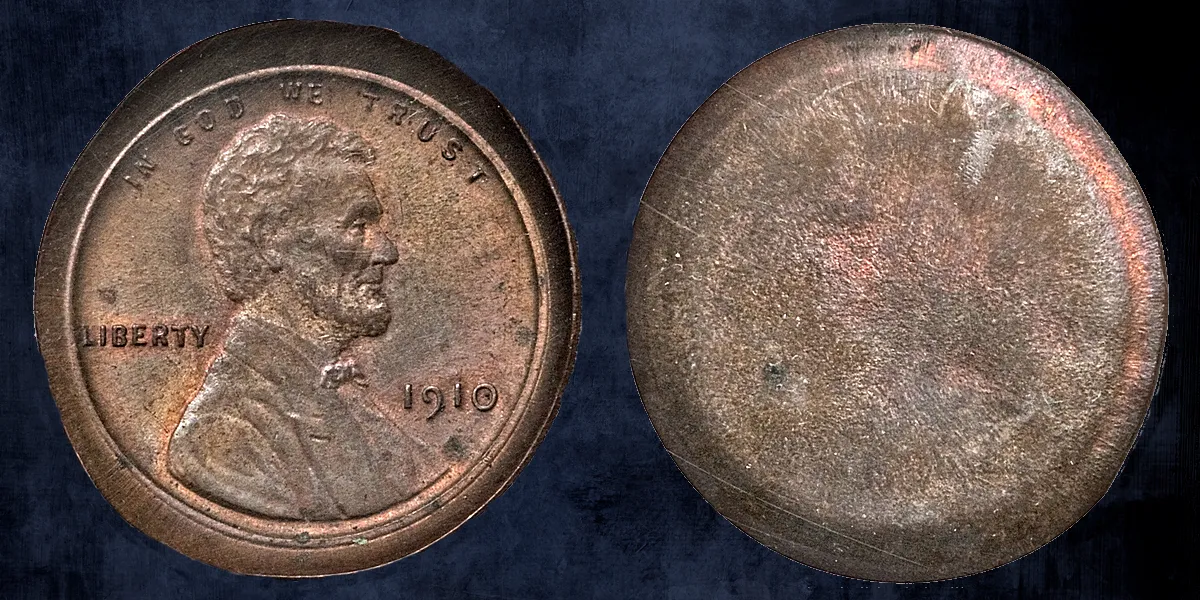
The blank side provides the central mystery. It shows no trace of ONE CENT, UNITED STATES OF AMERICA, the wheat ears, or E PLURIBUS UNUM. Therefore, a conventional reverse die did not impress that face.
However, that fact alone does not reveal why.
A Mint employee could have placed the planchet against a flat surface or backing piece for an intentional obverse test. Alternatively, another cent planchet could have blocked the reverse die during an accidental strike.
Where Did the Mint Produce It?
No source reviewed for this article cites a Mint record that identifies the striking location.
The obverse carries no mintmark. Therefore, it matches the Philadelphia version of the 1910 Lincoln cent. PCGS lists the regular Philadelphia issue at 19 millimeters, 3.11 grams, and 95% copper with 5% tin and zinc.
Philadelphia offers the most plausible origin. The Mint’s engraving and die operations also made that facility the logical place for experimental die work.
Still, the coin cannot prove its own birthplace. No work order, production ledger, or employee account has surfaced. Therefore, CoinWeek treats Philadelphia as a strong inference rather than a documented fact.
Why Would the Mint Make a 1910 Die Trial?
Heritage offered the most direct explanation.
The auction house suggested that Mint employees created the piece to test the obverse die. They may also have checked how much pressure the press required to bring up Lincoln’s portrait and the surrounding lettering. The deep strike supported that interpretation.
The theory makes practical sense. Mint personnel routinely needed to inspect dies, set presses, and evaluate strikes. A one-sided test could show whether the obverse die produced complete detail.
Moreover, 1910 marked only the second year of Lincoln cent production. The Mint had introduced Brenner’s new design in 1909. Production personnel still had recent experience with die modifications and striking problems.
Nevertheless, no surviving Mint document confirms that purpose.
Heritage used cautious language in 2006. It described the piece as “probably” created to test the die and striking pressure. That qualification remains important.
The physical evidence supports a die trial. Yet it does not reveal the intentions of the person who operated the press.
The Bellaire Collection Brings the Coin to Auction
The piece later entered The Bellaire Collection, Part Two.
Heritage Auctions offered it as Lot 5232 in its 2006 April Central States Numismatic Society Signature Auction. The auction ran from April 26 through April 29 in Columbus, Ohio. Lot 5232 crossed the block during the final session on Saturday, April 29.
Heritage cataloged the piece as a 1910 Lincoln Cent Obverse Uniface Test Strike, PCGS AU58.
The cataloger highlighted its deep strike, broad planchet, remaining red color, and clean appearance. Heritage also suggested that Mint personnel used it to determine the pressure needed to produce full obverse detail.
An internet bidder won the lot for $4,312.50. Heritage charged a 15% buyer’s premium during the sale.
Auction Record
- Heritage Auctions: Auction 404
- The Bellaire Collection: Part Two
- Lot: 5232
- Date: April 29, 2006
- Location: Columbus, Ohio
- Grade: PCGS AU58
- Realized: $4,312.50
- Bid source: Internet bidder
- Status: UNIQUE
Heritage’s 2006 sale remains the only confirmed public-auction appearance located during CoinWeek’s review. Byers’s website also marks the piece as sold. However, that page does not publish another sale date or price.
Mike Diamond Challenges the Test-Strike Attribution
The PCGS holder and Heritage sale did not end the debate.
In 2014, mint-error specialist Mike Diamond examined the available photographs and questioned the die-trial explanation. Coin World posted his article online on June 28, 2014. USPatterns cites the corresponding July 14, 2014, print publication date.
Diamond argued that collectors should approach claims involving experimental planchets and test strikes with caution. Unusual errors can mimic intentional Mint experiments. Moreover, an exotic attribution can increase both attention and value.
He believed the 1910 cent looked indistinguishable from a uniface broadstrike.
A broadstrike occurs when the collar fails to contain the planchet during the strike. Without that restraint, the metal expands beyond the die faces.
Diamond focused on the radial lines in the expanded outer margin. In his view, those striations showed that the copper squeezed outward during the strike. Therefore, the planchet may have started at a normal diameter.
He then proposed a specific production sequence.
Two cent planchets entered the press together. Neither planchet sat properly inside the collar. The obverse die hit the upper planchet. Meanwhile, the lower planchet blocked the reverse die. The upper piece spread outward and received only the obverse design.
That sequence would produce a blank reverse without any deliberate experiment.
Diamond also questioned the description of the planchet as slightly oversized. More importantly, he noted that no published weight accompanied the piece at that time. A normal weight would strengthen the error theory. An unusually heavy planchet could support the die-trial theory.
For a time, that missing measurement left the attribution on uncertain ground.
The Conflicting Weight Evidence
The weight creates the most difficult fact-checking issue.
Heritage’s current online lot page displays a weight of 3.11 grams. That figure matches the official weight of a normal bronze Lincoln cent. However, the same page also connects the lot to PCGS number 2435, the catalog number for a regular 1910 Brown cent.
Therefore, the 3.11-gram entry may represent standard database information rather than a recorded measurement of the uniface piece. The Heritage catalog description itself does not discuss a scale reading.
Meanwhile, USPatterns now states that the irregular planchet weighs more than a standard cent planchet. The site does not provide the exact weight.
These two sources conflict.
Consequently, CoinWeek does not treat 3.11 grams as the confirmed weight of the die trial. Nor can we publish an exact heavier weight. No accessible source provides the measurement, the scale used, or a certification document recording it.
However, USPatterns says that the coin’s weight and overall fabric ultimately changed its conclusion.
USPatterns Accepts the Die-Trial Explanation
USPatterns catalogs the piece as JA1910-1/P3528.
The current entry describes an obverse die trial on an oversized, irregular copper planchet. It also states that the planchet exceeds the weight of a standard cent.
Importantly, USPatterns preserves Diamond’s objections. The page explains his radial-striation argument and his proposed stacked-planchet broadstrike sequence.
However, the site no longer accepts that explanation.
USPatterns now concludes that the weight and overall physical character of the piece conflict with the broadstrike theory. Therefore, it assigns the coin as a die trial.
That change gives the die-trial attribution strong specialist support. PCGS accepted the attribution first. Heritage then used it in 2006. Later, USPatterns reviewed the counterargument and still returned to the die-trial conclusion.
Yet one limitation remains.
USPatterns does not cite a Mint document. Instead, it bases its conclusion on physical evidence. Therefore, the site supports what the object appears to be. It cannot prove why a Mint employee made it.
Die Trial or Mint Error?
The surviving evidence supports several firm conclusions:
- First, the piece represents a genuine 1910 Lincoln cent obverse strike.
- Second, the opposite side carries no reverse design.
- Third, PCGS examined and certified it as a uniface test strike.
- Fourth, Heritage sold the same piece in 2006.
- Finally, USPatterns now accepts the die-trial attribution.
However, several questions remain open.
No known Mint record explains the strike. No employee account identifies its creator. No published document records the original experiment. In addition, no accessible source provides the exact weight that prompted the current USPatterns conclusion.
Diamond’s broadstrike theory still matters because it explains the visual evidence through known mint-error mechanics. Nevertheless, USPatterns reports that the piece’s weight and fabric rule against that scenario.
Therefore, the strongest current attribution remains obverse die trial.
Still, careful cataloging should preserve the uncertainty. The piece has strong physical and specialist support. It does not have documentary proof of Mint intent.
Is the 1910 Lincoln Cent Uniface Die Trial Unique?
Byers introduced the piece as unique and unreported. USPatterns catalogs only this example. Moreover, no second specimen appears in the auction and specialist sources reviewed for this article.
No later verified public sale also surfaced during the review.
That status adds to the coin’s importance. Yet uniqueness does not automatically prove an experimental purpose. Some complex mint errors also survive as unique pieces.
Instead, the coin’s significance comes from its combination of features:
It carries an early Lincoln cent obverse. It uses an irregular copper planchet. It has no struck reverse. PCGS certified it. Heritage sold it. A leading mint-error specialist challenged it. Finally, a major pattern reference reconsidered the evidence and accepted it.
Few Lincoln cents offer such a complicated history.
CoinWeek’s Assessment
The Unique 1910 Lincoln Cent Uniface Die Trial stands among the most intriguing early Lincoln cent discoveries.
The object itself presents no authenticity problem. PCGS certified the piece. Its unusual shape and one-sided strike also appear clearly in published images.
The debate concerns classification.
Heritage viewed it as a likely pressure or die test. Mike Byers promoted it as a unique discovery. Mike Diamond later offered a credible mint-error explanation. Then USPatterns reconsidered the physical evidence and accepted the die-trial attribution.
Today, 1910 Lincoln Cent Uniface Die Trial offers the most defensible name.
However, the final chapter remains unwritten. A Mint ledger, die-room note, or exact weight report could strengthen the attribution. Until then, the coin will remain both a recognized die trial and an unresolved piece of Mint history.
That tension gives the piece its real power.
The blank reverse does not end the story. It created one.
test strike…..it makes sense( no pun intended)…….:)
What will be found next?
First I’ve heard of thie very interesting story, thanks!
I sometimes question why so many errors.
amazing story
amazing how much these curiosity coins command
quality control issues?
Interesting summation.
I tend to thinking that Mike Diamond is correct, that it is a broadstrike.
As there is no mint records to back up that it was a die trial piece.
Interesting story about the origin of the coin.
Wow, learn something new everyday. Very interesting article.
Pretty amazing story. Though if it was a test strike, then would it still be an error?
I have a penny like this but it has both obv/rev. So weird
Very cool article on the 1910 Lincoln cent with no reverse.
i think it was a deliberate coin error from the mint
It’s truly amazing how much there is to learn about error coins.
Never heard of this one. Neat!
Will we ever know the answer? Probably not, but part of not knowing is what creates the intrigue and value.