America Had Millions of Unwanted Pennies. Then Came the Legendary 1877 Indian Head Cent
In November 2023, a small bronze penny crossed the GreatCollections auction block and sold for an astonishing $340,875. The coin contained no gold or silver. Its original purchasing power amounted to a single cent. Yet collectors competed fiercely to own it.
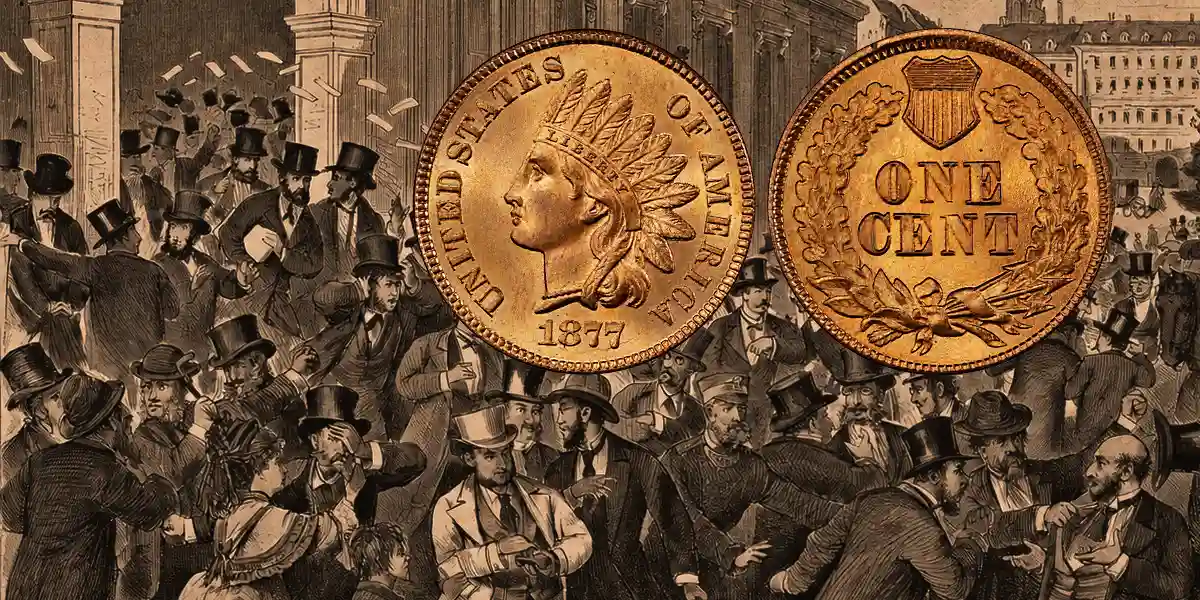
The coin was an 1877 Indian Head Cent, the legendary key date of one of America’s most popular 19th-century series.
What makes this story remarkable is how the rarity came into existence. In 1877, American banks had millions of unwanted pennies. The economy remained in crisis, businesses struggled, and the Philadelphia Mint had little reason to produce additional cents.
Almost 150 years later, that shortage of new coinage helped turn an ordinary denomination into one of America’s great numismatic prizes.
The Financial Panic That Changed America’s Pennies
To understand the 1877 Indian Head Cent, we must return to September 1873.
America’s railroad industry had expanded at a breathtaking pace. Investors poured money into new lines, often relying on borrowed funds and optimistic projections. However, the railroad boom could not continue indefinitely.
When the prominent banking house Jay Cooke & Company collapsed on September 18, 1873, financial panic spread. Credit tightened, railroad projects failed, and businesses closed. The resulting depression gripped the country for years.
By 1877, the financial crisis had become a national social crisis.
That July, railroad workers protested another round of wage cuts. Their walkouts grew into the Great Railroad Strike of 1877. Violence erupted in several cities as workers, railroad companies, militias, and federal troops confronted one another.
Meanwhile, the nation’s monetary system faced a quieter problem. Banks had accumulated more small change than commerce could absorb.
For the Philadelphia Mint, this created an unusual situation. America already possessed enormous quantities of pennies. What it lacked was sufficient demand for newly struck ones.
Millions of Old Pennies, but Few New Ones
The federal government had addressed the surplus several years earlier.
Under legislation Congress approved in 1871, the Mint could redeem excess minor coins. Initially, officials melted many of the returned pieces and used the recovered metal for new coinage.
However, that process consumed time and resources. By 1874, Mint officials had adopted a more practical approach. They began returning suitable bronze cents directly to circulation.
The numbers from 1877 reveal just how important this policy became.
According to research by Indian cent specialist Rick Snow, the Philadelphia Mint redeemed 9,908,148 bronze cents that year. It also reissued 9,821,500 previously struck cents.
In other words, the Mint could satisfy much of the country’s demand for pennies without striking new ones.
Consequently, official records report a circulation-strike mintage of just 852,500 Indian Head Cents bearing the 1877 date.
Only the 1909-S Indian Head Cent, with its mintage of 309,000, records a smaller production figure in the series.
Yet the 1877 remains the more elusive coin today. Its scarcity reflects more than the number of pieces in the Mint’s annual report.
A 149-Year-Old Mystery in the Mint Records
There is another intriguing wrinkle in the story.
Numismatic researchers have identified just two obverse dies paired with a single reverse die among surviving 1877 circulation strikes.
That finding raises questions.
Could such a limited group of dies have produced all 852,500 coins that the Mint reported? Some specialists doubt it.
Researchers have suggested that the official total might include pieces bearing earlier dates or coins that the Mint reissued rather than newly struck.
However, no definitive evidence has established a revised mintage. Therefore, the official figure of 852,500 remains the accepted number.
Nevertheless, the die evidence adds a fascinating mystery to an already remarkable coin. The surviving specimens may tell a more complicated story than the government’s accounting records.
Why Collectors Didn’t Save the 1877 Indian Head Cent

Today, a collector might carefully preserve an unusual new coin. In 1877, however, Americans had little reason to think that their everyday pennies would become valuable collectibles.
The Indian Head Cent had already circulated for nearly two decades. Chief Engraver James Barton Longacre introduced the design in 1859, portraying Liberty wearing a Native American feathered headdress.
The reverse originally carried a wreath without a shield. In 1860, the Mint introduced the oak-and-olive wreath and shield design that continued through the series’ final year.
Then, in 1864, the Mint replaced the heavier copper-nickel composition with a lighter bronze alloy.
By 1877, the coin had become an established part of American commerce.
Collectors of the period often preferred Proof coins, which the Mint produced specifically for the collector market. Few systematically saved ordinary circulation strikes by date.
As a result, many 1877 cents entered everyday use. Over time, circulation wore away their details and original mint color.
Others suffered damage, corrosion, or cleaning. Such problems remain important when collectors evaluate surviving examples.
The 1909-S Indian Head Cent had a different advantage. It appeared near the end of the series, when more collectors recognized the importance of saving scarce dates.
That difference in collector behavior helps explain why the 1877 commands such extraordinary attention today.
The Golden Princess: An 1877 Penny Worth $340,875
Few coins illustrate the 1877 Indian Head Cent’s appeal better than the famous Golden Princess.
The late Stewart Blay, a New York sculptor and celebrated numismatist, assembled exceptional collections of American cents. He pursued coins with outstanding originality, preservation, and visual quality.
His 1877 Indian Head Cent became one of the great treasures of his collection.
PCGS graded the coin MS66+ Red, recognizing its exceptional preservation and original red copper appearance. The coin also earned CAC approval.
Blay’s extraordinary specimen became known as the Golden Princess.
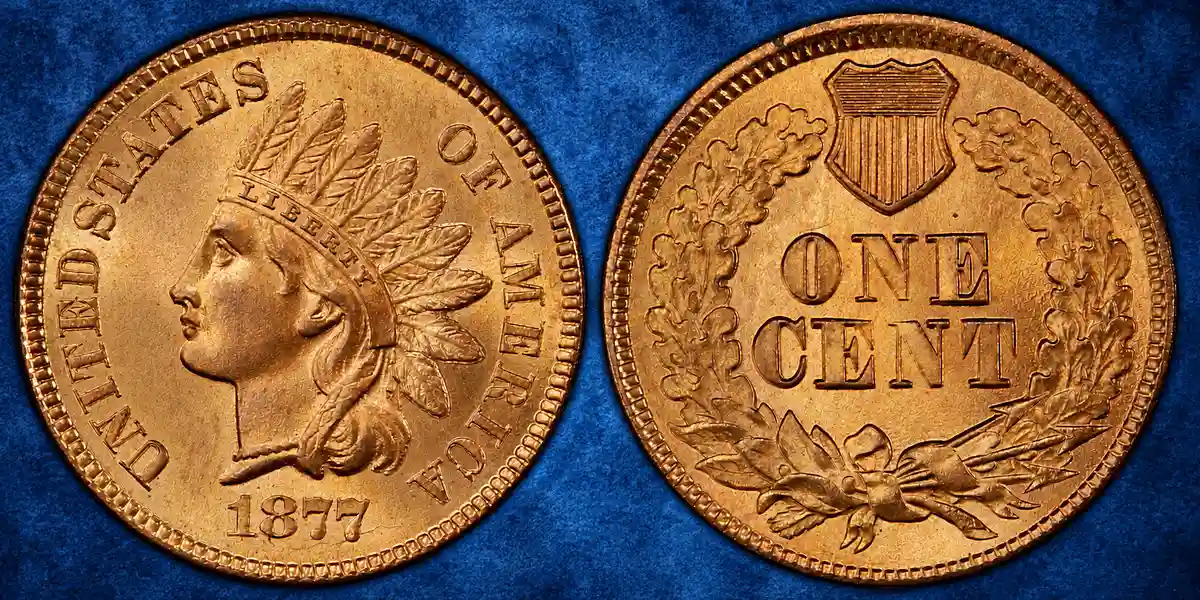
In November 2023, GreatCollections offered the coin as part of the Stewart Blay Collection. The auction attracted intense collector interest.
When bidding ended, the 1877 Indian Head Cent had realized $340,875, establishing a new auction record for the issue.
The result demonstrated how strongly advanced collectors value exceptional quality, original color, and an important pedigree.
However, most collectors do not need six figures to pursue the 1877.
Recent auction results reveal a much broader market.
What the 1877 Indian Head Cent Is Worth in 2026
Auction activity during 2026 shows how dramatically grade, color, and surface preservation affect the market.
In January, Stack’s Bowers sold a PCGS Good-4 Brown example for $528. Although heavily circulated, the coin still offered collectors an opportunity to own the celebrated key date.
Meanwhile, Heritage Auctions sold a PCGS MS65+ Red-Brown example with CAC approval for $29,280 during its May 2026 Central States sale.
More recently, Heritage’s October 2026 auction produced three useful comparisons.
A PCGS AU53 example attributed as Snow-2 realized $4,148 on October 8. The following day, a PCGS MS64 Brown specimen brought $8,845, while an NGC XF40 example sold for $2,928.
These transactions illustrate the wide range of prices that 1877 Indian Head Cents command.
Of course, grade alone never tells the entire story. Originality, strike quality, color, eye appeal, and surface problems can influence the final price.
For collectors, the lesson is straightforward. Examine the individual coin rather than relying exclusively on a price guide or the number printed on its holder.
The Small Detail That Helps Identify a Genuine 1877
The 1877 Indian Head Cent also presents a significant authentication challenge.
Its rarity and value encourage counterfeiters to alter dates on more common cents or manufacture convincing imitations.
Fortunately, specialists have identified several useful diagnostics.
One important feature involves the letter N in ONE on the reverse. Genuine 1877 circulation strikes typically display the distinctive Shallow N reverse, while Proofs use the Bold N style.
Collectors should also examine Liberty’s portrait, feather details, lettering, and date placement.
However, a convincing reverse alone does not establish authenticity. Counterfeiters can reproduce familiar diagnostics, and altered coins may retain genuine Mint features from another date.
Therefore, professional authentication through an established grading service offers important protection, particularly when purchasing an expensive example.
Proof 1877 Indian Head Cents also require separate consideration. The Mint did not maintain definitive annual records of minor-coin Proof production before 1878.
Researchers estimate that approximately 900 Proof cents entered collector distribution in 1877, although total production may have approached 1,500. Those figures remain estimates rather than a firmly documented mintage.
A Small Coin With an Extraordinary American Story
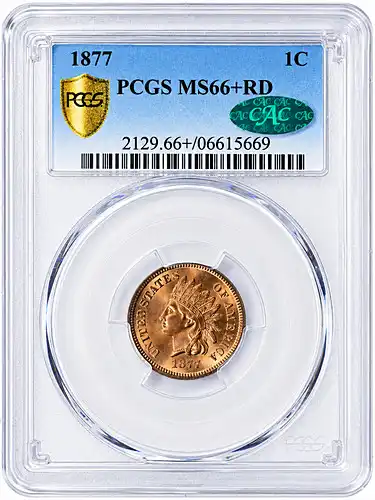
From the Stewart Blay Collection of Indian Cents
The 1877 Indian Head Cent measures just 19 millimeters and weighs 3.11 grams. Its bronze alloy contains 95% copper and 5% tin and zinc.
Nevertheless, this modest coin tells a story far larger than its denomination.
Its origins connect directly to one of America’s longest economic downturns. Its scarcity reflects a federal policy that returned millions of unwanted pennies to circulation. Its surviving dies even raise questions about the accuracy of historical production records.
Then there is the human side of the story.
The workers who spent these pennies in 1877 could hardly have imagined that future collectors would pay thousands of dollars for a well-preserved example. Nor could they have foreseen a single specimen eventually selling for more than $340,000.
That is what makes the 1877 Indian Head Cent so compelling.
Its importance lies not simply in how few the Mint made, but in the extraordinary historical circumstances that made so few new pennies necessary.
For additional information about the issue’s design, varieties, grading, and specifications, explore CoinWeek’s original 1877 Indian Head Cent: History and Value reference article.