A $1.25 Million Dime Helps Push Stack’s Bowers Auction Past $70 Million
A legendary 1894-S Barber dime, colonial silver coins dating to 1652, and rare Indian Peace medals helped Stack’s Bowers Galleries achieve the largest auction total in its more than 90-year history.
The firm’s Summer 2026 Global Showcase Auction realized $70,011,421, as collectors competed for more than 12,000 lots spanning centuries of numismatic history.
The auction featured United States, world, and ancient coins, as well as numismatic Americana, medals, tokens, and U.S. and world paper money. Stack’s Bowers conducted the event as an Event Auctioneer Partner of the American Numismatic Association’s World’s Fair of Money.
However, the auction’s importance extended beyond its record total. Results throughout the sale showed strong demand for historic rarities, exceptional preservation, distinguished pedigrees, and coins with outstanding eye appeal.
A $1.25 Million Dime Leads the Historic Auction
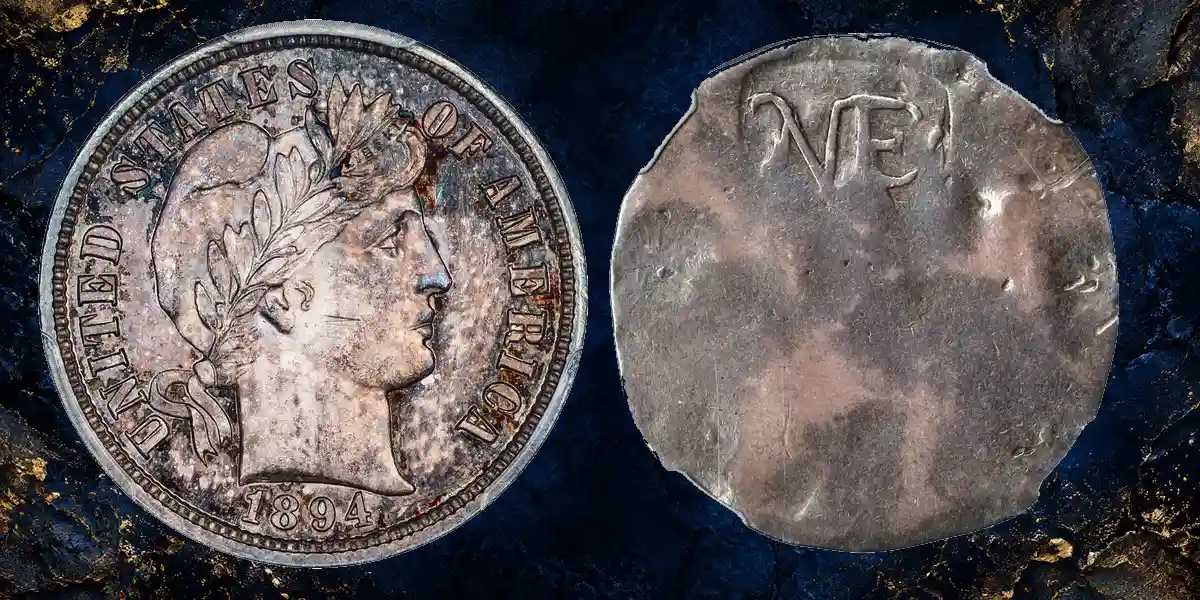
One of the auction’s most celebrated coins was the Norweb specimen of the 1894-S Barber dime. The San Francisco Mint struck only 24 examples in 1894, creating one of the most famous mysteries in American numismatics.
Today, collectors know of just nine surviving specimens. The reasons behind the extraordinarily small original production remain a subject of debate.
The Norweb dime, which PCGS graded Proof-63 and which carries CAC and CMQ approval, realized approximately $1.25 million during the auction’s Rarities Night session.
That session alone generated $26,305,945 from 631 lots. Nevertheless, the broader auction demonstrated that competition extended far beyond coins with seven-figure price tags.
Rare Indian Peace Medals Command Six-Figure Prices
The opening U.S. coin and Americana session introduced collectors to the Skylar Leichty Collection of Indian Peace Medals.
Leichty assembled an exceptional cabinet of historic medals, with particular emphasis on issues associated with European colonial powers. These pieces represent an important chapter in the history of diplomacy, trade, and relations between colonial governments and Indigenous nations.
Leading the collection was lot 1028, a remarkable solid silver Lion and Wolf medal that realized $103,700.
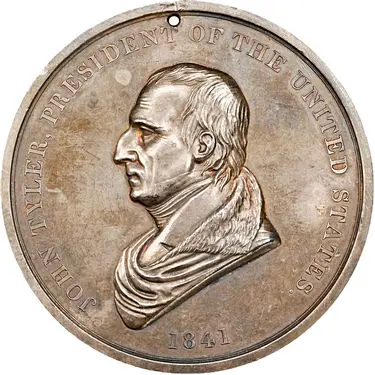
Other consignors added several major rarities to the session. Lot 1042, a Russian Slava Rossii medal, brought $134,200. A newly discovered 1841 John Tyler First Size silver Indian Peace medal matched that price at $134,200.
Meanwhile, an undated John Jacob Astor/American Fur Company Indian Trade medal in tin realized $122,000. The medal offered a tangible connection to the commercial networks that helped shape America’s western frontier.
Collectors also pursued early American portrait medals. A 1786 Benjamin Franklin Natus Boston medal in silver brought $41,480, while a bronze Washington Before Boston medal achieved the same price.
Another notable result came from a 1909 Abraham Lincoln Preserve, Protect, Defend silver medal by Victor David Brenner. One of only two examples believed to survive in silver, the medal sold for $29,280. Brenner’s enduring connection to the Lincoln cent adds another dimension to this important work of medallic art.
Colonial Coins Bring America’s Earliest Money Into Focus
The same session continued with colonial and pre-federal coinage, including pieces that predated the establishment of the United States Mint.
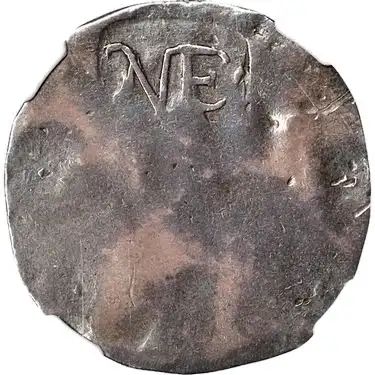
Among the most significant offerings was the Robison-Salmon Noe 3-B New England shilling, lot 1294, which realized $134,200.
The Massachusetts Bay Colony began striking New England silver coinage in 1652. These early pieces carried simple punches rather than the elaborate designs collectors associate with later American coins. Their significance rests in their place among the earliest coins struck in what became the United States.
The Robison-Salmon shilling illustrates the enduring appeal of these colonial survivors, particularly when collectors can trace their ownership through prominent collections.
Other early American rarities attracted considerable attention. Lot 1311, the Gem 1722 Wood’s Hibernia farthing from the Newman Collection, brought $17,080.
An MS-63 1694 Carolina Elephant token, lot 1320, realized $53,680. Meanwhile, lot 1321, the Garrett-Roper Freidus 1.3-A Higley copper, sold for $42,700.
The session also included a rare Albany Church Penny, lot 1347, which achieved $29,280. Together, these results reflected continued collector interest in early American tokens and privately issued coinage.
Early Federal Coins and Condition Rarities Draw Strong Bids
The competition continued as the session moved into federal coinage, from half cents through twenty-cent pieces.
A 1793 half cent graded Fine-12 by NGC realized $8,235. Another early copper rarity, a 1794 Sheldon-31 large cent in AU-55, brought $9,150.
Among later issues, a superb 1904 Liberty Head nickel attracted $26,840. PCGS graded the coin MS-67+, placing it in a tie for the finest examples the grading service had certified.
Early silver also performed well. A 1796 Draped Bust dime graded PCGS Fine-15 with CAC approval achieved $17,080. In addition, a freshly graded 1926-S Mercury dime realized $12,200.
These results illustrated how collectors pursued both classic rarities and especially desirable examples of familiar series.
Seated Liberty Dollars Produce Some of the Auction’s Most Surprising Results
Session 5 featured quarters through trade dollars, including the J B N Collection of Liberty Seated dollars.
The collection attracted particular attention because of the quality of its coins and their appeal within the specialized Seated Liberty dollar market.
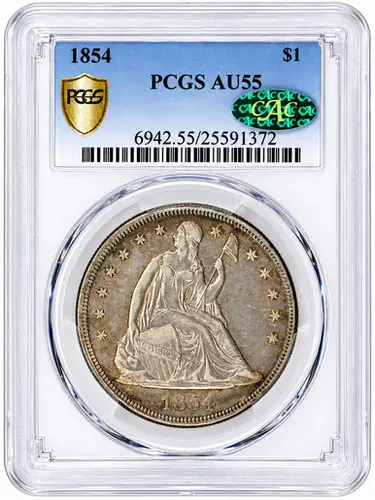
One standout was an 1854 Liberty Seated dollar graded PCGS AU-55 with CAC approval. It realized $39,040, an exceptional price for the numerical grade.
Stack’s Bowers noted that the realization approached the PCGS Price Guide figure for an MS-64+ example at the time of the sale. The result underscored the importance collectors placed on the individual coin’s quality, appearance, and CAC approval.
Another strong result came from an 1872-CC Liberty Seated dollar graded EF-40. The Carson City rarity brought $23,180.
The session also featured an 1858 Liberty Seated dollar graded Proof-20, which realized $17,080.
The 1858 holds a special place in the series because the Philadelphia Mint produced no circulation-strike silver dollars that year. Collectors must therefore seek a Proof example to complete a date set. Even an impaired or heavily worn survivor can command considerable interest.
Elsewhere in Session 5, an 1825/4/2 Capped Bust quarter graded AU-58, lot 3009, realized $6,710. A heavily circulated but scarce 1871-CC quarter graded PCGS Good-4 brought $9,760.
An 1812/1 Large 8 Capped Bust half dollar in VF-35 achieved $10,675, while a beautifully toned 1897-S Barber half dollar graded PCGS MS-64 with CAC approval realized $7,930.
Morgan Dollars Show the Power of Exceptional Quality
Morgan dollars provided another measure of demand for outstanding individual coins.
Lot 3218, an 1879-CC Morgan dollar graded PCGS MS-64 and housed in an old green-label holder, realized $15,860.
A superb 1887 Morgan dollar with Deep Mirror Prooflike surfaces, lot 3277, brought $29,280. The auction house described the coin as tied for the finest certified.
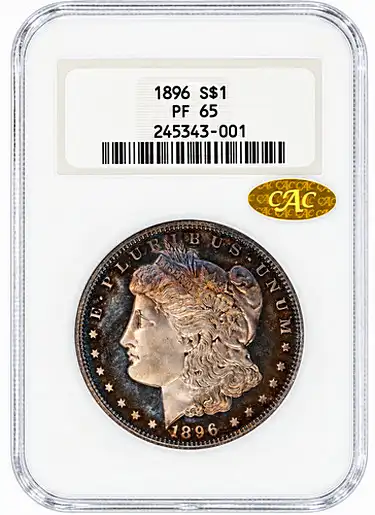
However, one of the more memorable results involved lot 3345, an 1896 Proof Morgan dollar graded Proof-65 by NGC.
The coin remained in an older NGC holder and carried a Gold CAC sticker. It realized $39,040, demonstrating the premium collectors were willing to pay for an especially desirable Proof Morgan dollar.
Together, these Morgan dollar results showed how preservation, surface character, and certification history can influence bidding well beyond the importance of the date alone.
Gold Coins Set Records as Collectors Chase High-Grade Rarities
Session 9 concluded the live U.S. coin offerings with federal and territorial gold, commemoratives, patterns, and error coins.
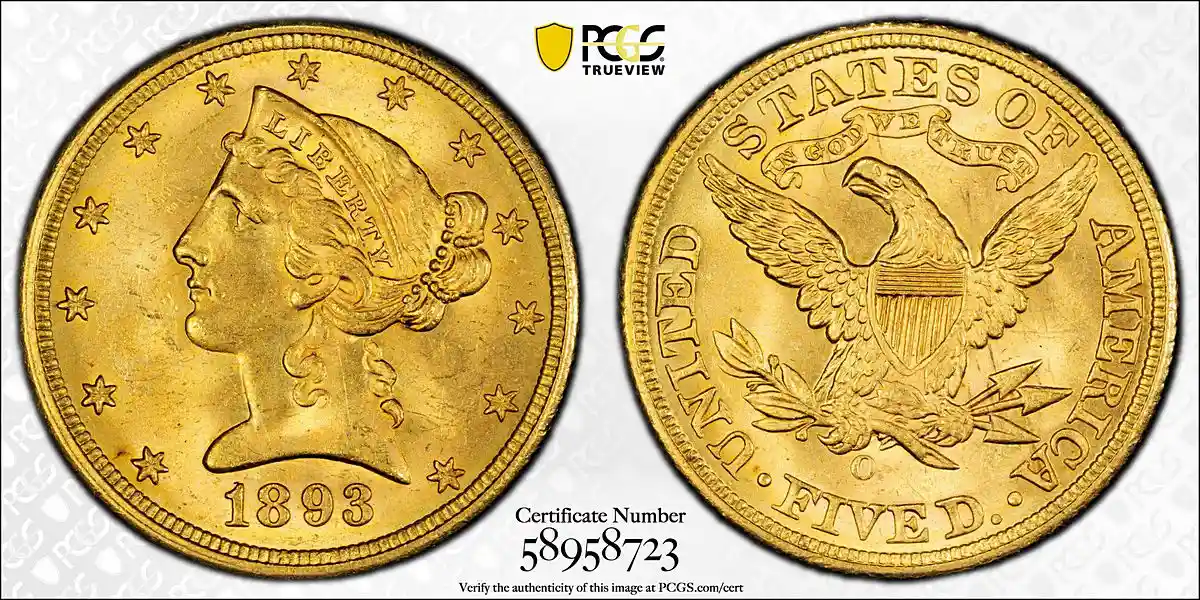
The strongest gold result among the session’s reported highlights came from lot 5366, an 1893-O Liberty Head half eagle.
The New Orleans $5 gold piece, graded PCGS MS-64 with CAC approval, realized $43,920. According to Stack’s Bowers, the result established a new auction record for the issue and approached twice the PCGS Price Guide figure at the time.
Another Southern gold rarity, an 1846-C Liberty Head half eagle graded NGC AU-58, brought $19,520. The Charlotte Mint issue offered collectors an example from one of the historic Southern branch mints.
Meanwhile, a 1911 Indian Head $10 gold eagle graded PCGS MS-64 with a Gold CAC sticker realized $18,910.
Session 9 also featured several important non-gold issues. A beautifully toned Columbia, South Carolina, commemorative half dollar, lot 5543, brought $26,840.
A Gem 1858 Flying Eagle cent pattern, Judd-206, lot 5680, realized $13,420. The experimental issue reflects the Mint’s efforts to refine small-cent designs during a period of significant change in American coinage.
Finally, an 1883 Hawaiian dollar with a Gold CAC sticker, lot 5758, achieved $26,840. The coin represents a brief but fascinating chapter in Hawaiian monetary history before the islands became a U.S. territory.
World Coins, Currency and Specialized Collections Add to the Record
The Global Showcase was much more than a traditional U.S. coin auction.
World and ancient coins generated significant interest, including a countermarked Curaçaoan 180 reaals struck over a Brazilian 12,800 reis gold coin. That rarity realized $390,400.
United States currency also contributed to the record total. Four U.S. paper money sessions realized a combined $7,085,455.
Additionally, the Mack C. Chase Collection of Walking Liberty half dollars attracted strong competition. Its 253-lot September offering produced $2,448,125, highlighting the continuing appeal of carefully assembled specialized collections.
Online sessions further expanded the auction’s reach and helped bring collectors from numerous numismatic specialties into the sale.
Stack’s Bowers Records Its Most Valuable Auction
For Stack’s Bowers Galleries, the $70 million result marks a milestone in a history stretching back more than nine decades.
The firm has handled many of American numismatics’ most celebrated collections, including those formed by Louis E. Eliasberg, John J. Ford Jr., D. Brent Pogue, Harry W. Bass Jr., and the Norweb family.
Yet the Summer 2026 Global Showcase Auction achieved something the company had never accomplished before: a single auction event exceeding $70 million.
“Demand was strong across every category we offered,” said Brian Kendrella, president of Stack’s Bowers Galleries.
Kendrella credited the company’s consignors, participating bidders, and auction team for the historic result. He also emphasized that broad participation across U.S., world, and ancient coins, currency, and numismatic Americana made the sale the firm’s most valuable to date.
For collectors, the results offer an important snapshot of the rare coin market in 2026. Famous trophy coins continue to command headlines, but exceptional pieces in established collecting series also attract determined bidders.
In this auction, the record total came from both ends of the market: seven-figure rarities and the many historic coins, medals, and paper money treasures that collectors pursued throughout the sale.
Collectors can review complete prices realized, including the online sessions, through the auction archives at StacksBowers.com.
For information about consigning to an upcoming Stack’s Bowers Galleries auction, contact the firm at 800-458-4646 or email [email protected].