


Eliasberg 1893-S Morgan Dollar Returns From Overseas
A famous PCGS MS65 CAC example of the “King of Morgan Dollars” traces its ownership to the coin’s earliest years. GreatCollections will offer the Clapp-Eliasberg rarity on August 9, 2026.
In January 1893, the San Francisco Mint struck just 100,000 Morgan dollars. Then Washington ordered the presses to stop.
Most of those coins disappeared into Western commerce. Many suffered decades of wear. Others may have vanished into melting pots. However, one remarkable survivor took a very different path.
Within about a year of production, the coin entered the collection of pioneering numismatist J. Colvin Randall. It later passed through the legendary cabinets of John M. Clapp and Louis E. Eliasberg, Sr. More recently, Bob Simpson and the builder of the Wizard collection owned it.
Now, after spending the past decade overseas, the celebrated 1893-S Morgan Dollar PCGS MS65 CAC will return to the auction block.
GreatCollections will close bidding on Sunday, August 9, 2026, at 6:55 p.m. Pacific Time. The auction firm describes the coin as the centerpiece of one of the finest Morgan Dollar collections ever assembled.

The King of Morgan Dollars Returns
The 1893-S Morgan Dollar needs little introduction.
The San Francisco Mint struck only 100,000 circulation coins that year. That total marks the lowest business-strike mintage in the entire Morgan Dollar series. Moreover, no other Morgan issue combines such a low production figure with so few high-grade survivors.
PCGS grades the GreatCollections coin MS65. In addition, CAC awarded it a green sticker for quality within the assigned grade.
GreatCollections calls the coin the second-finest known example. However, the established Condition Census requires a little more precision. The unique PCGS MS67 Vermeule specimen stands alone at the top. A small group of PCGS MS65 coins shares the next tier. Therefore, the Clapp-Eliasberg coin ranks among the finest known rather than as an uncontested number two.
That distinction hardly reduces its importance. Any Gem 1893-S ranks among the great prizes of American numismatics. Furthermore, this coin carries one of the most compelling pedigrees available for the date.
A January Telegram Changed the Morgan Dollar Series
Collectors often connect the 1893-S Morgan Dollar directly to the Panic of 1893. Yet the actual timeline tells a more interesting story.
Congress had forced the Treasury to purchase and coin huge quantities of silver for years. The Bland-Allison Act of 1878 required monthly silver purchases worth between $2 million and $4 million. The Treasury then converted that metal into standard silver dollars.
Next, the Sherman Silver Purchase Act of 1890 changed the program. It directed the Treasury to purchase as much as 4.5 million ounces of silver bullion each month. The government paid for that bullion with newly issued Treasury notes. Holders could then redeem those notes in coin.
The policy produced mountains of silver dollars. Yet Americans showed little demand for them. As a result, Mint and Treasury vaults filled with bags of coins that rarely circulated.
Mint Director Edward O. Leech finally acted.
On January 12, 1893, Leech instructed the San Francisco Mint to suspend silver-dollar production after the end of the month. The Mint completed the entire 100,000-coin mintage in January.
This sequence matters. Leech issued his order before the worst phase of the Panic of 1893. He also acted months before Congress repealed the Sherman Silver Purchase Act.
Therefore, the Panic did not cause the January halt. Instead, the Treasury had already decided that it did not need more silver dollars.
Then the Economy Collapsed
Although the Panic did not create the low mintage, it shaped the world into which the coins emerged.
The Panic of 1893 became one of the nation’s most severe financial crises. Treasury gold reserves had fallen from about $190 million in 1890 to roughly $100 million. That decline undermined confidence in the government’s ability to redeem Treasury obligations in gold.
At the same time, the economy slowed. Loan defaults weakened bank balance sheets. Depositors rushed to withdraw their money. Then bank runs swept through cities across the Midwest and West.
More than 100 banks suspended operations during June. Another 340 banks suspended operations from mid-July through mid-August. Credit contracted, asset prices fell, and commerce suffered.
President Grover Cleveland called Congress into special session. After a bitter political fight, Congress repealed the Sherman Silver Purchase Act in the fall of 1893.
The San Francisco Mint never resumed Morgan Dollar production that year.
Where Did the 100,000 Coins Go?
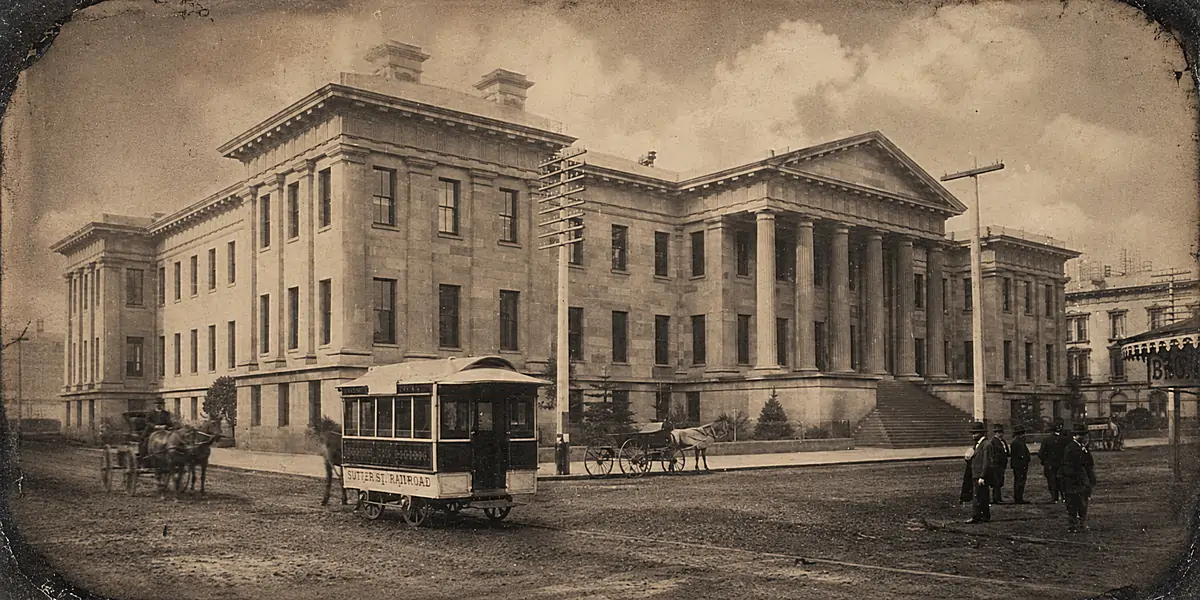
For decades, collectors repeated a simple story. According to that version, the San Francisco Mint released most 1893-S dollars directly into Western commerce during the financial crisis. Miners, ranchers, merchants, saloons, and banks then wore them down.
That story contains some truth. However, archival research has revealed a more complex trail.
In June 1894, San Francisco Mint Chief Clerk Robert Burnett responded to a request for 1893-S dollars. He reported that the Mint had already distributed every coin.
Researchers Richard Kelly and Nancy Oliver later documented several large withdrawals. Cyrus Walker of the Puget Mill Lumber Company acquired 17,500 silver dollars between July and October 1893. The company may have used them for payroll.
In August, customers exchanged gold for another $16,000 in silver dollars at the San Francisco Mint. Robert Richard Bulmore, an agent for the Almaden Quicksilver Mine, also acquired 21,700 silver dollars through six transactions.
Together, those documented withdrawals account for 55,200 coins. That total represents more than half of the entire mintage.
Collectors also secured a few pieces. Records show that a collector identified as Fontaine received one coin in early July. George W. Rice obtained two. Peter Mongey also acquired two in October.
The records prove that large numbers left the Mint during 1893. However, distribution does not always mean immediate circulation. Banks, mines, lumber companies, and other businesses could have held some coins before paying them out.
That uncertainty helps explain another numismatic mystery.
Did Most 1893-S Dollars Circulate Later?
The wear patterns on surviving coins have led some researchers to question when widespread circulation began.
Most collectible 1893-S dollars grade Fine or Very Fine. That level of wear suggests years of use. Yet numismatist E.S. Thresher reported in 1925 that six years of searching circulation had failed to produce a single example.
Q. David Bowers later proposed that many coins may not have entered broad circulation until the mid-1920s. Under that theory, banks or Treasury facilities held portions of the issue before releasing them.
Later evidence also shows that some worn 1893-S dollars returned to government storage. During the 1950s and early 1960s, collectors occasionally found circulated examples in mixed Treasury bags.
Consequently, the 1893-S story does not fit one tidy explanation. Large quantities left the San Francisco Mint in 1893. Some probably entered payrolls and commerce at once. Others may have remained in bank or Treasury channels for years.
What Role Did the Pittman Act Play?
Numismatic tradition often blames the Pittman Act for destroying tens of thousands of 1893-S dollars.
Congress passed the Pittman Act in 1918. Under its authority, the government ultimately melted 270,232,000 silver dollars. The Treasury sold much of that silver to support wartime needs and later replaced the melted coins.
However, the government did not record the dates and mintmarks of individual coins that entered the furnaces.
Therefore, no surviving record proves how many 1893-S dollars the Treasury melted. Some coins could have returned to government vaults and met that fate. Still, researchers cannot support a precise number.
The new distribution records also weaken the old claim that the San Francisco Mint held most of the issue until the Pittman Act. Burnett’s 1894 letter shows that the Mint had already distributed the full mintage.
The Pittman Act probably contributed to the loss of many Morgan dollars. Yet circulation, attrition, loss, damage, and later melting all likely shaped the surviving population of the 1893-S.
Rare in Every Grade, Extraordinary in Mint State
Experts continue to debate how many 1893-S Morgan Dollars survive.
PCGS CoinFacts estimates 9,948 surviving coins across all grades. Q. David Bowers previously suggested a range of roughly 6,000 to 12,000 pieces. However, recent grading-service totals show more than 22,000 certification events.
Those figures do not represent 22,000 different coins. Owners often resubmit valuable coins in hopes of higher grades. They also cross coins from one grading service to another. Details-graded pieces can create further duplication.
Consequently, the true number remains uncertain.
Still, one point faces little dispute. The 1893-S becomes dramatically rarer as the grade rises.
Thousands of circulated pieces survive. In contrast, Mint State coins appear only rarely. The major grading services reported 72 Mint State certification events through March 13, 2026, although resubmissions almost certainly inflate that total.
Gem examples occupy another realm entirely.
PCGS CoinFacts lists an estimated 18 survivors at MS65 or finer. However, PCGS expert David Hall has argued that only six or seven separate Gem coins may actually exist.
That extreme condition rarity explains why the Clapp-Eliasberg coin matters so much.
A Famous Find in Montana
Only a handful of significant Mint State discoveries have entered numismatic literature.
One account describes approximately 20 uncirculated 1893-S dollars mixed into a bag of 1894-S dollars in Great Falls, Montana. The bag reportedly surfaced during the early 1950s.
Dealer John Love later remembered approximately 28 examples and placed the discovery in the early 1960s. The conflicting accounts probably describe the same find, although researchers cannot confirm every detail.
Wayne Miller credited the Montana group with supplying many of the Mint State coins available during the 1970s and early 1980s. Dealers reportedly dispersed the pieces slowly, often one or two at a time.
Another report describes a single Brilliant Uncirculated roll that dealer Aaron Stollman handled during the early 1970s.
Even those discoveries produced only a tiny number of coins. Moreover, many lacked the surface quality and eye appeal required for a Gem grade.
The Clapp-Eliasberg Pedigree Begins Near the Source
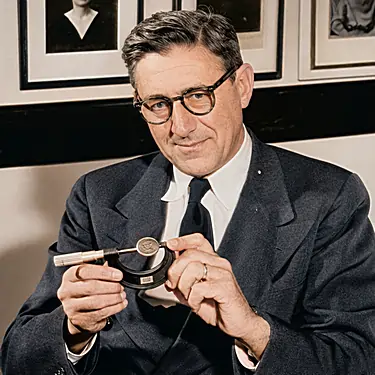
The pedigree gives the GreatCollections coin an importance that grade alone cannot provide.
GreatCollections lists the ownership chain as:
J. Colvin Randall; John M. Clapp; John H. Clapp; Louis E. Eliasberg, Sr.; the Stellar Collection; the Sunnywood Collection; Bob R. Simpson; and the Wizard collection.
The earliest link contains a small but noteworthy discrepancy.
GreatCollections dates Randall’s acquisition to 1893. Earlier Stack’s Bowers research places the acquisition in March 1894 and suggests that Randall may have obtained the coin through the Assay Commission.
Either account places the coin remarkably close to its production date.
John M. Clapp acquired the dollar in 1894. His son, John H. Clapp, later inherited the collection. In 1942, Louis E. Eliasberg, Sr. purchased the Clapp holdings intact.
That transaction helped Eliasberg pursue an unprecedented goal. He sought every United States coin by date, denomination, mint, and major variety that collectors then recognized.
The coin remained in the Eliasberg Collection until Bowers and Merena sold it in April 1997. It realized $198,000 in that sale.
Later owners included the Stellar and Sunnywood collections. Bob R. Simpson then acquired it. Legend Rare Coin Auctions sold the coin in October 2014 for $646,250.
The GreatCollections listing calls the most recent cabinet the “Wizard of Aus” Collection. Earlier auction records use “Wizard of Oz.” The difference appears to reflect catalog terminology rather than two separate ownership steps.
Four Gem Coins Share the Second Tier
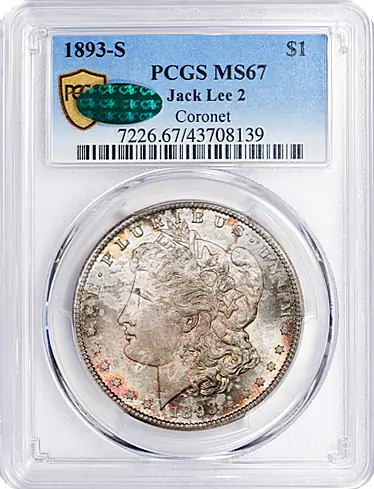
The lone PCGS MS67 Vermeule coin leads the Condition Census. GreatCollections sold that example for $2,086,875 on August 29, 2021. The price established an auction record for a Morgan Dollar and a company record for GreatCollections.
Below that coin, researchers have traced several PCGS MS65 examples.
They include the Larry H. Miller specimen, the Clapp-Eliasberg coin, the Elliott Goodman–Ralph and Lois Stone example, and the Amon G. Carter–Wayne Miller coin. PCGS has also reported another MS65 certification, although researchers have questioned whether that entry represents a fifth coin or a resubmission.
Therefore, the present coin shares the second-highest established grade tier. Its CAC approval and elite pedigree further separate it from the already tiny pool of Gem survivors.
Why Counterfeiters Target the 1893-S
The fame and value of the 1893-S have attracted counterfeiters for generations.
One common alteration starts with a genuine 1893 Philadelphia Morgan Dollar. Because Philadelphia coins carry no mintmark, an altered piece only needs a false “S” on the reverse.
Another method changes the final digit on an 1898-S dollar to create the illusion of an 1893-S.
Fortunately, specialists know the genuine dies well. The San Francisco Mint paired one obverse die with two reverse dies for the issue. Therefore, every authentic coin should display known diagnostics.
Both die marriages share the same obverse. Genuine pieces show a diagonal die-polishing line in the upper portion of the “T” in LIBERTY. They also show two small marks in the lower-left foot of the “R.” Specialists call those marks the “rabbit ears.”
Still, no single marker guarantees authenticity. Sophisticated counterfeiters can copy genuine coins and reproduce some diagnostics. Collectors should rely on several markers and purchase high-value examples in holders from leading authentication services.
The Coin That Escaped the Usual Fate
The 1893-S Morgan Dollar earned its royal nickname through more than a low mintage.
Its story links the silver politics of the Gilded Age with a national banking crisis. It also connects Western payrolls, Treasury vaults, the Pittman Act, and the rise of American coin collecting.
Most survivors tell that story through wear. Their surfaces record years of circulation.
The Clapp-Eliasberg coin tells another story.
It shows what the issue looked like before commerce erased the detail. Moreover, its pedigree reaches back to the moment when the coin still ranked as a new issue rather than a famous rarity.
That combination gives the coin its true “wow” factor. Collectors will not simply compete for an 1893-S Morgan Dollar on August 9. They will compete for one of the few Gem survivors—and for a coin that passed through some of the greatest collections in American numismatic history.
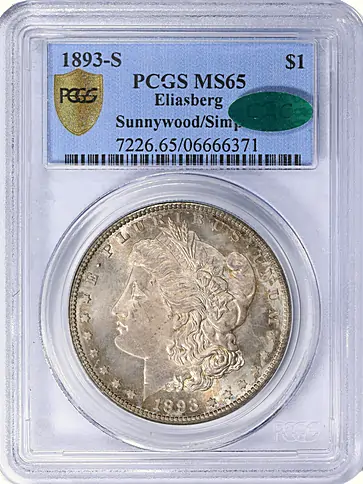
1893-S Morgan Dollar Specifications
- Country: United States
- Denomination: One Dollar
- Mint: San Francisco
- Mintage: 100,000
- Designer: George T. Morgan
- Composition: 90% silver and 10% copper
- Weight: 26.73 grams
- Diameter: 38.10 mm
- Edge: Reeded
- GreatCollections coin: PCGS MS65, CAC Green
- Auction closing: August 9, 2026, at 6:55 p.m. Pacific Time



I would love to have one of those beauties in my collection
Wow! That’s a very interesting story. It’d be great to have one.
Morgans rules!!!
I’d take a couple for my collection. Lol
Muhtesem gorunumlu 1882 and 1921 (One dollar) ve
Kennedy half dollars 1964 to 1969 series. Ilgilenirmisiniz?
What a story, and what a coin. Morgans are one of my favorite designs.