


Before Hollywood, The Odyssey Was Struck on Ancient Coins
By Mike Markowitz for CoinWeek
Tell me about a complicated man Muse, tell me how he wandered and was lost when he had wrecked the holy town of Troy, and where he went and who he met, the pain he suffered on the sea, and how he worked to save his life and bring his men back home.
— Odyssey, Book I [1]
Christopher Nolan’s The Odyssey has brought Homer’s ancient world back into popular culture. Yet for coin collectors, Odysseus, Homer, Scylla, the Sirens, and even the hero’s faithful dog have never completely disappeared.
They Survive in Metal
The legendary events surrounding the Trojan War belong to the Late Bronze Age. Ancient tradition usually placed the war in the 12th or 13th century BCE. Coinage, however, did not emerge in western Asia Minor until the seventh century BCE. Therefore, centuries separate the supposed age of Odysseus from the first coins.
Homer came later.
Tradition places the poet in or around the eighth century BCE, although scholars still debate when the Iliad and Odyssey reached something close to their surviving form [2]. Scholars also continue to debate whether one poet composed the works, whether several poets contributed, and how writing interacted with a long oral tradition.
Whatever the answer, later Greeks and Romans revered Homer. His poetry became part of their shared cultural inheritance.
Inevitably, Homer and the unforgettable characters of his epics found their way onto coins.
Homer: A Poet Claimed by Many Cities
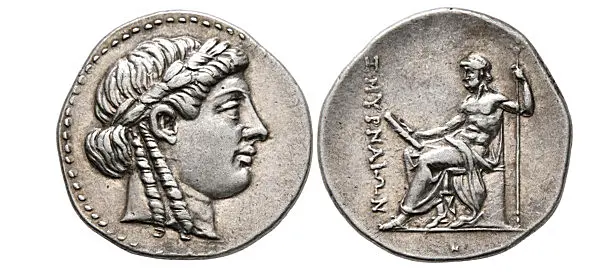
Many Greek cities and islands claimed Homer as their own. Ancient traditions connected him with Smyrna, Chios, Cyme, Colophon, Athens, and several other places. Meanwhile, the island of Ios developed a particularly strong tradition that Homer died there [3].
The rivalry even reached the coinage.
A magnificent silver drachm of Smyrna, today İzmir, Türkiye, dated to circa 190/189-180 BCE, depicts the bare-chested poet seated and holding a scroll. The 20 mm silver coin weighs 4.19 grams.
The obverse bears the laureate head of Apollo, god of poetry and music. Homer dominates the reverse.
Tradition describes Homer as blind. Nevertheless, the engraver gives him a scroll. That apparent contradiction opens another ancient mystery. Scholars still debate how literacy, writing, dictation, and oral performance contributed to the creation and preservation of the Homeric poems. The Odyssey itself certainly belongs to a culture in which oral performance remained fundamental.
Leu Numismatik called this drachm one of the finest known examples and praised its exceptional Hellenistic portrait of the poet. It hammered for CHF 26,000 in 2023, equivalent to more than $28,000 at the time [4].
For a poet who lived centuries before this coin appeared, Homer had become remarkably marketable civic property.
Another City Lays Claim
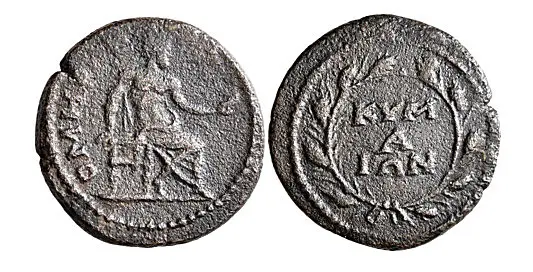
The ancient coastal city of Cyme, near modern Aliağa, Türkiye, made the same claim.
A Roman-era bronze assarion struck during the time of Commodus, circa 184-190 CE, shows Homer seated with a scroll. His name, OMHPOC, identifies him. The reverse places the name of Cyme inside an oak wreath [5].
The coin measures 20 mm and weighs 5.00 grams.
According to one tradition, Homer married Aresiphone, daughter of Gnotor of Cyme. Whether history or legend, the story strengthened the city’s connection with the poet.
Coins offered cities something monuments could not. They traveled.
Every Homer coin that left Cyme carried the city’s claim into markets, ports, military camps, and neighboring communities.
Ios and the Great Portrait of Homer
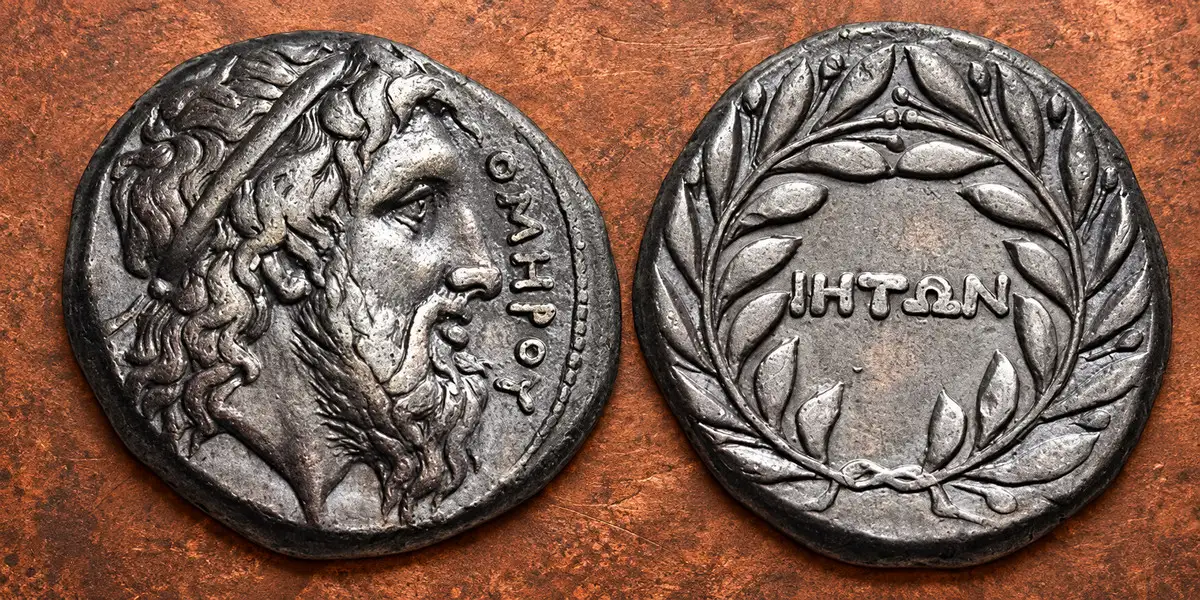
>From the BCD Collection, acquired in the early 1970s from a aspiring collector who had just inherited it from his father-in-law, who had, in turn, seemingly acquired it from his own father prior to World War I.
Ios had perhaps the most powerful Homeric claim of all: ancient tradition identified the small Cycladic island as the place where the poet died.
From the fourth through the second centuries BCE, Ios issued its own coins. Among them stands one of the masterpieces of Greek portraiture.
A rare silver didrachm of circa 325-300 BCE depicts an idealized bearded Homer wearing a simple taenia, or headband. The coin measures 19 mm and weighs 6.20 grams.
The reverse inscription, ΙΗΤΩΝ, means “of the people of Ios.”
Nomos described the coin as the “finest and most famous” numismatic portrait of Homer and praised its late Classical style. Formerly part of the celebrated BCD Collection associated with Greek numismatist Basil C. Demetriadi, the coin hammered for CHF 360,000 in a 2022 Swiss auction, or roughly $370,000 at the time [6].
That price reveals something important.
Collectors did not simply compete for an ancient silver coin. They competed for one of antiquity’s most powerful attempts to give a face to a man whose actual appearance remains completely unknown.
Argos: The Dog Who Waited 20 Years
…So Argos lay there dirty covered with fleas. And when he realized Odysseus was near, he wagged his tail, and both his ears dropped back. He was too weak to move towards his master…
…Twenty years had passed since Argos saw Odysseus and now he saw him for the final time, then suddenly black death took hold of him.
— Odyssey, Book 17 [7]
Few scenes in the Odyssey carry more emotional force.
Odysseus finally returns to Ithaca after 20 years away. He disguises himself as a ragged beggar. His household does not recognize him.
His old dog does.
Argos, once a powerful hunting dog, now lies neglected and dying. He recognizes his master, lowers his ears, wags his tail, and dies soon afterward [8].
Rome Put That Heartbreaking Moment on a Coin
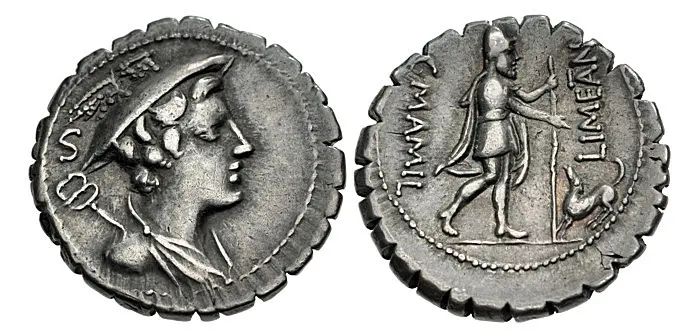
In 82 BCE, the Roman moneyer C. Mamilius Limetanus issued a silver serrate denarius showing Ulysses–the Roman name for Odysseus–approaching Argos.
Roman mint magistrates often came from ambitious aristocratic families. Their coin designs could advertise family traditions, famous ancestors, or legendary genealogies. The Mamilian family claimed descent from Mamilia, daughter of Telegonus, the legendary son of Odysseus and the goddess Circe [9].
That supposed family connection made Odysseus an ideal subject.
Mercury appears on the obverse. Greeks knew the same god as Hermes, who plays an important role as divine messenger and guide in the Odyssey.
The denarius also has a curious feature. Its edge carries a series of deliberate notches. Mint workers cut these into the blank before striking the coin.
Collectors call such pieces serrate denarii.
Why Rome produced serrated coins remains uncertain. Some numismatists argue that the cuts discouraged plated counterfeits by exposing the interior metal. However, ancient counterfeit serrate denarii also exist, so the practice did not provide foolproof protection.
Trajan Brings Argos Back
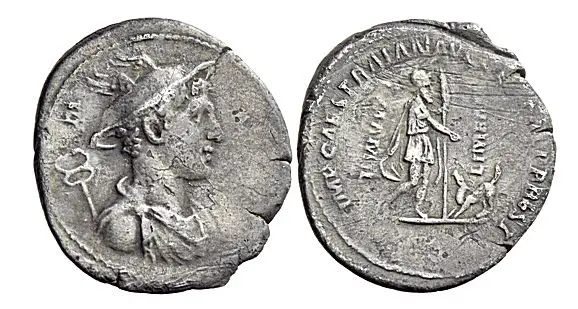
Nearly two centuries later, Rome returned to the same scene.
Emperor Trajan, who ruled from 98 to 117 CE, issued an extremely rare silver denarius that copied the earlier C. Mamilius Limetanus design [10].
Numismatists call these “restitution” coins because they revive types from Rome’s distant past.
The original serrated rim disappeared. Trajan’s version used a normal round flan. However, the essential imagery remained.
Mercury appears on the obverse. On the reverse, Ulysses approaches Argos.
A long inscription identifies Trajan and credits the old moneyer:
IMP CAES TRAIAN AVG GER DAC P P REST / C MAMIL LIMETAN
In expanded form, it names Emperor Caesar Trajan Augustus, conqueror of the Germans and Dacians, Father of the Country, and identifies the design as restored from C. Mamilius Limetanus.
One documented example measures 19 mm and weighs 2.99 grams.
At the time of this article’s research, only a tiny number of examples appeared in major auction databases. That rarity makes the Trajan restitution far more elusive than the Republican original.
Rome had revived not merely a coin design, but one of Homer’s most human stories.
Scylla: The Monster in the Strait
![Sextus Pompeius, 44-35 BC.Denarius circa 37-36 BC, Sicily. MAG PIVS - [IMP ITER] Galley with aquila on prow. In the background, pharos of Messana surmounted by statue of Neptune / [PRAEF ·ORAE · MARIT · ET · CLAS. · S. · C·] The sea monster Scylla wielding rudder with both hands. 3,91g. Crawford 511/4a; Sydenham 1348.](https://coinweek.com/wp-content/uploads/2026/09/6.webp)
— Odyssey, Book 12 [11]
Odysseus faced few choices worse than the passage between Scylla and Charybdis.
On one side lurked Charybdis, whose violent whirlpool could swallow a ship. On the other waited Scylla in a cliffside cave.
Later tradition often located the story in the Strait of Messina between Sicily and the Italian mainland.
Scylla also became a perfect symbol for a Roman admiral fighting for control of those same waters.
Sextus Pompey, son of Pompey the Great, controlled Sicily during the Roman Civil Wars that followed Julius Caesar’s assassination. He fought Caesar’s heir Octavian and used his naval power to challenge Rome.
A remarkable silver denarius struck in Sicily circa 37-36 BCE shows a galley and the Pharos of Messana on one side. Scylla dominates the other [12].
Here she appears with a woman’s upper body, fishlike lower extremities, and snarling dogs emerging from her waist. She raises a ship’s rudder like a club.
The imagery worked on several levels.
It evoked Homer. It advertised Sicily and the dangerous waters around Messana. Most importantly, it transformed an ancient sea monster into a symbol of Sextus Pompey’s naval power.
One documented example weighs 3.91 grams.
Sextus ultimately lost his war against Octavian. He fled east and was captured and executed in 35 BCE.
Scylla survived him.
Odysseus Fights Scylla Again
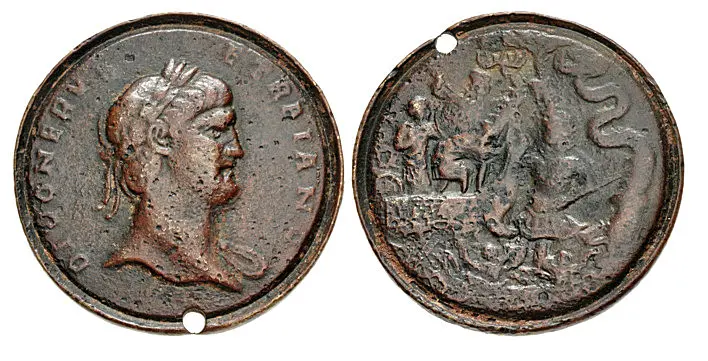
Centuries later, Roman artists returned to the monster.
Contorniates are large Roman bronze medallions produced mainly during the fourth and fifth centuries CE. A deep groove usually runs around their edge.
They were not ordinary money.
Their exact function remains debated. Scholars have suggested that Romans distributed them as gifts associated with public spectacles, including chariot races. Many carry portraits of earlier emperors, especially Nero and Trajan. Others depict famous cultural figures such as Homer, Solon, Euclid, and Socrates.
Some examples show piercing or heavy wear, which suggests that owners treasured, handled, displayed, or even wore them for long periods.
A late fourth-century contorniate gives the Odyssey spectacular treatment [13].
Its reverse shows Scylla attacking Odysseus’ ship. Three crewmen fight from the prow while two men struggle helplessly in the sea below.
The example measures 37.5 mm and weighs 23.53 grams.
This is no static portrait. It is an action scene.
More than a thousand years after the supposed age of the Trojan War, Homer’s monster still had the power to terrify.
The Sirens: Beauty That Kills
First you will reach the Sirens who bewitch all passersby. If anyone goes near them in ignorance and listens to their voices, that man will never travel to his home,
…The Sirens who sit there in their meadow will seduce him with piercing songs. Around about them lie great heaps of men, flesh rotting from their bones.
— Odyssey, Book 12 [14]
The Sirens make their first surviving literary appearance in the Odyssey.
Interestingly, Homer never tells us exactly what they look like.
Later Greek artists solved that problem for themselves. By the Archaic period, they commonly represented Sirens as creatures combining women and birds.
Their weapon was not brute strength. It was desire.
Their song drew sailors toward a deadly rocky shore. The men knew danger awaited them, but they wanted to hear the voices anyway.
Few ancient myths understood temptation better.
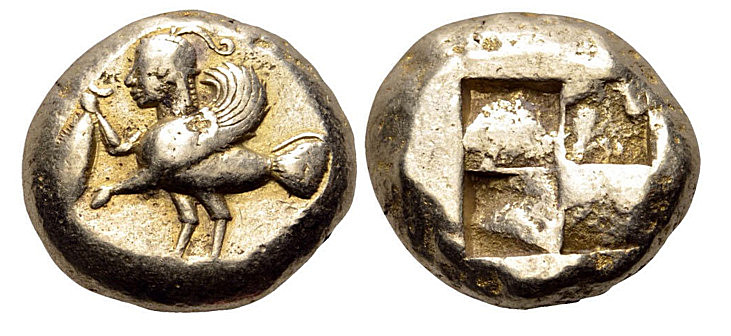
An exceptionally rare electrum stater of Kyzikos, dated to circa 550-500 BCE, shows a winged Siren standing left and holding a tunny fish [15].
The tunny served as Kyzikos’ famous civic emblem. It appears again and again on the city’s extraordinarily varied electrum coinage.
Roma Numismatics sold the cited example for £3,200 in 2017.
The combination is striking. One of Homer’s most seductive monsters holds the commercial symbol of one of the ancient world’s important trading cities.
Myth and money occupied the same tiny surface.
Ithaka: Home at the End of the World
…my Ithaca is set apart, most distant facing the dark, it is a rugged land, but good at raising children. To my eyes no country could be sweeter…
— Odyssey, Book 9 [16]
For all the monsters, gods, shipwrecks, enchantresses, and temptations of the Odyssey, Odysseus wants one thing above everything else.
He wants to go home.
That home is Ithaka, a rocky island in the Ionian Sea off the western coast of Greece. The island covers only about 37 square miles, or roughly 97 square kilometers.
Yet Ithaka became one of the most famous places in Western literature.
Its ancient coinage is extremely rare.
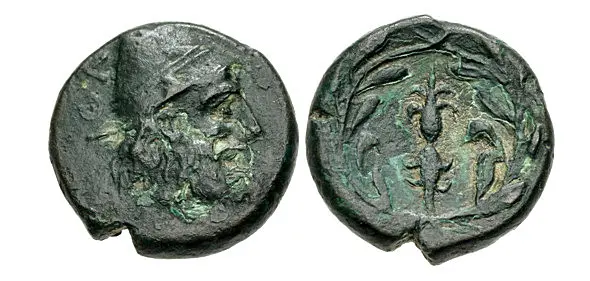
During the fourth and third centuries BCE, Ithaka issued several small bronze types. Some depict the head of Odysseus wearing his distinctive conical cap, known as a pilos or pileus.
One rare bronze type pairs Odysseus with a thunderbolt, the weapon of Zeus.
A particularly attractive example from the mid-to-late fourth century BCE measures 16 mm and weighs 3.69 grams. Classical Numismatic Group described it as Near Very Fine and “very rare.” It realized $4,750 in September 2024 [17].
Few ancient coins connect a legendary hero so directly with the place that defined his story.
Odysseus could wander through the entire known world.
Ithaka remained home.
Odysseus, or Another Hero?
I took the sheep and slit their throats above the pit. Black blood flowed out. The spirits came up out of Erebus and gathered round…
— Odyssey, Book 11 [18]
One of the strangest adventures in the Odyssey takes Odysseus to the edge of the world of the dead.
While he and his men remain on Circe’s island, she tells him that only Tiresias, the blind prophet who dwells among the dead, can tell him how to reach Ithaka.
Odysseus must summon the spirits.
He digs a pit. He sacrifices sheep. Their blood attracts the dead from Erebus.
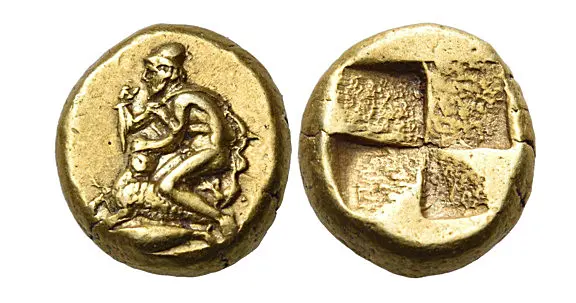
A tiny electrum hekte struck at Kyzikos between circa 450 and 330 BCE may show that eerie moment [19].
The coin measures just 11 mm and weighs 2.64 grams.
A male figure wearing a pilos and chlamys kneels over a ram. He pulls the animal’s head back with one hand while preparing to sacrifice it with a dagger held in the other.
But There is a Problem
The man may not be Odysseus.
He could instead represent Phrixus, another famous hero from Greek mythology [20]. Phrixus escaped death aboard the magical ram whose fleece later became the Golden Fleece sought by Jason and the Argonauts.
The uncertainty makes the coin even more fascinating.
Kyzikos used hundreds of coin designs, many with no obvious direct connection to the city. The tunny fish usually served as the identifying civic symbol.
The Nomos cataloguer explained the two possibilities:
“Unlike most Greek mints which used designs having to do with some aspect of the city’s history, mythology, economy, or religion, the mint at Kyzikos employed hundreds of designs with no direct or obvious connection to the city, with the exception of the tunny fish, which represented the wealth of the city… This wonderful coin depicts probably either Odysseos or Phrixus in the act of sacrificing a ram to the gods. If Odysseos, who is often depicted wearing a pileus as is the case on this coin, the ram was provided by Circe before descending into Hades.” [21]
The coin hammered for CHF 6,000 in 2023.
And its identity remains open to interpretation.
Homer’s World in the Palm of Your Hand
The Odyssey predates coinage by centuries. Homer himself, if there was a single historical Homer, could never have imagined his characters circulating through the ancient world on silver, bronze, and electrum.
Yet that is exactly what happened.
Greek cities used Homer to proclaim cultural prestige. Roman aristocrats used Odysseus to advertise legendary ancestry. Sextus Pompey transformed Scylla into naval propaganda. Later Romans revived old Homeric designs centuries after the original coins had disappeared from circulation.
Even the smallest details endured.
The cap of Odysseus, the song of the Sirens, the jaws of Scylla, a sacrificed ram, and an old dog waiting 20 years for his master to come home.
Coins can preserve rulers, battles, gods, and empires. But in this case, we have preserved something even larger.
We preserved the stories.
References
- Greensmith, Emma (editor). Cambridge Companion to Ancient Greek Epic. Cambridge (2024).
- Harris, William. Ancient Literacy. Cambridge, MA (1989).
- Hexter, Ralph. A Guide to The Odyssey: A Commentary on the English Translation of Robert Fitzgerald. New York (1993).
- Osborne, Robin. Greece in the Making: 1200-479 BC. London (1996).
- Rieu, E. V. (translator). The Odyssey. London (1946).
- Sear, David. Greek Coins and Their Values. London (1978).
- Wilson, Emily (translator). Homer. The Odyssey. New York (2018).
Citations
[1] Wilson (2018), page 105.
[2] See discussion of Homeric chronology and composition in modern scholarship; A. M. Bowie, “History of the Text,” Homer: Odyssey Books XIII and XIV, Cambridge University Press (2014).
[3] Davide Tronchin, “Sacred Law from Ios in Homer’s Honour,” Axon, Vol. 6 (2022).
[4] Leu Numismatik Auction 13, May 27, 2023, Lot 122. Hammer price: CHF 26,000.
[5] Leu Numismatik Web Auction 13, August 15, 2020, Lot 851.
[6] Nomos Auction 24, May 22, 2022, Lot 152.
[7] Wilson (2018), pages 396-397.
[8] Homer, Odyssey 17; see also Perseus commentary on Argos and the recognition of Odysseus.
[9] https://en.wikipedia.org/wiki/Mamilia_gens
[10] Roma Numismatics Auction XIX, March 26-27, 2020, Lot 825. Trajan restitution issue of C. Mamilius Limetanus; hammer price £2,800.
More….
[11] Wilson (2018), page 304.
[12] Numismatica Genevensis Auction 22, November 24, 2025, Lot 151. Hammer price: CHF 4,500.
[13] CNG Auction 127, September 17, 2024, Lot 638. Hammer price: $900.
[14] Wilson (2018), page 302.
[15] Roma Numismatics E-Sale 38, July 29, 2017, Lot 214. Hammer price: £3,200.
[16] Wilson (2018), page 241.
[17] CNG Auction 127, September 17, 2024, Lot 132. Hammer price: $4,750.
[18] Wilson (2018), page 280.
[19] Nomos Auction 30, November 6, 2023, Lot 1324. Hammer price: CHF 6,000.
[20] https://en.wikipedia.org/wiki/Phrixus
[21] Nomos Auction 30, November 6, 2023, Lot 1324.






Gorgeous coins, amazing history, well-researched, and timely.
Such treasures!!
It is amazing how Greek mythology endured in coinage from so many different areas and time periods. Wonderful pictures. Wonderful article.
I love browsing these articles. The history is awesome!
Very interesting read on the influence of the Odyssey on ancient coinage.
Great work on this, fascinating.
The history of these coins is amazing