

Gold From a 45-Minute Disaster: The 1836 Half Eagle of the S.B. Pulaski
An 1836 Classic Head Half Eagle recovered from the S.B. Pulaski carries two remarkable histories. One began at the Philadelphia Mint. The other ended beneath the Atlantic only two years later.
A gold coin can survive generations of commerce and still tell a story. However, an 1836 $5 Classic Head Half Eagle from the S.B. Pulaski tells something far more dramatic.
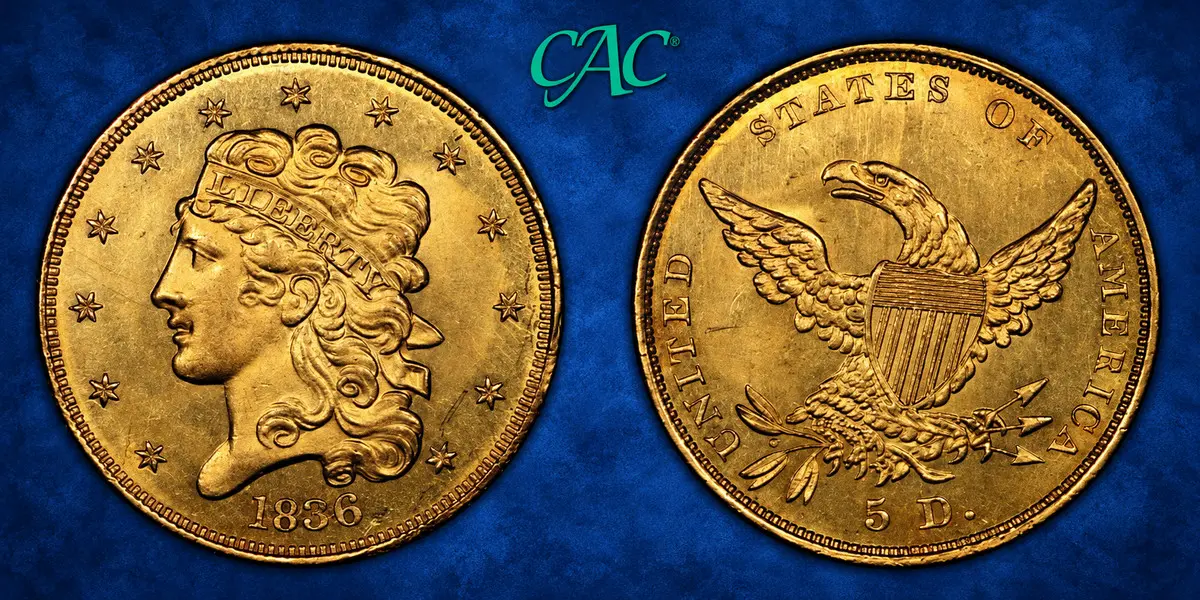
The United States Mint struck the coin in Philadelphia during a major transformation of the nation’s gold coinage. Then, only about two years later, someone carried it aboard one of America’s most luxurious early steam packets.
That journey ended catastrophically.
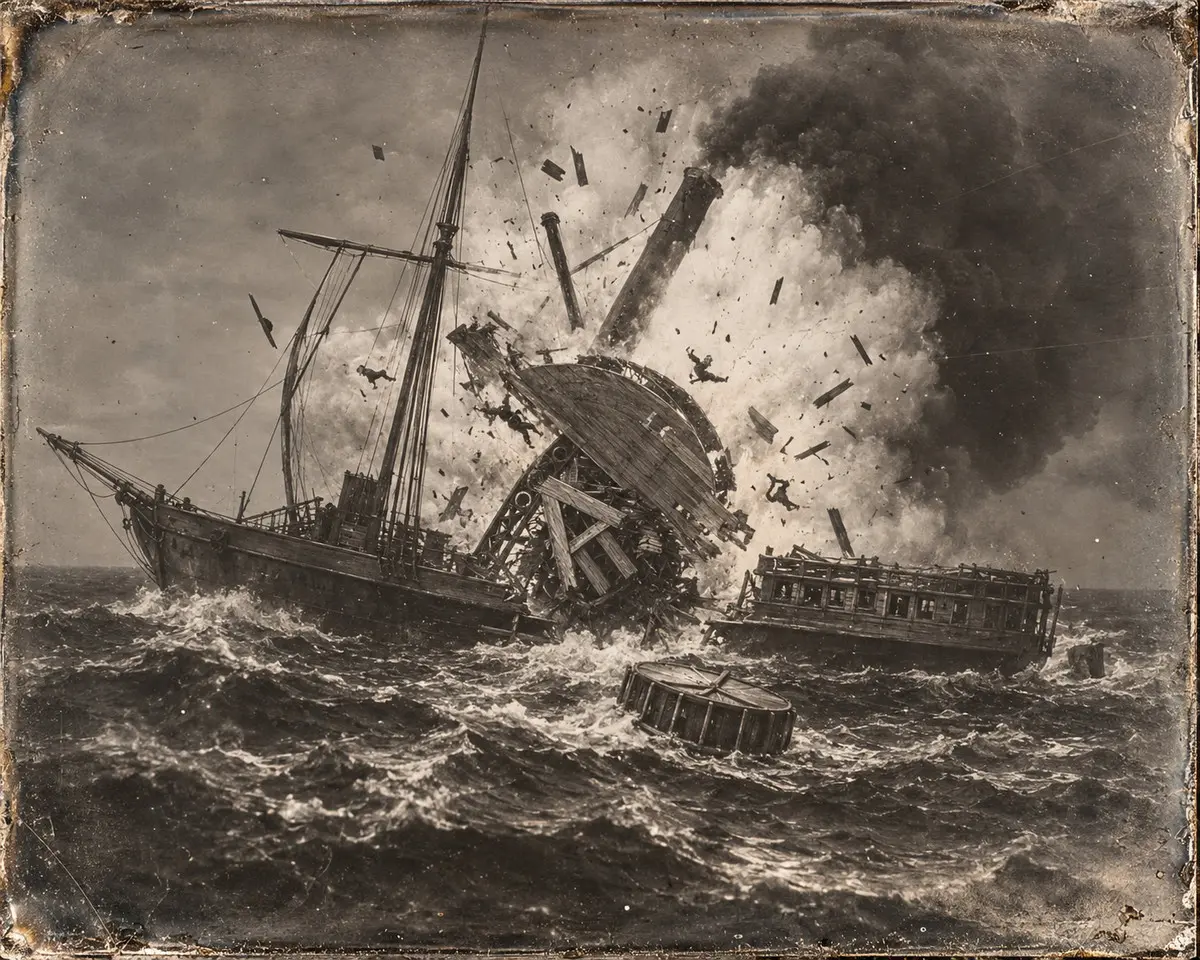
On the night of June 14, 1838, the S.B. Pulaski suffered a boiler explosion off the North Carolina coast. The blast ripped through the vessel. The ship broke apart and disappeared beneath the Atlantic in roughly 45 minutes.
The coin went with it.
There it remained for nearly 180 years.
That extraordinary provenance makes a Pulaski half eagle more than an early U.S. gold coin. It represents a frozen moment in American life just before the Civil War era, when domestic gold coins shared everyday commerce with Spanish, Mexican, British, and other foreign money.
And unlike treasure ships loaded with commercial bullion, the Pulaski carried wealth that belonged largely to the people aboard.
The Luxury Steamship That Became a National Tragedy
John A. Robb & Co. built the Pulaski in Baltimore in 1837 for the Savannah and Charleston Steam Packet Company. The ship carried passengers, cargo, and mail between the South and Baltimore. The company equipped the new vessel for an affluent clientele at a time when regular steamship travel still represented cutting-edge transportation.
The passenger list reflected that market. Prominent families and wealthy travelers frequently used the route to escape the Southern summer for northern destinations.
The Pulaski began its final northbound voyage from Savannah on June 13, 1838. After a stop in Charleston, it continued toward Baltimore.
At about 11 p.m. on June 14, disaster struck.
The starboard boiler exploded while the vessel traveled roughly 40 miles off North Carolina. The explosion destroyed the ship’s central section. Contemporary accounts reported that the Pulaski went down about 45 minutes later. Only 59 people survived. Historical sources generally place the death toll at approximately 128.
The catastrophe shocked the nation. Blue Water Ventures notes that contemporary newspapers described it as among the worst disasters ever to strike the American coast. More than a century later, Discovery Channel would use the title “America’s Titanic” for an Expedition Unknown episode devoted to the wreck.
Yet the Pulaski disappeared before the age of underwater archaeology could recover its story.
For generations, the Atlantic kept it.
Nearly 180 Years Later, Gold Returned to the Surface
The modern search accelerated in 2017.
Endurance Exploration Group, through the Swordfish Partners venture, conducted surveys of a suspected wreck site off North Carolina. Blue Water Ventures International later joined the recovery effort. Operations began at the site in late 2017, at a depth of roughly 120 feet.
Then came the coins.
In January 2018, the recovery team announced the discovery of early U.S. and foreign silver coins, followed by gold. But coins alone could not prove the wreck’s identity.
The decisive evidence soon followed.
In May 2018, Blue Water Ventures announced that divers had recovered artifacts carrying the Pulaski name, including a candlestick holder marked “SB Pulaski” and a numbered brass tag. Those objects established the wreck’s identity.
Suddenly, one of America’s great 19th-century maritime disasters had returned to the surface.
This Was Not a Bank’s Gold Shipment
That distinction gives the Pulaski coins much of their historical power.
The famous S.S. Central America, for example, carried enormous quantities of commercial gold when it sank in 1857. The Pulaski presents a different story.
Endurance Exploration described the lost treasure in SEC filings as passenger valuables, with contemporary estimates placing their face value near $150,000 at the time of the wreck. One survivor, Charles Ridge, reportedly lost $20,000 in gold coins alone.
Therefore, many Pulaski coins may represent the actual money that travelers carried with them.
That matters.
A Pulaski half eagle did not simply sit inside a bank shipment. Someone may have placed it in a pocket, purse, trunk, or strongbox before boarding the ship.
In effect, the wreck preserved a sampling of money that Americans actually used in the 1830s.
Recovery teams found U.S. gold half eagles and silver coins alongside money from Spain, Mexico, Great Britain, and elsewhere. Foreign coins still played an important role in American commerce, and federal law recognized several foreign gold issues as legal tender.
By September 2018, the recovery team reported more than 500 gold and silver coins from the wreck. The first 502 later went to the market through a commercial sale. Additional recovery seasons produced more coins and artifacts.
Numismatic Conservation Services and Numismatic Guaranty Company handled the initial conservation, attribution, grading, and encapsulation program. NGC created a special Pulaski certification label featuring an engraving of the ship.
Later PCGS-certified Pulaski pieces also entered the market with the shipwreck pedigree.
The 1836 Half Eagle Was Already a Revolutionary Coin
The shipwreck story alone would make the coin fascinating.
However, the 1836 Classic Head Half Eagle carries another important history.
By the early 1830s, America’s gold coinage had a serious economic problem. The gold inside many older U.S. coins had become worth more in international trade than the coins’ stated face value.
As a result, gold coins frequently left American circulation through export or melting.
Congress responded with the Act of June 28, 1834.
The law reduced the half eagle’s standard weight to 129 grains and its pure gold content to 116 grains. The change altered the relationship between the coin’s bullion value and its five-dollar face value. Consequently, the new gold pieces had a far better chance of remaining in domestic circulation.
The United States Mint also needed collectors and merchants to distinguish the lighter new coins from the older gold pieces.
Chief Engraver William Kneass supplied the answer.
A New Liberty, and No E PLURIBUS UNUM
Kneass created what collectors now call the Classic Head design.
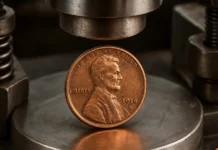
Liberty faces left on the obverse. Curly hair surrounds her portrait, while a headband carries the word LIBERTY. Thirteen stars encircle the portrait, with the date below.
The reverse shows an eagle with a shield across its breast. An olive branch and arrows appear below.
Most importantly, the Mint removed E PLURIBUS UNUM from the reverse.
That omission helped distinguish the new, lighter gold coinage from the earlier standard. The Classic Head Half Eagle lasted only from 1834 through 1838 before Christian Gobrecht’s Liberty Head design replaced it in 1839.
The Philadelphia Mint struck 553,147 half eagles in 1836. PCGS identifies nine recognized die marriages for the date.
Lost When It Was Almost New
Here the two stories collide.
Philadelphia struck the Pulaski’s 1836 half eagles only about two years before the wreck.
That short period matters enormously.
Many surviving Classic Head gold coins spent years circulating. Others disappeared through melting. Wear softened Liberty’s curls, flattened the eagle, and marked the fields.
The Pulaski interrupted that process.
Certainly, the ocean did not preserve every recovered coin equally. Silver and base-metal coins can suffer severe saltwater damage. Yet several Pulaski gold coins emerged in remarkable Mint State condition.
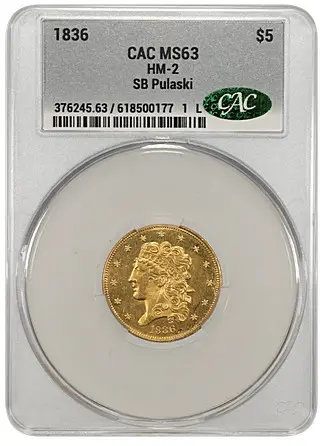
NGC highlighted an 1836 $5 graded MS63+ when it announced the Pulaski conservation program. Heritage later sold other Pulaski-pedigreed 1836 half eagles in lofty Mint State grades.
One particularly important example illustrates the combination of condition, die variety, and provenance.
In January 2025, Heritage Auctions sold an 1836 HM-2 Classic Head Half Eagle graded NGC MS64 with CAC approval and an S.B. Pulaski pedigree for $28,800. Heritage described the coin as a condition-census example of the scarce HM-2 die marriage.
That price also reveals something important about shipwreck coins.
Collectors do not simply buy the metal.
They buy the story.
1836 Classic Head $5 Half Eagle Specifications
- Denomination: $5 Half Eagle
- Date: 1836
- Series: Classic Head Half Eagle
- Designer / Engraver: William Kneass
- Mint: Philadelphia
- Mintmark: None
- Mintage: 553,147
- Composition: 89.92% gold, balance alloy
- Weight: 8.36 grams
- Actual Gold Weight: Approximately 0.24169 troy oz.
- Diameter: 22.50 mm
- Edge: Reeded
- Obverse: Liberty facing left with LIBERTY headband
- Reverse: Eagle with shield, olive branch, and arrows
- Motto: No E PLURIBUS UNUM
Specifications align with PCGS, Heritage Auctions, and the statutory gold standard Congress established in 1834.
A Coin That Turns Provenance Into History
Collectors often use the word provenance to describe ownership history.
The S.B. Pulaski pedigree goes much further.
An 1836 Pulaski half eagle connects the collector directly to the American economy of the 1830s. It represents Congress’ attempt to keep U.S. gold coins circulating. It shows William Kneass’ short-lived Classic Head design in the form Americans actually carried.
Then history adds another layer.
Someone took that five-dollar gold piece aboard the Pulaski.
The boiler exploded.
The ship vanished.
And instead of circulating for another decade, disappearing into a melting pot, or passing anonymously through generations of commerce, the coin settled onto the Atlantic floor in 1838.
Nearly 180 years later, divers brought it back.
That combination of early American gold, extraordinary preservation, personal passenger wealth, and a documented maritime tragedy gives the S.B. Pulaski 1836 Half Eagle something that no mintage figure or population report can measure.
It survived a 45-minute disaster, and then carried its story with it.

Very interesting article about the 1836 Classic Head Half Eagle.
Always liked these Classic Pieces.