


The 1869 Rainbow $2 Bill: America’s Forgotten Masterpiece
The 1869 Rainbow $2 bill introduced Thomas Jefferson to the federal two-dollar denomination. More than 150 years later, his engraved portrait still anchors America’s modern $2 bill.
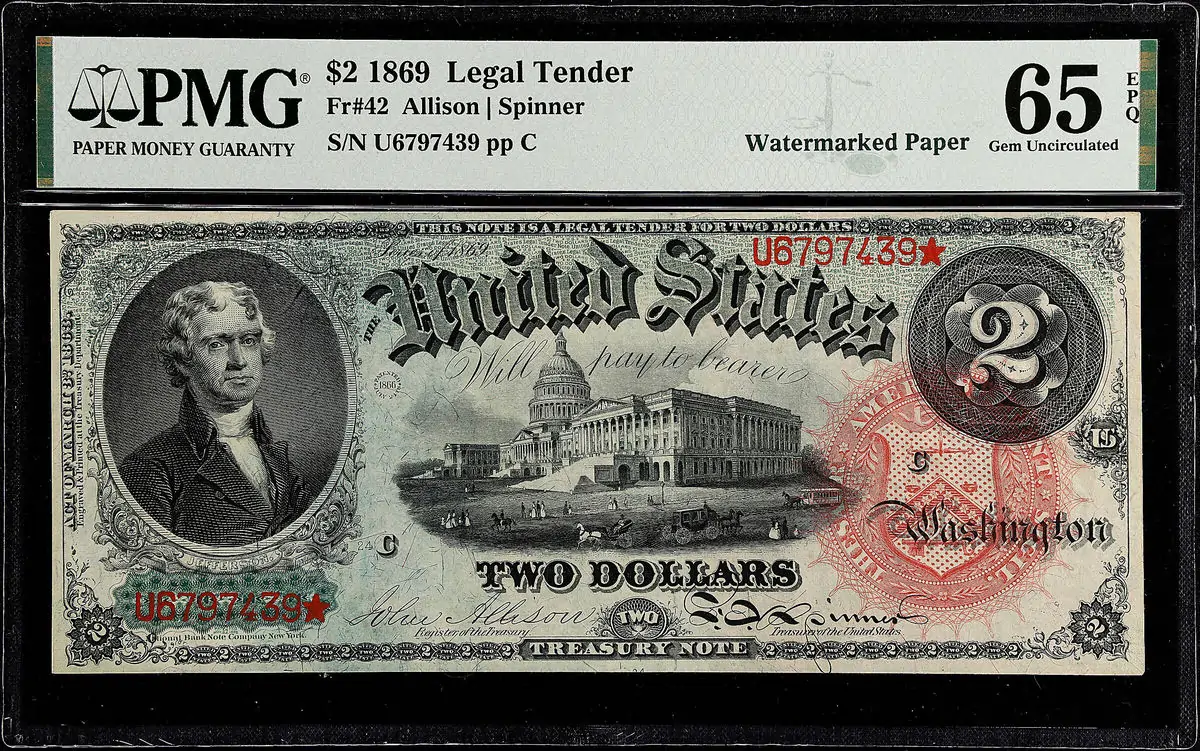
Yet the portrait tells only part of the story.
The note also presents a detailed view of the United States Capitol. Moreover, red, blue, green, and black elements animate the design. Complex engraving fills nearly every open space. Still, the note never feels crowded.
The result ranks among the great artistic achievements of American paper money.
American Paper Money Once Embraced Bold Design
United States paper money has favored consistent designs for much of the past century. However, 19th-century currency followed a very different path.
Federal notes often combined portraits, historical scenes, allegorical figures, intricate borders, and experimental security devices. Engravers treated each denomination as a separate work of art.
The Series of 1869 Legal Tender Notes pushed that approach even further. Collectors now call them Rainbow Notes because their faces combine green, blue, and red hues. Printers also used blue-tinted security paper that followed a patent issued to inventor James M. Wilcox in 1866.
The federal government released notes from the series between October 19, 1869, and July 25, 1874.
The Rainbow Note Series Included Nine Denominations
The full Series of 1869 included nine denominations:
The $1 featured George Washington. The $2 featured Thomas Jefferson. The $5 featured Andrew Jackson. Meanwhile, the $10 carried Daniel Webster’s portrait. The $20 showed Alexander Hamilton. The $50 honored Henry Clay. The $100 featured Abraham Lincoln.
The series then continued with a $500 note featuring John Quincy Adams and a $1,000 note featuring DeWitt Clinton.
Collectors often call the $10 the Jackass Note. An eagle appears near the bottom of its face. When someone turns the note upside down, the eagle can resemble a donkey’s head.
Each denomination offers a distinct composition. However, the $1, $2, and $5 notes stand apart. Of those three, the 1869 $2 bill may offer the most balanced and inviting design.
A Remarkable View of the United States Capitol
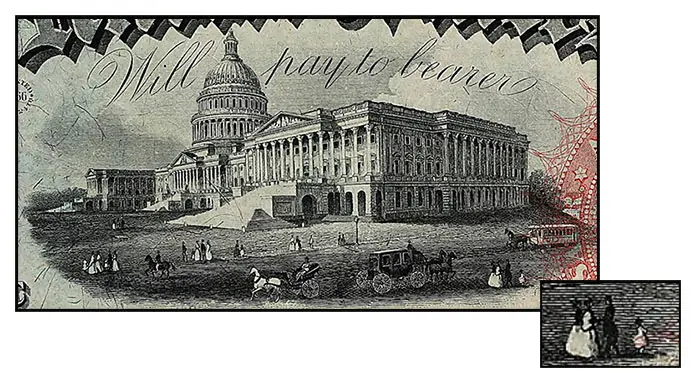
The note places the United States Capitol at its center.
The scene does more than document a building. It presents Washington as a living city.
Clouds hang over the Capitol grounds. Horses and carriages move through nearby streets. Pedestrians cross the foreground. Children and adults gather in small groups.
One tiny scene appears to show a man greeting a woman while a young girl plays nearby. These figures add warmth to an otherwise formal government image.
The engravers also understood scale. The Capitol dominates the composition. However, the people, vehicles, trees, and streets give the building a sense of place.
Consequently, the vignette works as both an architectural portrait and a snapshot of daily life.
Jefferson Makes His Federal $2 Debut
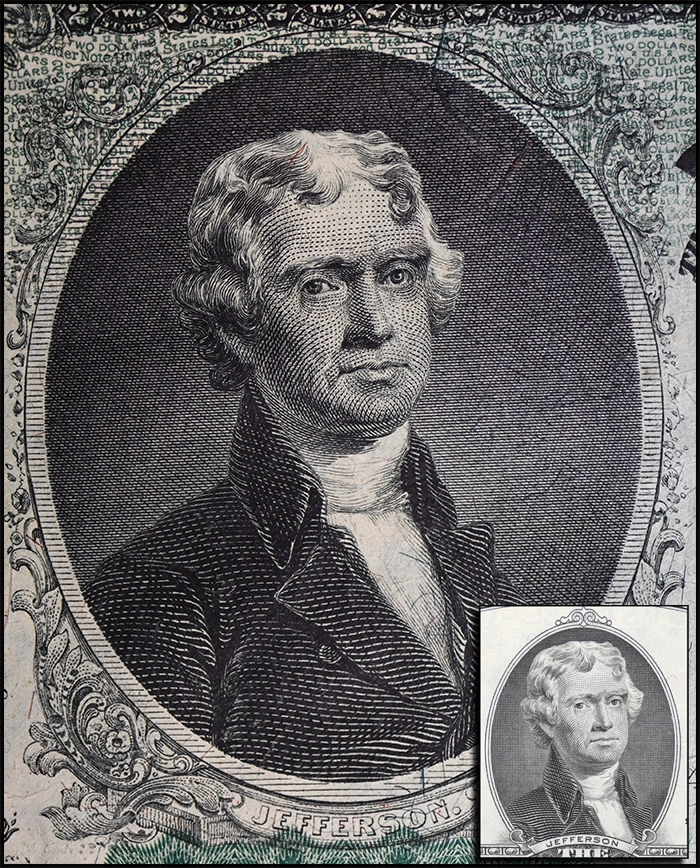
Thomas Jefferson appears inside an oval frame on the left side of the note.
The first federal $2 United States Note, issued in 1862, featured Alexander Hamilton. The Series of 1869 replaced Hamilton with Jefferson. Therefore, the 1869 issue marked Jefferson’s first appearance on the federal two-dollar denomination.
The Bureau of Engraving and Printing credits Charles K. Burt with the Jefferson portrait. Burt based the likeness on a portrait by Gilbert Stuart. The engraved image faces the opposite direction from Stuart’s familiar composition.
Most importantly, Burt’s engraving created a lasting visual identity.
The BEP also credits Burt with the Jefferson portrait on later $2 United States Notes and modern $2 Federal Reserve Notes. As a result, today’s note continues a portrait tradition that began in 1869.
The government later cropped and standardized the image. Nevertheless, Jefferson’s expression, hair, clothing, and general pose remain unmistakable.
What Happened to the James Smillie Attribution?
The earlier CoinWeek article credited James Smillie with the entire design. However, the Bureau of Engraving and Printing’s historical record does not support that attribution. Looks like we were wrong.
The BEP identifies the overall designer as unknown. It credits Charles K. Burt with Jefferson’s portrait. It also credits Louis Delnoce and William Chorlton with the Capitol vignette.
James Smillie still holds an important place in American engraving history.
Smillie entered the world in Edinburgh, Scotland, in 1807. He later moved to Quebec and then established his career in New York. He worked as an engraver and produced major landscape prints. His sons James David Smillie and George Henry Smillie also pursued successful artistic careers.
However, those facts do not establish his authorship of the 1869 $2 note,unless new primary documentation emerges.
The 1869 Rainbow $2 Bill Fought Counterfeiters With Art
The note’s beauty served a practical purpose.
Counterfeiters could copy simple images and plain lettering. However, they struggled to reproduce complex geometric engraving with precision. Therefore, banknote designers filled the 1869 $2 bill with fine lines, patterned counters, microlettering, and layered color.
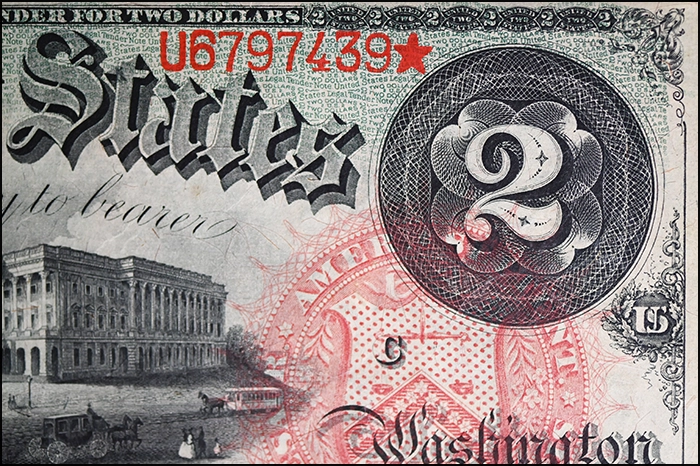
Engravers used elaborate lathework, often called guilloché, across both sides of the note. The face places a large numeral 2 inside an intricate circular counter at the upper right.
The engraver rendered parts of this counter in negative. Blank lines form the web while dark ink fills the background. Meanwhile, the reverse uses positive linework across its large denomination counters.
The face also includes a prominent red Treasury Seal. Green security printing crosses other parts of the design. In addition, a flowing line of small text alternates between UNITED STATES LEGAL TENDER NOTE and TWO DOLLARS.
Each feature added another obstacle for counterfeiters.
Two Companies Left Their Names on the Note
The original article only discussed the American Bank Note Company credit. However, the note identifies two private banknote companies.
The face carries the imprint NATIONAL BANK NOTE COMPANY NEW YORK. It also states that the Treasury Department engraved and printed the note.
The reverse carries the AMERICAN BANK NOTE COMPANY, NEW YORK imprint along the lower edge.
These credits reflect the complicated transition from private banknote production to greater federal control. The Treasury drew from dies, plates, and technical expertise that private security printers had developed.
The Reverse Turns Security Printing Into Design
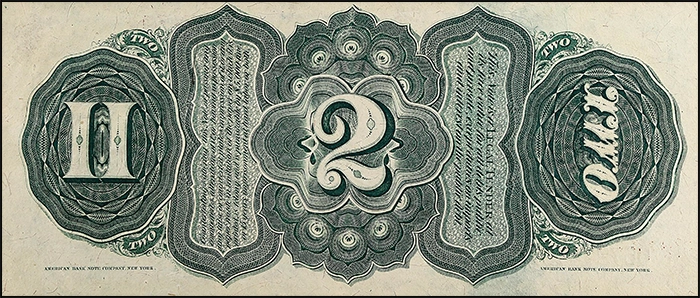
The back uses green ink almost exclusively. Yet the single-color design carries enormous visual energy.
Large geometric counters divide the composition into three main sections.
A Roman numeral II appears at left. An Arabic numeral 2 dominates the center. Finally, the word TWO runs vertically at right.
Scalloped borders surround each form of the denomination. The central counter resembles a peacock’s spread tail. Smaller patterns fill the remaining spaces.
The intricate work never overwhelms the note. Instead, the patterns guide the viewer from one denomination marker to the next.
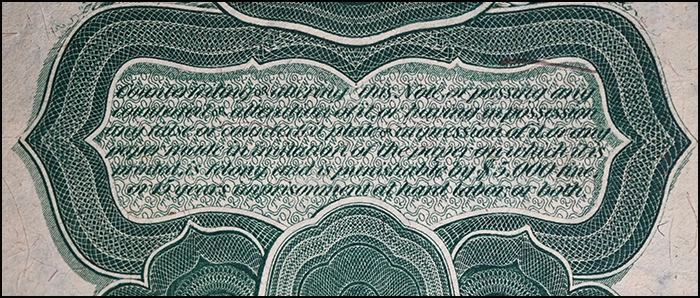
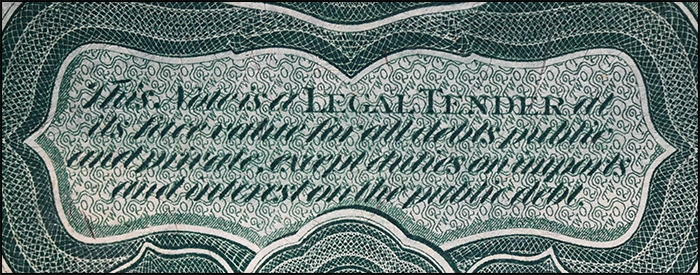
The reverse also carries two important legal notices. One warns counterfeiters. The other explains the note’s legal-tender status.
The Counterfeit Warning Threatened a Severe Penalty
The counterfeit warning uses extremely small lettering. Moreover, an ascending pattern of the word TWO and the numeral 2 runs behind the text.
The warning covers several crimes. It addresses anyone who counterfeits or alters the note. It also covers anyone who knowingly passes an altered note.
In addition, the provision targets anyone who possesses a false plate, a counterfeit impression, or paper that imitates the genuine note stock.
The law treated those acts as felonies. It authorized a $5,000 fine, 15 years of imprisonment at hard labor, or both.
The original transcription contained several errors. It used “paperer stock” instead of “paper made.” It also used “printing” where the note says “printed.”
These small corrections matter. Paper-money researchers often rely on exact inscriptions to identify designs and varieties.
What “Legal Tender” Meant in 1869
The second notice explains how owners could use the note.
The government accepted the note at face value for most public and private debts. However, it excluded two important obligations.
People could not use the note to pay duties on imports. They also could not use it to pay interest on the public debt.
Federal law required specie for those payments. In other words, the payer needed coin rather than ordinary United States Notes. Gold coin handled much of that role, although the legal category also covered qualifying silver coin.
Therefore, the earlier statement that those obligations required only gold went too far. Coin or specie provides the more accurate description.
Modern United States currency no longer carries this limitation.
What Is an 1869 Rainbow $2 Bill Worth?
The 1869 Rainbow $2 bill carries the Friedberg catalog number Fr. 42. However, no single price can cover every example.
Grade plays a major role. So do margins, color, paper originality, repairs, stains, and overall eye appeal.
The PMG Gem Uncirculated 65 EPQ example in CoinWeek’s earlier article brought $31,200 in Stack’s Bowers’ March 23, 2023 auction. The Stack’s Bowers catalog confirms the note’s grade and its placement in that sale.
However, collectors should not treat that result as a standard price for every Gem note.
Recent auction records reveal a broad market:
A PMG Very Fine 20 example brought $1,129 at Heritage in April 2026. A PMG Very Fine 25 brought $2,562 one month earlier. Meanwhile, a PMG Choice Very Fine 35 sold for $2,196 in February 2026.
At higher levels, a PMG About Uncirculated 50 brought $6,100 in April 2026. A PMG Choice About Uncirculated 58 EPQ sold for $9,150 in January. A PCGS Banknote Gem Uncirculated 65 PPQ brought $14,030 during that same month.
At the top end, Stack’s Bowers sold a PCGS Banknote Gem Uncirculated 66 PPQ example for $31,200 in April 2025.
Therefore, the original market summary still works as a rough starting point, but it needs context. A problem-free Very Fine note can sell for slightly more than $1,000. However, stronger color, better margins, original paper, and premium-quality designations can lift the price sharply.
Likewise, lower-Uncirculated notes can enter the market in the mid-four figures. Yet Choice and Gem examples often command far more.
A Warning for New Collectors
Collectors should approach the 1869 Rainbow $2 bill with caution.
The danger does not involve authenticity alone. Instead, this note can open the door to an expensive new pursuit.
First comes the $2. Then the matching $1 or $5 begins to look essential. Soon, the collector starts studying large-size Legal Tender Notes, Educational Notes, Treasury Notes, Silver Certificates, and National Bank Notes.
That path can become long and costly.
However, it also leads to some of the most artistic objects that the United States ever placed into circulation.
Why the 1869 Rainbow $2 Bill Still Matters
The 1869 Rainbow $2 bill combines portraiture, architecture, security printing, and storytelling.
Charles K. Burt’s Jefferson portrait established a visual tradition that continues today. Meanwhile, Louis Delnoce and William Chorlton turned the Capitol into a bustling national scene.
The complex counters and colored security work fought counterfeiters. The legal inscriptions documented the financial rules of the Civil War era. Finally, the small figures near the Capitol gave the design a human dimension.
Few American notes accomplish so much within such a small space.
That achievement makes the 1869 Rainbow $2 bill more than an attractive collectible. It makes the note an American masterpiece.




Enjoyed this read good information thanks .
They don’t make currency like this anymore. Good article I learned something new today. I love the “artwork and design” on this bill.
Great Designs from 1869 how some traits were incorporated in
The modern $2 bill. Thomas Jefferson would be proud to represent
A monetary mark in American History
Very interesting story on the 1869 Rainbow two dollar bill.
I need this
What an unbelievable bill