

1938-D/S Buffalo Nickel: History, Varieties and Value
The 1938-D/S Buffalo Nickel presents an immediate mystery. The United States Mint struck no Buffalo Nickels at San Francisco in 1938. Yet traces of an “S” appear beneath the Denver “D” on this famous variety.

That contradiction has fascinated collectors for more than 60 years.
Moreover, the coin appeared during a major transition in American coinage. The Buffalo Nickel had reached the end of its 25-year run. Meanwhile, the United States Mint prepared to introduce the Jefferson Nickel.
As a result, the 1938-D/S Buffalo Nickel connects two important eras. It also offers collectors a dramatic example of how Mint employees corrected working dies before the modern production process eliminated hand-punched mintmarks.
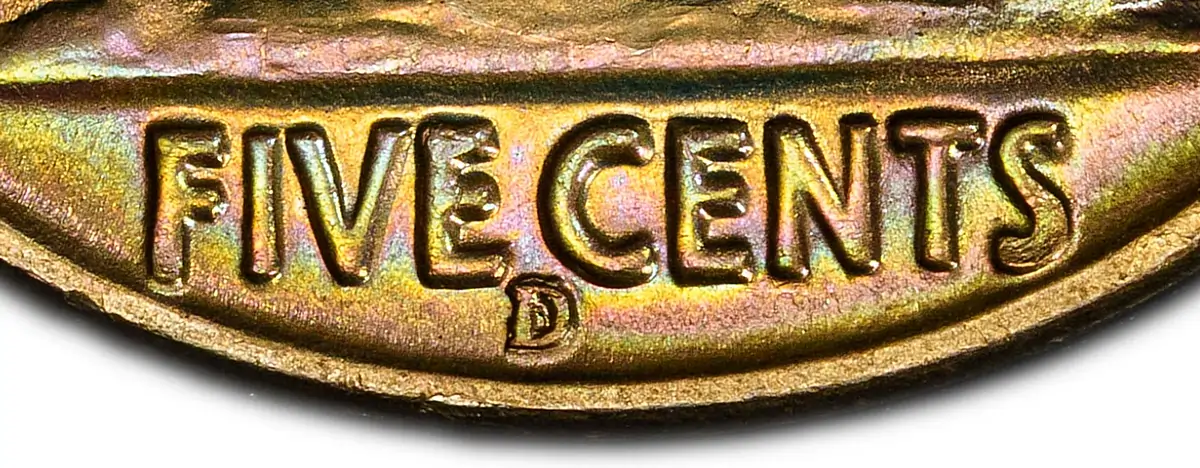
A Final-Year Buffalo Nickel Variety
James Earle Fraser designed the Buffalo Nickel, which the Mint produced from 1913 through 1938. The series includes several major varieties. These include the 1918/7-D overdate, the 1916 doubled-die obverse, and the celebrated 1937-D Three-Legged Buffalo.
However, the 1938-D/S stands apart.
The Denver Mint struck the entire 1938 Buffalo Nickel mintage of 7,020,000 coins. Each coin contains 75% copper and 25% nickel. It weighs 5 grams and carries a plain edge. Fraser designed both sides.
The D/S variety forms only a small part of that total mintage. Therefore, collectors should not confuse the 7,020,000 figure with the number of over-mintmark coins produced.
Why It Is an Over-Mintmark, Not an Overdate
Collectors sometimes use the terms overdate and over-mintmark interchangeably. However, they describe two different production events.
An overdate shows one date over another. The 1918/7-D Buffalo Nickel provides the best-known example in this series. Its die received impressions from hubs carrying two different dates.
In contrast, the date on the 1938-D/S remained unchanged. The variety appears only around the mintmark.
Therefore, numismatists classify it as an over-mintmark, or OMM. More specifically, a Denver “D” sits over an earlier San Francisco “S.”
Mint employees still punched mintmarks into individual working dies by hand during this period. The process often required more than one blow. Consequently, misplaced, repunched, and overpunched mintmarks could enter production.
How Did the 1938-D/S Buffalo Nickel Happen?
The standard explanation begins with reverse dies that carried San Francisco “S” mintmarks.
According to the accepted numismatic reconstruction, the Mint initially planned to use those dies for Buffalo Nickel production at San Francisco. However, officials canceled that production before coinage began.
The Mint then faced a practical choice. It could discard usable dies, or it could alter them for another facility.
The leading theory holds that Mint employees punched Denver “D” mintmarks over the original “S” mintmarks. The Mint then used the altered dies at Denver.
PCGS describes this explanation as likely. It notes that the Mint struck no 1938 Buffalo Nickels at San Francisco and that workers apparently repunched S-mintmarked dies with a D.
Still, collectors should treat parts of this story with care. The published sources reviewed for this article do not reproduce a surviving Mint order that explains the exact decision. They also do not establish every step in the die-transfer process.
Therefore, the physical evidence supports the salvage theory. However, no known administrative document tells the complete story.
The Jefferson Nickel Transition Added Pressure
The timing strengthens the theory.
The Mint ended Buffalo Nickel production during the first part of 1938. At the same time, officials moved forward with the new Jefferson Nickel, which entered production later that year.
The Mint had already used Fraser’s design for the minimum 25-year period required before officials could replace it without congressional approval. Therefore, the agency could introduce a new nickel design through normal administrative action.
This transition also explains why collectors saved so many 1938-D Buffalo Nickels. They knew the long-running design would soon disappear.
Dealers and collectors placed large quantities into rolls. Consequently, the regular 1938-D now ranks among the most available Buffalo Nickels in Mint State. Many examples show strong strikes and bright luster.
That early saving also preserved many D/S examples.
Collectors Discover the Variety
Collectors C.G. Langworthy and Robert Kerr identified the 1938-D/S variety in 1961.
They submitted their discovery to Coin World. Q. David Bowers then examined the variety and confirmed its authenticity.
CoinWeek’s 2025 collector guide dates the first Coin World report of the 1938-D/S Buffalo Nickel to March 16, 1962. The Newman Numismatic Portal confirms that the variety appeared in that issue, which means the September 14, 1962 date cited in a later PCGS article cannot represent its first public appearance
The discovery quickly attracted attention. Moreover, collectors soon located thousands of Mint State examples. That early activity established the 1938-D/S as a major Buffalo Nickel variety rather than an isolated curiosity.
How Many D Over S Dies Exist?
This question requires a more nuanced answer than older references suggest.
Traditional accounts identify three principal reverse dies. CoinWeek’s 2025 collector guide also describes three dies that originally carried S mintmarks before receiving Denver D mintmarks.
However, current specialist catalogs divide the family more finely.
The CONECA Master List now records five 1938-D/S entries:
- OMM-001
- OMM-002
- OMM-003
- OMM-004
- OMM-005
Therefore, collectors may encounter references to either three principal dies or five cataloged OMM entries. The difference likely reflects how researchers group or separate individual mintmark configurations and die states.
For general collectors, the strongest variety remains the most important. For specialists, however, the weaker OMMs offer a deeper collecting challenge.
The Strong 1938-D/S Variety
The most desirable examples show clear remnants of the underlying S. They also show multiple impressions of the D.
![1938 D Buffalo Nickel D over S Mintmark [LEFT] Weak D/S [RIGHT] Strong D/S](https://coinweek.com/wp-content/uploads/2026/07/Week-and-strong-mintmarks_650.webp)
Collectors can see parts of the S inside and around the D. In addition, the multiple D impressions create a distinctly tripled appearance.
This bold configuration requires less magnification than the weaker varieties. Therefore, it attracts the broadest market demand.
PCGS also notes that only the strong form usually brings a noticeable premium. The weaker versions appeal mainly to collectors who specialize in Buffalo Nickel die varieties.
How to Identify a Genuine 1938-D/S Buffalo Nickel
First, examine the mintmark below FIVE CENTS on the reverse.
A strong example should show more than simple thickness or mechanical distortion. Look for clear, structured remnants of the underlying S.
Important features may include:
- Curved portions of the S inside or beside the D
- Extra D impressions that create a tripled appearance
- Distinct mintmark edges rather than flat strike doubling
- Die markers that match a recognized FS or OMM attribution
However, weaker varieties require greater care. Small marks, corrosion, contact damage, or lighting can imitate parts of an underlying mintmark.
Therefore, collectors should compare a potential discovery with reliable diagnostic photographs. Certification also makes sense for valuable or high-grade examples.
PCGS and NGC Attribution: What the Services Recognize
Older summaries often describe PCGS as recognizing only one generic strong D/S variety. They also describe NGC as recognizing OMM-1 through OMM-4.
Current grading-service listings do not support that simple comparison.
PCGS maintains a major 1938-D/S CoinFacts listing. In addition, PCGS lists three individual Fivaz-Stanton varieties:
- Attribution source Current listings Collector significance
- PCGS Major 1938-D/S listing, plus FS-511, FS-512, and FS-513 Covers the primary variety and three individually cataloged dies
- NGC VarietyPlus FS-511 LDS, FS-512, and FS-513 Attributes three listed varieties through VarietyPlus
- CONECA Master List OMM-001 through OMM-005 Provides the broadest specialist breakdown
PCGS currently lists FS-511, FS-512, and FS-513 directly under its 1938-D/S CoinFacts entry.
Likewise, NGC VarietyPlus lists FS-511 LDS, FS-512, and FS-513. NGC also cross-references FS-512 as CONECA OMM-002.
Therefore, neither service follows the older “PCGS recognizes one, while NGC recognizes four” description.
Instead, both major services recognize several published varieties. Meanwhile, CONECA records five specialist OMM entries.
Collectors should also remember that FS and OMM numbers do not always align neatly across every reference. Before submitting a coin, confirm the exact service attribution and required diagnostics.
Registry and Market Considerations
Registry collectors usually pursue the boldest and most widely recognized D/S variety.
That preference makes sense. The strong over-mintmark offers the clearest visual evidence. It also appears more often in auction descriptions, price guides, and major variety sets.
However, weaker OMMs provide a different kind of challenge. They demand careful study, strong magnification, and familiarity with die markers.
Consequently, the strongest variety dominates the general market. The weaker forms remain most important to specialists.
Registry requirements can also change. Therefore, collectors should review the current set definition before buying a coin for a specific registry slot.
Survival Estimates and Availability
The 1938-D/S Buffalo Nickel carries substantial collector demand. However, it does not qualify as a major rarity in most grades.
PCGS estimates that approximately 20,000 examples survive across all grades. Of those, PCGS estimates that about 7,000 grade MS60 or finer. It also estimates that roughly 6,000 grade MS65 or finer.
Those figures help explain the variety’s unusual market profile.
Collectors can locate attractive Mint State examples without extraordinary difficulty. Many coins also show strong luster and good strikes. However, prices rise quickly at the highest grade levels.
The large number of saved 1938-D rolls contributed to that survival rate. Moreover, the final-year status encouraged collectors to preserve coins before circulation could wear away their surfaces.
Current 1938-D/S Buffalo Nickel Values
The market has changed since PCGS published its 2020 article on the variety.
As of July 22, 2026, the PCGS Price Guide lists the following estimates for the major 1938-D/S listing:
Grade PCGS Price Guide estimate
- F12 $15
- XF40 $25
- MS60 $65
- MS63 $165
- MS65 $200
- MS66 $260
- MS67 $625
- MS67+ $2,400
- MS68 $14,500
- MS68+ $27,500
These figures represent guide estimates rather than guaranteed selling prices. Actual results depend on the precise die variety, strike, color, surface quality, eye appeal, certification, and market conditions.
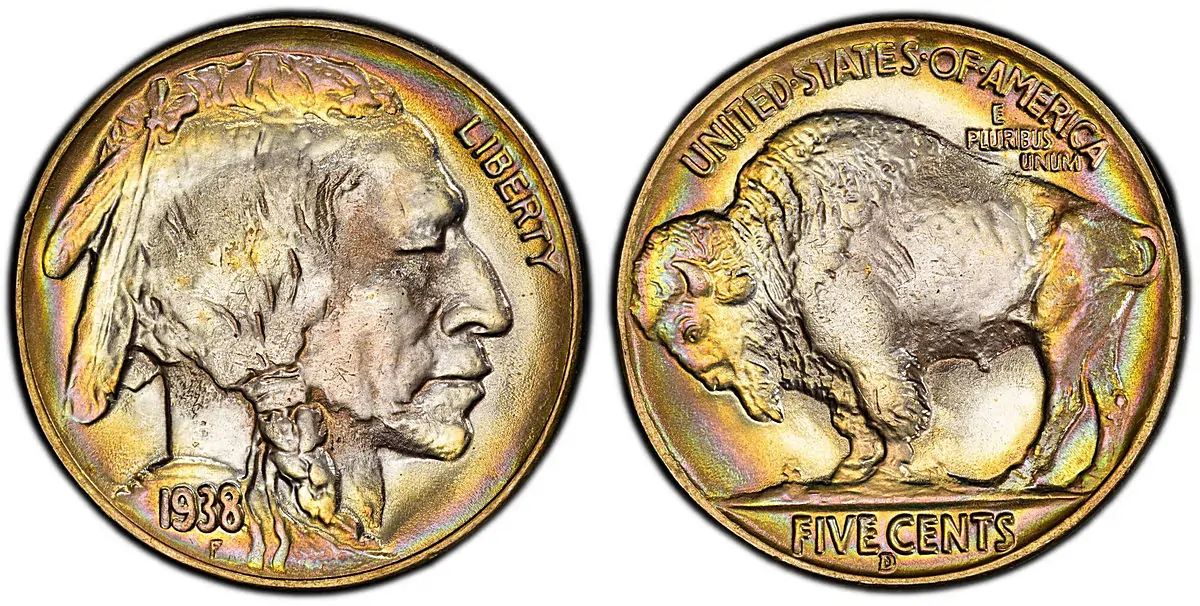
The updated PCGS CoinFacts page also displays MS68+ examples. Therefore, the older claim that MS68 represented the finest grade no longer reflects the current certified market.
PCGS still lists a $25,300 Heritage Auctions sale from August 18, 2004, for an MS68 example as the major listing’s auction record.
A Note About Buying Uncertified Examples
Collectors should approach raw examples carefully.
First, confirm that the coin shows a recognized mintmark configuration. Next, compare the surrounding die markers with published references.
Also, do not rely on a seller’s description alone. Machine doubling, damage, corrosion, and lighting can create misleading shapes around the D.
Finally, remember that not every faint mark under a Denver mintmark indicates an S.
A strong example should present clear evidence. A weaker OMM should match established die diagnostics.
Why the 1938-D/S Buffalo Nickel Still Matters
The 1938-D/S Buffalo Nickel combines several qualities that collectors value.
It carries a visible and understandable Mint-made variety. It also comes from the final year of one of America’s most admired coin designs.
Moreover, the coin tells a practical story. Mint employees worked with existing tools, hand-punched mintmarks, and changing production schedules. Their solution left permanent evidence on thousands of coins.
The variety also rewards collectors at several levels.
A circulated example offers an affordable entry point. A Gem Mint State coin provides strong luster and visual appeal. Meanwhile, a top-grade specimen can rank among the most valuable coins in the final-year Buffalo Nickel issue.
Most importantly, the 1938-D/S links the closing chapter of Fraser’s Buffalo Nickel with the arrival of the Jefferson Nickel.
That combination of history, strong diagnostics, and broad availability keeps the variety relevant. It also ensures that the 1938-D/S will remain a cornerstone of advanced Buffalo Nickel collections.

Suggested caption:
Coin Specifications
- Country: United States
- Year: 1938
- Denomination: Five Cents
- Mint: Denver
- Mintage: 7,020,000 for the complete 1938-D issue
- Composition: 75% copper and 25% nickel
- Weight: 5.00 grams
- Diameter: 21.20 mm
- Edge: Plain
- Designer: James Earle Fraser
- Quality: Business Strike
* * *
Quality control issues
Love the Buffalo 5 cent pieces !!
Great coin
Now I have to double check a whole bunch of nickels…
Best historical coin ever made.
Only 25 years minted, I remember seeing these as a kid, Have not seen one in years
That’s some really cool information!
Great article and coin
Interesting having both Denver and San Francisco mintmarks on the same coin.
Interesting read.
Always learn here
Interesting
Fascinating information about this coin.
Interesting. I learn so much from this page.
Interesting, never heard of this one.
Man oh man. I am going to find my old nickels. Hard to see the s. Thanks.
One cool error. On my to buy list
Very cool error. On my to buy list.
Nice to learn about this coin, which I collected as a child.
Must have done this to save money in production. Re-use and re-purpose.
How else could this error have happened?
Cool Article!
The stories behind some of these errors are fascinating! It is amazing how people are able to reconstruct the origins of certain coins. The history of the Mint is just as varied as our country itself!
The buffalo nickel is one of my favorite coins.
Very interesting.
Love buffalo nickels!!
Another coin which is far nicer than the present day Jefferson.
I should be so lucky to find one.
Nice read. Now I’ll have to check my couple UNC 38Ds
Awesome
What an awesome error coin
Interesting history lesson, thanks.
Great information!
I used to collect Buffalo nickels a kid so this was interesting to read
love the Indian head nickels
What’s up with the 1937 buffalo nickel
As a Buffalo Lover, I love Buffalo.
Love everything about the buffalo nickel.