

No United States nickel variety combines historical circumstance, technical clarity, and long-term collector demand as powerfully as the 1918/7-D Buffalo Nickel. This overdate is not merely a curiosity within the Buffalo nickel series; it is one of the most important die varieties produced by the U.S. Mint in the 20th century. Its origins are well documented, its diagnostics are unmistakable, and its rarity in Mint State is firmly established.
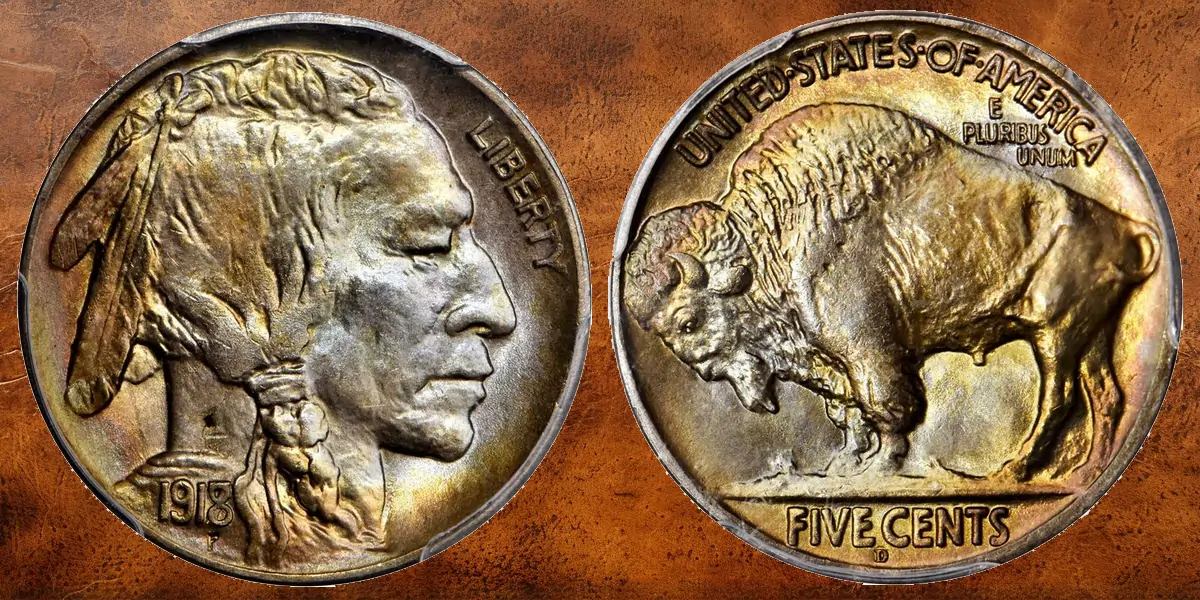
This is the coin by which all Buffalo nickel varieties are measured.
The Wartime Conditions That Created the Overdate
The 1918/7-D Buffalo Nickel exists because of extraordinary production pressure at the United States Mint during World War I. By late 1917, the nation faced a severe shortage of cents and nickels. Industrial expansion, military mobilization, and increased consumer spending all demanded massive quantities of minor coinage.
To meet this need, the Philadelphia Mint worked continuously to produce hubs and dies for both 1917- and 1918-dated coinage. During this period, one Buffalo nickel obverse die received an initial hubbing from a 1917 master hub. Instead of being discarded, that same die later received a second hubbing from a 1918 master hub. The second hubbing failed to fully efface the earlier date, leaving clear remnants of the “7” beneath the “8.”
The Mint then shipped the finished die to Denver, where it struck a limited number of coins before the die was retired. Every genuine 1918/7-D Buffalo Nickel traces back to this single die.
Clear and Undisputed Diagnostics
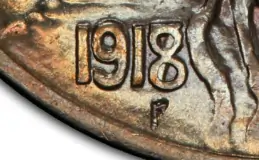
The 1918/7-D overdate is one of the most visually decisive varieties in U.S. numismatics. Collectors can consistently identify it by several well-established features:
- A distinct curved lower portion of the underlying “7” visible within the lower loop of the “8”
- A straight or slightly angled line cutting through the “8,” corresponding to the vertical stroke of the “7”
- Additional metal distortion near the top of the “8”
- A Denver “D” mintmark, confirming the die’s use at the Denver Mint
Because these features result from die hubbing and not post-strike alteration, they remain visible even on worn examples. Nevertheless, professional authentication remains essential, as Counterfeits have appeared in the marketplace for decades.
A Variety Unknown for More Than a Decade
Unlike many modern varieties, collectors did not recognize the 1918/7-D during its year of issue. In fact, the numismatic community overlooked the coin entirely until 1930, thirteen years after it entered circulation.
The first documented public offering occurred that year, when a New York dealer described the coin as something neither collectors nor the Mint itself appeared to know existed. Early auction appearances during the 1930s remained infrequent, and Mint State examples were already scarce by that time.
By the late 1930s, high-grade specimens largely disappeared from the market. Coins appearing in the 1940s and beyond were almost always circulated, reinforcing the variety’s reputation as a condition rarity long before third-party grading existed.
Rarity Profile by Grade

The 1918/7-D Buffalo Nickel is scarce in all grades and genuinely rare in Mint State.
Circulated examples appear regularly but remain valuable due to constant demand.
Lower Mint State coins exist in small numbers, with most certified examples clustering at MS63 and MS64.
Gem examples (MS65) are extremely rare and represent the highest-confirmed grade level seen at public auction.
This sharp cutoff at the Gem level defines the 1918/7-D as one of the most challenging condition rarities in the Buffalo nickel series.
Market Performance and Collector Demand
For decades, the 1918/7-D Buffalo Nickel held the distinction of being the most valuable coin in the series. Although other varieties have since competed for that title, none have displaced its stature as the series’ defining overdate.
High-grade examples consistently command six-figure prices at major auctions. More importantly, demand has remained steady across multiple generations of collectors, registry competitors, and advanced variety specialists.
Auction records firmly establish MS65+ as the highest grade reliably traded in the marketplace. Although grading populations list an NGC MS-66 that exists, no verified public auction appearances for this coin exit.
As a result, MS65+ CAC stands as the highest demonstrably obtainable grade for collectors. One was auctioned by GreatCollections on Sun, Feb 11, 2024 and sold for $511,875
The coin’s importance does not depend on trend or novelty, it rests on fundamentals that have never changed.
Why the 1918/7-D Buffalo Nickel Endures
The lasting importance of the 1918/7-D Buffalo Nickel comes from the rare convergence of three factors:
- Documented historical origin tied directly to World War I production pressures
- Unambiguous diagnostics that leave no doubt about authenticity when properly examined
- Severe rarity in Mint State, especially at the Gem level
Few U.S. coins satisfy all three conditions completely.
More than a century after it was struck, the 1918/7-D remains a cornerstone of American numismatics. It tells a precise story about how coins were made, why mistakes happened, and how those mistakes became permanent records of history. For collectors, it is not just a key date or a major variety, it is the standard by which Buffalo nickel rarities are judged.
In every meaningful sense, the 1918/7-D Buffalo Nickel is the overdate that defines the series.
i can’t remember the last time i saw a buffalo nickel.
There is no end to what coinweek teaches you. thanks
That baby won’t be in my collection at mint state grade. That’s okay. I would love to get one in almost any grade.
I made one of the most significant finds of 21st century 1918 8/7 overdate the video is available and pictures of this significant find. YouTube BAYOUCHICKEN.