


China’s 1911 Pattern Dollar Could Bring $600,000
In 1911, China’s Qing Dynasty stood on the edge of history. Its government still tried to modernize the nation’s money. Its mints still experimented with designs for a unified silver currency. Yet revolution would soon bring more than two centuries of Qing rule to an end.
One remarkable silver dollar pattern captures that moment better than almost any other coin.
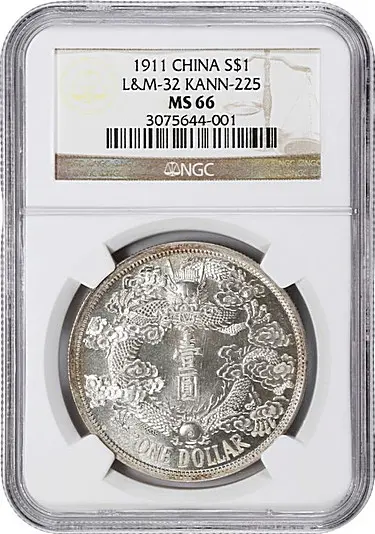
![CHINA. Silver "Reversed Dragon" Dollar Pattern, Year 3 (1911). Tientsin Mint. Hsuan-t'ung (Xuantong [Puyi]). NGC MS-66.](https://coinweek.com/wp-content/uploads/2026/09/1911-reverse-pattern-dragon-1200.webp)
However, the estimate tells only part of the story.
This dragon literally coils in the opposite direction from the design China eventually selected for circulation. In effect, collectors can hold one of the final artistic “what ifs” of imperial Chinese coinage.
A Dragon From the Final Year of Imperial China
The coin dates to the third year of the Xuantong era, or 1911, during the reign of Puyi, the last emperor of the Qing Dynasty.
Puyi had succeeded to the throne in 1908 while still a small child. His reign took the era name Xuantong. By 1911, however, the Qing government faced political upheaval that would soon overwhelm the monarchy. The revolutionary crisis erupted later that year, and the Qing emperor formally abdicated on February 12, 1912.
That chronology gives the Reversed Dragon pattern extraordinary historical weight. Mint officials created it while the imperial government still pursued a modern national coinage. Yet the political system behind that coinage had almost reached its end.
The pattern therefore represents much more than a rare dragon dollar. It records an unfinished monetary experiment from the closing chapter of imperial China.
China’s Push for a Uniform National Coinage
For years, China had struggled with a complicated monetary system. Provincial mints produced different coins, while foreign silver dollars circulated extensively in commerce.
The Qing government wanted greater uniformity.
A 1905 U.S. diplomatic translation of Qing monetary regulations describes an imperial effort to establish a central mint at Tientsin and standardize weights, fineness, and designs. The government wanted the central authorities to control dies and impose common standards on the country’s mints.
The Central Mint at Tientsin consequently became an important center for experimental and national coinage.
During the final years of the dynasty, its engravers tested several dramatic dragon-dollar designs. Those experiments produced some of the most famous patterns in Chinese numismatics.
The Reversed Dragon ranks among them.
Why Collectors Call It the “Reversed Dragon”
At first glance, the coin displays many features collectors associate with China’s celebrated late Qing dragon dollars.
A serpentine imperial dragon twists through clouds. A flaming pearl appears near the lower portion of the design. The denomination appears as 壹圓, or one yuan, while the English inscription ONE DOLLAR runs below.
However, look at the dragon’s body.
On this pattern, the creature coils in a roughly C-shaped formation, with its tail extending toward the right and seemingly disappearing into the surrounding clouds. The direction runs opposite the arrangement that appeared on the adopted circulation design.
That reversal gave the pattern its modern nickname.
Stack’s Bowers identifies the coin as L&M-31; Kann-225; KM-Pn308; WS-0042A; and Wenchao-115. The catalog also identifies it as a Type II variety with raised veins in the outer leaves.
Those leaf details matter. They help specialists distinguish L&M-31 from other members of the complicated 1911 pattern-dollar family.
A Silver Dragon Nearly Frozen in Time
Condition adds another dimension to this particular coin.
NGC graded the example MS-66, an extraordinary level of preservation for this rare imperial pattern. More importantly, NGC reports that it has certified 10 examples of the Raised Veins on Leaves variety, and this MS-66 stands alone at the top of the NGC census.
That figure refers only to NGC-certified examples. Other pieces reside in PCGS holders or outside the major grading services. Therefore, collectors should not interpret the NGC population as the total number of surviving coins.
Even so, the certification gives this specimen an important distinction.
The coin shows strong, bright silver surfaces with only slight golden coloration near portions of the perimeter. The strike brings sharp definition to the dragon, clouds, inscriptions, and ornamental elements. Meanwhile, the largely untoned centers allow the design to command immediate attention.
For a coin created more than a century ago during one of the most turbulent periods in modern Chinese history, the preservation appears remarkable.
A Seven-Figure Precedent
The Reversed Dragon also has a formidable auction history.
In April 2023, Stack’s Bowers sold another L&M-31 Reversed Dragon Dollar graded PCGS SP-65. PCGS Auction Prices records a total realization of $1,380,000 and identifies that result as the auction record for the issue in its database.
That result should not serve as a direct prediction for the current coin. Different specimens, grading services, market conditions, pedigrees, and bidders can produce very different prices.
Still, the seven-figure sale demonstrates how seriously advanced collectors view the type.
Other Reversed Dragon patterns have also returned to market. For example, Stack’s Bowers offered a PCGS SP-62 example in October 2023 and a PCGS SP-63 example in April 2024. Those appearances underline both the rarity of the type and the intense collector interest whenever a high-grade example surfaces.
1911 Reversed Dragon Dollar Pattern Specifications
- Country: China, Qing Dynasty
- Emperor: Xuantong Emperor, Puyi
- Date: Year 3 / 1911
- Mint: Central Mint, Tientsin
- Denomination: 1 Yuan / One Dollar
- Type: Silver pattern dollar
- Composition: Silver
- Weight: 26.90 grams
- Diameter: 39 mm
- Thickness: Approximately 2.5 mm
- Alignment: Medal alignment
- Attributions: L&M-31; K-225; KM-Pn308; WS-0042A; Wenchao-115
- Variety: Type II, raised veins in outer leaves
- Certification: NGC MS-66
- Auction Estimate: $400,000-$600,000
A Coin From a Future That Never Arrived
Patterns fascinate collectors because they show possibilities.
Most coins tell us what a government decided to produce. Patterns can tell us what officials considered, tested, changed, and ultimately rejected.
Few examples make that point as dramatically as the 1911 Reversed Dragon Dollar.
The Tientsin Mint experimented with the direction of the dragon, the treatment of the surrounding foliage, and other details while China pursued a standardized national currency. Eventually, another dragon arrangement won out.
Then history intervened.
The Qing Dynasty collapsed. Puyi abdicated. China entered the republican era. The imperial dragon that had symbolized dynastic authority disappeared from China’s national coinage.
Yet a tiny number of these experimental silver dollars survived.
More than 115 years later, the dragon that faced the other way remains one of the most evocative survivors of the Qing Dynasty’s final monetary experiments.
And in MS-66, this example gives collectors something even more compelling: a remarkably preserved glimpse of the coin China almost made.





That is one pricy coin!
China produced some beautiful designs in the final years of the Empire. Too bad most of the coins produced by modern China are so bland.
That’s a cool coin.