


1961 Franklin Half Dollar Doubled Die Reverse: FS-801 Guide
Millions of Proof Franklin half dollars left the Philadelphia Mint in 1961. Most remain affordable today.
However, one reverse die created something entirely different.
The 1961 Proof Franklin Half Dollar Doubled Die Reverse FS-801 ranks among the most dramatic varieties in the entire Franklin series. Its doubling jumps from the coin without a microscope. Better yet, collectors know exactly where to look.
Then rarity changes the equation.
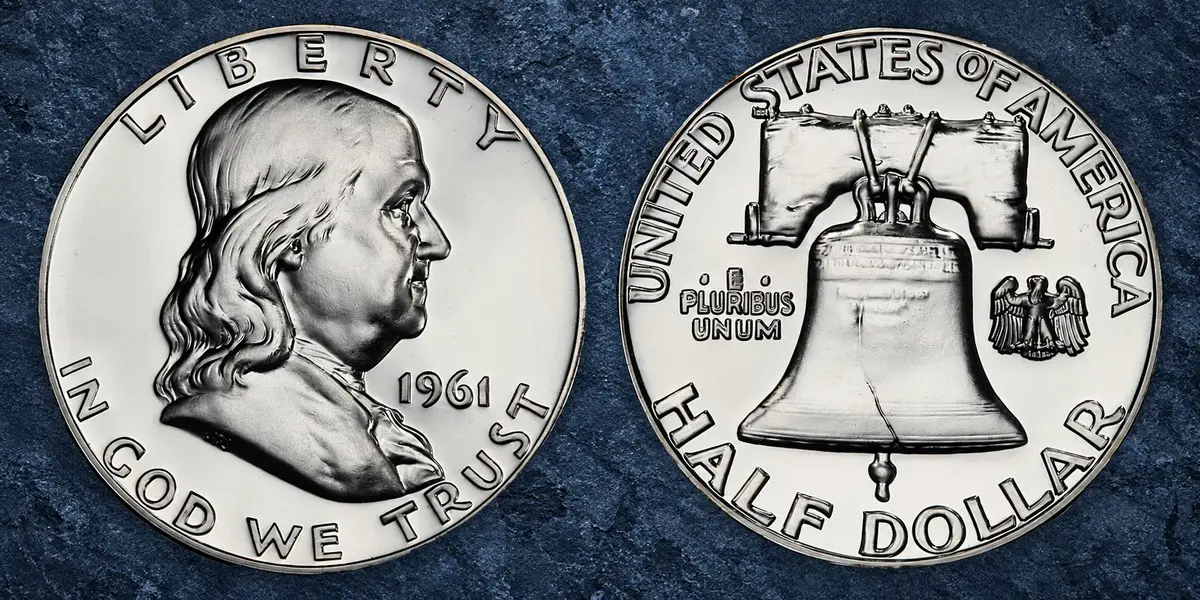
PCGS estimates that only about 1,000 examples survive across all grades. It places roughly 370 survivors at PR65 or better. Meanwhile, Cameo pieces enter an entirely different level of rarity. PCGS estimates only about 20 Cameo survivors, including perhaps 10 at PR65 or better.
At the extreme end, GreatCollections sold an NGC Proof-67 Ultra Cameo CAC example for an extraordinary $46,125 in April 2021. The coin attracted 96 bids. NGC called it the only Ultra Cameo example on either major grading-service census at that time.
That creates a remarkable contrast. An ordinary 1961 Proof Franklin can cost relatively little. Yet the right doubled die with exceptional contrast can reach deep into five figures.
More Than Another Franklin Half Dollar Variety
Franklin half dollar collectors have plenty of varieties to chase.
The colorful “Bugs Bunny” coins attract attention because of their memorable nickname and distinctive die clash. However, FS-801 offers something different. It delivers the kind of dramatic doubling that collectors normally associate with celebrated doubled dies from other U.S. coin series.
PCGS calls the 1961 Doubled Die Reverse one of the most dramatic, exciting, and valuable Franklin half dollars. Stack’s Bowers has repeatedly called it the strongest doubled die in the Franklin series. Numismatic author and Franklin specialist Rick Tomaska went even further, calling it the “king” of 20th-century Proof half dollar error varieties.
The variety even earned a prominent place in hobby literature. Heritage noted that the fifth edition of the Cherrypickers’ Guide featured the coin on its cover because of its dramatic, naked-eye-visible doubling.
That visibility helps explain its staying power.
Many die varieties demand a loupe. FS-801 does not.
Three 1961 Doubled Die Reverses – But One Dominates
Collectors need to make an important distinction.
The 1961 Proof Franklin half dollar has more than one recognized doubled die reverse. PCGS lists FS-801, FS-802, and FS-803 among the date’s major and die varieties. However, FS-801 commands the greatest attention and the strongest prices.
So, where should collectors look?
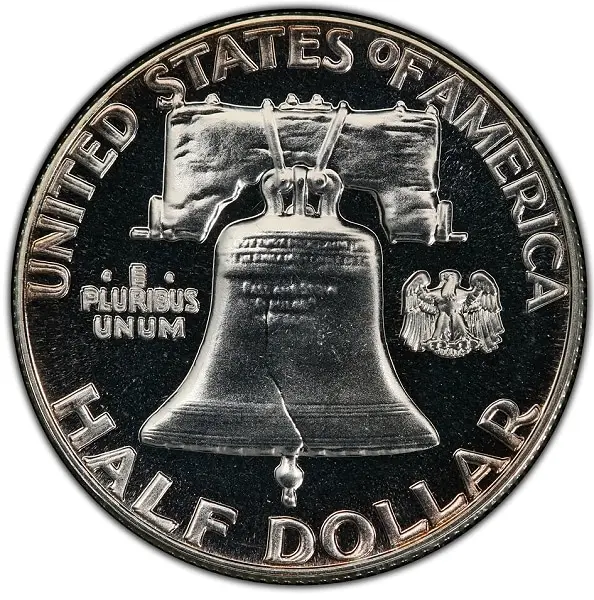
Start with E PLURIBUS UNUM.
Then examine UNITED STATES and HALF DOLLAR.
FS-801 shows wide and obvious separation through those inscriptions. The doubling becomes especially strong along portions of the left and lower edges of the letters. As a result, collectors can often identify a strong example without magnification. PCGS continues to use those inscriptions as the key diagnostics for the variety.
That matters because the difference between FS-801 and a lesser doubled die can equal thousands of dollars.
A Tiny Population Hidden Inside a Three-Million-Coin Proof Issue
The Philadelphia Mint produced 3,028,244 Proof Franklin half dollars in 1961.
However, the Mint did not record how many coins came from the FS-801 reverse die. Therefore, no official FS-801 mintage exists.
For years, specialists have estimated that perhaps 1,500 to 2,000 pieces escaped the Mint before workers removed the die from production. GreatCollections reported that estimate in its 2017 discussion of the variety. The firm also suggested that approximately 1,000 examples might remain.
Current PCGS research lands in the same neighborhood. PCGS now estimates about 1,000 survivors in all grades and roughly 370 in PR65 or better.
That creates the central mystery of the issue.
The Mint made more than three million 1961 Proof half dollars. Yet only a tiny fraction carry the famous FS-801 reverse.
For collectors, that combination creates an irresistible target. The coin looks dramatic. It remains scarce. And unlike many subtle varieties, buyers can actually see what they are paying for.
Registry Collectors Cannot Ignore It
FS-801 also carries substantial weight in competitive collecting.
PCGS includes the 1961 Doubled Die Reverse in its Franklin Half Dollars Complete Variety Set, Proof (1950-1963). Importantly, PCGS has expanded that set since CoinWeek last examined the variety.
The registry now requires 30 coins, rather than 29. PCGS describes the set as the complete Proof Franklin collection incorporating Fivaz/Stanton varieties.
PCGS also includes the 1961 doubled die in its shorter Franklin Half Dollars with Major Varieties, Proof (1950-1963) set, which currently requires 16 coins.
Therefore, registry competitors do not treat FS-801 as an optional curiosity. The coin fills a major slot.
That competition adds another layer of demand for high-grade examples.
What Is a 1961 FS-801 Worth in 2026?
The market depends heavily on grade, eye appeal, certification, and especially cameo contrast.
As of September 2026, the PCGS Price Guide lists regular Proof FS-801 values around $3,150 in PR65, $5,000 in PR66, $5,750 in PR67, and $17,500 in PR68. Greysheet continues to show a broad retail market stretching from the hundreds of dollars into the five-figure range.
Actual auction results can vary.
For example, Heritage sold a PCGS PR65 FS-801 for $2,562 on July 28, 2026. Another PCGS PR66 brought $2,562 on July 17, 2026. A PCGS PR67 had previously realized $4,080 in November 2025.
At the top of the regular Proof category, Stack’s Bowers sold a PCGS PR68 CAC example for $15,000 in November 2020. PCGS still lists that transaction as the auction record for its regular Proof FS-801 category.
However, cameo contrast changes everything.
Cameo Contrast Turns Scarcity Into a Different Market
Collectors once discussed Cameo FS-801 coins as almost unobtainable. Older references even stated that no Deep Cameo examples had surfaced.
The market eventually proved otherwise.
A PCGS PR66+ Cameo CAC example brought $14,100 in November 2016. Then, in April 2021, GreatCollections offered something far more dramatic: an NGC Proof-67 Ultra Cameo CAC FS-801.
Ninety-six bids pushed that coin to $46,125.
That sale changed the modern market history of the variety.
PCGS also records a $22,800 auction result for a PCGS PR67 Cameo that Stack’s Bowers sold on June 16, 2023. PCGS continues to list that result as the record within its Cameo category.
Then another important Cameo returned to market in 2026.
Stack’s Bowers sold a PCGS PR66+ Cameo CAC, CMQ example for $17,080 in June 2026. At the time of sale, PCGS listed two coins at PR66+ Cameo and only one finer. Stack’s Bowers also emphasized the extreme rarity of true Cameo FS-801 examples.
Therefore, collectors should not compare a brilliant Proof FS-801 directly with a Cameo or Ultra Cameo coin. They occupy different levels of the market.
1961 Franklin Half Dollar FS-801 Specifications

- Denomination: 50 cents
- Mint: Philadelphia
- Overall 1961 Proof mintage: 3,028,244
- FS-801 mintage: Unknown
- Composition: 90% silver, 10% copper
- Weight: 12.5 grams
- Diameter: approximately 30.6 mm
- Silver weight: approximately 0.36169 troy ounce
- Edge: Reeded
- Designer: John R. Sinnock
- Strike: Proof
- Major diagnostic: Strong reverse doubling in E PLURIBUS UNUM, UNITED STATES, and HALF DOLLAR
The Franklin Variety That Refuses to Fade
The 1961 Proof Doubled Die Reverse Franklin half dollar succeeds because it checks almost every box that variety collectors want.
The doubling looks dramatic. Collectors can see it easily. The issue carries genuine scarcity. Registry competition adds pressure. High-grade pieces remain difficult. Cameo examples enter another level entirely.
Most importantly, the variety still creates discoveries for collectors.
More than three million Proof Franklin half dollars entered the market in 1961. Yet PCGS estimates that only about 1,000 FS-801 examples survive today. Somewhere between those two numbers lies much of the coin’s appeal.
An ordinary-looking 1961 Proof Franklin can sit in a collection for decades.
Turn it over, look at E PLURIBUS UNUM, and the story can change very quickly.




I am looking now. thanks
Being reminded that this 1961 Franklin Proof DDR is out there makes me want to examine the dozens of 1961 Proof Sets, many still sealed, that we have put away.
Now I have a weekend project to look forward to.
Good luck. Guess I’ll do the same
The Franklin halves are a very nice non-cluttered coinage. Short and to the point of what it is. A lot of clear surface. Wold love to find a Double Die 1961!!
Very nice
guess I’ve got to take a closer look at my sets
I don’t expect I’ll find one, but I know what to look for now.
Good explanation of what to look for.
It is truly amazing how much there is to learn about error coins.
I will have to look at what I have, thanks
Had not heard about this before. Very interesting.
i love to find a few of these myself
Franklins have always been my favorite American coin.
Fantastic article
Wow, what a great coin.
Great article. Thanks for the article
Franklins are one of my favs
good article
It’s crazy what some people are willing to pay for a common date coin that happens to be in top grade.
One of these day, a coin like this will show up in my pocket. i am willing it to happen.
thanks for the info.
I have both the 1958 & 1957 proof Franklins, They look pretty perfect, I should get them graded
I need a magnifying glass to see the doubled die changes in the 1961 Franklin Half Dollar Reverse.
Wow! I’ve never heard of this error before. Thank you for the vast amount of knowledge you shared in this article. Now I’ve got something else to add to my search list.