by Charles Morgan for CoinWeek…
Throughout history, war and political instability have often severely disrupted nations’ monetary systems, sometimes causing irreparable damage. This was evident in the United States in the 1860s, when hard currency vanished from circulation, replaced by “Greenbacks”—an emergency paper currency that laid the foundation for the paper money we use today. In Europe, financial calamities and two World Wars profoundly affected national monetary systems. World War I effectively ended the classical gold standard, while World War II saw many combatant nations suspend domestic coinage production. A notable example is the Philippine government’s 1942 decision to dump its silver pesos into Manila Bay to prevent their capture by Japanese occupiers.
More recently, the impact of war and international sanctions on Iraq’s monetary system is a stark illustration. Iraq issued its last series of coins before the Persian Gulf War in 1990. Following Saddam Hussein’s disastrous attempt to annex Kuwait, Iraq would not see a new coinage issue for 14 years.
20th Century Iraqi Coinage
Iraq remained under Ottoman rule until the empire’s collapse in 1917. Subsequently, its territory, along with surrounding regions, came under British administration. The British drew Iraq’s modern borders, a decision that contributed to later internal strife by solidifying a power imbalance among different ethnic and religious groups within the nascent nation.
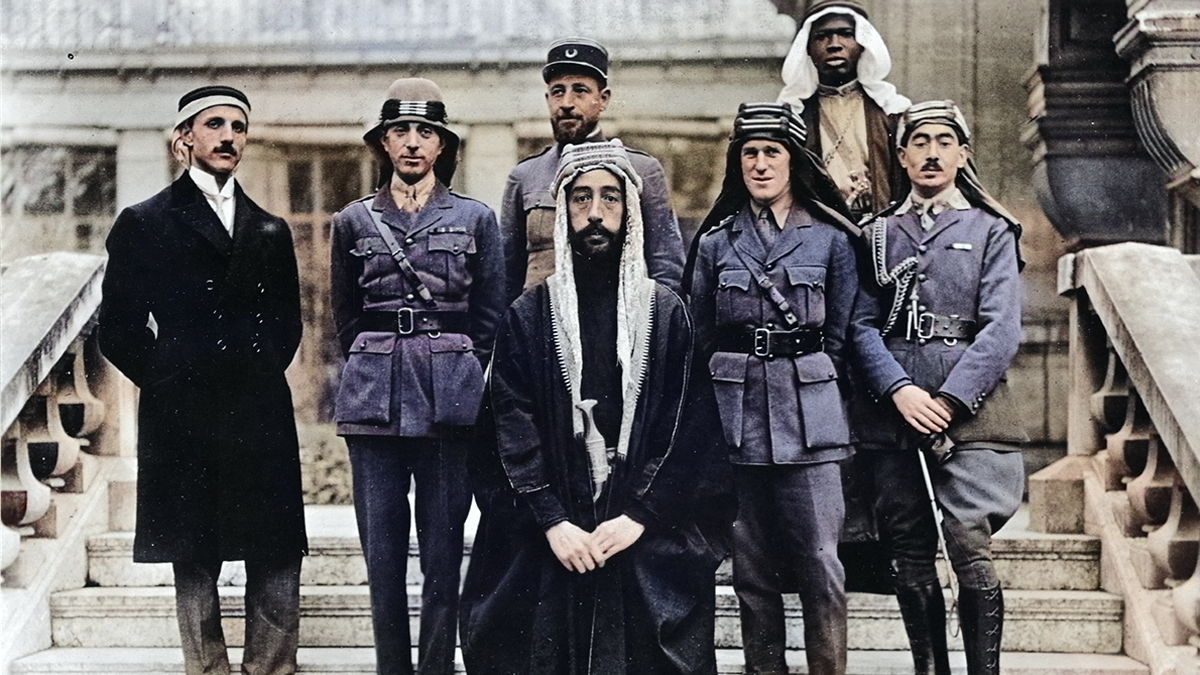
Iraq achieved formal independence from Britain on October 3, 1932, and subsequently issued its first coinage bearing the likeness of King Faisal I. Faisal I left a positive legacy in the region. The British had supported his leadership in the Arab Revolt against Ottoman rule and his efforts to establish a short-lived Arab government in Syria in 1920. After French forces rejected Faisal’s claim to Syria and invaded, pushing him into exile, the British continued their support, installing him as King of British-administered Iraq in 1921.
Faisal I’s coinage commenced in 1931 and continued until his death in 1933. These coins included denominations of the Iraqi Dinar. Specifically, 20 fulūs, 50 fulūs, and 1 riyal (200 fulūs) coins were struck in .500 fine silver.
Coinage continued under the rule of Faisal I’s only son, Ghazi I. Unlike his father, Ghazi was perceived as less engaged politically and his reign was marked by growing tensions with British loyalists. Ghazi died in a car crash on April 4, 1939, at the age of 27. Some suggest his death was not accidental. His coins were struck at the Royal Mint and the Bombay Mint. Denominations minted between 1936-38 included 1 fils, 4 fulūs, 10 fulūs, 20 fulūs, and 50 fulūs. The 20 and 50 fulūs coins were again struck in .500 fine silver. Additionally, one million 4 fulūs coins were struck in 1939.

Ghazi was succeeded by his son Faisal II, who was a month shy of being four years old when his regency began in 1939. During World War II, Faisal II was evacuated to England, where he and his cousin Hussein, the future King of Jordan, attended Harrow School. Faisal II officially became king in 1953 when he came of age. Scalloped 4 fulūs and 10 fulūs coins struck in 1943 already bore the effigy of the then eight-year-old Faisal II. His main coinage series resumed in 1953 with a full complement of coins: 1 fils, 2 fulūs, 4 fulūs, 10 fulūs, 20 fulūs, 50 fulūs, and 100 fulūs. The 20, 50, and 100 fulūs coins were struck in .500 fine silver.
Faisal II’s reign met a bloody end on July 14, 1958, amidst plans for an Arab Federation uniting Jordan and Iraq. While the young king himself was not a tyrannical figure, his government and its policies, largely influenced by his powerful uncle and regent, Prince Abd al-Ilah, and the veteran Prime Minister Nuri al-Said, were deeply unpopular across significant portions of Iraqi society.
The coup against Faisal II was swift and brutal. The royal family, including the King, Prince Abd al-Ilah, and other close relatives, were killed at the Al-Rehab Palace. Faisal II was shot in the head and neck; his body was subsequently hanged and mutilated.
With the monarchy overthrown, Brigadier Abd al-Karim Qasim and Colonel Abdul Salam Arif rose to power, establishing a republican form of government. This marked a dramatic turning point for Iraq. It ushered in a period of intense political instability characterized by frequent coups, counter-coups, and assassinations, ultimately paving the way for the rise of the Ba’ath Party and the long dictatorship of Saddam Hussein.
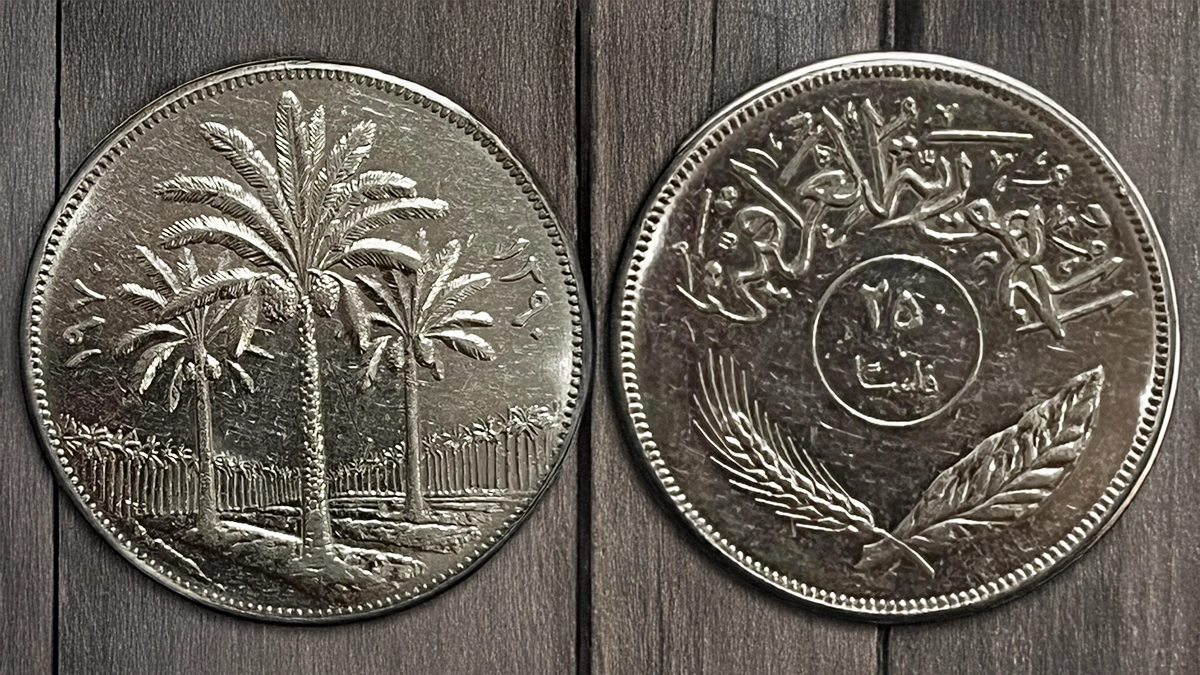
Iraqi Republican coinage, beginning with its 1959 issues, replaced the portraits of kings with symbols like oat sprigs and stars. The familiar palm tree design debuted in 1967. The nickel 250 fulūs coin struck in 1970 was notably included in that year’s F.A.O. (Food and Agriculture Organization) album. Other Iraqi F.A.O. issues followed, as did various silver and gold commemorative issues.
The final Iraqi coin issue of the 20th century was the 250 fulūs struck in 1990. On August 2, Saddam Hussein ordered the Iraqi military to invade its southern neighbor, the oil-rich emirate of Kuwait. International condemnation was swift and severe. Within months, a U.S.-led coalition of 34 countries launched a massive assault on Iraqi positions, pushing its army out of Kuwait and severely degrading the country’s military capabilities. Iraqi losses were staggering, and within one month, Iraq accepted the United Nations’ terms for a ceasefire. Hussein remained in power, but the country’s economy was in tatters, and its monetary system in crisis.
Beyond the immediate destruction of infrastructure, the long-term economic repercussions, primarily driven by stringent international sanctions, plunged the nation into a prolonged period of hardship and hyperinflation. Iraq’s GDP plummeted dramatically, with data from CEIC indicating a fall from 157.428% annual growth in 1990 to -79.518% in 1991. Oil exports, the lifeblood of the Iraqi economy, were severely restricted, leading to an estimated significant revenue loss, as Iraq’s national revenue depended mostly on oil, and the price dropped from $18 to $12 per barrel in July 1990 due to overproduction by Kuwait and the UAE. Many Iraqis could no longer afford food, resulting in widespread malnutrition and dramatically increased mortality rates, especially among children, due to shortages of food, medicine, and clean water.
The Iraqi dinar suffered a catastrophic devaluation. Before the war, the official exchange rate was approximately 1 Iraqi dinar to $3.5 USD. By 1997, the black market rate saw 1 U.S. dollar equivalent to around 2,000 dinars, indicating a massive loss of purchasing power. This hyperinflation rendered Iraqi coins practically useless, and increasingly higher face-value currency notes flooded the economy.
A Limping Return of Iraqi Coins
Following the September 11, 2001 attacks on the World Trade Center and the Pentagon, the George W. Bush Administration grew increasingly concerned that Saddam Hussein had surreptitiously worked to reconstitute several arms programs prohibited under United Nations Security Council resolutions, notably Resolution 687, adopted on April 3, 1991.
Hussein was vague about whether Iraq possessed these so-called Weapons of Mass Destruction (WMDs), and UN weapons inspectors found no evidence that Iraq had active programs to create WMDs or stockpiles of them. Nevertheless, a U.S.-led invasion commenced on March 20, 2003, with an initial “shock and awe” bombing campaign targeting key Iraqi military and government installations. This was quickly followed by a ground invasion by a coalition of forces, primarily from the United States and Britain. The Iraqi military, weakened by years of sanctions, was quickly overwhelmed. Hussein went into hiding, and his government collapsed. After months of intense searching, the former Iraqi leader’s location was discovered. On December 13, 2003, an Iraqi-American interpreter, “Samir,” pulled the disheveled despot from a hideaway at a remote farm south of Tikrit.

The Americans established a provisional Iraqi government, which administered the state from July 2003 to June 2004, when control was handed over to an interim Iraqi government. In 2004, Iraq issued new coins in three denominations: 25 dinars, 50 dinars, and 100 dinars. One side of these coins featured a simple depiction of Iraq along with the date, while the other side displayed the denomination and legend.
While Iraqis were largely relieved to see Hussein removed, frustration grew due to the complex and challenging task of nation-building and civil administration, which proved to be far more extensive than what the Americans had initially planned. Iraq was subsequently thrust into a decade of violence, insurgency, and the brutal rise of ISIS.
Today, Iraq is more stable and prosperous than in previous turbulent decades, but it still faces many challenges. Despite high voter turnout in elections and increased representation along sectarian and gender lines, systemic corruption continues to hamper growth. The Iraqi monetary system continues to adjust to meet contemporary demands, though largely without the widespread use of coins in daily transactions.