HomeAncient CoinsWrestlers on Ancient Coins

Wrestlers on Ancient Coins

Is Thisby Mike Markowitz
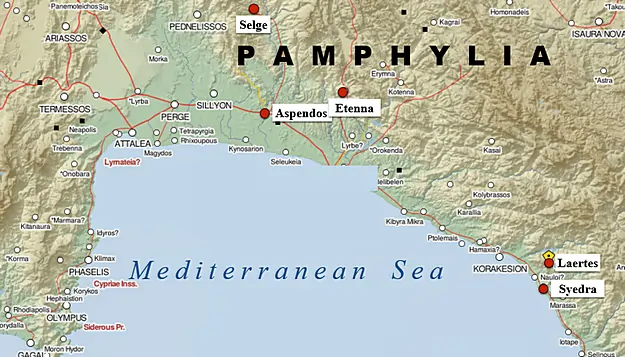
Digital Atlas of the Roman Empire

Ancient Greeks loved wrestling [1]. Cities celebrated champion wrestlers as hometown heroes. They raised statues in their honor. Even today, modern Greco-Roman wrestling still echoes that old tradition, although ancient wrestlers competed naked. Several cities struck coins that show the sport in action, especially in Pamphylia and Pisidia on the southern coast of Anatolia.

A Tiny Silver Coin Starts the Story
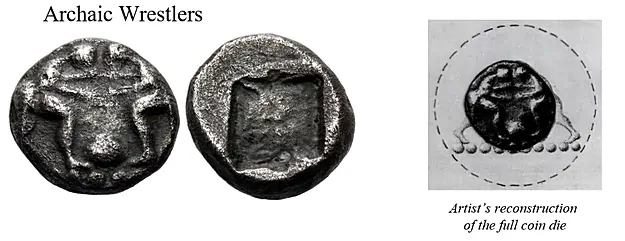
Uncertain mint. Early-mid 5th century. trihemiobol (Silver, 9.5 mm, 0.94 g). Two wrestlers about to grapple with each other, their arms extended and their hands touching; between them, cauldron; below, dotted ground line. Rev. Rough incuse square. Extremely rare, and possibly unique. Porous. Nearly very fine.From the collection of Major Anthony F. Milavic, USMC (Ret.),Nomos Auction 32   8 June 2022  Lot: 93   realized: $2,231
Nomos Auction 32 8 June 2024 Lot: 93 realized: $2,231
Uncertain mint. Early-mid 5th century. trihemiobol (Silver, 9.5 mm, 0.94 g). Two wrestlers about to grapple with each other, their arms extended and their hands touching; between them, cauldron; below, dotted ground line. Rev. Rough incuse square. Extremely rare, and possibly unique. Porous. Nearly very fine. From the collection of Major Anthony F. Milavic, USMC (Ret.),Nomos Auction 32 8 June 2022 Lot: 93 realized: $2,231 Nomos Auction 32 8 June 2024 Lot: 93 realized: $2,231

In 1990, Major Anthony F. Milavic (USMC, retired) acquired an enigmatic little silver coin [2]. It shows two wrestlers about to grapple. Over the next several decades, Milavic built a world-class collection of ancient coins with athletic themes. The style and fabric of this piece, especially its simple square punch-mark reverse, place it in the Archaic era, which numismatists date to before about 480 BCE.

The coin weighs 0.94 gram. That weight suggests a trihemiobol on the “Thraco-Macedonian” standard. The blank was too small for the die, so part of the design falls off the edge. A row of dots marks the ground line beneath the wrestlers. The source identifies the large pellet between their feet as a bronze cauldron, the prize awarded to winners in these contests [3].
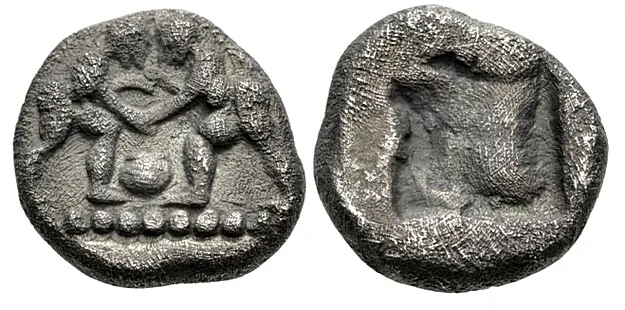
Uncertain. Early-mid 5th century BC. AR Diobol or Eighth Stater (?) (10mm, 1.24 g). Two wrestlers grappling; aryballos (?) between / Incuse square punch.. Toned, granular surfaces. VF. Extremely rare. Classical Numismatic Group Triton XXVIII 14 January 2025 Lot: 341 realized: $450 

Earliest Known Image of Wrestlers

Milavic later acquired a second, larger, and sharper example. A cataloguer suggests that this 1.24 gram coin may be a diobol or one-eighth stater (?) [4]. The same cataloguer identifies the round object between the wrestlers as an aryballos, a small spherical flask that athletes used to carry scented olive oil to the gymnasium for skin preparation and cleaning. Together, these two pieces present the earliest known image of wrestlers on ancient coinage.

Aspendos Turns Wrestling Into a Civic Emblem
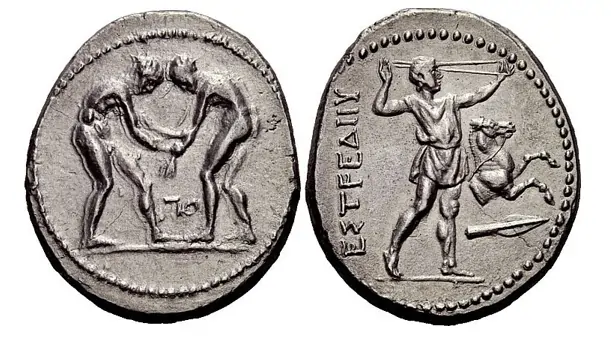
Aspendus Stater circa 420-370, AR 10.48 g. Two wrestlers grappling; in lower middle field, ?O. Rev. ESTFE?IIY Slinger standing r.; in r. field, forepart of horse above spearhead. Boston 2101 (these dies).Numismatica Ars Classica Auction 59 4 April 2011 Lot: 636 realized: $2,174
Aspendus Stater circa 420-370, AR 10.48 g. Two wrestlers grappling; in lower middle field, ?O. Rev. ESTFE?IIY Slinger standing r.; in r. field, forepart of horse above spearhead. Boston 2101 (these dies). Numismatica Ars Classica Auction 59 4 April 2011 Lot: 636 realized: $2,174

The city of Aspendos, or Aspendus, stood on the Eurymedon River about 16 km, or 10 miles, inland from the sea in Pamphylia, in today’s Turkish province of Antalya. The city prospered through trade in salt, oil, and wool. It began issuing handsome and abundant silver coinage in the 5th century BCE.

After Alexander the Great

After Alexander the Great conquered Aspendos in 333 BCE, the city paid an annual tribute of 100 gold talents and 4,000 horses [5]. Beginning about 420 BCE, the silver stater of Aspendos shows a pair of naked wrestlers grappling within a dotted border. On the reverse, the coin carries a slinger and the city name EΣTFEΔIIY, or Estvediys, in the local dialect [6].


Aspendos. Circa 380-325 BC. Stater (Silver, 23 mm, 10.87 g, 12 h). Two wrestlers beginning to grapple with each other: the righthand one extends his right leg between his opponent's legs, grasps his right shoulder with his left hand and his left forearm with his right hand; the lefthand wrestler grasps his opponent's right knee with his left hand. Rev. [?S?]-??[?]-IIV-S Slinger striding right, t, triskeles to right; at the slinger's feet to right, statue of Athena on a low pedestal to right. SNG Copenhagen 436 Nomos Auction 32 8 June 2024 Lot: 116 realized: $6,134
Aspendos. Circa 380-325 BC. Stater (Silver, 23 mm, 10.87 g, 12 h). Two wrestlers beginning to grapple with each other: the righthand one extends his right leg between his opponent’s legs, grasps his right shoulder with his left hand and his left forearm with his right hand; the lefthand wrestler grasps his opponent’s right knee with his left hand. Rev.  Slinger striding right, t, triskeles to right; at the slinger’s feet to right, statue of Athena on a low pedestal to right. SNG Copenhagen 436 Nomos Auction 32 8 June 2024 Lot: 116 realized: $6,134
Later Aspendos staters change the wrestlers’ poses. On a coin dated to about 380 to 325 BCE, one wrestler extends his leg to trip his opponent, while the other grabs his knee [7]. That small adjustment gives the scene unusual movement. It also shows how carefully die engravers observed the sport itself.

Neighboring Mints Follow the Type

Selge. Circa 325-250 BC. AR Stater (24mm, 8.92 g, 1h). Two wrestlers, nude, grappling; K between / Slinger in throwing stance right; to right, triskeles above club and cornucopia. SNG BN 1947. Near EF. Well centeredClassical Numismatic Group Auction 129 13 May 2025 Lot: 287 realized: $1,000
Selge. Circa 325-250 BC. AR Stater (24mm, 8.92 g, 1h). Two wrestlers, nude, grappling; K between / Slinger in throwing stance right; to right, triskeles above club and cornucopia. SNG BN 1947. Near EF. Well centered Classical Numismatic Group Auction 129 13 May 2025 Lot: 287 realized: $1,000

The town of Selge [8] lay upstream on the Eurymedon from Aspendos and straddled the border between Pisidia and Pamphylia. Selge’s coins [9] closely copy the coinage of Aspendos. In fact, scholars have argued that the imitation runs so close that the same engravers may have worked for both mints, which points to close ties of friendship between the two cities [10].
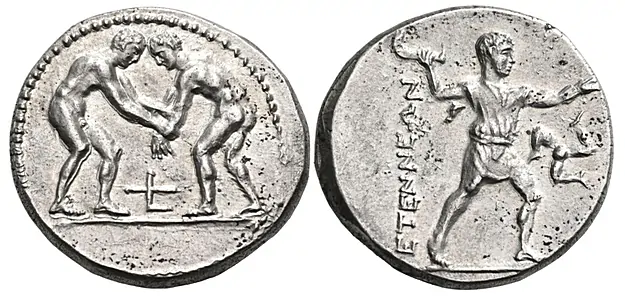
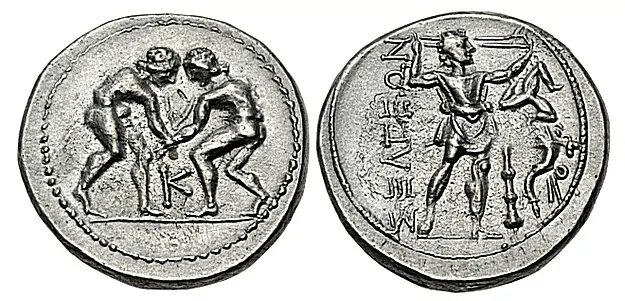
Etenna. Circa 320-280 BC. Stater (Silver, 25 mm, 10.79 g, 12 h). Two wrestlers grappling, the one on the left grasping the wrists of the one on the right; between them, linear symbol. Rev. ??????O? Male figure striding to right, wearing short, hunting dress, preparing to hurl a sickle-shaped knife held in his right hand and extending his left before him; in field to right, triskeles to left. Of great rarity, missing from all major collections. With a fascinating reverse type, the best known example. Extremely fine.Nomos Auction 28 22 May 2023 Lot: 1232 realized: $9,422
Etenna. Circa 320-280 BC. Stater (Silver, 25 mm, 10.79 g, 12 h). Two wrestlers grappling, the one on the left grasping the wrists of the one on the right; between them, linear symbol. Rev. ??????O? Male figure striding to right, wearing short, hunting dress, preparing to hurl a sickle-shaped knife held in his right hand and extending his left before him; in field to right, triskeles to left. Of great rarity, missing from all major collections. With a fascinating reverse type, the best known example. Extremely fine. Nomos Auction 28 22 May 2023 Lot: 1232 realized: $9,422

Etenna, another inland neighbor of Aspendos, also issued very rare coins with the same obverse pair of wrestlers. Yet the reverse breaks from the familiar pattern. At first glance, the coin looks like a normal slinger stater from Pisidia or Pamphylia. However, the lightly armed figure attacks with a sickle-shaped weapon instead of a sling, and that weapon seems to serve as the badge of the city of Etenna [11].

The Wrestlers Return Under Rome
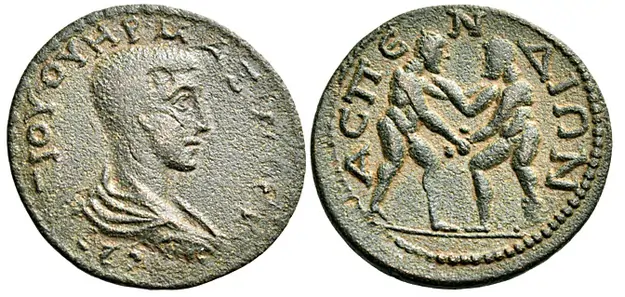
Maximus, as Caesar, 235-238. Diassarion (Bronze, 25 mm, 5.76 g), Aspendus in Pamphylia. G ??? ???? ??????C ???-C?? Draped and cuirassed bust of Maximus to right; on his forehead, illegible countermark in a circular indent. Rev. ?C?E???O? Two wrestlers beginning to grapple with each other. RPC online 6330. SNG Leypold 1804. Rare, the seventh known example. An interesting and attractive coin, with a dusty, rough patina. Some pitting. Good very fine.Nomos  Auction 21 21 November 2020 Lot: 336 realized: $1,206
Maximus, as Caesar, 235-238. Diassarion (Bronze, 25 mm, 5.76 g), Aspendus in Pamphylia. G ??? ???? ??????C ???-C?? Draped and cuirassed bust of Maximus to right; on his forehead, illegible countermark in a circular indent. Rev. ?C?E???O? Two wrestlers beginning to grapple with each other. RPC online 6330. SNG Leypold 1804. Rare, the seventh known example. An interesting and attractive coin, with a dusty, rough patina. Some pitting. Good very fine. Nomos Auction 21 21 November 2020 Lot: 336 realized: $1,206

During the first century CE, Rome absorbed Pamphylia into the empire. Even so, the Greek cities of the region continued to produce bronze small change for local use for another two centuries. Collectors long neglected these modest Roman Provincial coins. Now, however, they attract more attention as prices for classic Greek silver continue to rise. A strong example is a 5.76 gram bronze assarion with a portrait of Maximus as Caesar, struck from 235 to 238 CE. Its lively reverse with wrestlers clearly recalls Aspendos’s early Hellenistic silver coinage, where two wrestlers formed the obverse type [12].
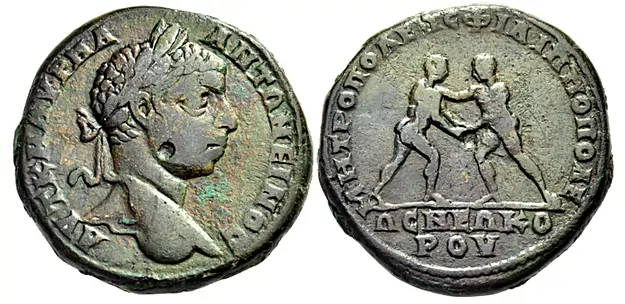
THRACE. Philippopolis. Elagabalus, 218-222. 5 Assaria (Bronze, 28 mm, 18.03 g, 7 h). ??? ? ? ????? - ???O?????? Laureate head of Elagabalus to right. Rev. ?????????O? F??????????//O? ??O??/??? Two nude wrestlers facing each other and grappling; the one on the left grasping, with both of his hands, his opponent's left hand, and the one on the right, grasping his opponent's left shoulder. BMC 44 Clear and well-centered, with a brown-green patina. Very fine.From the collection of Major Anthony F. Milavic, USMC (Ret.)
Nomos Auction 32 8 June 2024 Lot: 104 realized: $245
THRACE. Philippopolis. Elagabalus, 218-222. 5 Assaria (Bronze, 28 mm, 18.03 g, 7 h). Laureate head of Elagabalus to right. Rev. ?????????O? F??????????//O? ??O??/??? Two nude wrestlers facing each other and grappling; the one on the left grasping, with both of his hands, his opponent’s left hand, and the one on the right, grasping his opponent’s left shoulder. BMC 44 Clear and well-centered, with a brown-green patina. Very fine. From the collection of Major Anthony F. Milavic, USMC (Ret.) Nomos Auction 32 8 June 2024 Lot: 104 realized: $245

And on to Thrace

Philippopolis [13], in the Balkan province of Thrace, is now Plovdiv, Bulgaria, a city famous for its well-preserved Roman theater. A large bronze coin of Elagabalus, dated to 218 to 222 CE and struck as a 5-assaria piece, carries the familiar image of two wrestlers grappling on the reverse [14].
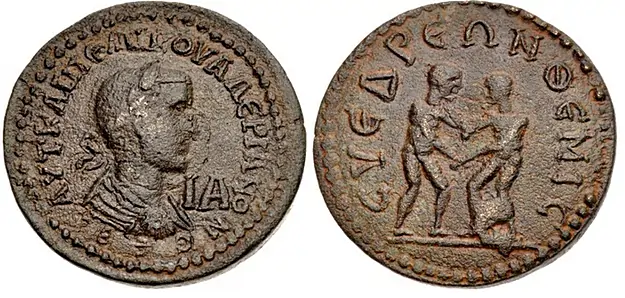
CILICIA, Syedra. Valerian I. AD 253-260. Æ 11 Assaria (32mm, 19.44 g, 12h). AYT KAI ?O ?IK OVA??PIANON C?B, laureate, draped, and cuirtassed bust right; IA in right field / CV??P?ON T?MIC, two wrestlers grappling. SNG BN 661.Classical Numismatic Group  Electronic Auction 442 17 April 2019 Lot: 797 realized: $320
CILICIA, Syedra. Valerian I. AD 253-260. Æ 11 Assaria (32mm, 19.44 g, 12h).  laureate, draped, and cuirtassed bust right; IA in right field / CV??P?ON T?MIC, two wrestlers grappling. SNG BN 661. Classical Numismatic Group Electronic Auction 442 17 April 2019 Lot: 797 realized: $320

Founded in the 7th century BCE, Syedra stood on the eastern edge of Pamphylia as a small coastal town [15]. Under Valerian, who ruled from 253 to 260 CE, the city issued a bronze 11-assaria piece weighing 19.44 grams with two wrestlers grappling on the reverse [16]. The type fits neatly into a broader civic coinage that linked athletics, local identity, and public spectacle.
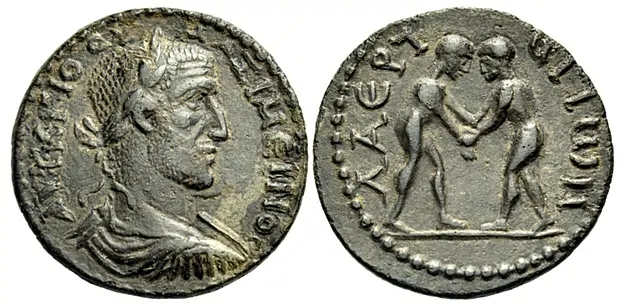
CILICIA. Laertes. Maximinus I, 235-238. 4 Assaria (Bronze, 24 mm, 6.41 g, 12 h). AYT K G ?? ?? - ?????EIN?? Laureate, draped and cuirassed bust of Maximinus I to right, seen from behind. Rev. ????? - ???W? Two wrestlers beginning to grapple. RPC VI Online, 6951. Extremely rare, only a single example -in the Fitzwilliam - was hitherto known; the present piece is much better preserved. Slightly double struck on the obverse, otherwise, good very fine.Nomos  Auction 32 8 June 2024 Lot: 100 realized: $1,338
CILICIA. Laertes. Maximinus I, 235-238. 4 Assaria (Bronze, 24 mm, 6.41 g, 12 h). Laureate, draped and cuirassed bust of Maximinus I to right, seen from behind. Rev. Two wrestlers beginning to grapple. RPC VI Online, 6951. Extremely rare, only a single example -in the Fitzwilliam – was hitherto known; the present piece is much better preserved. Slightly double struck on the obverse, otherwise, good very fine. Nomos Auction 32 8 June 2024 Lot: 100 realized: $1,338

Within a few miles inland from Syedra, the hill town of Laertes also struck its own bronze coins under Roman rule. A rare example from the brief reign of Maximinus Thrax, from 235 to 238 CE, carries the now-familiar image of wrestlers [17]. Even in a small inland town, the wrestling type still held enough force to define a coin’s reverse.

Myth’s Greatest Wrestling Match

EGYPT. Alexandria. Antoninus Pius, 138-161. Drachm (Bronze, 32.5 mm, 18.01 g, 12 h), year ?? = 24 = 160/1. [??]??? ????? - ???W????? ?? [??] Laureate bust of Antoninus Pius to right, slight drapery on his left shoulder. Rev. L - ?/? Heracles standing facing, his head to left, grabbing Antaeus with his two hands and lifting him off the ground; to right, club and lion skin; below Antaeus, rocky ground. Dattari 2603. Köln -. RPC IV.4, 2198.2 (this coin). Very rareThe Anthony Milavic Collection of Ancient Games Coins. 
Nomos Auction 32 8 June 2024 Lot: 125 realized: $4,238
EGYPT. Alexandria. Antoninus Pius, 138-161. Drachm (Bronze, 32.5 mm, 18.01 g, 12 h), year ?? = 24 = 160/1. Laureate bust of Antoninus Pius to right, slight drapery on his left shoulder. Rev. L – ?/? Heracles standing facing, his head to left, grabbing Antaeus with his two hands and lifting him off the ground; to right, club and lion skin; below Antaeus, rocky ground. Dattari 2603. Köln -. RPC IV.4, 2198.2 (this coin). Very rare The Anthony Milavic Collection of Ancient Games Coins. Nomos Auction 32 8 June 2024 Lot: 125 realized: $4,238
The most famous wrestling match in mythology pits Hercules against the Libyan giant Antaeus. Greek and Roman coinage shows that struggle again and again. Gaia, the earth goddess, mothered Antaeus, and as long as he stayed in contact with the earth he could not be beaten. Hercules solved the problem with brute force. He lifted Antaeus off the ground and crushed him in a bear hug. The scene appears on the reverse of a bronze drachma of Antoninus Pius, who ruled from 138 to 161 CE, struck at Alexandria [18].

Collecting the Wrestlers

For collectors, wrestler coins offer a remarkable mix of sport, civic identity, and mythology. In the source survey, CoinArchives Pro, then recording over 2.7 million auction records, returned 2,756 hits for the term “wrestlers,” and about three-quarters of those were coins of Aspendos. For anyone who wants to study the series seriously, the 2024 Nomos AG sale catalog for the Milavic collection remains an essential reference.

The theme also lives on in modern coinage. Nations including the Soviet Union, Greece, Mongolia, and Hungary have all issued coins depicting wrestlers, usually in connection with the Olympics or major wrestling events.

What gives this subject its real force, though, is the backstory. A tiny silver coin bought by a retired Marine in 1990 opened a trail that runs from Archaic Greece to Roman Egypt, from Pamphylian city pride to mythic combat. That is the wow factor here. These are not just coins with athletes. They are coins that preserve movement, rivalry, memory, and local identity in metal.

References

  • Kraay, Colin. Archaic and Classical Greek Coins. New York (1976)
  • Milavic, Anthony F. “Research and analysis reveal the first Greek wrestler-type coin.” Celator (February, 1993)
  • McDonnell, Myles. “The Introduction of Athletic Nudity: Thucydides, Plato and the Vases.” Journal of Hellenic Studies. 111 (1991)
  • Olçay, Nekriman and Otto Mørkholm. “The Coin Hoard from Podalia.” Numismatic Chronicle (1971)
  • Sayles, Wayne. Ancient Coin Collecting II: Numismatic Art of the Greek World. 2nd edition. Iola, WI (2007)
  • Sear, David. Greek Coins and their Values. Vol. 2 Asia & Africa. London (1975)

Citations

  • [1] https://en.wikipedia.org/wiki/Greek_wrestling
  • [2] Milavic (1993) page 6
  • [3] Nomos Auction 32, June 8, 2024, Lot 93, realized $2,231
  • [4] CNG Triton XXVIII, January 14, Lot 341, realized $450
  • [5] https://en.wikipedia.org/wiki/Aspendos
  • [6] NAC Auction 59, April 4, 2011, Lot 636, realized $2,174
  • [7] Nomos Auction 32, June 8, 2024, Lot 116, realized $6,134
  • [8] https://en.wikipedia.org/wiki/Selge
  • [9] CNG Auction 129, May 13, 2025, Lot 287, realized $1,000
  • [10] Kraay (1976) page 278
  • [11] Nomos Auction 28, May 22, 2023, Lot 1232, realized $9,422
  • [12] Nomos Auction 21, November 21, 2020, Lot 336, realized $1,206
  • [13] https://en.wikipedia.org/wiki/Philippopolis_(Thrace)
  • [14] Nomos Auction 32, June 8, 2024, Lot 104, realized $245
  • [15] https://en.wikipedia.org/wiki/Syedra
  • [16] CNG E-Auction 442, April 17, 2019, Lot 797, realized $320
  • [17] Nomos Auction 32, June 8, 2024, Lot 100, realized $1,338
  • [18] Nomos Auction 32, June 8, 2024 Lot 124, realized $4,238

Do you have any tips or insights to add on this topic?
Share your knowledge in the comments! ......

Mike Markowitz
Mike Markowitz
Mike Markowitz is a member of the Ancient Numismatic Society of Washington. He has been a serious collector of ancient coins since 1993. He is a wargame designer, historian, and defense analyst. He has degrees in History from the University of Rochester, New York, and Social Ecology from the University of California, Irvine. Born in New York City, he lives in Fairfax, Virginia.

Related Articles

3 COMMENTS

  1. I never thought about collecting based on theme rather than buy country, age or precious metal. I wonder if there has every been a coin for ancient Japanese Sumo wrestling.

  2. Another excellent article by Mike Markowitz, but why couldn’t Coinweek put transcriptions of the coin legends into the photo captions instead of the foolish-seeming ?????????s (etc.) or nothing? It is not so difficult to transliterate Greek.

LEAVE A REPLY

Please enter your comment!
Please enter your name here

This site uses Akismet to reduce spam. Learn how your comment data is processed.

Search CoinWeek

Social Media

Stacks Bowers December Auction

NGC Ancients Coin Grading

Sarasota Ancient Coins

Northern Nevada Rare Coins

David Lawrence Rare Coin Auctions

David Lawrence Rare Coins Auctions