


The 1822 Quarter That Almost Became a Half Dollar
The 1822 B-2 Capped Bust Quarter carries one of the boldest mistakes in early United States coinage. It also tells a better story than most famous rarities.
On the reverse, the denomination reads 25 C. However, look closer. Beneath it, the ghost of 50 C. still shows. A Mint worker first punched the die as if it belonged to a half dollar. Then, someone corrected the die to read quarter dollar.
The mistake stayed visible. Even more surprising, the Mint still used the die.
A Famous Blundered Denomination
Collectors know this variety as the 1822 Capped Bust Quarter B-2, Rarity-5, 25/50 C. PCGS also recognizes it as FS-901.
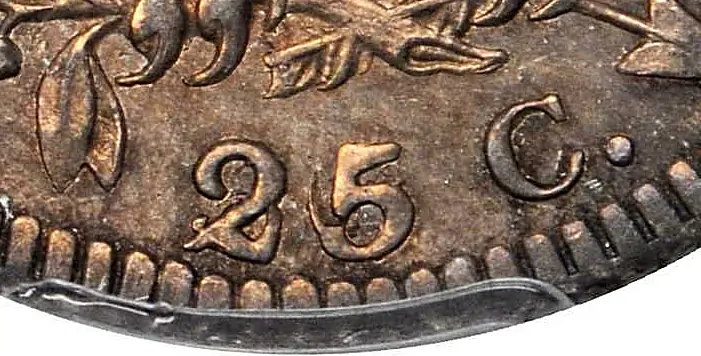
The reverse shows 25 punched over an erroneous 50. In addition, specialists see extra repunching on the primary 5. As a result, many describe the variety as 25/5/50 C.
This is not a date overdate. Instead, it is a blundered denomination. That distinction matters. The die sinker did not punch one date over another. He punched the wrong denomination into the reverse die.
Then, the Mint corrected the error just enough to use the die.
The “Half Dollar” Quarter
The backstory gives this coin its power.
Early Mint dies required time, skill, and expensive die steel. So the Philadelphia Mint did not casually discard usable dies. That pressure helps explain why this damaged reverse survived.
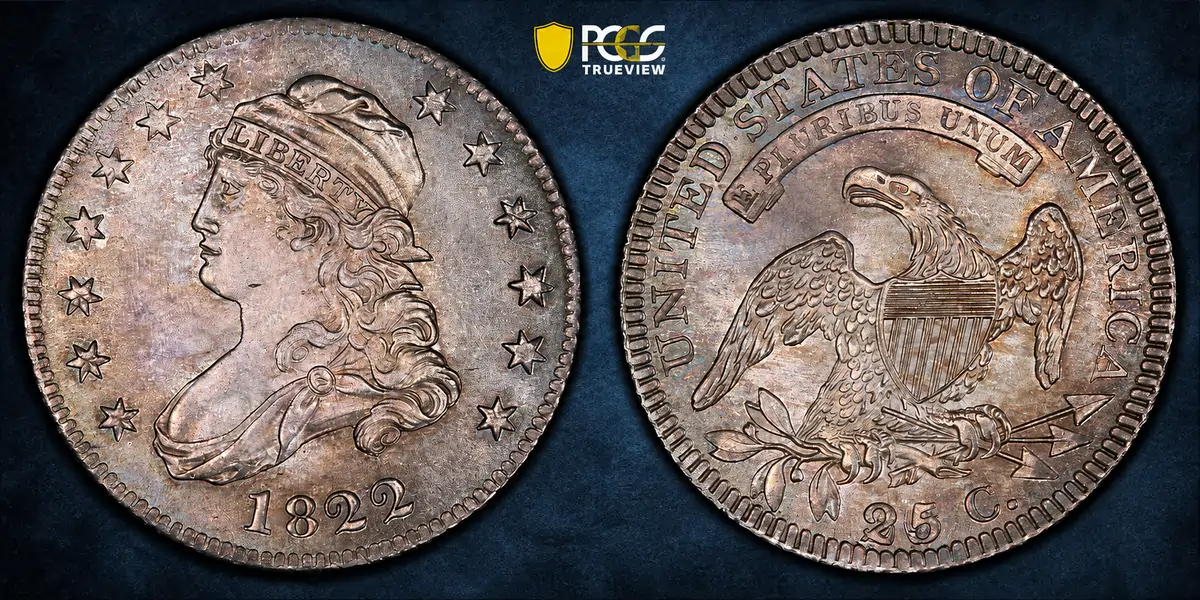
Modern scholarship ties the reverse die to 1818. The numeral and dentil punches match other 1818 reverse dies. Therefore, researchers believe the Mint prepared the die years before it struck the 1822 B-2 quarter.
At some point, a Mint worker punched 50 C. into the die. That denomination belonged on a half dollar, not a quarter. The error came late in the die-making process. Stack’s Bowers notes that this suggests the Mint placed the central design first, then the legend, and finally the denomination.
That sequence created the trap. One wrong punch turned a normal quarter reverse into a famous numismatic accident.
The First Use of the 25/50C Reverse
The 1822 B-2 represents the first known use of this 25/50C reverse on a regular-issue Capped Bust quarter.
However, the story did not end in 1822. The Mint later pulled the same reverse die from storage and used it again for the 1828 B-3 quarter. By then, the die showed additional age. Some 1828 examples display reverse die rust.
Therefore, collectors should view the 1822 B-2 and 1828 B-3 as linked rarities. They are not separate Mint mistakes. Instead, they share one remarkable reverse die.
The 1822 B-2 remains the tougher coin. It is scarcer overall. It also becomes especially difficult in grades above Very Fine.
Why Quarters Were Scarce in 1822
The quarter dollar did not dominate commerce in the early 19th century. The Capped Bust half dollar served as the workhorse silver coin. Meanwhile, Spanish colonial two reales still filled many daily transactions.
As a result, demand for quarters stayed limited.
The Mint delivered only 64,080 quarters in calendar year 1822. These coins came from one obverse die and multiple reverse dies. Specialists identify the B-2 as the famous blundered denomination reverse.
One Stack’s Bowers catalog notes that only part of the 8,572-coin delivery for warrant #905 on December 20, 1822 likely came from the B-2 reverse. That helps explain why survivors remain so elusive today.
A Rarity in Any Grade
PCGS estimates only 42 survivors of the 1822 25/50C quarter in all grades. It also estimates just two Mint State survivors and only one Gem-level survivor.
Ron Guth has described the blundered denomination as two to three times scarcer than the normal reverse for 1822. Denis Loring has also called it tough to find in any grade. He noted that high-grade pieces remain extremely rare, with only eight known above Very Fine.
That rarity drives demand from two collector groups at once. Bust quarter variety specialists need the B-2. Red Book variety collectors want the dramatic 25/50C reverse. Therefore, strong examples rarely pass quietly.
The Steve M. Tompkins Reference Collection Coin
Stack’s Bowers sold a notable example from the Steve M. Tompkins Reference Collection of Early United States Quarters in its Summer 2025 Global Showcase Auction. The coin appeared as lot 4283 and realized $19,200.
PCGS graded the coin AU Details–Cleaned.
Even with that details grade, the coin carried major importance. It showed bold About Uncirculated definition across the design. The strike came nicely centered and well executed. Only light high-point wear matched the grade.
The surfaces showed moderate hairlines and a matte-like texture from cleaning. Even so, the coin had no large marks. A thin planchet drift mark, made at the Mint, appeared on Liberty’s neck and extended into the field before her chin. That feature helps identify the coin for future provenance work.
The coin showed light slate-gray surfaces with natural olive and powder-blue retoning.
Even more important, this coin did not appear in the 2008 Tompkins census or the 2010 Rea, Peterson, Karoleff, and Kovach census. Both censuses listed examples down to the VF level. Therefore, this piece added real interest for specialists.
Tompkins had earlier owned a VF-20 example from the 2006 Reiver sale. However, this AU Details coin drew him in for two reasons. It had stayed off the market for at least 80 years. Also, aside from a handful of Uncirculated pieces, it ranked as the highest-graded example above VF-35 to appear at auction in the previous 25 years.
To buy it, Tompkins sold his lower-grade piece to dealer Rich Uhrich.
The coin traces earlier to Heritage’s June 2016 Long Beach Signature Auction, where it appeared as part of the Rev. Dr. James G. K. McClure Collection.
Other Important Auction Appearances
A PCGS VF-30 example also shows why collectors chase this variety. Stack’s Bowers described that coin as a pleasing mid-grade example with dove-gray toning and darker patina in protected areas. The strike came nicely centered, and the devices retained strong detail. A small old pinscratch crossed Liberty’s portrait, but it had worn into the surfaces and did not distract to the naked eye.
PCGS had graded only nine examples finer at the time of that offering.
The famous Norweb example shows the top end of the market. Stack’s Bowers sold the Norweb 1822 25/50 Reverse Capped Bust Quarter, graded MS-61 by PCGS, for $48,468.75. The catalog called it Condition Census No. 7 for the variety.
That coin displayed satin to semi-prooflike surfaces with vivid reddish-apricot iridescence and powder-blue highlights. It also carried a major provenance. It came from the Norweb Collection sale by Bowers and Merena in March 1988, then appeared in ANR’s January 2005 auction and Stack’s January 2009 sale.
The variety also includes a small group of Proofs. Stack’s Bowers has reported four known Proof examples, including one in the Smithsonian Institution.
The Finest Survivors
At the top of the regular-issue population, PCGS CoinFacts lists an MS65+ example as the finest. That coin sold through Heritage in June 2016 for $108,687.50 and later joined the D.L. Hansen Collection.
The Eliasberg-Pogue coin ranks among the legendary survivors. It sold for $188,000 in the D. Brent Pogue sale. It had earlier appeared in the Louis E. Eliasberg Sr. Collection and in multiple major auctions.
Another important coin traces to the Virgil Brand Collection and later to Eugene Gardner and Dr. Charles Link. PCGS lists it as MS64+. Earlier scholarship and cataloging treated that coin differently at times, which shows how deeply specialists have studied this variety.
The Regency Auction description for a PCGS MS65+ example captured the appeal well. The coin showed frosty devices, prooflike obverse fields, crisp stars, and a sharp eagle. Its toning blended silver-slate, dove-gray, blue, tan, olive, and gold. That coin carried PCGS certification number 83774410 and stood as the only MS65+ graded at the time of that description.
Why This Coin Still Feels Modern
The 1822 B-2 quarter feels like a Mint error collector’s dream. Yet it comes from the handmade die era.
That mix gives the coin its “wow” factor. It is not a minor misplaced digit. It is a quarter that briefly became a half dollar in the die shop. Then the Mint corrected the mistake, accepted the visible scar, struck coins with it, shelved the die, and used it again six years later.
Today, the reverse tells the whole story without a loupe. The “50” still lives under the “25.”
That makes the 1822 B-2 more than a scarce Bust quarter. It is physical evidence of how the early Mint worked under pressure. It also proves that even famous mistakes could survive when die steel mattered, production mattered, and a usable die still had value.
For collectors, the lesson remains clear. The 1822 B-2 is not just another early quarter variety. It is the first chapter of the 25/50C reverse, one of the most dramatic denomination blunders in United States coinage.
Coin Specifications
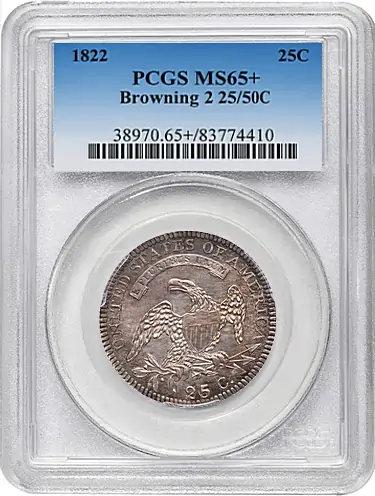
- Coin: 1822 Capped Bust Quarter
- Variety: B-2, FS-901
- Designation: 25/50 C., also described as 25/5/50 C.
- Rarity: Rarity-5
- Mint: Philadelphia
- Designer: John Reich
- Mintage: 64,080 quarters for calendar year 1822
- Composition: 89.2% silver, 10.8% copper
- Weight: 6.74 grams
- Diameter: 27.50 mm
- Edge: Reeded
- PCGS No.: 5333 for 1822 25/50C; 38970 for Browning-2 25/50C
- NGC ID: 23RH




Thanks for another interesting article!
What a nice coin cant take my eyes off it.
Flaws are more valuable than perfection, it wasn’t in their mind when not fixing the die, sounds like cost saving was, but it created a great imperfection